
Forex Market Hours 2026: Session Times in GMT and Local Time

The forex market opens for the week at 17:00 New York time on Sunday and closes at 17:00 New York time on Friday. In GMT that is 21:00 from 8 March to 31 October 2026, while New York is on daylight time, and 22:00 for the rest of the year. Between those two points quotes run without a break, handed from Sydney to Tokyo to London to New York.
Most tables of session times print one set of GMT hours and leave it there. Three of the four centres change their clocks, on three different calendars, so any single table is right for part of the year and an hour out for the rest. The tables below give each 2026 phase with its dates.
Key takeaways
- The weekly open and close sit at 17:00 New York time: 21:00 GMT until the end of October 2026, then 22:00 GMT until the second week of March 2027.
- Session hours are a market convention, not a rule any exchange or regulator publishes, so two pages can disagree by an hour and both be following a convention.
- New York, London and Sydney change their clocks on different dates in 2026 and Tokyo never does, which splits 2026 into seven stretches with six different GMT timetables.
- The London and New York overlap runs 12:00 to 16:00 GMT in the northern summer and 13:00 to 17:00 GMT in the winter, and stretches to five hours in the weeks between.
- Riyadh and Dubai never change their clocks, so their forex hours move by an hour twice a year. Cairo changes its clocks on its own dates, which keeps its London open at 10:00 in both seasons.
Table of contents
- The Weekly Open and Close, Dated for 2026
- Session Times in GMT for Each Part of the Year
- Where the Sessions Overlap, and How Far the Overlaps Move
- Forex Hours in Kuala Lumpur, Dubai, Riyadh, Cairo and Karachi
- Is the Market Open Today? Weekends, Holidays and Thin Hours
- What Changes From One Session to the Next
- When This Timetable Does Not Apply to You
- Frequently Asked Questions
The Weekly Open and Close, Dated for 2026
The trading week is anchored to one clock: 17:00 in New York. The week ends there on Friday, and the new one starts at the same New York hour on Sunday, when the first quotes come out of Sydney and Wellington, where it is already Monday morning.
Because the anchor is a New York hour, it moves in GMT whenever New York changes its clocks and at no other time. London and Sydney switching do not shift the weekly open, even though they move the sessions around it.
| Weeks in 2026 | New York clock | Sunday open (GMT) | Friday close (GMT) |
|---|---|---|---|
| 1 January to 7 March | Eastern Standard Time, UTC-5 | 22:00 | 22:00 |
| 8 March to 31 October | Eastern Daylight Time, UTC-4 | 21:00 | 21:00 |
| 1 November to 31 December | Eastern Standard Time, UTC-5 | 22:00 | 22:00 |
Clock changes from the IANA Time Zone Database, release 2026c: New York moves forward on 8 March 2026 and back on 1 November 2026, then forward again on 14 March 2027.
A broker does not reopen to the second. Many start quoting a few minutes after 17:00 New York time and stop a few minutes before it, each on a schedule it publishes for its own servers. That schedule, and not this table, decides when an order can be placed on a given account.
The platform clock is a separate matter again. Most MetaTrader servers run on GMT+2 in winter and GMT+3 in summer so that their midnight lands on the New York close, and the weeks when that alignment slips are covered on the page about broker server time. Everything on this page is in GMT unless a city is named.
Session Times in GMT for Each Part of the Year
No exchange, central bank or regulator publishes the hours of the Sydney, Tokyo, London or New York session. The names describe when the dealing desks in each centre are staffed, and every published timetable is a choice of start and end. Tokyo in particular appears an hour apart from one source to the next.
The rule used here is stated so it can be checked: each session is 08:00 to 17:00 on the local clock of its city, converted to GMT with the IANA Time Zone Database. Sydney and Tokyo start the previous GMT evening, because their morning comes first.
| Weeks in 2026 | Sydney | Tokyo | London | New York |
|---|---|---|---|---|
| 1 January to 7 March | 21:00 to 06:00 | 23:00 to 08:00 | 08:00 to 17:00 | 13:00 to 22:00 |
| 8 March to 28 March | 21:00 to 06:00 | 23:00 to 08:00 | 08:00 to 17:00 | 12:00 to 21:00 |
| 29 March to 4 April | 21:00 to 06:00 | 23:00 to 08:00 | 07:00 to 16:00 | 12:00 to 21:00 |
| 5 April to 3 October | 22:00 to 07:00 | 23:00 to 08:00 | 07:00 to 16:00 | 12:00 to 21:00 |
| 4 October to 24 October | 21:00 to 06:00 | 23:00 to 08:00 | 07:00 to 16:00 | 12:00 to 21:00 |
| 25 October to 31 October | 21:00 to 06:00 | 23:00 to 08:00 | 08:00 to 17:00 | 12:00 to 21:00 |
| 1 November to 31 December | 21:00 to 06:00 | 23:00 to 08:00 | 08:00 to 17:00 | 13:00 to 22:00 |
All times GMT, each session 08:00 to 17:00 local time. Clock changes in 2026: New York 8 March and 1 November, London 29 March and 25 October, Sydney 5 April and 4 October, Tokyo none.
Seven rows for one year is the point. New York moves first in March, London three weeks later, and Sydney, in the southern hemisphere, goes the other way in April. In the autumn the order runs Sydney, then London, then New York, and in 2026 the gap between London and New York is exactly one week.
Tokyo is the fixed row. Japan keeps UTC+9 all year, so its session sits at 23:00 to 08:00 GMT in every week, and every other session slides around it.
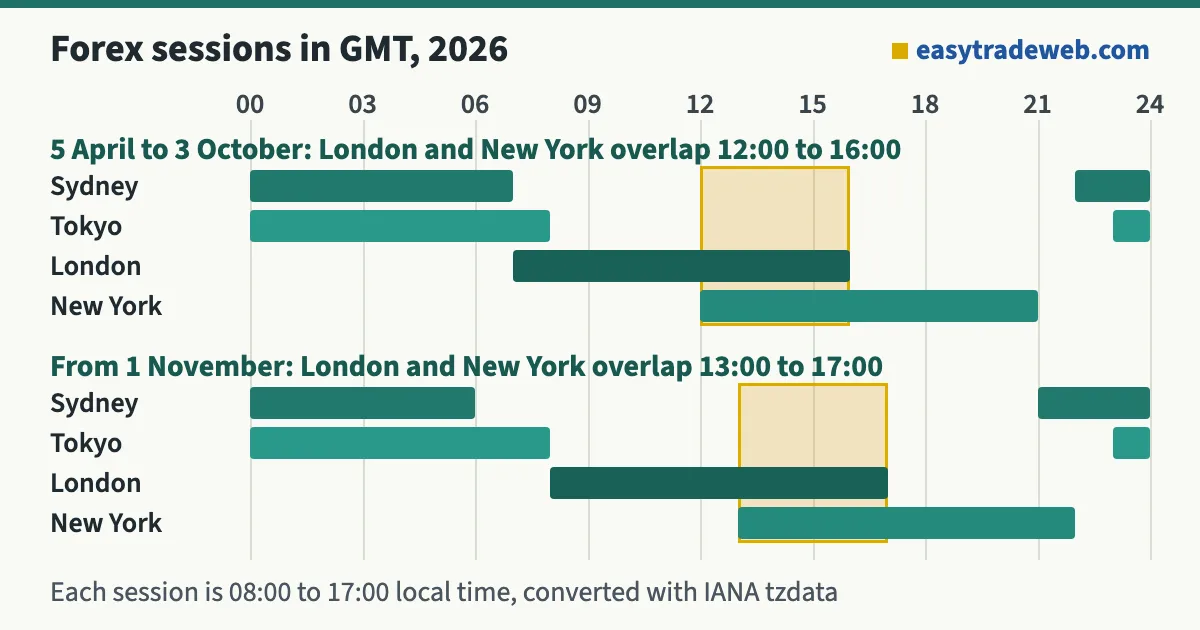
Where the Sessions Overlap, and How Far the Overlaps Move
An overlap is the stretch when two centres are staffed at once. Under the 08:00 to 17:00 rule there are three candidates, and one of them disappears for half the year.
| Weeks in 2026 | Sydney and Tokyo | Tokyo and London | London and New York |
|---|---|---|---|
| 1 January to 7 March | 23:00 to 06:00 | None | 13:00 to 17:00 |
| 8 March to 28 March | 23:00 to 06:00 | None | 12:00 to 17:00 |
| 29 March to 4 April | 23:00 to 06:00 | 07:00 to 08:00 | 12:00 to 16:00 |
| 5 April to 3 October | 23:00 to 07:00 | 07:00 to 08:00 | 12:00 to 16:00 |
| 4 October to 24 October | 23:00 to 06:00 | 07:00 to 08:00 | 12:00 to 16:00 |
| 25 October to 31 October | 23:00 to 06:00 | None | 12:00 to 17:00 |
| 1 November to 31 December | 23:00 to 06:00 | None | 13:00 to 17:00 |
All times GMT, derived from the session table above.
The London and New York overlap is normally four hours. In the weeks when New York has moved its clocks and London has not, it becomes five: 12:00 to 17:00 GMT from 8 to 28 March 2026 and again from 25 to 31 October. A rule written as the four-hour window from 13:00 to 17:00 GMT is wrong for about eight months of the year.
Tokyo and London only overlap while London is on summer time. Once London falls back to GMT on 25 October, its 08:00 start meets the Tokyo close at 08:00 GMT exactly and the overlap is gone until 28 March 2027.
The overlap that carries the most business is the one with London in it, and that part is measured. In the Bank of England summary of the April 2025 survey, the United Kingdom accounted for 37.8 per cent of global foreign exchange turnover, more than any other centre. The busiest hours are the ones when the London desks are open.
Two things are worth checking against these windows. Scheduled releases that land inside an overlap are listed with their times on the economic calendar, in a time zone the reader sets. And a ranking of the most volatile forex pairs by daily range does not say which of these hours produced the range.
Forex Hours in Kuala Lumpur, Dubai, Riyadh, Cairo and Karachi
For a reader outside the four centres the useful question is what the clock on the wall says. Four of the five cities below never change their clocks, so their forex hours move twice a year. The fifth, Cairo, moves on dates of its own.
| City (UTC offset) | Week opens | London opens | London and New York overlap | Week closes |
|---|---|---|---|---|
| Kuala Lumpur and Manila (UTC+8) | Mon 05:00 | 15:00 | 20:00 to 00:00 | Sat 05:00 |
| Dubai (UTC+4) | Mon 01:00 | 11:00 | 16:00 to 20:00 | Sat 01:00 |
| Riyadh (UTC+3) | Mon 00:00 | 10:00 | 15:00 to 19:00 | Sat 00:00 |
| Cairo (UTC+3 in summer time) | Mon 00:00 | 10:00 | 15:00 to 19:00 | Sat 00:00 |
| Karachi (UTC+5) | Mon 02:00 | 12:00 | 17:00 to 21:00 | Sat 02:00 |
Local times for the weeks from 5 April to 3 October 2026, and for Cairo from 24 April to 24 October 2026.
| City (UTC offset) | Week opens | London opens | London and New York overlap | Week closes |
|---|---|---|---|---|
| Kuala Lumpur and Manila (UTC+8) | Mon 06:00 | 16:00 | 21:00 to 01:00 | Sat 06:00 |
| Dubai (UTC+4) | Mon 02:00 | 12:00 | 17:00 to 21:00 | Sat 02:00 |
| Riyadh (UTC+3) | Mon 01:00 | 11:00 | 16:00 to 20:00 | Sat 01:00 |
| Cairo (UTC+2 in standard time) | Mon 00:00 | 10:00 | 15:00 to 19:00 | Sat 00:00 |
| Karachi (UTC+5) | Mon 03:00 | 13:00 | 18:00 to 22:00 | Sat 03:00 |
Local times from 1 November 2026 to 7 March 2027. Offsets and clock changes from the IANA Time Zone Database, release 2026c.
Cairo is the odd one. Egypt runs summer time from the last Friday of April to the last Thursday of October, which in 2026 means 24 April and 29 October. Those dates differ from Europe and the United States, so a Cairo reader keeps the same London open and the same overlap in both seasons, but gets a one-hour shift in the gap weeks: from 29 March to 23 April the London open falls at 09:00 in Cairo, and from 25 to 29 October it falls at 11:00.
The rest of the setup for a reader based there is on the page about forex trading in Egypt.
In the Gulf the effect runs the other way. A trader in Riyadh or Dubai who watches the London open at 10:00 or 11:00 through the summer should expect it an hour later from 25 October, with nothing changing on the local clock.

Is the Market Open Today? Weekends, Holidays and Thin Hours
From the Sunday open to the Friday close the market has no scheduled pause. From the Friday close to the Sunday open there is no interbank dealing, and a broker has nothing to price a spot pair against, so retail platforms stop accepting orders on currency pairs over the weekend.
Prices do not stand still over those two days, because news does not. The Sunday open can print away from the Friday close, and the mechanics of that gap, including what happens to stop orders, are set out on the page about weekend gap risk.
Public holidays are less clear-cut. There is no single holiday calendar for a market with no central exchange. On 25 December and 1 January most dealing centres are shut, liquidity is thin, and many brokers shorten hours or stop quoting some pairs. The only reliable answer for a given account is the holiday notice the broker publishes ahead of those dates.
The quietest stretch of an ordinary day falls just after the New York close, before Tokyo is fully staffed. Spreads on retail accounts often widen for a short time there, which is also when the daily swap is applied to positions held overnight.
What Changes From One Session to the Next
A session changes who is dealing, and that changes which pairs move. The yen and the Australian and New Zealand dollars see their local business in the Asian hours. Sterling, the euro and the Swiss franc do most of theirs while Europe is open, and the US and Canadian dollars once New York joins.
Scheduled data does more to a given hour than the session label does. A US release set for a fixed New York hour arrives an hour earlier in GMT while New York is on daylight time, so the same release can sit at the start of the overlap in one season and an hour into it in the other. The calendar shows those times in whatever zone the reader chooses, and the non-farm payrolls report is the release that most often moves the whole market.
Which currencies keep pricing deep through all four sessions is a separate question, answered by the set a dealing desk calls the G10 currencies. Outside that set, some emerging market currencies trade actively only while their home centre is open.
Range is the part most often overstated. A daily average range says how far a pair travelled in a day, not in which hours, and the same average can come from one busy hour or from a slow drift. Any volatility ranking has to be read against the session a trader is actually awake for.
Trading around the clock is also not the same as settling around the clock. A spot trade settles on its value date, normally two business days later, and the page on settlement and value dates covers what happens when a holiday falls in between.
Put the theory into practice
Concepts become far easier to understand once you see them on a live chart. A demo account gives you real market data with no capital at risk while you build familiarity.
Advertising disclosure: partner link. Easy Trade may receive compensation. Educational content, not financial advice. CFDs carry a high risk of losing your capital.
When This Timetable Does Not Apply to You
The timetable above describes spot currency pairs. Three kinds of product on the same platform run to other clocks, and a reader trading them needs a different schedule.
Commodity and index CFDs follow the exchange where the underlying contract trades, with a daily break and holiday closures of their own. Oil is the common case, and its hours, including the break and the Brent and WTI difference, are on the page about oil trading hours.
Cryptocurrency pairs at a broker can trade through the weekend, because the underlying markets do not close. The page on crypto market opening hours covers them.
Currency futures are a third case. They trade on an exchange with its own session and its own maintenance break, so the spot timetable above does not describe them even when the underlying pair is the same.
Frequently Asked Questions
When does the forex market open on a Sunday?
At 17:00 New York time, which is 21:00 GMT on every Sunday up to 25 October 2026 and 22:00 GMT from 1 November 2026 to 7 March 2027. Brokers usually start quoting a few minutes after that, on their own published schedule.
Is the forex market open today?
From Sunday evening to Friday evening, yes. It is closed from the Friday close at 17:00 New York time until the Sunday open at 17:00 New York time, and liquidity thins on 25 December and 1 January even where a broker keeps quoting.
What are the forex session times in GMT right now?
From 5 April to 3 October 2026, taking each session as 08:00 to 17:00 local time: Sydney 22:00 to 07:00, Tokyo 23:00 to 08:00, London 07:00 to 16:00 and New York 12:00 to 21:00.
When does the London session open in GMT?
At 07:00 GMT while the United Kingdom is on summer time, which in 2026 runs from 29 March to 25 October, and at 08:00 GMT for the rest of the year.
What time does the forex market open in Malaysia?
Malaysia keeps UTC+8 all year, so the week opens at 05:00 on Monday in Kuala Lumpur until 1 November 2026 and at 06:00 on Monday after it. The London and New York overlap runs from 20:00 to midnight now, and from 21:00 to 01:00 in the winter.
When does the forex market open in the UAE?
Dubai keeps UTC+4 with no summer time. The week opens at 01:00 on Monday and closes at 01:00 on Saturday until 1 November 2026, then at 02:00 on both days.
Why do forex session times change twice a year?
Because New York, London and Sydney move their clocks on different dates and Tokyo does not move at all. Every session defined in local business hours therefore lands one hour earlier or later in GMT, and in a few transition weeks only some of them have moved.
Sources checked 17 September 2026. Internet Assigned Numbers Authority, Time Zone Database release 2026c, for the UTC offsets and the 2026 and 2027 clock change dates of New York, London, Sydney, Tokyo, Cairo, Riyadh, Dubai, Karachi, Kuala Lumpur and Manila, from which every GMT and local time on this page is computed. Bank of England, Summary of UK survey results, BIS Triennial Survey of foreign exchange and OTC interest rate derivatives markets in April 2025, for the UK share of global foreign exchange turnover.
Risk disclaimer: This page explains market hours as educational material, not investment advice or a recommendation to trade. Leveraged forex and CFD trading carries a high risk of loss, losses can exceed what you expect, and the majority of retail CFD accounts lose money. Trade only with money you can afford to lose, and consider independent financial advice. Some links on this site are affiliate links, and the site may earn a commission at no extra cost to you.