
Forex Demo Account: How It Works and Why Traders Use One

What is a demo account? To answer that question, you first need to know how to use the features of a forex trading platform before you start trading on it. Traders can test each platform by opening a forex demo account, which means no real money is at risk. Here we look at why demo trading matters and explain what to look for when you try out different platforms — the same idea applies to demo accounts for trading digital currencies. Related reading: XM Demo Account.
A demo account is also the safest place to test features you have not used before, including copy trading, so you can see how allocation settings translate into real position sizes before any money is committed.
Points to Know Before Trading on a Demo Account
- Every platform is different, so even experienced traders need to learn how a platform works before trading real money on it — whether that is a Binance demo account or opening a new forex account.
- It is generally a good idea to place at least 50 practice trades to see how solid strategies work, especially stop orders.
- Opening a forex account can also help traders see how well a platform records transactions for tax purposes.
- Demo trading is not real, but it can help traders prepare for using live accounts — in effect, simulated trading for practice.
Read also: 4 tips before you start trading on a demo account
Platform Types
Many brokers offer several platforms. MetaTrader 4 and 5, also known as MT4 and MT5, are both popular, and most brokers provide additional platforms on top of them. These extra options may be proprietary to the broker, though, which means the platform may not be available from other brokers.
While each platform may look slightly different from the next, most offer roughly the same features. These include forex quotes, charts, technical analysis tools, news feeds, trade history, drawing tools, and buy and sell functions for currencies.
Some platforms also carry more features than others, and some have integrated fundamental analysis tools. That may matter to a long-term investor, but not to a short-term trader. The image below is a screenshot of the MetaTrader 4 platform.
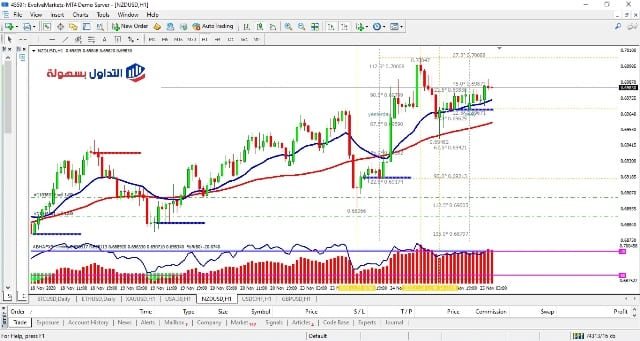
In the screenshot, shortcuts along the top of the platform lead to various tools and settings. Below those shortcuts sits a chart window for viewing the price history of a specific currency pair or asset. The platform has several tabs that give access to news, account history, and current trades. Not every platform is set up this way, but most offer the same features arranged differently.
Read also: Get to know the best Saudi stock trading platforms
Placing Orders on a Demo Account
It is a good idea to place at least 50 practice trades on a platform before trading real money, so you master the details of order entry. A trader should never trade live unless they can confidently answer all of the following questions:
- How do I place a limit order?
- How do I set a stop order?
- Can I attach a limit and a stop at entry?
- Are the spreads on the platform fixed or variable? What is the typical spread?
- What lot size can I trade (100 units, 1,000 units, 10,000 units, 100,000 units)?
- Can I mix and match lot sizes?
- Do I have another way to trade if my main internet connection goes down?
Some platforms use pop-up order windows, while others let you trade by clicking prices directly on the chart.
Usually, you click the ask side of a quote to buy a currency pair, and when you want to sell, you click the bid side. Some platforms let you choose between a market order and a limit order after the quote window appears; others force you to make that choice in advance.
Below is a sample order screen in MetaTrader 4. Suppose you want to bring up a detailed order screen like this one: on most trading platforms, you can right-click on the chart or the quote and select a new order or a new trade.
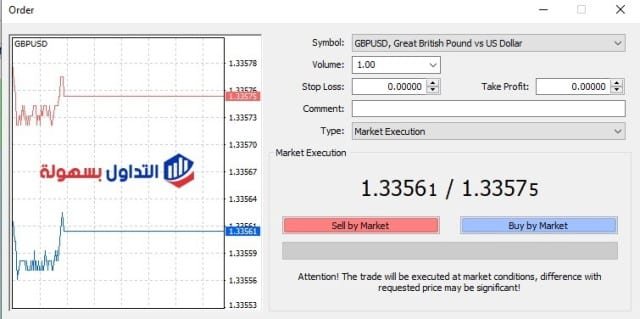
On the left is a very short-term chart of the currency pair to be traded. The same pair is also listed at the top of the trade box. After that, enter the size you want to trade.
Then enter the stop-loss and take-profit levels for the trade. The trade type can be a market order or a pending order: if you want to buy or sell at the current price, choose market as the type; if you want to buy or sell at a different price, choose pending — all inside the demo account.
A pending order comes with more options, since you need to enter the price at which you want to buy or sell. You can also choose to set an expiry on the order. Once everything is filled in, place the order.
What Is a Demo Account? Trading That Mimics the Real Thing

Once you have mastered the basic functions of a trading platform, use the demo platform to try out different strategies. Work out which kind of trader you are: are you a short-term momentum trader who likes high leverage and tries to catch moves of 10 to 20 pips?
Or do you prefer lower leverage and holding long-term positions that could run for hundreds of pips? Demo trading can help you discover which type of trading suits you.
Demo trading is not real, but it helps prepare you for live trading. Many traders stay perfectly calm after taking a large loss in a demo account, yet some of those same traders become completely rattled by a small loss in a real account. To make demo trading as useful as possible, you need to treat the demo account as if the money were real. The step after that is a live account, and where a broker offers a no deposit bonus the conditions attached to it decide whether anything can be withdrawn.
Finally, real-money experience — started with a small amount — is often the best way to begin. Some forex brokers, such as OANDA, let you open an account with less than one US dollar. Once you start trading with a few hundred dollars, the experience becomes real. Trading small amounts is the natural extension of demo trading.
Put the theory into practice
Concepts become far easier to understand once you see them on a live chart. A demo account gives you real market data with no capital at risk while you build familiarity.
Advertising disclosure: partner link. Easy Trade may receive compensation. Educational content, not financial advice. CFDs carry a high risk of losing your capital.
Frequently Asked Questions | Demo Account
What is a demo account?
It is a practice account that beginner traders can open with a forex company to train on trading and place different kinds of trades to discover which style suits them. It works like a real account, but the money is only numbers — no gains and no losses, just practice.

How do I open a demo trading account?
Trading platforms differ from one another. Once you choose a platform, you go to it and register with your personal email. After activating the link sent to your inbox, you create a free demo account and can then start demo trading.
How can I trade for free?
You trade for free by opening a demo account, which lets you trade at no cost on a practice basis. Free trading is meant to train beginner — and even professional — traders on the different forms of trading across various platforms.
How do I open an account on the Egyptian Exchange?
All it takes is choosing one of the brokerage firms operating in Egypt — all of them are listed by name and details on the official Egyptian Exchange website — then signing a contract after the trader submits the required documents to the brokerage firm, a step known locally as “coding” (obtaining an investor code).
What is the difference between an investment account and a portfolio?
An investment portfolio is a collection of assets and financial instruments, such as stocks and bonds, and its value is the sum of those assets. An investment account, on the other hand, is a bank account that earns fixed interest on the deposited principal — monthly or yearly — and lets the depositor withdraw from and add to the principal at any time.
What are the best trading companies that offer a demo account?
Many companies and trading platforms provide demo or practice accounts. Among the best-known platforms are MT4 and MT5, as well as the Binance platform.
Can foreigners buy stocks?
This differs from one country to another. Egypt, for example, does not prevent foreign investors from investing on its exchange and treats them the same as Egyptian investors, while Saudi Arabia only allows qualifying non-Saudi institutional traders — not individuals — to trade and buy stocks.
How do you become a qualified investor in the Nomu market?
By meeting one of several criteria, including that the investor’s net assets are no less than five million Saudi riyals in the Saudi capital market, or having spent at least a number of years working in the Saudi financial sector.
Related guides: best forex brokers for beginners, the minimum deposit to open a forex account.
Disclaimer: This article is for educational purposes only and is not investment advice. Forex and CFD trading involves leverage and carries a high level of risk — losses can exceed your deposits, and results on a demo account do not guarantee similar results on a live account. Some links on this site may be affiliate links, meaning we may earn a commission at no extra cost to you.