
Inducement in Trading: Why No Two Guides Define It Alike

Four guides to inducement were read for this page. One states plainly that it is not a chart pattern. Another states that it is a false breakout, which is a chart pattern. A third calls it a level, a thing that sits on the chart and waits. A fourth calls it a move, a thing that happens.
None of the four mentions that the others disagree. Each presents its own account as the account, and a reader who has read one has no way of knowing that reading a second would contradict the first.
That disagreement is checkable, and it is more useful than a sixth explanation would be. What follows sets the definitions side by side, works out what each one would require you to see before a move rather than after it, and asks what is left of the idea when the retrospective part is removed.
Key takeaways
- The four guides read for this page disagree on the most basic question about the term: whether inducement is a place on the chart or an event that happens to price.
- One of them says explicitly that it is defined by purpose rather than by any candle shape; another defines it as a false breakout, which is a shape.
- Every account identifies it after the reversal. Nothing in any of the definitions read here lets you mark a level and be told you were wrong.
- The claim assumes knowledge of where other traders hold stop orders, and no spot forex feed publishes that. The nearest published data is a weekly futures position report that contains no resting orders at all.
- Bar replay cannot settle it either, because the outcome that supplies the label is already in the file being replayed.
Table of contents
- The Word Names an Outcome, Not a Pattern
- Four Guides, Four Definitions That Do Not Agree
- What You Would Need to See Before the Move
- What the Claim Requires You to Know, and Cannot Give You
- Marking It Live Against Marking It in Replay
- What Changes If You Call It a Failed Breakout Instead
- Which Figures This Page Does Not State, and Why
- Who This Page Is Not For
- Questions Readers Ask About Inducement
The Word Names an Outcome, Not a Pattern
Read the definitions carefully and a grammatical fact emerges that none of them draws attention to. Inducement is described by what it achieved. Traders were drawn in; price then went the other way. The second half of that sentence is doing the identifying.
Compare it with a term that names a shape. A doji is a doji when the open and the close are close together, and it stays a doji whatever price does next. You can be wrong about a doji only by misreading the candle. Nothing about the future is involved.
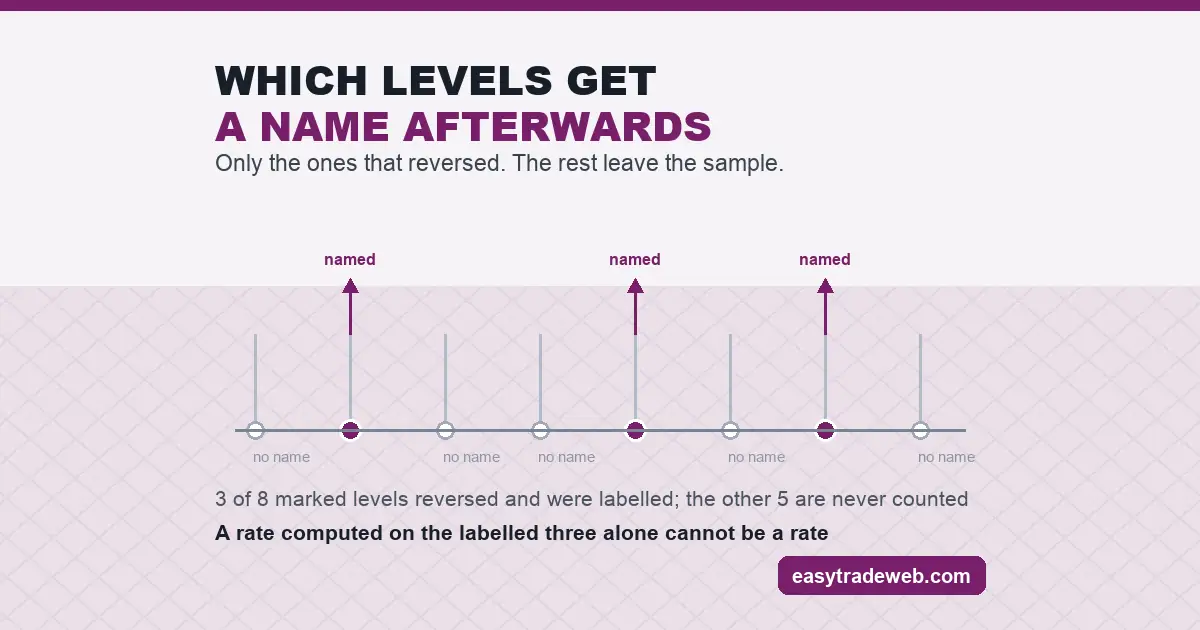
Inducement has no such anchor in any of the four accounts. A level that traders enter at and price continues through is not called a failed inducement. It is not called anything; it drops out of the sample. So the term collects only the cases where the reversal arrived, and the rate at which those cases occur cannot be computed from a set assembled that way.
This is a different criticism from saying the idea is wrong. The behaviour it points at is real enough: orders do cluster where price has recently turned, and moves through those clusters do sometimes reverse. The problem is with the label, which is applied by the outcome and therefore cannot be tested by it.
The wider version of this argument, about the vocabulary as a whole rather than this one term, is set out in what a retail forex chart contains.
Four Guides, Four Definitions That Do Not Agree
The four accounts read for this page anchor the term to four different things. Set out together, two of them cannot both be right.
| What the guide anchors it to | Is it a place or an event? | What that implies you mark |
|---|---|---|
| Purpose rather than any candle shape | Neither; an intention | Nothing on the chart by itself |
| A key level or a structure that persuades | A place | A line you can draw in advance |
| A move that gets traders in before the turn | An event | A completed swing, after it prints |
| A false breakout that precedes a reversal | An event, and a named pattern | A breakout that has already failed |
The first and the fourth rows are the pair to look at. If the term is defined by purpose rather than by any shape on the chart, then it cannot also be the specific shape called a false breakout. One of those two statements has to give, and neither guide acknowledges the other exists.
The middle two split a different way. A level is something you can draw before price arrives; a move is something you can only mark once it has finished. A reader following one guide is drawing lines in advance, and a reader following another is labelling swings in hindsight, and both believe they are doing inducement.
The disagreement is checkable without taking any single account on trust, this page included. Open any four explanations of the term and write down, for each, the answer to one question: could you draw this on a chart before the reversal happened? Only one of the four read here answers yes; the other three describe something that can only be named once the move is complete, and the split shows up in the first paragraph of each.
That instability is not unique to this word. The same absence of an agreed definition, traced through a different term in the same vocabulary, is documented under terms no two guides define alike.
What You Would Need to See Before the Move
Take the strongest version of the idea, the one that gives you something to draw. A level is marked because orders are expected to sit there. Price runs through, those orders are taken, and the market turns.
Written that way, it makes a prediction, and a prediction can be checked. So what would you have to observe, in advance, for the check to be possible?
Three things, at minimum.
That orders are resting at the level rather than merely that price turned there before. That the run through them is the cause of the reversal rather than something that happened alongside it. And a condition under which you would accept that this particular level was not one, stated before the fact rather than after.
The third is the one that never appears. None of the four guides read here supplies a rule that would mark a level as a failure while the trade is still open. Without it the level cannot be wrong, and a level that cannot be wrong is not making a prediction, whatever it looks like on the chart. A parallel check, applied to whether a gap can be said to have filled, is worked through in checking a claim on your own chart.
What the Claim Requires You to Know, and Cannot Give You
The first of those three conditions is worth separating out, because it is the one people assume is satisfied.
Spot foreign exchange has no central book. There is no venue that collects every order and publishes what is resting where, so the stops the claim depends on are not observable to anyone outside the firm holding them.
The nearest published thing is a weekly report of futures positions. It is worth knowing exactly what that is: the CFTC explanatory notes describe open interest as contracts entered into and not yet offset, and the positions of individually identified large traders, classified as commercial or non-commercial, which usually cover between 70 and 90 percent of open interest in a market.
Positions held, in futures, once a week. Not resting orders, not spot, not intraday, and not the level you are looking at. What that data can and cannot support is covered in more detail on the pillar page linked above.
Marking It Live Against Marking It in Replay
The natural response is to go and test it, and bar replay is where most people go. It is the right instinct and the wrong instrument for this particular question.
Replay hides future bars from your eyes. It does not remove them from the file. The whole series is loaded, the reversal already exists in it, and the person marking the level is the same person who knows the general shape of what the exercise is meant to demonstrate.
The specific failure is subtle. You mark a candidate level, price runs it, price turns, and you record a success.
What you cannot record is the count you never made: the levels you did not mark because, mid-session, they did not feel like inducement. That feeling is trained on the outcomes of previous replays, so the sample marks itself.
A forward log fixes the arithmetic. Write the level, the time, and the invalidation condition down before the bar prints, then count both outcomes for a month. What that method can and cannot establish is set out under what bar replay cannot prove.
What Changes If You Call It a Failed Breakout Instead
One of the four guides already equates the two, which makes the substitution easy to test. Rename every instance and see what is lost.
Very little, as it turns out, and something is gained. A failed breakout describes the same price behaviour: a move through a level that does not hold and reverses. It carries no claim about who was on the other side, and it needs no assumption about orders you cannot see.
What the older name gives up is the story. Inducement asserts intent, that somebody engineered the move to collect those stops. Failed breakout asserts only the sequence. If the two describe the same candles, the difference between them is a claim about motive, and that claim is the part no chart can settle.
The practical consequence is testability. Failed breakouts can be counted both ways, because a breakout that holds is a visible non-instance rather than a case that quietly leaves the sample. Whether the firm on the other side of your position has any interest in your stop at all is a separate question, answered by which side of your trade the broker takes.
Which Figures This Page Does Not State, and Why
No success rate appears anywhere above. Rates of that kind are published for this concept by nobody, and any figure quoted for it would be computed over a sample that keeps only its successes, so it would be meaningless even if a source existed.
No count of how often price reverses after running a level appears either. That number depends entirely on how the level was chosen, and the choosing is the step under examination here.
Nor is any of the four guides treated as a source of fact. They are cited for one thing only, which is what they state and where they differ from each other. Where a figure was needed, it came from the regulator that publishes it, and where no such figure exists the page says so rather than borrowing one.
Who This Page Is Not For
If you are looking for entry rules, stop placement and a target for an inducement setup, several guides supply all three and this page does not.
If the concept is already working in a logged, forward-tested process of yours, nothing here contradicts your log. A record kept before the fact is stronger evidence than any argument on this page, including this one.
Questions Readers Ask About Inducement
What does inducement mean in smart money concepts?
There is no single answer, and that is the honest one. Of the four guides read for this page, one defines it by purpose rather than by any chart shape, one as a key level that persuades a trader to enter, one as a move that draws traders in before the market turns, and one as a false breakout. A place and an event are not the same kind of thing, so the accounts cannot all be describing one concept.
How does inducement differ from a liquidity grab?
In the accounts read here the two are sequential rather than separate: the inducement is the part that draws traders in, and the grab is the part where the orders are taken. The distinction is drawn after both have happened, which is the same difficulty the main term has. Neither label can be applied to a level before price reaches it.
Can inducement be identified before price reverses?
A candidate level can be marked in advance. Whether the label applies cannot be settled until the reversal has printed, because the reversal is part of what the definitions require. None of the four guides supplies a condition that would rule a marked level out while the move is still in progress, so no marking is falsifiable in real time.
Does any exchange publish the stop orders inducement assumes?
No. Spot foreign exchange is traded bilaterally with no central book, so no venue holds the full set of orders to publish. The closest public data is the weekly CFTC report of futures positions by trader category, which records contracts held rather than orders waiting, and covers futures rather than spot.
Is inducement the same as a failed breakout?
One of the four guides defines it as exactly that. The price behaviour is the same in both descriptions, and the difference is that the first name adds a claim about intent while the second describes only the sequence. The second is countable in both directions, because a breakout that holds is still a case, which makes it the more testable of the two names.
Risk warning: this page is educational and examines how a trading term is defined and whether it can be tested. It is not advice to trade any method or instrument, and nothing here is a signal or a prediction. Leveraged exposure to currency markets carries a high risk of losing money.