
The Sahm Rule: Built as a Payment Trigger, Not a Forecast

The Sahm rule reached most readers as a recession alarm: a line on a chart that flips from safe to unsafe. That is how it is used. It is not what it was built for.
The rule first appeared in 2019, in a chapter of a fiscal policy volume, written by an economist who was then on the staff of the Federal Reserve Board. The chapter is not about recession forecasting. It is a proposal to send money to households automatically, and the rule is the switch that would release the payments.
Key takeaways
- The threshold is precise. Average the unemployment rate over three months, find the lowest that average reached in the past year, and the condition is met once the current figure sits half a percentage point or more above it.
- The original proposal used that threshold to release lump-sum payments to individuals totalling 0.7 percent of GDP in the first year, with a second year of payments if unemployment rose 2.0 percentage points or more from its starting level.
- Claudia Sahm wrote plainly that the measure gives little advance warning of recessions, because the unemployment rate lags the business cycle and usually peaks after a recession has ended.
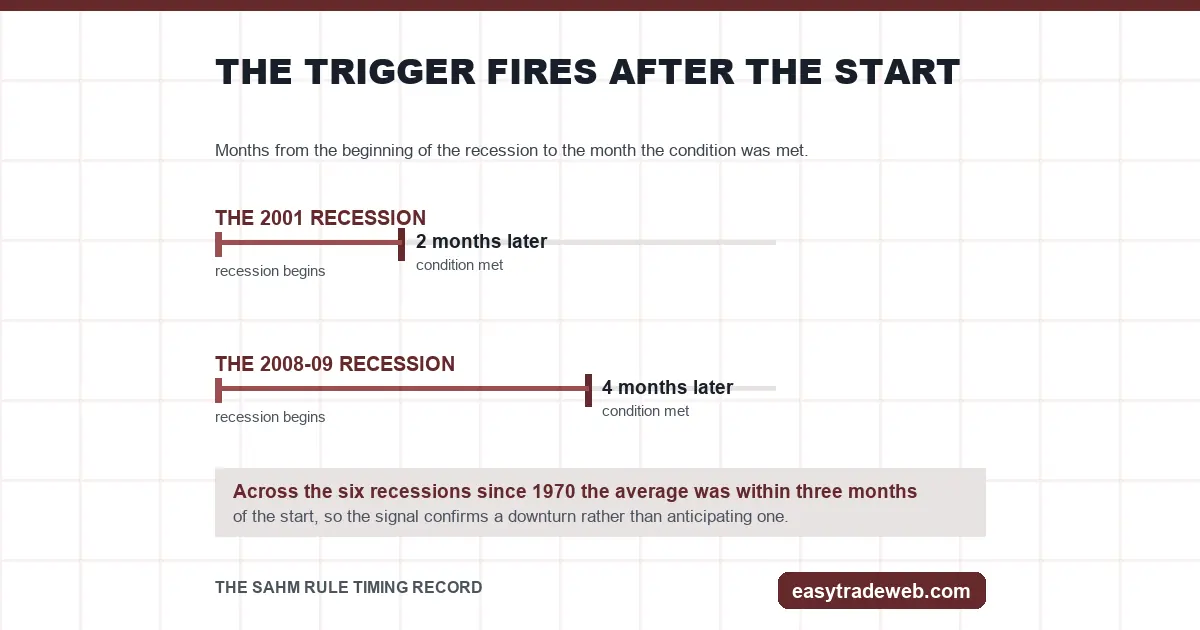
- On the record she published, the average delay across the past six downturns was three months from the start: four months in the 2008-09 case and two months in the 2001 case.
- Two published versions of the same rule can disagree, because the answer depends on whether you use the unemployment data as first published or as later revised. The proposal notes that working from the figures policymakers first saw delays the trigger by a few months against the revised series.
Table of contents
- What the Sahm Rule Actually Measures
- The Chapter It Comes From Proposed Payments, Not a Recession Call
- The Threshold, Step by Step, With the Comparison Window Most Pages Omit
- Why Two Published Versions of the Same Rule Disagree
- The Timing Record: It Fires After the Recession Has Started
- The Rule Does Not Declare a Recession, and Cannot
- Who Should Not Trade Off It
- Frequently Asked Questions
What the Sahm Rule Actually Measures
The input is the national unemployment rate, the headline figure from the monthly employment report. Nothing else enters the calculation: no output data, no prices, no survey of business sentiment.
The proposal gives a reason for that narrowness, and it is a practical one. An unemployment reading for any month lands at the start of the next one. Output data arrives later, gets revised often, and swings enough that two or three consecutive weak quarters would have to pile up before it said anything at all.
So the rule trades breadth for speed: one series, published fast, watched by the same threshold every month.
The Chapter It Comes From Proposed Payments, Not a Recession Call
The document is titled Direct Stimulus Payments to Individuals. Its argument is that ad hoc payments in the 2001 and 2008-09 recessions raised consumer spending, and that tying such payments to a fixed trigger would get money into the economy faster than a fresh act of legislation each time.
The numbers attached to the proposal are fiscal, not analytical. Payments in the first year total 0.7 percent of GDP, which the chapter also expresses as 1 percent of personal consumption expenditures. If the unemployment rate rises 2.0 percentage points or more above its starting level, a second year of payments follows at the same aggregate size.
The chapter is also explicit that the switch need not be automatic in the strict sense: the trigger could disburse the payments directly, or it could initiate a congressional vote on them.
None of that has anything to do with telling a trader what the economy is doing. The threshold was calibrated to answer one question: has the labour market weakened enough that households should receive money.
Reading it as a verdict on the business cycle is a second use, invented by its audience, and it inherits none of the design work that would justify the reading. That gap is worth holding in mind alongside the ordinary phases of the economic cycle, which the rule never attempts to identify.
The Threshold, Step by Step, With the Comparison Window Most Pages Omit
The condition compares two numbers. One is the unemployment rate averaged across the latest three months. The other is the lowest value that same average reached at any point in the preceding year. The rule is satisfied when the first exceeds the second by half a percentage point or more.
The part that gets dropped in retelling is the second half. The comparison is not against last month, and not against a fixed level. It is against the lowest reading of the rolling three-month average over the preceding year, which moves as that year moves.
Four separate decisions sit inside that one sentence, and the proposal gives a reason for each.
| Design choice | What it is | Reason given in the proposal |
|---|---|---|
| The series | The national unemployment rate | Timely, available at the start of the following month, and measured consistently for many decades |
| The smoothing | A three-month moving average rather than a single month | Removes some of the monthly random variation and avoids false positives outside downturns |
| The comparison | Against the low of the prior 12 months, not a fixed level | A trigger keyed to change survives shifts in what counts as a healthy labour market |
| The size | 0.50 percentage points | A move this small has historically appeared only inside downturns or immediately after them |
The third row carries more weight than it looks. A fixed threshold ages badly because the unemployment rate consistent with a healthy labour market is not a constant: the chapter cites Congressional Budget Office estimates that fall from 6.2 percent in 1978 to 4.6 percent in 2019.
A rule written against a level in 1978 would have been meaningless by 2019, and a change-based rule is not, which is why the comparison window is the load-bearing part rather than the 0.50 figure everyone quotes. Anyone tracking releases through the economic calendar is watching the input to that comparison arrive once a month.
Why Two Published Versions of the Same Rule Disagree
Two people can apply the same threshold to the same country in the same month and reach different answers about when it fired. Neither has made an arithmetic error. They are using different vintages of the same data.
The unemployment rate is not fixed when it is first printed. Estimates get revised, and seasonal adjustment factors are recalculated, so the value a policymaker saw in a given month is often not the value in the series today.
The proposal is explicit about which one it used and what difference the choice makes. Throughout, it works from the readings policymakers actually had in front of them at each date, and it says the effect of that choice is a trigger arriving a few months later than the revised series would produce.
That is the whole explanation for the two published series that carry this rule, one built on real-time estimates and one on the current revised series. It also means a trigger date quoted without its vintage is an incomplete statement, and a claim that the rule fired in a particular month is not checkable until someone says which version of history it was measured against.
The Timing Record: It Fires After the Recession Has Started
The record published with the proposal is a record of catching downturns, not of anticipating them. In every recession since 1970 the rate climbed by at least half a percentage point in the opening months, and averaged across those six downturns the payments would have started three months in.
The record carries one blemish and the chapter names it: across the earlier postwar period the only false positive was 1959, and a recession followed six months later.
The two individual figures are the ones worth remembering. For 2008-09 the condition was satisfied four months in. For 2001 it took two. Both are counted from the beginning of the contraction, so in each case the downturn was already running before the rule said anything.
The chapter states the limitation directly rather than leaving it to be inferred. Unemployment trails the cycle rather than leading it, and its peak normally arrives once the contraction is already over, which is why the measure gives little advance warning. What it does do, on the same account, is flag a downturn almost at once and well ahead of the point where it is formally recognised.
Those two claims are compatible and they are often confused. Beating the official announcement is not the same as beating the recession: a signal arriving two to four months into a contraction is early relative to the bodies that date recessions, and late relative to the market.
A further limit sits in the same passage. The rise in unemployment before a recession does not predict how severe it will be, and the increases ahead of the 2001 and 2008-09 recessions were similar even though the rise during and after 2008-09 was more than double. Traders who watch an inverted yield curve for lead time are asking a different question from the one this rule answers.
The Rule Does Not Declare a Recession, and Cannot
In the United States the chronology of business cycles is maintained by the Business Cycle Dating Committee of the National Bureau of Economic Research, which fixes the month in which activity reached its high point and the month it reached bottom.
That committee does not use a threshold. It weighs three criteria, depth, diffusion and duration, and treats them as somewhat interchangeable, so that extreme conditions on one criterion may partly offset weaker readings on another. Each still has to be met individually to some degree.
The published chronology shows why a mechanical threshold cannot substitute for that judgement. The contraction that began at the February 2020 peak ended at the April 2020 trough and lasted two months, the shortest in the record. A rule built on a three-month moving average compared against a 12-month low needs more months than that episode contained.
So the rule and the committee answer different questions: one is a fast mechanical switch designed to release money, the other a deliberative judgement about whether a decline was deep, broad and long enough to count.
Who Should Not Trade Off It
Anyone looking for a signal that precedes a downturn should look elsewhere, because the author of this one wrote that it gives little advance warning and the timing record supports her.
Anyone sizing a position on the severity of what is coming has no help here either. The proposal states that the pre-recession rise in unemployment does not predict how deep the recession will be, and the 2001 and 2008-09 comparison is the worked example of that failure.
Anyone quoting a trigger date without naming the data vintage is quoting an incomplete figure, and anyone treating the reading as an official recession call has confused a payment switch with the committee that dates business cycles.
What the rule is good for is narrower and still useful: a fast, rules-based summary of how far the labour market has fallen from its own recent best, published monthly, with no discretion in it. Read next to the growth and inflation releases, and next to conditions such as stagflation, it is one input rather than a verdict.
Frequently Asked Questions
What was the Sahm rule originally designed to do?
It was designed as the trigger for automatic stimulus payments to individuals. The 2019 proposal that introduced it sets first-year payments at 0.7 percent of GDP, with a second year of payments at the same aggregate size if the unemployment rate rises 2.0 percentage points or more above its starting level. Recession identification was never the stated purpose.
How is the Sahm rule threshold calculated?
Average the unemployment rate across the latest three months, then compare that figure with the lowest the same average reached at any point in the previous year. The condition is met once the gap between them reaches half a percentage point. The comparison window moves forward every month, so the reference point is never fixed.
Does the Sahm rule predict a recession before it starts?
No. The proposal states that unemployment trails the cycle rather than leading it, so the measure gives little advance warning. On the record published with it, the condition was satisfied four months into the 2008-09 contraction and two months into the 2001 one. It marks a downturn that is already running, well before that downturn is formally recognised.
Why can two versions of the Sahm rule show different dates?
Because they use different vintages of the unemployment rate. Estimates are revised after first publication, so the figure a policymaker saw at the time can differ from the figure in the series today. The proposal works from the readings available at each date and notes that this choice delays the trigger by a few months against the revised series.
Who decides that a recession has officially begun?
In the United States it is the Business Cycle Dating Committee of the National Bureau of Economic Research, which maintains the chronology of business cycles and fixes the month of each high point and each bottom. It weighs depth, diffusion and duration rather than applying any single threshold, and it treats those three criteria as somewhat interchangeable.
Risk warning: this page is educational and describes what one published policy proposal and one recession-dating body state about their own methods. It is not advice to buy or sell any instrument, it recommends no broker, platform or product, and nothing here is a signal, a performance claim or a prediction. Leveraged trading carries a high risk of losing money rapidly.