
Seigniorage: How Issuing Money Earns a Central Bank Income

A central bank puts notes into circulation and receives assets in exchange. Those assets earn interest. The notes do not, because a banknote pays its holder nothing. The gap between the two is seigniorage, and it is one of the few places where a government earns money simply by issuing it.
Most explanations stop at that arithmetic. What they leave out is the part a currency trader would want: the conditions under which the number is large enough to affect a currency, and the far more common conditions under which it is an accounting line that changes nothing. This page separates the two, and replaces the dated figures the subject is usually explained with.
Key takeaways
- Seigniorage is the return on the assets a central bank holds against the notes it has issued, less what those notes cost to produce and replace. It is an income stream, not a transfer.
- Two different things share the name. The modern meaning is that interest margin; the older one is the mint profit on turning metal into coin. They differ by orders of magnitude and get quoted interchangeably.
- Foreign demand is what makes the figure interesting for a currency. Notes held abroad are an interest-free loan to the issuer that may never be called.
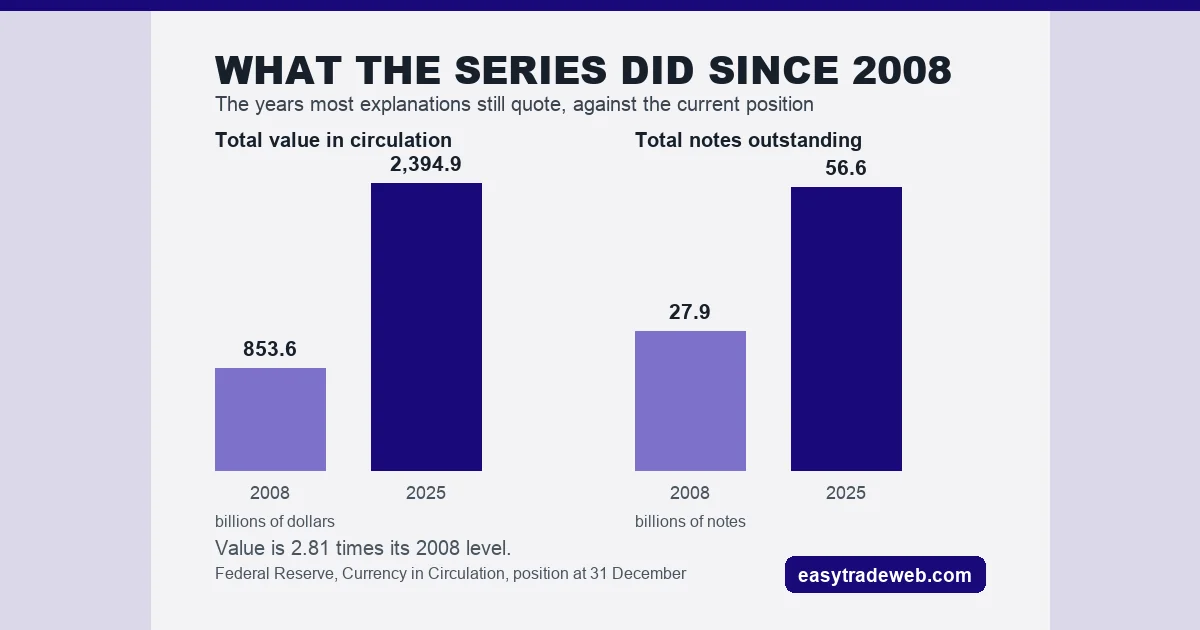
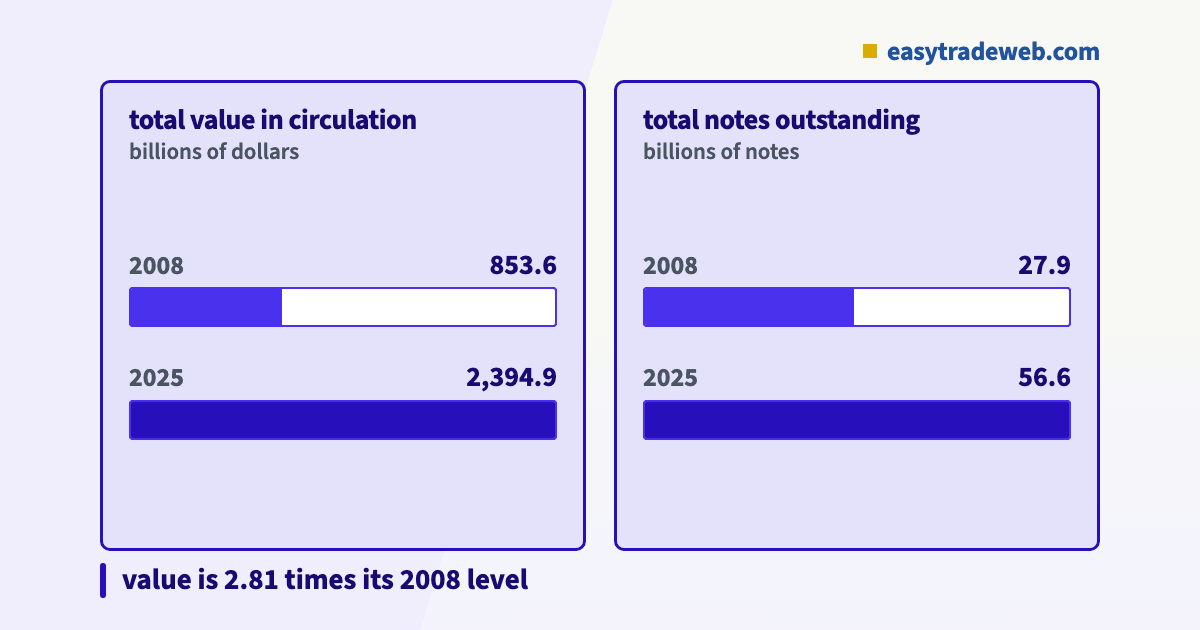
- The United States had 2,394.9 billion dollars of currency in circulation at the end of 2025, against 853.6 billion at the end of 2008, and the hundred-dollar note accounted for 83.0 per cent of the 2025 value.
- For a trader, the reading that matters is not the income itself. It is whether a government has begun to depend on it, which is a fiscal condition with a currency consequence and not an accounting one.
Table of contents
- Where the Income Actually Comes From
- The Two Meanings of Seigniorage That Get Mixed Together
- What Happens When a Currency Circulates Outside Its Own Border
- When It Matters to a Currency Trader and When It Is Just an Accounting Line
- The Figures Most Sources Quote Are Fifteen Years Old
- What the Balance Sheet Page Covers Instead
- Who This Page Is Not For
Where the Income Actually Comes From
When a commercial bank orders notes, it pays for them out of its account at the central bank. The central bank hands over paper and receives value, and it invests that value in assets, typically government securities. From then on the assets pay a return and the notes in the public hand cost nothing to service.
That is the whole mechanism, and two features of it are worth holding on to. The income is a flow, not a one-off: it continues for as long as the notes stay outstanding and the assets keep paying. And it is a return on a liability that carries no interest rate, which is why it exists at all.
Against the flow sit real costs. Notes have to be printed, moved, checked and destroyed when they wear out, and a note only earns for the years it survives in circulation. A central bank calculating the figure honestly nets those costs off, and the two published explainers from central banks that this page was checked against both do exactly that.
The cost side is smaller than it looks but not negligible, and it turns on how long a note survives. A note that lasts a decade spreads its production cost across ten years of interest income; one that wears out in eighteen months does not. Durability is therefore an income decision as much as a practical one, which is part of why several issuers moved their smaller denominations to polymer.
Interest rates matter more than any of that. The same note stock earns a large margin when policy rates are high and close to nothing when they sit near zero, without a single note being issued or withdrawn. Anyone comparing two years of seigniorage income is usually comparing two interest-rate environments.
What neither the arithmetic nor those explainers touch is the size of the asset side, which is a different question and one that belongs with the central bank balance sheet rather than here.
The Two Meanings of Seigniorage That Get Mixed Together
The word carries two definitions that are not variations on one idea. Reading a figure without knowing which is meant makes the figure useless, and encyclopedia treatments of the subject move between them inside a single article.
The older meaning belongs to metal coinage. A mint took bullion, struck it into coin, and kept a fee. The profit was the difference between the face value of the coin and the metal and labour that went into it, realised once, at the moment of striking.
The modern meaning is the interest margin described above. It is realised continuously rather than once, it depends on prevailing interest rates rather than on metal prices, and it can fall to almost nothing when rates are near zero without a single note leaving circulation.
A worked illustration makes the gap concrete without needing either figure. Under the older meaning, a country issuing a modest volume of new coin in a year earns on that year issue alone. Under the modern meaning, the same country earns on every note already outstanding, a stock built up over decades, multiplied by whatever its assets yield.
The difference is not academic. A figure built on the first meaning scales with how much new money is issued in a year. A figure built on the second scales with the whole stock outstanding multiplied by a rate. Confusing them can move an estimate by an order of magnitude in either direction.
What Happens When a Currency Circulates Outside Its Own Border
Everything above assumes the notes stay at home. For a handful of currencies they do not, and that is the point where the subject stops being domestic accounting and starts having a currency reading.
A note held outside the issuing country is a claim on that country that nobody is presenting. The issuer received real value for it once and pays nothing to keep it outstanding. If the holder is a household storing savings in a safer currency than its own, the note may never come back at all.
The composition of the notes in circulation is the visible trace of this. Small denominations are transaction money and circulate domestically. Very large denominations are stores of value, and a currency whose largest note dominates the total by value is one being held rather than spent.
The Federal Reserve publishes both series, by value and by count, and the shape is unmistakable. At the end of 2025 the hundred-dollar note accounted for 1,988.8 billion of 2,394.9 billion dollars in circulation, which is 83.0 per cent of the value but only 19.9 billion of 56.6 billion individual notes, or 35.2 per cent of the count.
A note that is a third of the pieces and more than four fifths of the value is not being carried in wallets. Where those notes physically sit is not something the Federal Reserve tables state, and this page does not estimate it, but the denomination split is the observable fact and it is consistent across the series.
When It Matters to a Currency Trader and When It Is Just an Accounting Line
Most of the time this subject is background. A central bank in a stable economy earns a margin on its note issue, remits most of it to the treasury, and the number moves no exchange rate. Reading the figure tells a trader nothing they can act on, and pages that imply otherwise are stretching.
The condition that changes this is dependence. Where a government cannot fund itself by taxing or borrowing at a tolerable rate, issuing money becomes a funding source rather than a by-product, and the income is then extracted by expanding the stock rather than by earning a margin on it. That is a different thing wearing the same name, and it is the inflation-tax case.
Three observable conditions distinguish the two, and none requires a seigniorage figure to be published. Whether the government is financing a persistent deficit through the central bank rather than the bond market. Whether the note stock is growing at a rate unrelated to economic activity. Whether the largest denomination in issue keeps being replaced by a larger one.
The second of those conditions is the one most often misread, because a growing note stock is not by itself a warning. What makes it one is growth detached from what the economy is doing with the money, and the measure that pairs with it is how fast money circulates.
The order of those three matters as much as the list. Deficit financing through the central bank is the condition; the growth in the note stock is the mechanism; a rising largest denomination is the symptom that appears last, once the existing notes have become inconvenient to carry. A trader noticing only the third has noticed the slowest of the three signals.
The first two are visible in central bank and treasury releases; the third is visible in the currency itself. Where all three hold, the exchange rate is usually already reflecting it, and the useful step is understanding why rather than acting on the discovery.
Where none of them holds, the correct conclusion is that this subject is not a trading input at all. The mechanisms that do move a stable currency in the short run are policy rates and official operations, and the latter are covered in the page on when a central bank acts in the market.
The Figures Most Sources Quote Are Fifteen Years Old
The general reference treatments of this subject lean on a cluster of statistics from between 2000 and 2009, and they are still being repeated on pages edited this year.
The encyclopedia entry checked while preparing this page carries United States circulation and denomination figures dated 2008, alongside several claims about foreign holdings from the 1990s. One of its currency-related statements is flagged as unsourced on the page itself while being stated as fact.
The underlying series has not stood still. The table below is taken directly from the Federal Reserve tables, which report the position as at 31 December of each year.
| As at 31 December | 2008 | 2025 |
|---|---|---|
| Total value in circulation | 853.6 billion dollars | 2,394.9 billion dollars |
| Value in 100-dollar notes | 625.0 billion dollars | 1,988.8 billion dollars |
| Total notes outstanding | 27.9 billion | 56.6 billion |
| 100-dollar notes outstanding | 6.3 billion | 19.9 billion |
The total value is 2.81 times its 2008 level. The count of notes has roughly doubled while the count of hundred-dollar notes has more than tripled, which is why the value share of that one denomination rose from 73.2 per cent in 2008 to 83.0 per cent in 2025.
Those percentages are calculated here from the two published columns rather than taken from any commentary. That is the point of the section: the series is public, current and directly readable, so quoting a figure from 2008 is a choice rather than a limitation.
What the Balance Sheet Page Covers Instead
Seigniorage sits on a central bank balance sheet, and it would be easy to let this page drift into that subject. It does not. How the asset side is expanded and contracted deliberately, what quantitative easing and tightening change, and how the pace of either is read are set out in the page on the central bank balance sheet.
The division is straightforward. That page is about the asset side being moved as policy. This page is about the income thrown off by one particular liability, the note issue, whatever the asset side is doing.
A third measure sits alongside both and answers a question neither does: how hard the existing stock of money is working, rather than how large it is or what it earns.
Who This Page Is Not For
This page will not give a trading signal, and it does not identify any currency as overvalued or undervalued. Nothing here is a prediction about an exchange rate.
It also does not publish a seigniorage figure for any central bank. The income is reported differently across institutions, sometimes net of costs and sometimes not, sometimes as a distinct line and sometimes folded into remittances to the treasury, and a single number lifted from one framework and compared against another is worse than no number.
What it does supply is the reading. If a currency you trade belongs to a government funding a persistent deficit through its central bank, with a note stock growing unrelated to activity, this subject is part of the explanation for what the exchange rate is already doing.
If it does not, the honest conclusion is that seigniorage is an accounting line, and your attention belongs on rates, on official operations, and on the flows measured in measuring the dollar.
Risk warning: this page is educational and explains a monetary concept and the published data behind it. It is not advice to buy or sell any instrument or currency, it makes no recommendation about any broker or platform, and nothing here is a signal or a prediction. Leveraged trading carries a high risk of losing money.