
What a Forex Trade Copier Does, and When It Needs a Licence

A trade copier is a program that watches one trading account and places the same trade on another. It is sold as plumbing, and as plumbing it is simple. What it moves is not.
Every page that explains a copier is published by a company selling one, so two questions go unanswered. The first is what the receiving account actually does when it cannot do what the sending account did. The second is the point at which running a copier over money that belongs to somebody else stops being a technical arrangement and becomes an activity that needs permission.
Both answers below come from the platform documentation and from the law that defines the regulated activity, not from any vendor.
Key takeaways
- A copier sends an instruction. It cannot guarantee the instruction became the same position, because the receiving account has its own execution mode, fill policy and deviation setting.
- Fill or Kill accepts one outcome: the whole requested size or nothing. Immediate or Cancel takes whatever size is there and drops the rest of the order.
- The sending account is unchanged in every one of those outcomes, so a copier reporting success is not evidence of a matched position.
- In the United Kingdom the activity called managing investments needs three conditions at once: somebody else owns the money, whoever runs it decides without asking, and what is traded is a contractually based investment.
- Trading only what the account holder tells you to trade removes the deciding condition, which puts the arrangement outside that particular activity even though other rules may still reach it.
Table of contents
- Whose Money Sits on the Receiving Side
- How One Instruction Becomes Two Orders
- When the Receiving Account Cannot Do What the Sending One Did
- Where the Delay Actually Comes From
- The Point at Which Copying for Other People Needs Permission
- What a Copier Cannot Do for You
- Questions Readers Ask About Trade Copiers
- Checking a Copier Setup Before You Rely on It
Whose Money Sits on the Receiving Side
The software does not care whose account it writes to. It reads a trade on one terminal and places a matching order on another, and the two accounts can belong to one person or to two hundred. Every consequence worth knowing follows from that ownership question rather than from the program.
Three arrangements are usually collapsed into the single phrase copy trading, and they are not the same relationship. In the first, both accounts are yours and the copier is a convenience: you trade a small account and mirror it into a larger one, or keep an account at a second broker in step with the first. Nothing changes about whose decision is taken or whose money is at stake.
In the second, the receiving account belongs to somebody else who has chosen to follow you, and you still decide every trade. Your decision is now being applied to a stranger balance. That is the arrangement the rest of this page is about, and it is where a limited power of attorney and the authorisation question both begin.
In the third, the receiving account belongs to somebody else who tells you what to place, and you operate the keyboard. The discretion has moved back to them, and as the next-to-last section shows, that single difference changes which rules apply. How a follower selects a provider and what the fees look like sit with following another trader positions, and this page leaves that half there.
How One Instruction Becomes Two Orders
A copier has a sending side and a receiving side. The sending side detects that a position has opened, closed or changed on the account it watches. The receiving side turns that event into an order on a different account. Between the two sits a translation step that decides most of what goes wrong.
Three things have to be mapped. The symbol name is the first: brokers name the same instrument differently, and a copier that cannot match a suffixed contract name to a plain one sends an order for an instrument the receiving account does not list.
The volume is the second, and there are three common rules for it. A fixed size ignores the sending account. A multiplier scales the sending size by a constant. A proportional rule sizes against the balance or equity of each account, so the same percentage is risked on both.
The third is the attached stop and target. These are price levels rather than distances, so a receiving account priced from a different feed, or quoted with a different number of decimal places, needs them recalculated rather than copied.
The two structures on offer differ only in where the sending side runs. A local copier keeps both terminals on one machine and passes the event between them directly. A remote copier sends it across a network to a terminal somewhere else, which is what makes copying between two brokers possible at all. Both put a second program on the terminal, and the constraints that come with that are covered in running more than one program on an account.
When the Receiving Account Cannot Do What the Sending One Did
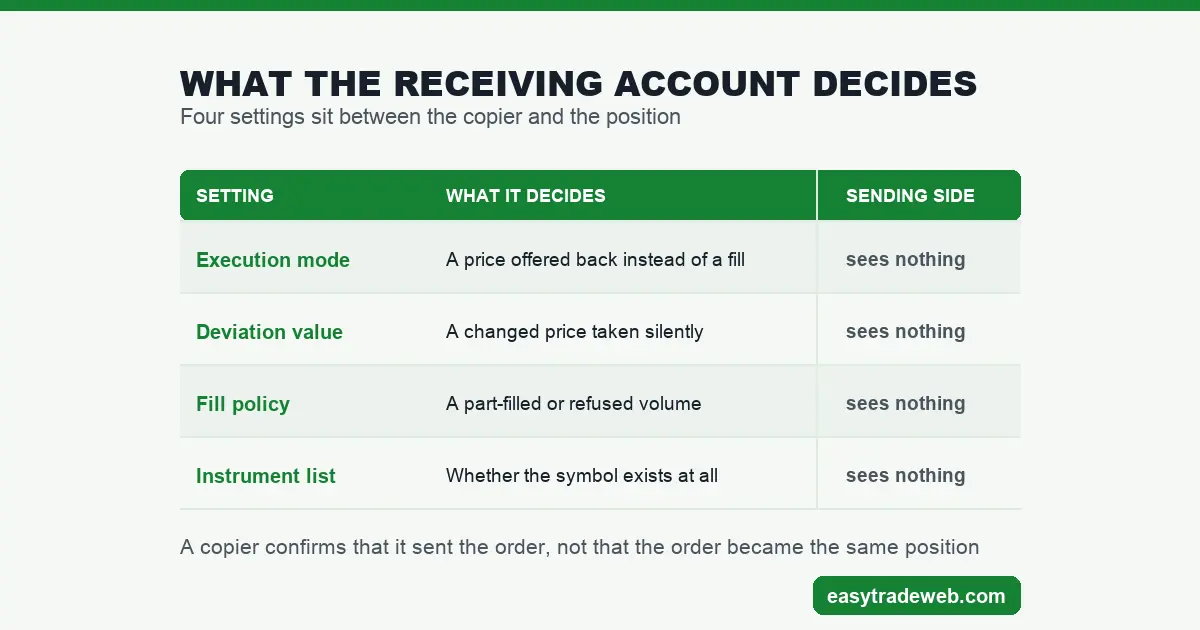
A copier reports that it sent an order. That is the only thing it can honestly report. Whether the order became a position of the same size, at a comparable price, or at all, is decided after the copier has finished its work, by settings that belong to the receiving account.
The platform documentation is explicit about the mechanisms. Under Instant Execution the terminal attaches the price it is holding, and a broker unwilling to deal there answers with a different price rather than with a fill.
Whether that is visible depends on the deviation value, which sets how far the dealt price may move from the price the trader agreed to accept. Inside that tolerance the trade goes through at the changed price and nothing is shown; outside it, the trader is asked again. On the sending account, none of this happened.
The fill policy decides the other half. Fill or Kill accepts one outcome: the whole requested size, or nothing at all if the market cannot supply it. Immediate or Cancel takes whatever size is there and drops the remainder of the order. Whether the second of those is offered is settled on the trade server, which makes it a property of the receiving broker rather than a choice the copier gets to make.
Put together, one copied order of a given size can arrive as that size, as a smaller size, or as nothing, and it can arrive at a price the sending account never saw.
The general mechanics of these settings belong to how a fill policy decides what gets executed and the difference between the execution modes. What matters here is narrower: the divergence is silent, it accumulates trade by trade, and the only way to see it is to compare the two account histories rather than the copier log.
| Setting on the receiving account | What it decides | What the sending account sees |
|---|---|---|
| Execution mode | Whether a price is offered back instead of filled | Nothing |
| Deviation value | Whether a changed price is accepted silently or returned | Nothing |
| Fill policy | Whether a partly available volume is filled or refused | Nothing |
| Instrument list | Whether the symbol exists to trade at all | Nothing |
Where the Delay Actually Comes From
Copier marketing treats delay as one number. It is three segments, and only one of them is the copier.
The first is detection: the sending side notices that something changed on the account it watches. The second is transport: the event reaches the receiving terminal, which on a local setup is a step between two programs on one machine and on a remote setup is a network hop. The third is execution: the receiving terminal places an order and the broker deals with it as it would with an order typed by hand.
A local copier removes the middle segment. Neither kind removes the third, which is the segment the sending account also pays and the one that varies most with the instrument and the moment. Keeping the receiving terminal on a server that stays on addresses availability and the first two segments; it does not touch the last one.
No figure for any of these three segments appears on this page. Every timing claim found while researching it was published by a vendor about its own product, with no measurement method stated and no independent source, and an unsourced number is worse than none.
The Point at Which Copying for Other People Needs Permission
This is the question no copier vendor answers, and the one with the largest consequence. The wording below is from the United Kingdom, given as a worked example of how such a rule is written rather than as the law wherever the reader happens to be.
The regulated activity is called managing investments, and article 37 of the Regulated Activities Order specifies it. The regulator perimeter guidance sets the same test out as three elements, and all three have to hold at once.
The first element is deciding. Where the person at the keyboard only places what the account holder has told them to place, the guidance puts that outside this particular activity, while noting that a different regulated activity, such as dealing as principal or as agent, may still reach it.
The second element is ownership: the money has to be somebody else money in the beneficial sense, which is what takes a person running their own account out of scope. The third is the kind of instrument, which has to be a security, a structured deposit or a contractually based investment, and the guidance stretches that to cover an arrangement where such an instrument could merely turn up.
Read those three against the second arrangement in the first section. A copier pushing your own trading decisions onto an account that belongs to somebody else supplies the discretion and the other person property, and the instruments a retail forex account holds are contractually based investments. The software is not what triggers the test. The relationship is.
What follows is a question for a regulator rather than for a page, and this one does not tell any reader whether they may operate a copier. Two things are worth doing: identify which regulator covers the entity the receiving account is held with, since a broker group may hold several licences with different perimeters, and read what the account agreement says about third-party access.
What a Copier Cannot Do for You
A copier multiplies a decision. It does not improve one. If the strategy on the sending account is unprofitable, copying it faithfully produces the same result on more accounts, and it produces that result faster because there is no second person pausing to think.
It cannot make two fills identical, for the reasons in the third section. It cannot make a strategy built around one account cost structure survive a different one, because the spread, the commission and the swap on the receiving account are the receiving broker terms and not the sending broker terms. A method with a small edge per trade is the most exposed to this, since the edge is measured in the same units as the cost difference.
It also cannot protect the receiving account from the ordinary gap between an intended price and an executed one, which is described in why a fill can miss the price. Copying adds a second account where that can happen rather than removing it from the first.
Questions Readers Ask About Trade Copiers
What is a forex trade copier?
A program that watches one trading account and places matching orders on one or more other accounts. It has a sending side that detects the trade and a receiving side that places the order, and between them a step that maps the symbol name, the volume and any attached price levels from one account to the other.
Can a copier send a trade to an account at a different broker?
Yes, and that is what the remote form of a copier exists to do. It also introduces the mismatches that matter most, because the second broker has its own instrument names, its own execution mode, its own fill policy and its own costs, and none of those follow the trade across.
What happens if the receiving account cannot fill the trade?
It depends on the fill policy set on that account. Fill or Kill accepts the whole requested size or nothing at all. Immediate or Cancel takes whatever size is there and drops the remainder. In both cases the sending account is unaffected, so the two accounts stop matching and nothing announces it.
Do I need permission to copy trades for other people?
That is decided by the rules of the jurisdiction the account sits in, not by the software. In the United Kingdom the activity called managing investments needs three conditions together: somebody else owns the money, whoever runs it decides without asking, and the instrument traded is a contractually based investment. Whether a given arrangement meets a test of that kind is a question for the relevant regulator.
Is a trade copier the same as copy trading?
No. Copy trading usually names a service inside a broker platform where a follower selects a provider from a list. A trade copier is a piece of software that sits between two terminals, and it does not select anything or supply anyone. One is a service and the other is a tool.
Checking a Copier Setup Before You Rely on It
Five checks, each done before any money depends on the answer.
- Place one small trade and compare the two account histories rather than the copier log, checking filled volume and fill price on both sides.
- Read the fill policy and execution mode on the receiving account, since those decide what a mismatch looks like.
- Confirm the symbol names match, including any suffix the receiving broker adds.
- Test what happens when the receiving account has too little free margin for the mapped volume.
- If a receiving account belongs to somebody else, identify the regulator covering the entity it is held with, and read the account agreement on third-party access.
Risk warning: this page is educational and describes how a piece of software works and how one jurisdiction defines a regulated activity. It is not advice to trade, not a recommendation of any copier or any broker, and not a legal opinion on any arrangement. Whether a particular setup requires authorisation depends on facts this page cannot know, and that question belongs to the relevant regulator. Leveraged trading carries a high risk of loss.