
Trailing Stop Loss: Where It Runs and When It Stops Working

A trailing stop is normally described as a stop-loss that follows the price up. That description is correct, and it omits the one detail that decides whether the tool does anything while you are away from the screen: where the instruction is actually held. On MetaTrader a stop-loss rests on the broker server. A trailing stop does not. It runs on the machine in front of you.
That difference changes what the tool is for, what happens to it overnight, and how much of your exit plan survives a closed laptop. The pages that rank for this term explain the concept and stop there. What follows is where the order lives, how close a broker will allow it to sit, which side of the quote it measures against, and how to confirm all of it on your own account.
Key takeaways
- MetaQuotes documents the MetaTrader trailing stop as running inside the platform rather than on the trade server, so it stops adjusting the moment the platform is closed.
- What survives a closed platform is the last stop-loss level the trailing stop wrote, and nothing further is moved until the platform is running again.
- MQL5 publishes a per-symbol minimum distance for placing stop orders, so a trail set closer than that distance cannot be placed at all.
- MetaQuotes states that one position can have its trailing stop processed no more often than once every ten seconds, which puts a floor under how fast it can react.
- The SEC notes that the execution price of a trailing stop order may differ from the price that triggered it, so the level reached is not the level filled.
- Every automatic adjustment is written to the platform journal, which makes the whole mechanism checkable after the fact rather than a matter of trust.
Table of contents
- What a Trailing Stop Actually Modifies
- Where the Order Lives: Your Terminal or the Broker Server
- The Minimum Distance Your Broker Will Accept
- Why the Trail Measures Against a Price You Do Not Trade At
- A Trailing Stop Is a Trigger, Not a Guaranteed Exit
- Fixed Distance or Percentage, and What Each Assumes About Volatility
- What a Trailing Stop Costs You in a Trend That Breathes
- Checking a Trailing Stop on Your Own Account Before You Rely on It
What a Trailing Stop Actually Modifies
A trailing stop is not a fifth order type sitting alongside the market, limit and stop orders your platform offers. It is an automation layered on top of an ordinary stop-loss, and the thing it changes is that stop-loss level, repeatedly, while a position is open.
The US Securities and Exchange Commission describes the arrangement in terms of the distance rather than the price: instead of naming a fixed level, you name an amount or a percentage away from the market, and the stop level is recalculated from wherever the market currently is. When price moves your way, the level is rewritten closer behind it. When price moves against you, the level stays exactly where it was last written.
The ratchet only turns one way, and that is the whole of the mechanism. Everything else that gets attributed to trailing stops follows from it or is a property of the order types a platform accepts rather than of the trail itself.
Because the trail rewrites a stop-loss rather than replacing it, a position that already carries one does not lose it when a trail is attached. MetaQuotes documents that the existing level is picked up and moved by the same rule, and that a position can carry only one trailing stop at a time.
Where the Order Lives: Your Terminal or the Broker Server
This is the part that the widely read explanations of trailing stops leave out, and it is not a subtlety. A stop-loss and a take-profit are held by the broker. Once set, they are the broker’s responsibility to watch, and they are watched whether your computer is on, off, asleep or disconnected.
The MetaTrader trailing stop is different. MetaQuotes places responsibility for it with the software on your own desk and not with the trade server, and its platform help is explicit that the feature therefore stops once that software is shut down.
What remains after a shutdown is the last stop-loss level the trail managed to write. That level is an ordinary server-side stop-loss and the broker continues to honour it. Nothing beyond it is adjusted again until the platform is back.
Read that consequence carefully, because it inverts the usual sales pitch. A trailing stop is often recommended for traders who cannot watch the market. On MetaTrader it is precisely the traders who cannot watch the market who get the least from it, because the automation runs on the same machine they have walked away from.
A position left open over a weekend shows the effect. If the platform was closed on Friday evening, the level protecting it on Monday is whichever one the trail last wrote before the machine went off. Nothing is broken. The tool was not running.
| Instruction | Where it is held | Still working with the platform closed | Price it is set from |
|---|---|---|---|
| Stop Loss | Broker trade server | Yes | A level you name once |
| Take Profit | Broker trade server | Yes | A level you name once |
| Trailing Stop | The MetaTrader platform on your machine | No, only the last level it wrote remains | A distance from the current price |
Traders who need the trail running while they are away keep the platform running elsewhere, which is what virtual hosting is sold for. That carries its own monthly cost and is worth reaching only once the tool has been shown to help.
The Minimum Distance Your Broker Will Accept
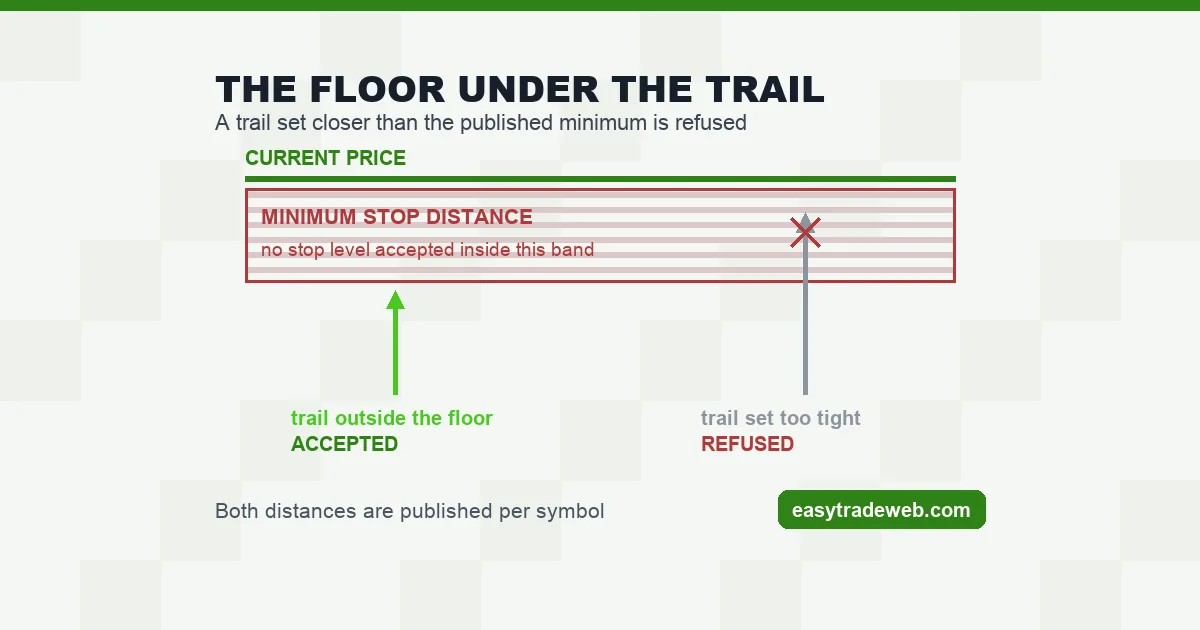
Choosing a trailing distance feels like a free choice. It is not. Every symbol carries a published floor beneath which stop levels cannot be placed at all, and a trail set tighter than that floor will simply fail to go on.
MQL5, the reference documentation for the platform, lists this as a symbol property: a minimum indentation, expressed in points, between the current price and any stop order placed against it. A second property sits beside it covering a band within which trade operations are frozen and modification requests are refused outright.
Both numbers are set per symbol and per broker, and both are readable from the contract specification of the instrument you are about to trade. The full behaviour is covered on our page about the minimum distance a broker will accept, and it applies to the trail exactly as it applies to a manually placed stop.
What makes this worth checking before rather than after is the interaction with the tightest trails, which are the ones traders reach for first. A trail of a few points on a symbol whose floor is wider than that trail is not a tight strategy that needs testing. It is an instruction the server will decline, and the position is left carrying whatever stop it already had while the trader believes something closer is protecting it.
The floor is not constant through the day either. Brokers widen it around illiquid periods and scheduled announcements, which is when a fast trail is most likely to be both wanted and refused.
Why the Trail Measures Against a Price You Do Not Trade At
A currency pair quotes two prices at once, and a long position is opened at the higher one and closed at the lower one. A chart usually draws only one of them. That gap between the two, the spread, does not disappear because a stop has been automated.
The distance a trail maintains is measured from the current price, and the exit it eventually produces happens on the opposite side of the quote. On a long position the trail follows the bid and the position closes on the bid, so the two agree. On a short position the trail follows the ask, which is the side a buyer pays, and that side sits above the line most charts display.
MetaQuotes makes the general rule explicit for stop orders on exchange-traded symbols: the trigger may be evaluated against the last traded price, but the buying or selling that follows is always done at the bid and ask. The trigger and the fill are quoted from different numbers.
None of this makes a trailing stop unusable. It means a chosen distance is narrower in practice than it looks on the chart by roughly the width of the spread, and that a distance chosen during quiet hours on a tight spread is a different instruction during a wider one.
A Trailing Stop Is a Trigger, Not a Guaranteed Exit
The comfort a trailing stop offers is the sense that profit already made has been secured. The mechanism does not support that reading, and the regulator says so directly.
In its bulletin on stop and trailing stop orders, the SEC points out that shares are sold when the price reaches the trailing stop level, while the price actually obtained may differ from it. The level is the condition that releases an order into the market. What that order then meets is whatever liquidity exists at that instant.
Where that distinction bites hardest is the situation a trailing stop is least equipped for: a market that reopens away from where it closed, or a release that moves price through several levels before any order can be filled. The trail wrote its level in a market that no longer exists, and the exit occurs wherever the book allows. Our page on the price you are filled at covers why the difference arises and how far it can run.
An exit that does carry a promise about the price is a different product, priced accordingly, and we cover what it costs on our page about a stop that is guaranteed for a fee. A trailing stop carries no such promise, and no broker claims it does. The claim tends to appear in the descriptions written about trailing stops rather than in the documentation of the tool itself.
Fixed Distance or Percentage, and What Each Assumes About Volatility
Platforms offer the trail as a fixed number of points, and some venues also express it as a percentage of price. The two are not interchangeable and each carries an assumption about how much the instrument moves.
A fixed distance in points assumes that a meaningful pullback is the same size today as it was last month. On an instrument whose daily range has doubled, that assumption produces a trail that is now far tighter relative to normal movement than the one that was originally chosen, and it will be reached by ordinary noise rather than by a change in direction.
A percentage distance widens as price rises, which addresses the problem in one direction only. Price level and volatility are separate things: an instrument can double in price while becoming calmer, or halve while becoming wilder.
The version that answers the underlying question measures recent range and sets the distance from it, which is what volatility-scaled exits such as an exit that trails by volatility are built to do. That is not automatically better: it replaces a fixed assumption with a measured one, and adds its own choice about how much history to measure.
The SEC adds a caution that applies to all three: short-term fluctuations in price can activate a trailing stop order, so the distance chosen has to be wide enough to sit outside ordinary movement, whatever method sets it.
What a Trailing Stop Costs You in a Trend That Breathes
A trend that runs without pausing is the case every explanation of trailing stops uses. Real trends pull back, and each pullback tests the distance that was chosen.
Because the ratchet never reverses, every pullback deep enough to reach the level ends the position, and it ends it at a level derived from the last high rather than from any judgement about whether the trend has finished. A trail that is tight enough to preserve most of an advance is also tight enough to be reached by a routine correction inside that advance.
There is a mechanical limit on top of the strategic one. MetaQuotes documents that the trailing stop for a single position is processed no more often than once every ten seconds, and that where several positions on one symbol carry trails, one is handled per incoming tick in rotation. In slow conditions this is invisible. In fast ones the level being enforced is a level that was correct a few seconds ago.
That is not a defect to work around. It is the resolution of the tool, worth knowing before a fast-market result gets attributed to a broker.
Checking a Trailing Stop on Your Own Account Before You Rely on It
Every claim above is checkable on the account you trade, and none of the checks needs money at risk. Run them on a demo account with the same broker and symbol before a trail is given responsibility for a live position.
- Read the floor first. Open the contract specification for the symbol and note the minimum stop distance and the freeze distance. Compare both against the trail you intend to use, in the same units.
- Watch the journal. MetaQuotes states that each automatic modification of the stop-loss is written to the platform journal. Set a trail, let price advance, and confirm the entries appear. If they do not, the trail is not running.
- Close the platform deliberately. With a trail active and a position open, shut the platform down, then reopen it later and read where the stop-loss sits. It will be at the last level written before the shutdown, which is the behaviour to plan around.
- Check both directions. Run the test once long and once short, and note the trail distance against the spread on each side rather than against the single line on the chart.
- Record what the pullbacks did. Note how many positions the trail closed during a move that later continued. That number, taken from your own instrument and your own distance, settles the question better than any general recommendation.
A trailing stop is a modest, well-documented piece of automation. It moves a stop-loss one way, inside limits the broker publishes, at a speed the platform documents, while the platform is running. Used with those four conditions understood, it does what it says. Used as a substitute for being present, it quietly stops working the moment you leave.
Risk warning: this page is educational and describes how a platform feature operates. It is not advice to open, hold or close any position, and automating an exit is not a method of producing a profit. A trailing stop does not guarantee an exit price and does not operate while the platform is closed. Leveraged trading carries a high risk of loss.