
ADP Employment Report: Release Time, Data Source, Revisions

The ADP National Employment Report is a monthly count of US private-sector jobs, built from anonymised payroll records of more than 26 million workers and published at 8:15 am Eastern by ADP Research with the Stanford Digital Economy Lab. The release of 2 September 2026 put August at 38,000 jobs added; the next lands on 30 September 2026.
Its publisher does not describe it as a preview of the government payrolls number, and the two are not built from the same kind of information at all.
What follows is what ADP states about its own report in the monthly releases it issues, what the number is drawn from, when it lands, and what a trader can and cannot settle with it.
Key takeaways
- The figure rests on anonymised weekly payroll records for over 26 million American private-sector workers, not on a sample of firms answering a questionnaire.
- ADP presents the report as a measure of the labour market in its own right. The description of it as a forecast of the government number is not a claim its publisher makes.
- It is produced by ADP Research together with the Stanford Digital Economy Lab.
- ADP restates its own previous month. The release of 2 September 2026 moved July from 44,000 to 46,000, after the 5 August release had moved June from 98,000 to 95,000.
- Each release carries pay measures as well as a jobs measure. From the August 2026 data onward ADP Pay Insights reports base pay and gross pay separately: 3.2 per cent and 4.7 per cent for all workers in the 2 September release.
- A weekly NER Pulse now appears on Tuesdays at 8:15 am Eastern in weeks without a monthly report.
Table of contents
- Where the ADP Number Comes From
- Why the Publisher Does Not Call It an NFP Forecast
- Payroll Records and a Survey Answer Different Questions
- The Release Clock: 8:15 Eastern, and Which Weekday
- ADP Revises Its Own Previous Month
- The Pay Figure Most Coverage Drops
- What the Report Can and Cannot Settle
- Frequently Asked Questions
Where the ADP Number Comes From
ADP is a payroll processor. Employers who use it run their wage payments through its systems, which means the company holds the payment records of a very large number of American workers as a by-product of doing its ordinary business.
The monthly release states the scale directly. The report is built on payroll data that is anonymised, collected weekly, and drawn from over 26 million American workers on private-sector payrolls. It is produced by ADP Research with the Stanford Digital Economy Lab.
Two words in that description carry most of the weight. Payroll means the figures come from money that was actually paid, recorded at the moment it was paid, rather than from anyone reporting what they believe happened. Weekly means the underlying records arrive at a finer interval than the monthly figure that is published from them.
The workers counted are those of ADP client firms. That is a large population, and it is not a randomly drawn one, which matters for the comparison in the next section.
Why the Publisher Does Not Call It an NFP Forecast
Market commentary routinely presents the ADP number as an early read on the government payrolls figure due later in the week, and treats a gap between the two as an error on ADP’s part.
ADP does not describe the report in those terms. Each release presents it as a measure of the labour market in its own right, produced from its own data, with no claim that it estimates or anticipates what any other body will publish.
That distinction changes how a difference between the two should be read. If one number is an attempt to predict the other, a gap is a miss and the smaller number is wrong. If they are two independent measurements of overlapping but different populations, taken from different kinds of evidence, a gap is information about where those populations and methods diverge.
Nothing here says ADP is the better measure. It says the widespread framing sets up a test the publisher never entered, and that reading a release against a standard it does not claim to meet produces conclusions about it that its own description does not support. The government series has its own construction, examined in our page on non-farm payrolls.
Payroll Records and a Survey Answer Different Questions
An administrative record and a survey response are different kinds of evidence, and the difference is not a matter of one being more careful than the other.
A payroll record is a transaction. It exists because a payment was made, it is complete for the firms whose payments run through the system, and nobody had to remember anything or fill anything in for it to exist. What it cannot do is describe firms that are not clients.
A survey works the other way. It is designed so that a sample can stand in for a whole population, which lets it speak about employers of every kind rather than about one processor’s customers. The cost is that it depends on responses arriving, and on estimation to bridge what did not arrive.
The practical form of that limit is worth being concrete about. A firm appears in the ADP data because it is a client, not because it was selected to represent firms like it, so any part of the economy where ADP has few clients is thinly represented however large that part is. Scale does not fix that on its own: twenty-six million records drawn unevenly still describe only the places they came from.
So the two are answering questions with different shapes. One asks what happened inside a very large and specific set of firms. The other asks what is likely to have happened across the economy. Neither answer substitutes for the other, and a page that treats one as a rehearsal for the other has collapsed the distinction.
The Release Clock: 8:15 Eastern, and Which Weekday
ADP publishes at 8:15 in the morning, Eastern time. The release naming the date of the next one is the reliable source for it: the report covering August 2026 was issued on 2 September 2026, and that release scheduled the report covering September for 30 September 2026.
The four consecutive dates visible across those releases are 1 July, 5 August, 2 September and 30 September 2026. All four fall on a Wednesday, which is the pattern the report has followed rather than a rule the publisher states as one.
Between the monthly reports ADP issues a weekly NER Pulse on Tuesdays at 8:15 am Eastern, skipped in the week a monthly report is due. It states a four-week moving average of the weekly change in employment with a two-week lag; the issue of 15 September 2026 gave 16,250 jobs a week for the four weeks to 29 August. ADP marks the figures preliminary and revises them as data arrives.
A widely repeated shortcut says the report always lands a fixed number of days before the government payrolls release. That relationship depends on two separate calendars, and it is read from them rather than assumed. Treat the position of any month’s release as something to look up in an economic calendar, in the same way the position of the JOLTS report has to be looked up rather than counted forward.
ADP Revises Its Own Previous Month
The report is frequently discussed as though each month produces one permanent figure. It does not.
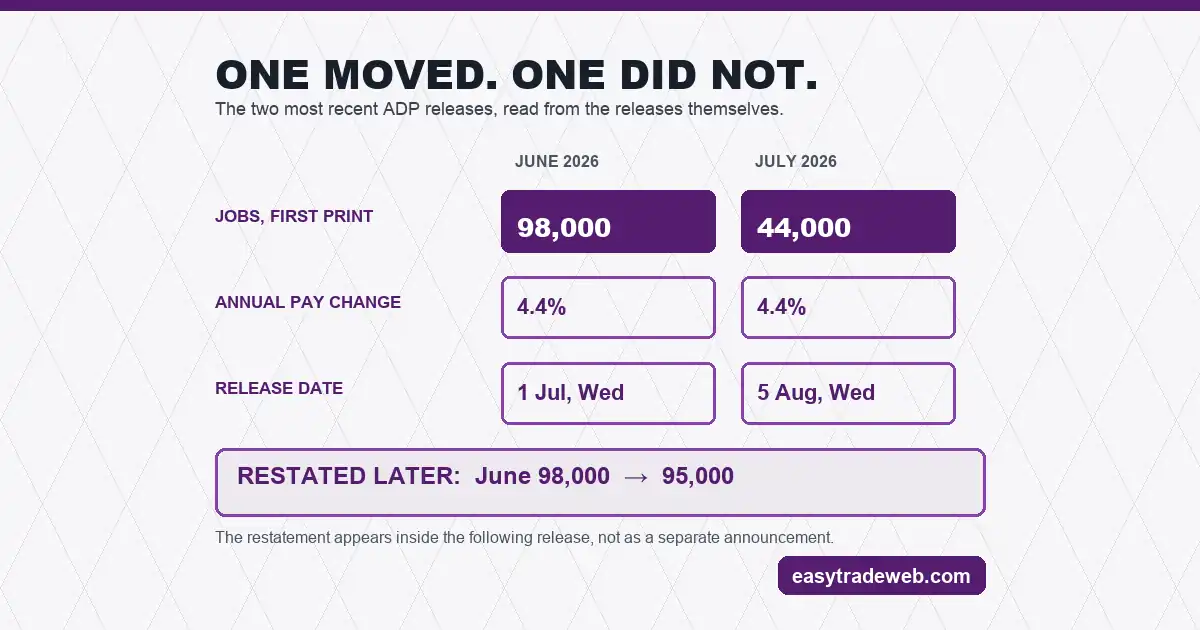
The release issued on 2 September 2026 restated the previous month: the July total, first published as 44,000 jobs added, was moved to 46,000. A month earlier the same thing had happened to June, moved from 98,000 to 95,000 in the 5 August release. The revision is stated inside the newer release rather than announced separately.
| Reference month | Release date | Jobs, as first published | Jobs, as later restated | Annual gross pay change, job-stayers |
|---|---|---|---|---|
| June 2026 | 1 July 2026 | 98,000 | 95,000 | 4.4 per cent |
| July 2026 | 5 August 2026 | 44,000 | 46,000 | 4.4 per cent |
| August 2026 | 2 September 2026 | 38,000 | Not restated in any release published so far | 4.4 per cent gross; 3.0 per cent base |
The rows are read from the ADP releases dated 1 July, 5 August and 2 September 2026. The report covering September 2026 was scheduled in the last of those for 30 September 2026.
Two or three thousand jobs is a small movement against totals between forty and a hundred thousand, and the size is not the point. The point is that the number a trader reacted to in early July was not the number the series carried a month afterwards, which is the same property that governs the government release and the CPI release.
The practical consequence is narrow and worth stating plainly: a first print is a first print. Any comparison built on ADP figures from several months back is being built on revised values, while the figures that moved prices at the time were the unrevised ones.
The Pay Figure Most Coverage Drops
Each release carries pay measures alongside the jobs figure, and coverage usually reports only the jobs figure. From the report covering August 2026, published 2 September, ADP Pay Insights states two of them: the change in base pay, taken from contracted rates, and the change in gross pay, which adds bonuses, commissions, tips and other earnings on top.
In that release base pay for all workers was up 3.2 per cent on a year earlier and gross pay 4.7 per cent. For job-stayers the gross figure was 4.4 per cent, the same reading the June and July releases had carried, while the employment number across those three releases went from 98,000 as first published to 44,000 and then 38,000.
The pay measure is a change against the same month a year earlier, which is why it moves slowly compared with the jobs figure. A monthly employment change can swing by tens of thousands between releases; an annual rate of pay growth is averaging over twelve months and will not.
That is the argument for reading both. A month in which hiring slows while pay growth holds steady is a different month from one in which both fall, and a reader who only ever sees the jobs figure cannot tell those apart.
What the Report Can and Cannot Settle
Five checks are enough to use the release without over-reading it.
- Read the release itself rather than the headline written about it, since the revision to the prior month sits inside the same document.
- Note all the figures: the change in employment, and the year-over-year changes in base pay and gross pay.
- Take the date of the next release from the current one instead of counting forward from another body’s calendar.
- Treat any comparison against the government series as a comparison of two different measurements, not as a scoring of one against the other.
- Treat the first print as provisional, and check whether a figure you are relying on from an earlier month has since been restated.
What the report cannot settle is what any market will do when it is published. It is a measurement of employment at a set of firms, released at a known time, and everything beyond that is a question about positioning and expectations rather than about the data.
Frequently Asked Questions
What is the ADP employment report?
It is a monthly measure of American private-sector employment, produced by ADP Research with the Stanford Digital Economy Lab from anonymised payroll records collected weekly across a base of over 26 million workers.
Does the ADP report predict non-farm payrolls?
ADP does not present it that way. The releases describe the report as a measure of the labour market in its own right, with no claim to estimate what any other body will publish, so a gap between the two is a difference in method and population rather than a miss.
What time is the ADP employment report released?
At 8:15 in the morning, Eastern time. The date of the next release is named inside the current one, which is the reliable place to read it.
How many workers does the ADP report cover?
Over 26 million American workers on private-sector payrolls, according to the description ADP prints in each monthly release.
Does ADP revise its jobs number?
Yes. The release of 2 September 2026 restated the July total from 44,000 jobs added to 46,000, and the revision appears inside the following release rather than as a separate announcement.
This page explains an economic data release. It is educational and is not investment advice, a recommendation to trade any instrument, a performance claim or a prediction. Release dates, figures and methodology are set by the publisher and change without notice. Leveraged trading carries a high risk of losing money rapidly.