
AI in Trading: What a Learned Model Can and Cannot Do

Artificial intelligence in trading is not one thing, and most of the argument about whether it works is an argument between people using the word for different objects. One person means the execution algorithm a bank uses to work a large order into the market. Another means a model fitted to price history that outputs a forecast. A third means any software that places orders without a human clicking.
Those three carry different risks, different evidence and different regulatory treatment. This page separates them, then checks the figures the subject is usually explained with against the documents those figures are supposed to come from.
Key takeaways
- The legal definition of algorithmic trading in EU law turns on whether a computer determines order parameters with limited or no human intervention. It says nothing about how the rule inside was produced, so a hand-written rule and a fitted model are the same object in law.
- Artificial intelligence, machine learning, neural network and deep learning appear zero times in the consolidated EU directive governing algorithmic trading, and zero times in the technical standard setting its operating requirements.
- The percentages quoted everywhere for how much trading is algorithmic do not come from the one official report written to answer that question. That 99-page report states no such percentage at all.
- The difference that matters to a trader is authorship. A rule you wrote can be read and explained; a rule a model fitted can only be observed. That changes what a failure looks like and what you can do about it.
- Institutional obligations assume a separate testing environment, an annual validation report and the ability to withdraw every resting order. A retail account has none of that infrastructure.
Table of contents
- What the Word Covers, and the Three Things It Is Used For
- A Rule You Wrote and a Rule a Model Found Are Not the Same Object
- The Figures Everyone Quotes, and Where They Actually Come From
- What Changes When the Model, the Data and the Account Are All Small
- Overfitting Is the Whole Problem, Not a Footnote
- How to Read a Claim About an AI Trading Product
- Who This Page Is Not For
- Frequently Asked Questions
What the Word Covers, and the Three Things It Is Used For
European law has a definition for the automated half of this subject, and it is narrower than the marketing use of the word. The Markets in Financial Instruments Directive defines algorithmic trading by what the computer decides: whether to send an order, and its timing, price, quantity or later management, with limited or no human involvement.
Read carefully, that definition is about the decision, not the technique. It does not ask whether the rule inside the system was typed by a developer or estimated from data. Both land inside it identically.
The absence is the more interesting half. Across the consolidated text of that directive, the terms artificial intelligence, machine learning, neural network and deep learning appear zero times. The same holds for the technical standard setting out how firms doing this must organise themselves.
So three distinct things travel under one label. There is automated execution, the regulated activity described above. There is statistical modelling, where a model is fitted to data and returns an estimate. And there is the promotional use, where the word is attached to any product that trades without a human present. Only the first has a settled definition, and the second is where the disputed claims live.
A Rule You Wrote and a Rule a Model Found Are Not the Same Object
The distinction that survives contact with a real account is authorship. If a developer wrote the condition, it can be read, and each clause traced back to a reason someone held. If the condition was fitted from data, what exists is a set of parameters that reproduce the training sample well. The output can be observed; the reason cannot be read off it.
That is separate from a question our page on systematic and discretionary methods already settles, which is who pulls the trigger. That page covers execution and judgement; this one covers where the rule came from. The two axes are independent.
| Question | Rule you wrote | Rule a model fitted |
|---|---|---|
| Where the rule comes from | A reason someone can state | Patterns present in the training sample |
| What you can inspect | Every condition, in full | Inputs, outputs and parameters, not reasons |
| What a failure looks like | A condition that no longer describes the market | Degrading output with no clause identifiably at fault |
| What you change when it stops working | The clause you can argue with | The data, the features or the fitting procedure |
| What a test on history proves | That the stated rule would have behaved this way | Less, because the rule was chosen using that history |
That last row is the one that does the damage, and it has a section of its own below.
The Figures Everyone Quotes, and Where They Actually Come From
Two numbers appear on nearly every page written about this subject. One is a share of market volume said to be algorithmic, usually put between sixty and eighty per cent. The other is a market size for AI trading software, stated in billions with a growth rate attached.
Both are normally given without a source. The second, when sourced at all, traces to a commercial market-research vendor rather than to an exchange, a filing or a regulator.
There is an official document written to answer the first question. The United States Securities and Exchange Commission published a staff report on algorithmic trading in US capital markets on 5 August 2020, produced under a Congressional mandate in the 2018 Economic Growth, Regulatory Relief, and Consumer Protection Act. It runs to 99 pages and roughly 36,600 words.
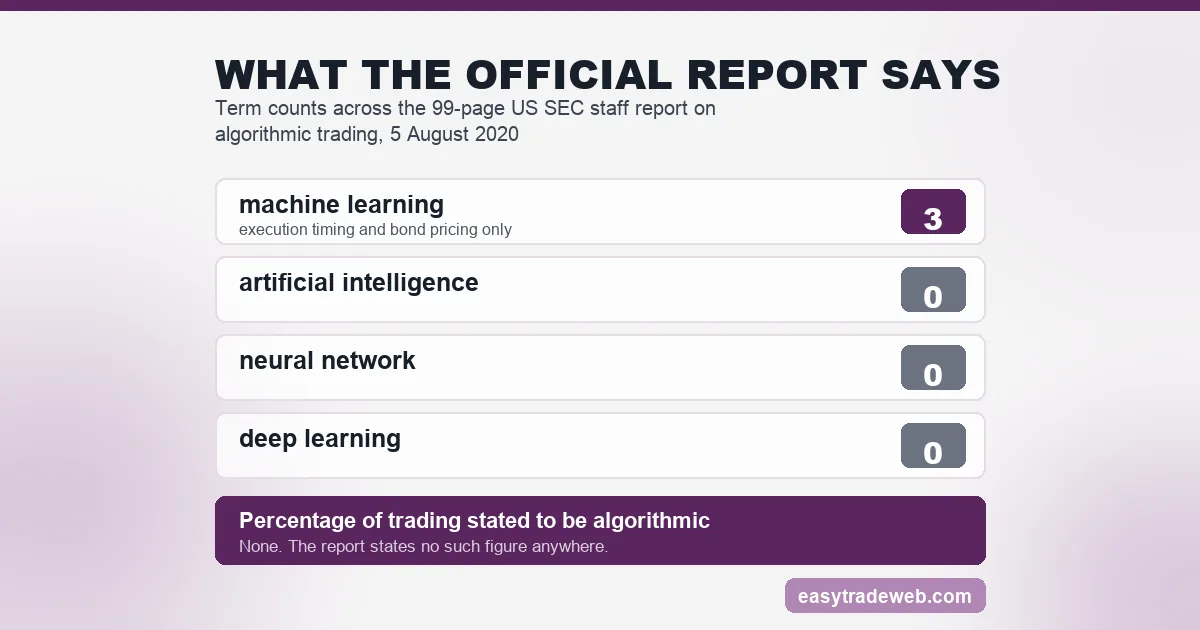
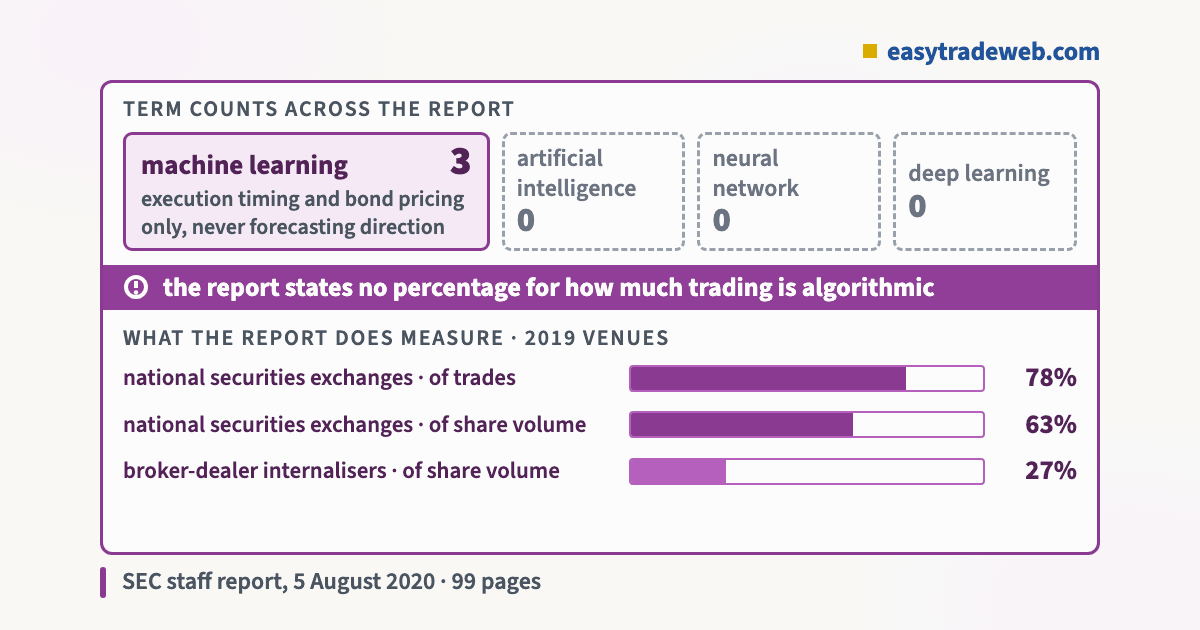
It states no percentage for how much trading is algorithmic. Checked across the full text, not one sentence contains both a reference to algorithms and a percentage figure.
This is not a report that avoids numbers. It reports that in 2019 national securities exchanges executed approximately 78 per cent of trades and 63 per cent of share volume in national market system stocks, and that broker-dealer internalisers executed about 27 per cent of share volume. The precision is there. It is applied to venue, because venue is measurable from records that exist, and not to algorithmic share, because that is not.
The same report mentions machine learning exactly three times, and none of the three concerns forecasting price: one trading system timing execution to reduce price impact, some vendors adding it to real-time analytics products, and bond platforms using it to generate a price for instruments that trade rarely. Artificial intelligence, neural network and deep learning do not appear at all.
Neither of the two popular figures appears anywhere on this page, because no official source states them.
What Changes When the Model, the Data and the Account Are All Small
The examples reached for in this subject are institutional, and the conditions attached to them do not travel. The EU technical standard governing firms engaged in algorithmic trading requires testing in an environment separated from the production environment, so a change is proven somewhere it cannot reach the market.
It also requires an annual self-assessment and validation process producing a validation report, reviewed by the firm risk management function, and the ability to withdraw all or some resting orders on demand.
A retail account holder has none of these as infrastructure. There is no separated production environment, no independent risk function to review a validation report, and the ability to cancel everything depends on a platform and a connection that may be the thing that failed.
Data is the second asymmetry, and the larger one. The institutional uses documented in the SEC report operate on order flow and quote streams the firm itself generates or receives. A retail feed is a downstream summary of that, delivered later and in less detail, so a model fitted to it is fitted to a thinner object.
Capital is the third. A strategy with a genuine but small edge needs enough independent occurrences for that edge to show through variance, and enough capital to survive the ordinary run of losses on the way. Whether a series even carries the persistence such a strategy assumes is a measurable question, addressed on the page on measuring persistence in a series.
Overfitting Is the Whole Problem, Not a Footnote
A model with enough parameters can reproduce any history it is shown. Reproducing history is exactly what the fitting procedure rewards, so a model that memorised noise and a model that learned something durable look identical on the data used to build them. Separating the two requires evidence the model never saw.
This is why a fitted rule and a written rule are not equally served by a test on history. When a developer writes a condition and then tests it, the test checks a claim made in advance.
When the condition is selected by searching for whatever fits best, the test has been consumed by the selection, and running it again measures the search rather than the strategy. What such a test can and cannot establish is set out on the page about testing a strategy on history.
One neighbouring fault is left to another page. Overfitting and survivorship bias are frequently blended together and are different failures with different remedies; the page on records with the failures removed separates them. This section stays with the fitting problem only.
The practical consequence is a standard of evidence. A result produced on data the model was fitted to establishes nothing on its own, whatever its size, and a result on held-back data establishes something only if the holdout stayed genuinely untouched throughout.
How to Read a Claim About an AI Trading Product
One provision is worth knowing before reading any sales page. The EU technical standard applies the firm obligations for algorithmic trading regardless of whether the system was built in-house, bought from a third party, or developed jointly with a client or supplier.
Responsibility does not transfer with a purchase. That principle is regulatory, but the reasoning holds for anyone: buying the system does not move the consequences of running it.
From there, four questions do most of the work. What is the model actually deciding: order timing and size, a price estimate, or a directional forecast? What data was it fitted to, and what was held back? What does the vendor say happens when it stops working, in specific terms rather than a promise of monitoring? And what evidence exists from a period the model was not built on?
A performance claim carries the same requirement as any other figure. If it has no source that can be checked it is not evidence, and a number repeated across several sites is still one unsourced number.
The operational questions matter as much as the statistical ones. Anyone considering running more than one expert advisor on a single account already knows that independent systems interact through the account they share, and adding a fitted model does not simplify that.
Who This Page Is Not For
This page recommends no product, platform or approach, and names no vendor. It contains no signal, no forecast and no view on whether any strategy will make money.
It is also not a build guide. Nothing here explains how to select features, fit a model or connect one to a trading account, because the questions that decide whether that is worth attempting come first.
Anyone looking for confirmation that a learned model reliably predicts price will not find it here. No official source consulted supports that claim, and the regulatory documents governing automated trading do not use the vocabulary at all.
What the page supplies is a way to tell the three meanings apart, and a standard of evidence to apply to claims made in any of them.
Frequently Asked Questions
What does artificial intelligence mean in trading?
It is used for three separate things: execution systems that decide the timing and size of orders, statistical models fitted to data that return an estimate, and marketing for any software that trades without a person present. Only the first has a settled legal definition, which turns on a computer determining order parameters with limited or no human involvement.
How is an AI model different from an automated strategy?
The difference is where the rule came from. An automated strategy runs conditions a developer wrote and can explain. A fitted model runs parameters estimated from data, so the output can be observed but the reasoning behind any single decision cannot be read. In law the two are treated the same, because the definition covers what the computer decides rather than how the rule was produced.
Can a machine learning model predict price?
No official source consulted for this page supports that claim. The staff report of the United States Securities and Exchange Commission on algorithmic trading mentions machine learning three times in 99 pages, and every mention concerns execution timing or generating a price for instruments that trade rarely, never forecasting direction.
What data would a retail trader need?
More than a standard retail feed supplies. The institutional uses described in official material operate on order flow and quote data the firm generates or receives directly, while a retail feed is a later and thinner summary of the same activity. A separate holdout period the model never saw is also required, and it has to stay untouched throughout development.
Why do backtested AI results rarely repeat live?
Because the history was used twice. A model selected for fitting the past well has already consumed that period as part of choosing itself, so testing it on the same data measures the search rather than the strategy. Live trading supplies data the selection never touched, which is the first genuine test the model faces.
Risk warning: this page is educational and explains how a set of terms is defined and what official documents do and do not say about them. It is not advice to buy or sell any instrument, it recommends no product, platform or broker, and nothing here is a signal or a prediction. Leveraged trading carries a high risk of losing money.