
Euribor Explained: Who Sets the Euro Benchmark, and How

Two numbers describe the price of euro money on the same morning, and they are built on opposite principles. One comes from a private administrator in Brussels and covers five forward maturities. The other comes from the European Central Bank, covers a single overnight tenor, and is compiled from trades that already settled the day before.
Euribor is the first of the two, and the description of it that circulates most widely stopped being accurate years ago. What follows is what the European Money Markets Institute states about the benchmark it administers, how a contribution is built today, and where the number sits against the two euro rates it is confused with.
Key takeaways
- The administrator does not define Euribor as lending between euro-area banks. It defines it as the cost of obtaining wholesale euro funds, unsecured, for credit institutions in countries currently or formerly in the European Union and the European Free Trade Association.
- Contributions are transaction-based first. A Level 1 contribution rests only on qualifying trades of at least 10 million euro, a threshold cut from 20 million in the methodology version dated 24 March 2021.
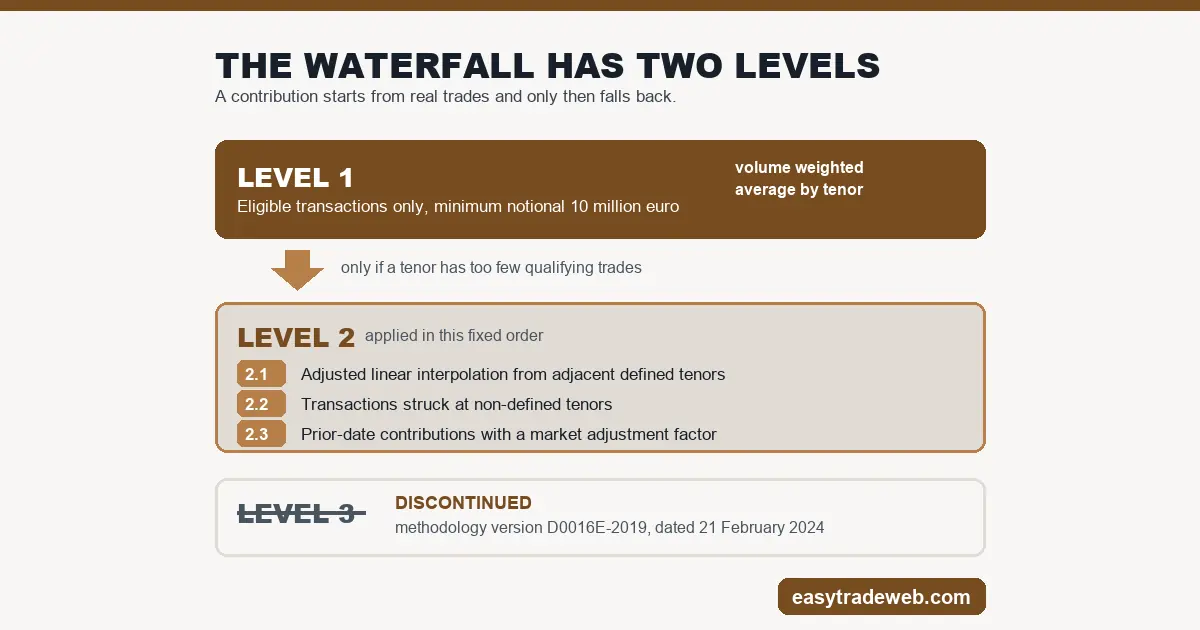
- The waterfall has two levels, not three. Level 3 was discontinued in methodology version D0016E-2019, dated 21 February 2024.
- The rate is published every TARGET2 day at or shortly after 11:00 CET, and it can be re-fixed intraday at 15:00 CET when input data is revised or a calculation error is found.
- Euribor, the policy rates of the European Central Bank, and the euro short-term rate are three separate measures with three different publishers, tenors and purposes.
Table of contents
- What Euribor Measures, in the Words of Its Administrator
- How the Hybrid Waterfall Builds Each Contribution
- Three Euro Rates, Three Different Things
- When the Number Lands, and When It Can Still Change
- What Moves Euribor, and What Does Not
- Where a Currency Trader Actually Meets Euribor
- Checking a Euribor Figure Before You Rely On It
What Euribor Measures, in the Words of Its Administrator
The sentence that appears on almost every page about this benchmark is that Euribor is the rate at which euro-area banks lend to each other. The European Money Markets Institute, which administers it, describes something narrower in one respect and wider in another.
Narrower, because the subject is funding rather than lending, and specifically wholesale funding raised without collateral. A retail deposit is outside it. A repo, which is secured against paper, is outside it too.
Wider, because the geography is not the euro area. EMMI extends the underlying interest to credit institutions in countries currently in the European Union and the European Free Trade Association, and to countries formerly in either.
The word euro in the name refers to the currency being borrowed, not to where the borrower sits.
The benchmark has been running since 30 December 1998, a few days ahead of the currency itself, and it is calculated for five maturities: one week, one month, three months, six months and twelve months. The European Commission designated it a critical benchmark in 2016 on grounds of systemic importance to financial stability, which is the legal reason its methodology is regulated rather than left to its administrator.
Scale is why that designation exists. EMMI puts the outstanding amount of instruments and contracts referencing the benchmark above 100 trillion euro, calling it an in-house estimate rather than a measured total. Anyone reading a euro release on an economic calendar is watching a market that prices a great deal of paper off this one number.
How the Hybrid Waterfall Builds Each Contribution
Twenty panel banks contribute, and Global Rate Set Systems has acted as calculation agent since July 2014. What each bank sends is not an opinion. Since the hybrid methodology was introduced, a contribution is assembled from a hierarchy, and the hierarchy decides how much of it rests on real trades.
At Level 1 the contribution rests on qualifying trades in the euro money market, uncollateralised, and on nothing else. Each such trade must carry a notional of at least 10 million euro, and the bank returns the volume-weighted average rate of those trades for the tenor in question.
That threshold used to be 20 million euro. It was halved in the methodology version dated 24 March 2021, the same revision that widened the underlying interest to take in former members of the two blocs.
A bank that has too few qualifying trades in a given tenor, but does have trades at nearby maturities or on earlier dates, moves to Level 2. Three techniques sit there, and they are applied in a fixed order rather than chosen freely.
First an adjusted linear interpolation from the neighbouring defined tenors. Then trades struck at maturities that are not defined tenors. Then contributions carried forward from earlier dates, with a market adjustment factor applied to them.
Here is the part that most published descriptions have not caught up with. The waterfall used to end in a third level, where a bank could fall back on modelling and expert judgement.
Level 3 was discontinued in methodology version D0016E-2019, dated 21 February 2024, in the same revision that reformulated Level 2.3. Euribor today is a two-level structure, and any account still describing three levels is describing the benchmark as it was more than two years ago.
The methodology is not frozen either. The EU Benchmarks Regulation obliges administrators to review their methodologies periodically, and EMMI runs that review annually. The version dated 29 June 2026 raised panel bank contribution rates from two decimal places to three.
Three Euro Rates, Three Different Things
A statistics page at a national central bank will print the policy rates of the European Central Bank, a row of Euribor tenors and the euro short-term rate one under the other. They are not variations on a theme, and reading them as though they were is how a move gets attributed to the wrong publisher.
The policy rates are decisions. They are set by the Governing Council of the European Central Bank and they change when that body decides they change, which is what makes an ECB rate decision an event with a scheduled date.
The euro short-term rate is a measurement, published by the same central bank. It covers overnight activity, and each daily figure is drawn from trades that were struck and settled one TARGET2 business day earlier. The ECB charges nothing for it and attaches no licence to its use.
It first appeared on 2 October 2019, covering trading done on 1 October. On its 28 August 2026 update the ECB put the rate at 2.188 for a reference date of 27 August 2026, drawn from 859 transactions across 48 active banks totalling 58,270 million euro, with the five largest of those banks accounting for 44 percent of the volume.
Euribor is a measurement too, but of something else entirely: term funding, at five maturities out to a year, administered privately and licensed. A one-year rate carries compensation for lending money for a year that an overnight rate cannot carry, whatever the policy setting happens to be.
| Euribor | Euro short-term rate | ECB policy rates | |
|---|---|---|---|
| Published by | European Money Markets Institute | European Central Bank | European Central Bank |
| Nature | Measured benchmark | Measured benchmark | Policy decision |
| Tenors | One week, one, three, six and twelve months | Overnight only | Not a tenor structure |
| Built from | Panel bank contributions under the hybrid waterfall | Transactions settled the previous TARGET2 day | A vote of the Governing Council |
| Publication time | At or shortly after 11:00 CET, every TARGET2 day | Each TARGET2 business day | On scheduled meeting dates |
| Licensing | Licensed by the administrator | Free, and not licensed | Not applicable |
| First published | 30 December 1998 | 2 October 2019 | Not applicable |
When the Number Lands, and When It Can Still Change
Publication runs on the TARGET2 calendar, not on a national one, so a day that is a holiday in one member state is still a fixing day if the payment system is open. Each tenor is published at or shortly after 11:00 CET.
The part worth knowing is that publication is not always final. EMMI allows an intraday re-fixing at 15:00 CET where input data has been revised, or where something went wrong in collecting, calculating or publishing the benchmark.
A correction is not a footnote added to the day. Faulty inputs are swapped for the revised ones, or the calculation itself is redone, and every fixing day inside the affected window is then recomputed. EMMI sets the recomputed series against what it originally put out.
The contrast with the overnight rate is instructive. The euro short-term rate is published in the morning for activity that finished the previous business day, so by the time it appears the underlying market has already moved on. Euribor is published mid-morning for the day in progress, and carries a defined window in which it can still be corrected.
What Moves Euribor, and What Does Not
Because contributions are assembled from transactions rather than from views, Euribor responds to what banks actually paid for wholesale money, not to what anyone expects the central bank to do next. The two are related, but they are not the same input, and the distinction matters on decision days.
A policy change does not mechanically reprice a term benchmark. The three-month and twelve-month tenors already carry a view of the funding path across their whole life, which is why they can drift for weeks before a meeting and barely react on the day. An overnight rate sits close to the policy corridor by construction.
Two other components ride inside a term rate and are absent from an overnight one: compensation for committing funds for a fixed period, and the credit standing of the institutions raising them, since this is money lent without collateral behind it.
When either of those widens, the gap between a term rate and an overnight rate widens with it. That gap describes funding conditions, not policy.
What will not move it is a single quotation from a single bank. A Level 1 contribution is a volume-weighted average of qualifying trades, and the panel is twenty banks wide.
Where a Currency Trader Actually Meets Euribor
Most people trading currencies never look up a Euribor fixing, and still deal with it every day through two channels.
The first is the forward curve. The difference between a spot rate and a forward rate for a currency pair is governed by the interest rate on each side of the pair, and the euro leg of that calculation comes from euro money market rates rather than from a policy headline. Anyone working with forward points is handling the output of exactly this market.
The second is the cost of holding a position overnight. A position financed in euro is financed at a euro funding rate, and the tenor structure of that market is what sets the rollover economics. That is the same machinery underneath the carry trade, where the whole return depends on the gap between two funding curves rather than on either rate alone.
In both cases the number that matters is the term rate rather than the overnight one, because the position has a horizon. A policy rate alone leaves out the part the broker charges against.
Checking a Euribor Figure Before You Rely On It
Rate boards copy each other, and few of them date what they show. Four checks separate a usable figure from a stale one.
- Confirm the tenor. There are five, and a page showing one unlabelled number is showing an unknown one.
- Confirm the fixing date, not the page date. A board updated today can be displaying a rate fixed several TARGET2 days ago.
- Check whether the day carried an intraday re-fixing at 15:00 CET before treating a morning figure as final.
- Trace the number to the administrator or a central bank rather than to an aggregator, and confirm the methodology version behind any description you are relying on, since the waterfall itself has changed twice since 2024.
Risk warning: this page is educational and explains how one euro money market benchmark is defined, calculated and published. It is not advice to buy or sell any instrument, it recommends no product, platform or broker, and nothing here is a signal, a performance claim or a prediction. Leveraged trading carries a high risk of losing money rapidly.