
ECB Interest Rate Decision: What Actually Moves the Euro

The latest ECB rate decision, on 10 September 2026, raised all three key rates by 25 basis points. From 16 September 2026 the deposit facility rate is 2.50 percent, the main refinancing operations rate 2.65 percent and the marginal lending facility rate 2.90 percent. Each decision is published at 14:15 CET, with the press conference at 14:45 CET.
Most explanations of an ECB rate decision describe one rate. The European Central Bank sets three, and they do not all mean the same thing to someone holding a euro position.
Four comparable guides were examined while preparing this article. Two list the three rates without saying which one the headline decision refers to. The other two never name them at all and write only about the ECB rate, as though there were one. All four then assert that the press conference matters more than the decision itself, and not one of them gives the timetable that would let a reader see why.
What follows sets out the three rates and how they are tied together, the gap between the day a decision is announced and the day it applies, then the two separate releases that make up a decision day, and what each of them contains.
Key takeaways
- The 10 September 2026 decision raised the three key rates by 25 basis points each. The deposit facility rate applies at 2.50 percent from 16 September 2026.
- The ECB sets three key rates, not one. The deposit facility rate is the one that steers short-term euro money market rates.
- Since 18 September 2024 the spread between the main refinancing operations rate and the deposit facility rate has been fixed at 15 basis points, so the three move together by an announced construction.
- A decision day carries two releases thirty minutes apart: the decision press release at 14:15 CET and the President’s press conference at 14:45 CET.
- Those two releases contain different things, which is the mechanism behind the common claim that the press conference moves the euro more than the rate does.
- A new rate applies from a later date than the announcement: six days later at both 2026 changes. A page quoting the current rate in that window can be right and already out of date.
Table of contents
- The Three Rates, and Which One the Headline Means
- Announced on One Day, Applied From Another
- The Decision and the Press Conference Are Two Separate Events
- What Is Actually in Each Release
- Why the Rate Itself Is Usually Not the News
- Reading a Decision Without Guessing the Next One
- Where the Published Figures Live and How to Check Them
- Which of These You Actually Need
The Three Rates, and Which One the Headline Means
The Governing Council sets three key rates at each monetary policy meeting, and those meetings are scheduled well in advance, so each one appears ahead of time as a scheduled release on the economic calendar. The three are the deposit facility rate, the main refinancing operations rate and the marginal lending facility rate, and each one applies to a different transaction between the central bank and the banks that deal with it. That fixed scheduling is what separates a decision from an event that decides nothing, where there is no release time to plan around.
Not every central bank commits to that much. The Bank of Japan sets its meeting dates two years ahead but publishes no release time for the decision, which makes it a decision with no published release time to plan around.
The deposit facility rate is what a bank earns on money left with the central bank overnight. The main refinancing operations rate is what a bank pays to borrow for a week against collateral. The marginal lending facility rate is what a bank pays to borrow overnight, at the top of the corridor. None of the three is Euribor, which is a measured market benchmark administered privately rather than a rate this meeting sets.
| Key rate | What it applies to | From 16 September 2026 | From 17 June 2026 |
|---|---|---|---|
| Deposit facility | Money banks leave with the central bank overnight | 2.50 percent | 2.25 percent |
| Main refinancing operations | One-week borrowing by banks against collateral | 2.65 percent | 2.40 percent |
| Marginal lending facility | Overnight borrowing at the top of the corridor | 2.90 percent | 2.65 percent |
Levels checked against the ECB key interest rates page on 17 September 2026.
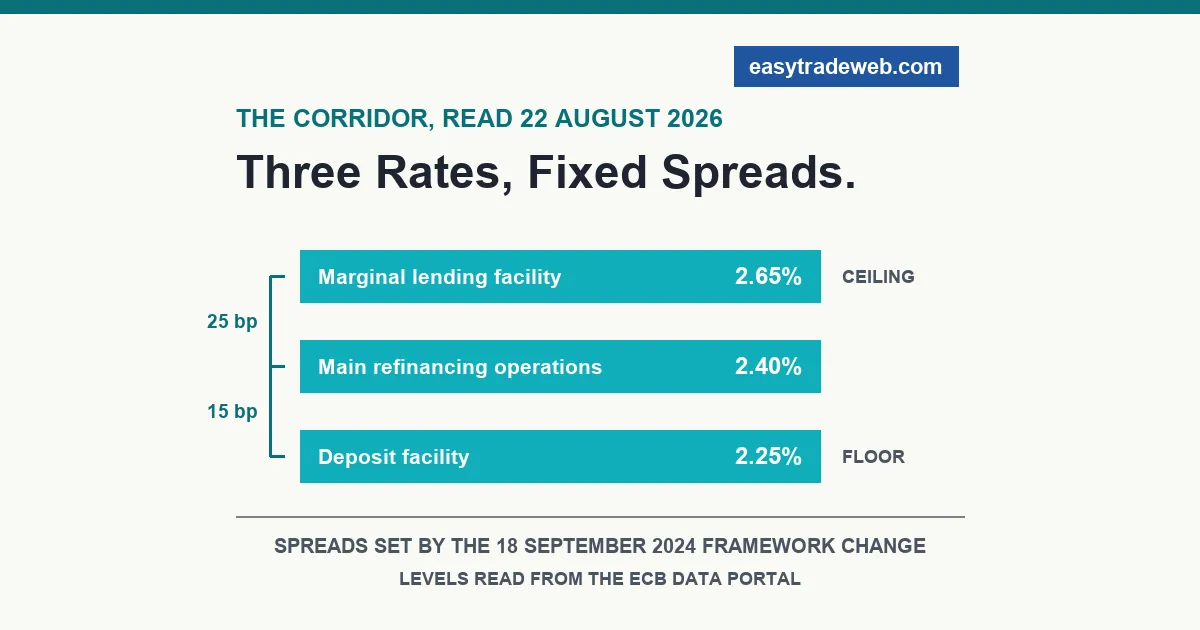
Set out that way the three describe a corridor. The marginal lending facility rate is the ceiling, because a bank with access to it has no reason to borrow overnight at more than that. The deposit facility rate is the floor, because a bank has no reason to lend at less than it can earn by leaving the money at the central bank instead. The main refinancing operations rate sits between them.
The three are not independent. On 18 September 2024 the ECB narrowed the spread between the main refinancing operations rate and the deposit facility rate to 15 basis points, and adjusted the marginal lending facility rate so that its own spread to the main refinancing rate was left unchanged. The levels above sit exactly 15 and 25 basis points apart, which is that construction still holding.
So the headline number a reader sees is one of three, and the one that steers short-term euro money market rates is the deposit facility rate. That is the anchor to watch when a decision is described as a cut or a hike, and it is the rate whose path feeds into how a central bank’s stance is read, a subject set out in how a central bank’s tone is read.
Announced on One Day, Applied From Another
A decision and the rate it sets do not share a date. The press release names the day the new levels apply, and at both 2026 changes that day came six days after the announcement: a Thursday meeting, then new rates from the following Wednesday.
| Decision announced | Change | Deposit facility rate | With effect from |
|---|---|---|---|
| 11 June 2026 | All three rates up 25 basis points | 2.00 to 2.25 percent | 17 June 2026 |
| 10 September 2026 | All three rates up 25 basis points | 2.25 to 2.50 percent | 16 September 2026 |
Dates and levels from the ECB press releases of 11 June and 10 September 2026 and the key interest rates page, checked 17 September 2026.
Before the June move the deposit facility rate had stood at 2.00 percent since 11 June 2025, so the two 2026 decisions are the only changes in that stretch.
The window between the two dates is where most confusion about the current rate starts. From 10 to 15 September 2026 the rate in force was still 2.25 percent, while 2.50 percent had already been decided. A search for the current deposit facility rate in those days had two defensible answers, and only the one carrying its effective date could be checked.
For a euro position the announcement is the event that moves the price, because it is the new information. The effective date matters for anything priced off the rate itself, such as what banks earn on overnight deposits with the central bank, and for reading any page that quotes a level without saying from when.
The Decision and the Press Conference Are Two Separate Events
A monetary policy meeting day is not one release. The decision reaches the public as a written statement timed at 14:15 CET, and the President then takes questions from 14:45 CET.
Both times are Frankfurt time, which the ECB labels CET all year. Under the EU summer-time rules clocks in Germany move forward on the last Sunday in March and back on the last Sunday in October, so from late March to late October 14:15 CET falls at 12:15 UTC, and in the winter months at 13:15 UTC. The September 2026 decision came out at 12:15 UTC. After 25 October 2026 the same 14:15 slot is 13:15 UTC.
Thirty minutes separate them, and they are not two formats of the same announcement. The first carries the decision. The second carries the reasoning, the assessment of conditions, and roughly forty-five minutes of unscripted answers to questions the central bank did not choose.
That gap is the mechanism behind a claim every one of the four guides makes and none of them supports: that the press conference moves the euro more than the decision does. Stated on its own it is folklore. Stated with the timetable attached it becomes something a reader can check, because the two releases are separately timestamped and the price reaction to each can be looked at separately.
It also explains a pattern that otherwise looks strange. A decision can land exactly where it was expected and produce very little, and then a sentence in the Q&A half an hour later can produce a great deal. Nothing inconsistent has happened: the first release contained no new information and the second one did.
For anyone tracking the release rather than the reasoning, the practical consequence is that a decision day carries two calendar entries rather than one, and a calendar showing only the first of them is incomplete.
What Is Actually in Each Release
Four documents come out of a monetary policy meeting, and knowing which is which saves reading the wrong one.
The monetary policy decision is the 14:15 press release. It states the three rates and whether each has changed. It is short, and on a meeting where nothing moves it is close to a formality.
The monetary policy statement is read at the start of the press conference. It sets out how the Governing Council reads inflation, growth and financing conditions, and it is the prepared text, so its wording is chosen deliberately and compared closely against the previous one.
The question and answer session follows the statement and is not prepared. It is transcribed and published, and it is where the President is asked about the things the statement did not settle.
Later, the account of the meeting is published, giving a fuller picture of the discussion. It arrives well after the decision has been traded, which makes it a document for understanding rather than for reacting. Asset purchases and their unwinding, when they are part of the discussion, are a separate instrument from the rates and are covered in asset purchases and their unwinding.
Why the Rate Itself Is Usually Not the News
A rate decision moves a price to the extent that it differs from what was already assumed. If a change was widely anticipated, the anticipation has already been acted on, and the announcement confirms rather than informs.
This is why the size of a move and the size of a reaction are not the same measurement. A quarter-point change that surprises nobody can pass with little effect, and no change at all can produce a large one if the accompanying language differs from what was assumed.
It also means a meeting where all three rates are left alone is not automatically a non-event. The decision release will be brief and will report no change, and the content that day sits entirely in the statement and the Q&A that follow it half an hour later.
The mechanism is about the gap between expectation and outcome rather than about the number itself. That gap cannot be read off the decision press release, because the release states only what was decided. It has to be inferred from what the market had already assumed, which is a separate exercise and one this page does not attempt to do for any specific meeting.
The same logic governs the projections a central bank publishes about its own future path, though the ECB and the Federal Reserve do not publish those in the same form. The Federal Reserve publishes its own projections differently, and the two should not be read as equivalents.
Reading a Decision Without Guessing the Next One
The published documents settle some questions completely and others not at all, and the line between the two is worth being explicit about.
They settle what the three rates are now, when the change takes effect, how the Governing Council currently describes inflation and growth, and what the President said when asked. All of that is on the record and checkable.
They do not settle what happens at the next meeting. The Governing Council states repeatedly that it decides meeting by meeting on the data available at the time, which is a statement about method rather than a hint about direction. Reading a commitment into it is reading something the document does not contain.
So the honest boundary is this: a decision can be read, and a stance can be described from the published wording. The next decision cannot be derived from either, and any page that gives you a probability for it has moved from reading policy to forecasting it. Monetary policy also sits alongside government spending and taxation as a separate lever, a distinction drawn out in monetary policy sits alongside fiscal policy.
Where the Published Figures Live and How to Check Them
The three current levels are published on the key ECB interest rates page and are available as data series from the ECB Data Portal, which also carries the date each level took effect. The decisions themselves are archived by meeting date on the monetary policy decisions pages.
Checking the effective date matters more than it sounds. Two of the four comparable guides compared for this article state the same three levels and then disagree about when they were set, one attributing them to June 2026 and the other to a decision of 23 July 2026. The ECB series shows the move to 2.25 percent with effect from 17 June 2026, so the July attribution was wrong.
The level itself has since moved again. When this page was first written on 22 August 2026 its table gave 2.25 percent as the current deposit facility rate. From 16 September 2026 that figure is out of date, which is the same failure in our own table and the reason the table above now carries the date each level applies from.
The Data Portal is the more reliable of the two routes for this, because the daily series records a value for every day and the effective date is simply the day the value changes. A page that states a level without a date cannot be checked at all, which is a different problem from stating one that has since moved.
That is the general case rather than one publisher’s slip. A level quoted on any third-party page, including this one, is a reading taken on a particular day, and the only way to know whether it still holds is to check the date attached to it against the source.
Which of These You Actually Need
If you hold euro positions across a decision, the timetable is the part that matters. Two releases, 14:15 and 14:45 CET, carrying different content, and a calendar entry that shows one of them is incomplete.
If you only want to know why a euro pair moved on a day you were not watching, the useful documents are the statement and the Q&A transcript rather than the decision release, because on most meeting days the decision is the part that was already assumed.
And if you are trying to work out what comes next, the published record will not give it to you. It supports a description of the current stance and nothing beyond that, and treating a meeting-by-meeting formulation as a signal is the most common way of reading these documents wrongly.
Risk warning: this page is educational and explains how a central bank publishes a rate decision and what each document contains. It is not advice to trade any instrument, it states no view on any future decision, and nothing here is a signal or a prediction. Leveraged exposure to currency markets carries a high risk of losing money.