
Fiscal Policy vs Monetary Policy: Which One Moves a Currency

Monetary policy is set on dates published more than a year in advance. Fiscal policy is set whenever a bill passes. That single difference decides more for a currency trader than the whole of the comparison usually published about these two.
The standard treatment sorts them by who controls them and which tools they use. Both statements are correct, and neither one answers the question a trader is actually holding, which is whether either of these can be positioned for.
What follows works through what each one controls, why the usual comparison settles nothing at the screen, the calendar asymmetry that does settle it, how long a fiscal change takes to reach a currency, why the two so often pull against each other, and what is left to watch on the fiscal side once it is clear there is no release to trade.
Key takeaways
- The Federal Reserve defines the split by authority: monetary policy is the action of central banks, fiscal policy is the tax and spending policy of a national government, and the Fed states plainly that it plays no role in setting the second one.
- The difference that decides anything at a screen is not authority but timing. The Federal Open Market Committee met eight times in 2026 on dates published ahead of the year, and a 2027 calendar is already out. No equivalent date exists for a change in taxation or spending.
- Monetary policy is observable the moment it happens, at a minute known in advance. A fiscal change has no such moment, and reaches a currency indirectly through borrowing, yields and the growth and inflation outlook.
- The Fed describes that indirectness in its own terms: the FOMC considers the current and projected paths of fiscal policy when it reviews the outlook, so even the shortest route from a fiscal change to a rate decision runs through a meeting weeks or months away.
- A trader waiting for a fiscal release to trade is waiting for something that does not exist in that form. What does exist is a set of dated fiscal-side publications, and they are listed at the end of this page.
Table of contents
- What Each One Actually Controls, in One Pass
- The Comparison Everyone Publishes, and Why It Settles Nothing for a Trader
- Monetary Policy Has a Calendar, Fiscal Policy Does Not
- How a Fiscal Change Reaches a Currency, and How Long It Takes
- The Two Can Pull in Opposite Directions, and Usually Do
- What a Currency Trader Can and Cannot Position For
- Where to Watch Fiscal Policy If There Is No Release to Trade
What Each One Actually Controls, in One Pass
The Federal Reserve answers this directly in its own published questions. Monetary policy is what central banks do, the Fed among them, in pursuit of the economy-wide goals they are set: prices that hold steady, employment at its highest sustainable level, and growth that does not lurch. Fiscal policy is the tax and spending policy of a national government.
In the United States those spending and taxation decisions are made by Congress and the Administration, and the Fed states that it plays no role in determining them.
The separation runs the other way too. Congress handed the Fed two goals, maximum employment and steady prices, and then put the day-to-day running of policy beyond the reach of politics. That second decision is why the central bank is an independent federal agency and not a department answering to the Administration.
So there are two decision-makers, two mandates, and no obligation on either to move with the other. The reader who stops here has the textbook answer, and it is the same answer everywhere.
It is also the point at which most treatments end, having explained the institutions without touching what either one does to a price. The stance a central bank takes within its mandate is a separate reading again, covered where hawkish or dovish language is unpacked.
The Comparison Everyone Publishes, and Why It Settles Nothing for a Trader
Search this comparison and the results divide the two the same way every time: by who controls them, and by which tools each one uses. Rates and asset purchases on one side, spending and taxation on the other. Central bank on one side, legislature on the other.
Nothing in that is wrong. The problem is that it is written for a student being asked to tell two institutions apart, and a trader is not being asked that. A trader is not choosing between monetary and fiscal policy, and cannot act on either by knowing which body signs it off. Both arrive regardless.
The question that does matter is narrower: of these two, which can be positioned for, and on what notice. Answering it needs two columns the standard comparison leaves out entirely, namely when the decision becomes public and whether its size can be read on the day it lands. Add those, and the table stops being a civics lesson.
| Dimension | Monetary policy | Fiscal policy |
|---|---|---|
| Who decides | The central bank, independently | The legislature and the administration |
| Decision dates known ahead | Yes, published more than a year out | No scheduled decision date exists |
| How it becomes public | A statement released at a known minute | Legislation, passed when it passes |
| Route to the currency | Direct, through the rate path | Indirect, through borrowing and the outlook |
| Positionable as an event | Yes | No |
Those last two rows carry the whole of the practical difference, and the rest of this page is about them. The balance sheet side of the monetary column has its own mechanics, set out under asset purchases and their unwind.
Monetary Policy Has a Calendar, Fiscal Policy Does Not
The Federal Open Market Committee meets eight times a year. In 2026 those meetings fell on 27 and 28 January, 17 and 18 March, 28 and 29 April, 16 and 17 June, 28 and 29 July, 15 and 16 September, 27 and 28 October, and 8 and 9 December. Four of the eight, in March, June, September and December, carry a Summary of Economic Projections alongside the decision.
The dating does not stop at the decision. Minutes of each meeting are published on a stated lag of about three weeks: the January meeting produced minutes on 18 February, and the July meeting produced minutes on 19 August. A calendar for 2027 is already published. The entire monetary sequence, decision then projections then minutes, is therefore knowable before the year begins.
Now look for the equivalent on the fiscal side, and there is nothing to find. Taxation and spending are changed by legislation. The Constitution gives Congress the power to set a federal budget covering the coming fiscal year, which begins in October, and that budget is then approved by the President. But the date a bill clears is not fixed in advance, and a mid-year change to spending or taxation arrives on whatever day it arrives.
This is the point most comparisons never reach, and it is the one that changes what a reader can do. An economic calendar can list a rate decision to the minute because the minute was set months earlier. It cannot list a fiscal decision, because no such entry exists to list. What a calendar carries on the fiscal side is data about past spending and borrowing, not notice of a change to come.
How a Fiscal Change Reaches a Currency, and How Long It Takes
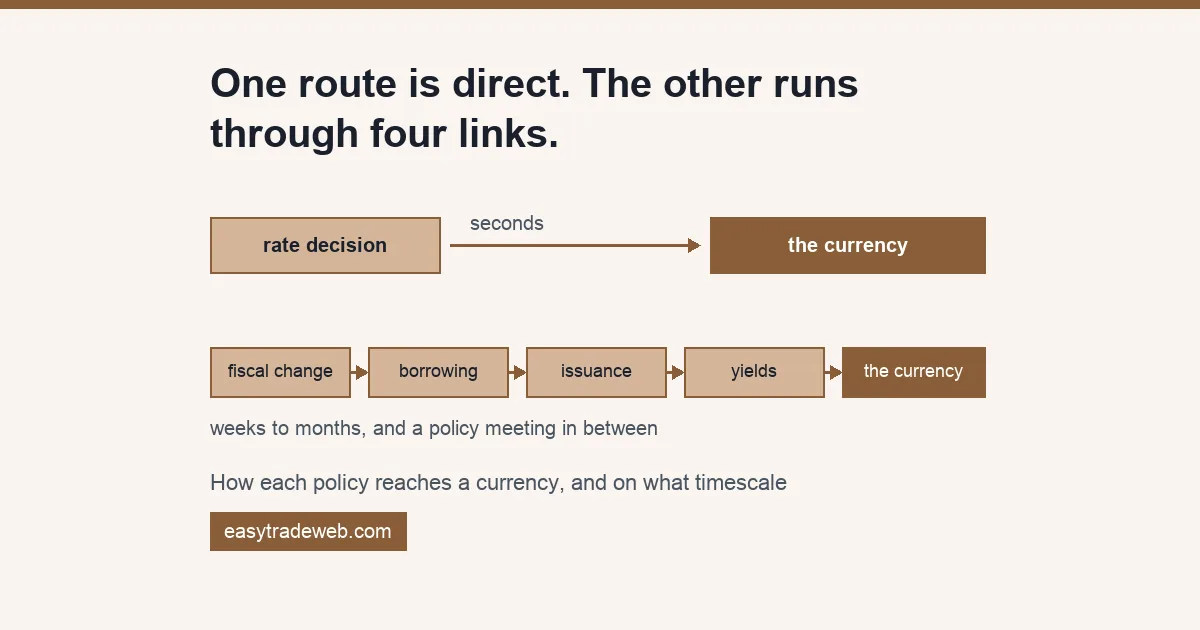
A rate decision reaches a currency by the shortest route available. The policy rate changes, or the expected path of it changes, and the pair reprices against the other side of it within seconds.
A fiscal change has no such route. It moves through a chain, and every link in that chain takes time.
A change in taxation or spending alters the amount the government needs to borrow. The borrowing requirement alters the volume and maturity of debt issued. Issuance affects yields, and yields are one of the inputs the currency responds to. Running alongside that, the same change alters expectations for growth and inflation, and those expectations feed the rate path.
The Fed describes the second half of that chain in its own words. The FOMC, when reviewing the economic outlook, considers how the current and projected paths of fiscal policy might affect growth, employment and inflation. Fiscal policy therefore acts on monetary policy indirectly, by acting first on the economy the committee is assessing.
Read that as a timing statement and it is stark: the fastest route from a fiscal change to a monetary response runs through a meeting that has not happened yet, and there are only eight of those in a year.
Yields are the visible middle of the chain, which is why the shape of the curve is worth reading in its own right, and what an inversion in it does and does not say about a currency is treated separately under what the yield curve is saying.
The Two Can Pull in Opposite Directions, and Usually Do
Given two decision-makers with different mandates and no requirement to coordinate, opposing settings are the ordinary case rather than the exception.
The mechanism is straightforward. A government raising spending or cutting taxes adds to demand. A central bank holding a price stability mandate responds to added demand that threatens its inflation objective by keeping policy tighter than it otherwise would. The two settings are then working against each other, and neither body is obliged to give way, because independence is the specific thing Congress legislated for.
For a currency this produces two signals on two different clocks. The monetary one arrives dated and immediate. The fiscal one arrives undated and slow. When they conflict, the dated and immediate signal is the one that reprices the pair on the day, and the slow one shows up in the level around which those repricings happen.
Election timing is a common place to look for the fiscal signal, and the evidence for reading a currency off a political calendar is weaker than it appears. That claim, and what it was actually measured on, is examined under the presidential cycle, which is where the election half of this question belongs.
What a Currency Trader Can and Cannot Position For
Set out plainly, the two sides come out as follows.
A monetary decision can be positioned for. The date is known, the release minute is known, a published expectation exists for the decision to be measured against, and the reaction is immediate enough to be observed. Everything an event needs to be tradable as an event is present.
A fiscal change cannot be positioned for in the same way, and the reason is not that it matters less. It is that there is no moment to position around. There is no scheduled announcement, no consensus figure published against a fixed release time, and no single number to be surprised by. By the time the effect is visible in a currency it has already been absorbed over weeks through yields and expectations.
That distinction is worth stating because the error it causes is common and specific. A reader who has learned that fiscal policy moves currencies goes looking for the fiscal equivalent of a rate decision, finds a scheduling gap where they expected an entry, and either concludes the calendar is incomplete or treats an unrelated data release as the event.
Neither is right. Data releases such as the GDP report measure what has already happened in the economy, which is a different thing from notice of a policy change to come.
Where to Watch Fiscal Policy If There Is No Release to Trade
The fiscal side does publish on a schedule. What it publishes is the consequence of policy rather than notice of it, which is exactly why it is followed rather than traded.
The Treasury holds a refunding round once a quarter, timed around each quarter’s midpoint, and it is through that round that shifts in how the government manages its debt are both settled and announced. That is the closest thing the fiscal side has to a dated event, and it speaks to issuance, the link in the chain sitting nearest to yields.
Separately, the Monthly Treasury Statement carries federal spending and receipts on a monthly cycle for a fiscal year that begins in October. And the FOMC itself publishes, in its minutes and projections, how it is currently reading the fiscal path, which converts a slow undated input into something that appears on a dated document eight times a year.
Which of these matters to a given reader depends on the holding period rather than on preference. An intraday or multi-day position lives entirely inside the monetary calendar, and the fiscal side is context that changes too slowly to act on within that window.
A position measured in weeks or months sits in the part of the chain where issuance and the outlook are doing the work, and there the quarterly and monthly fiscal publications are the ones worth the time. A reader who cannot say which of those two describes their own positions has not yet reached the question this page answers.
Risk warning: this page is educational and explains how two kinds of economic policy are decided, published and transmitted to a currency. It is not advice to buy, sell or hold any instrument, and no understanding of policy produces a profit. Positions taken around a policy decision can lose money whatever the analysis behind them, and leveraged exposure to that outcome carries a high risk of loss.