
Forex Broker Regulation: What Each Licence Actually Changes

A broker brand is regulated the way a passport is issued: not to the name on the sign, but to a specific company standing behind it. That company holds the licence, and the licence decides how much of the market you are allowed to reach.
Most explanations of broker regulation stop at whether your money is safe. That is one obligation among several, and it is not the one that changes your trading day. The licence on your account agreement sets the smallest deposit you may open a position with, whether you can hold two opposing trades at once, and whether a bonus you were offered is lawful for the firm to give you.
What follows is what a licence obliges, what it permits, and where two of the largest regimes are written in language that does not match the numbers everyone quotes for them.
Key takeaways
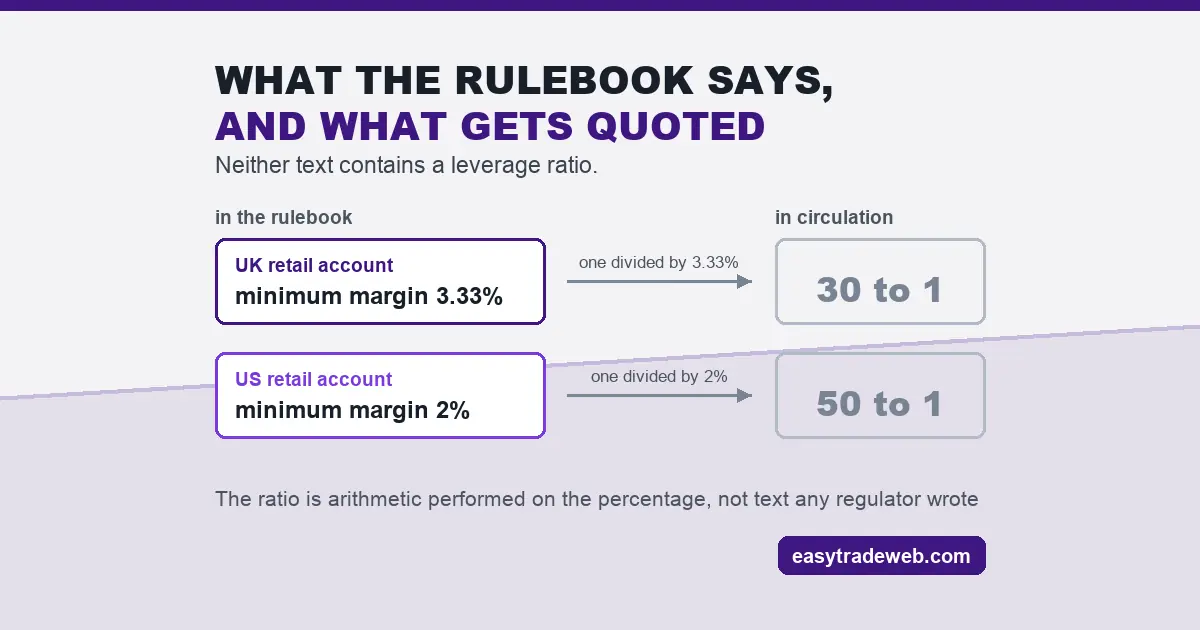
- Neither the UK nor the US rulebook states a leverage ratio. Both set a minimum share of the position that the client has to post as margin, and the familiar ratios are arithmetic performed on those percentages by other people.
- FCA Handbook COBS 22.5 requires at least 3.33% margin on a major currency pair and 5% on a minor one, and requires that margin to be posted as money rather than as any other asset.
- NFA Compliance Rule 2-43 forbids a forex dealer member from holding opposing positions in one customer account and requires the oldest to be closed first. COBS 22.5 carries no comparable rule.
- COBS 22.5 also forbids the firm from offering a retail client a bonus or a fee rebate, while stating that lower fees offered to every retail client are a different thing and remain allowed.
- A group can hold several licences at once. The terms that bind you belong to the entity named on your agreement, not to the brand shared across all of them.
Table of contents
- A Licence Belongs to an Entity, Not to a Brand
- What a Regulator Checks Before It Grants One
- The Leverage Ceiling Is Set by the Licence, Not the Broker
- Hedging, FIFO and Bonuses Are Permissions, Not Features
- Once You Know the Entity, What the Register Tells You
- Which Figures This Page Does Not State, and Why
- Who This Page Is Not For
- Questions Readers Ask About Broker Regulation
A Licence Belongs to an Entity, Not to a Brand
Comparison pages describe regulation as a property of the broker, as though a firm were regulated the way it is red or blue. It is closer to a driving licence held by one named person: the permission attaches to a legal company, and a group can own several of them.
That matters because the entities are not interchangeable. Two clients of the same brand, looking at the same website and the same platform, can be trading under different margin floors and different rules on how many positions they may hold, because the company each of them signed with is licensed somewhere else. One jurisdiction that publishes its margin floors as a schedule rather than leaving them to the firm is MAS regulation in Singapore.
The practical consequence runs the opposite way to how the choice is usually made. A trader picks a brand on spreads and platform, then discovers the trading terms after the account is open, when they are set by a document read before the account existed. The account agreement names the licensed company; the homepage names the group.
Two other pages here already do the work that follows from this. Which company holds your account, and how to confirm it on a public register rather than on the broker page, is covered in the guide to escalating a complaint, where the same question decides which body will hear you. What the licence obliges the firm to do with your deposit is covered in what actually protects client money.
This page takes the step neither of them takes: what the licence changes about the trading itself.
What a Regulator Checks Before It Grants One
An authorisation is a decision about a firm, taken before any client exists. The supervisor examines who owns and controls the company, whether the people running it are fit for the role, whether it holds capital against the business it intends to write, how it will hold client money separately from its own, and how it will handle complaints.
Being on a public list is a weaker fact than being authorised, and the two are often reported as one. A company can appear in a corporate registry because it was incorporated there, with no supervisor testing any of the above. The difference between an entry in a registry and a licence carrying conduct obligations is set out in detail under what an offshore licence obliges.
The reason the distinction earns space here is that the conduct rulebook, not the authorisation itself, is where your trading terms live. Authorisation makes the firm answerable to a supervisor. The rulebook that supervisor writes is what turns that answerability into a margin floor, a close-out level and a list of what the firm may and may not offer you.
The Leverage Ceiling Is Set by the Licence, Not the Broker
Here is where the reading of the actual rulebooks pays. Neither of the two regimes below expresses its limit as a leverage ratio. Both write a minimum percentage the client has to post to open a position, and the ratios in wide circulation are the reciprocal of those percentages, calculated by commentators rather than legislated by anyone.
The UK conduct rules for these instruments sit in COBS 22.5 of the FCA Handbook. They require at least 3.33% margin where the underlying is a major currency pair or relevant sovereign debt, 5% for a major stock market index, a minor currency pair or gold, 10% for a minor index or a commodity other than gold, and 20% for a share or anything not otherwise listed.
The margin must be posted as money. Where the client net equity falls under half the margin requirement, the firm has to close the open positions as soon as market conditions allow, and client liability across the account is capped at the funds in it.
The US position, as the CFTC states it to customers, is that leverage above 2% for major currency pairs or 5% for other pairs is beyond what is legally allowed there, and that a customer may be liable for losses past the initial deposit. How a firm applies its own limits above those floors, and why the tier you see is not the tier advertised, is covered under tiered leverage.
| What the rule constrains | UK retail account, FCA COBS 22.5 | US retail account, CFTC and NFA |
|---|---|---|
| Minimum margin, major currency pair | 3.33% | 2% |
| Minimum margin, other pairs | 5% for a minor pair | 5% |
| Form the margin has to take | Money | Not stated in the documents read for this page |
| Forced close-out level | Net equity under half the margin requirement | Not stated in the documents read for this page |
| Liability past the account balance | Capped at the funds in the account | Customers warned they may owe more than they deposited |
| Two opposing positions in one account | No such provision in COBS 22.5 | Not permitted; oldest closed first |
| Bonus or fee rebate to a retail client | Prohibited | Not stated in the documents read for this page |
Hedging, FIFO and Bonuses Are Permissions, Not Features
Brokers present these three as things they have decided to give you. In at least one regime each of them is a matter of law, and the firm has no discretion at all.
Take opposing positions first. NFA Compliance Rule 2-43 tells a forex dealer member that opposing trades cannot sit open together in one customer account, and that positions have to be closed in the order they were opened.
There is a narrow allowance: a customer may ask for a trade of a given size to be closed against the oldest trade of that same size, even where an older trade of a different size exists. The rule took effect in May 2009 and has been amended four times since, most recently in September 2022.
Nothing equivalent appears in COBS 22.5, which is why the same brand can permit the practice on one account and refuse it on another.
Bonuses run the same way, and the UK text is more precise than the summaries of it. A firm may not offer a retail client an incentive, in money or otherwise, when it markets or sells these instruments. The guidance attached to that rule counts an account-opening bonus and a fee rebate, including a rebate tied to volume, as incentives in money.
It also says two things most explanations leave out: a lower fee offered to every retail client is not an incentive, and research or information tools are not one either. So a cashback scheme and a cheaper commission for everyone are treated differently, though both reduce what you pay.
Client classification changes which of these apply, because most of them protect retail clients specifically. That permission, and what it costs to take it, is set out under elective professional client status.
Once You Know the Entity, What the Register Tells You
Confirming which company holds your account is a separate task, and the complaint guide linked above walks through it. This section starts one step later, with the register entry open in front of you.
Read three things on it. The status, because an entry can be current, lapsed or restricted, and a lapsed permission is not a licence. The activities permitted, because a firm may be authorised to arrange deals without being authorised to deal as principal against you. And the client types it may serve, because permission to deal with professional clients is not permission to onboard retail ones.
An entry that names a different company from the one on your agreement is the finding that matters most, and it is common enough to be worth the two minutes. It means the terms you assumed were yours belong to somebody else.
Which Figures This Page Does Not State, and Why
No leverage ratio appears above as though a rulebook contained one. The margin percentages quoted are the text; 30 to 1 and 50 to 1 are what those percentages become when someone divides, and presenting them as legislated numbers hides the fact that the constraint is written as an obligation on the firm.
Australian limits are also absent. The pages carrying the current product intervention order did not respond when this page was researched, and a figure that cannot be checked at its source does not go on the page, whatever the aggregators state.
Who This Page Is Not For
If your question is whether a specific broker is trustworthy, this page will not answer it. A licence is a floor, not a verdict, and licensed firms have failed clients.
If you are looking for a way around a limit that applies to you, that is not here either. The routes that change your limits are changes of client status or of licensed entity, and both narrow the protections that came with the account.
Questions Readers Ask About Broker Regulation
Which regulator licenses a forex broker in the United States?
Two bodies act together. The CFTC is the federal regulator for retail foreign exchange, and the NFA is the self-regulatory organisation whose compliance rules bind the dealer members. A firm dealing retail forex with US residents has to be registered and a member, and the NFA operates the public database where both facts can be checked.
Is it against the law to trade with an unregulated broker?
The obligation sits on the firm rather than on the client. What changes for you is not legality but recourse: where the company holds no licence in the place it serves you from, there is usually no supervisor to complain to and no compensation scheme behind it. The question worth asking is not whether you may, but who would hear you if something went wrong.
Does a licence limit how much leverage a broker can offer?
Yes, though not in those words. The UK rulebook requires a minimum margin of 3.33% of the position on a major currency pair for a retail client, and the CFTC tells customers that anything under 2% for major pairs is beyond what the US allows. Both are floors under the margin rather than caps on a ratio, and a firm may always require more than the floor.
How can a trader confirm which entity holds the account?
The legal company name and licence number appear on the client agreement and on the funding instructions, not on the marketing pages. Take both to the public register of the named regulator and confirm them there. Where the register shows a different company, or shows the permission as lapsed or restricted, that is the answer to several other questions at once.
Does a regulator recover money lost on a trade?
No. A supervisor tests conduct against a rulebook and disciplines firms that breach it. A position that moved against you is not a breach, and no regime treats a loss as something to be returned. Compensation schemes, where they exist, address a firm that has failed rather than a trade that has.
Which of the three sections above applies to you depends on one fact you can establish today. If you do not yet know which company holds your account, that is the first task, and everything else waits on it. If you know the entity but have never read its rulebook, start with the margin floor and the close-out level, because those two decide how much room a position has before the firm acts without asking.
And if you are weighing two brands, compare the entities they would actually onboard you to rather than the brands, since that is the comparison the terms are attached to.
Risk warning: this page is educational and describes what regulatory rulebooks require of firms. It is not advice to open an account anywhere, and a licence is not a guarantee against loss. Regulatory limits change, they differ by client classification and by licensed entity, and leveraged exposure to currency markets carries a high risk of losing money.