
MAS Regulation in Singapore: What It Covers for Traders

Singapore appears on the regulatory line of a great many broker websites, and the claim is usually followed by a leverage number. Those numbers do not agree with each other. Four widely read pages about trading in Singapore state three different retail limits between them, and not one of the four names the instrument the figure comes from.
The instrument exists, it is published, and it says something more specific than any of those pages report. This page sets out what the Monetary Authority of Singapore actually licenses a firm to do, where the margin figures are written down, and which layer of the rules the circulating numbers are really about.
Key takeaways
- Leveraged foreign exchange trading and dealing in contracts for differences are separate regulated activities under the Securities and Futures Act, and they do not share a margin instrument. Most pages treat them as one thing.
- Table 18 of the Fourth Schedule to the Financial and Margin Requirements Regulations sets a minimum margin of 2 per cent for foreign exchange contracts for differences, carrying the amendment marker S 507/2006 with effect from 28 August 2006.
- Regulation 24A(2) makes that table only one of two sources: margins follow it, and they also follow any further requirement the regulator issues in a written notice. That second source is the layer the circulating figures are really about, and no page found during research mentions it.
- The Regulations also set firm-level floors a client never sees: an adjusted net capital floor of 2 million dollars or the calculated adjusted net capital requirement, whichever is higher, and an aggregate indebtedness ceiling of 1,200 per cent of aggregate resources.
- A licence belongs to a specific company, and the protections attach to the company you actually contract with rather than to the brand printed on the platform.
Table of contents
- The One Licence That Permits Leveraged FX in Singapore
- Three Retail Leverage Figures Are in Circulation and They Disagree
- Retail or Accredited Investor: Which Set of Rules Reaches You
- What a CMS Licence Does Not Automatically Include
- If You Are Not Resident in Singapore, What Reaches You Instead
- What This Page Leaves to Our Broker Regulation Page
- Who This Page Is Not For
- Frequently Asked Questions
The One Licence That Permits Leveraged FX in Singapore
The Monetary Authority of Singapore is both the central bank and the financial regulator, and the permission a trading firm needs from it is a Capital Markets Services licence. That licence is not a single undifferentiated permit. It is granted for named regulated activities, and a firm holds it for the activities it applied for and no others.
This matters because leveraged foreign exchange trading is one such activity and dealing in capital markets products is another. A firm can hold a Capital Markets Services licence in Singapore and have no permission at all to offer you leveraged currency trading. The phrase “MAS regulated” on a website does not distinguish between those cases, and it is not meant to.
The wording of the activity is worth reading closely rather than summarising. Leveraged foreign exchange trading is defined as its own regulated activity in the Act, separate from dealing in capital markets products.
A contract for differences on a currency pair is not the same instrument as a leveraged spot foreign exchange contract, even though a platform may present both on the same screen. The margin rules described later in this page attach to the contracts for differences case.
The check is therefore not whether a firm appears in a register. It is which activity the entry lists. The Monetary Authority of Singapore publishes a Financial Institutions Directory that gives, for each licensed firm, the regulated activities it is authorised to carry out. Reading the activity line is the whole exercise, and it takes about a minute.
The general mechanics of how a licence attaches to a company rather than a brand, and what a register entry can and cannot tell you, are set out in the page on how a broker licence works. What follows here is the part that is specific to Singapore.
Three Retail Leverage Figures Are in Circulation and They Disagree
Research for this page read four pages about trading in Singapore. One states 20 to 1 as the typical retail limit under MAS rules. One states a retail cap of 1 to 20 alongside 1 to 50 for accredited investors. One states a minimum margin of 5 per cent introduced in October 2019. Search results returned a fourth account putting major pairs at 50 to 1. None of the four cites a regulation, a notice or a schedule.
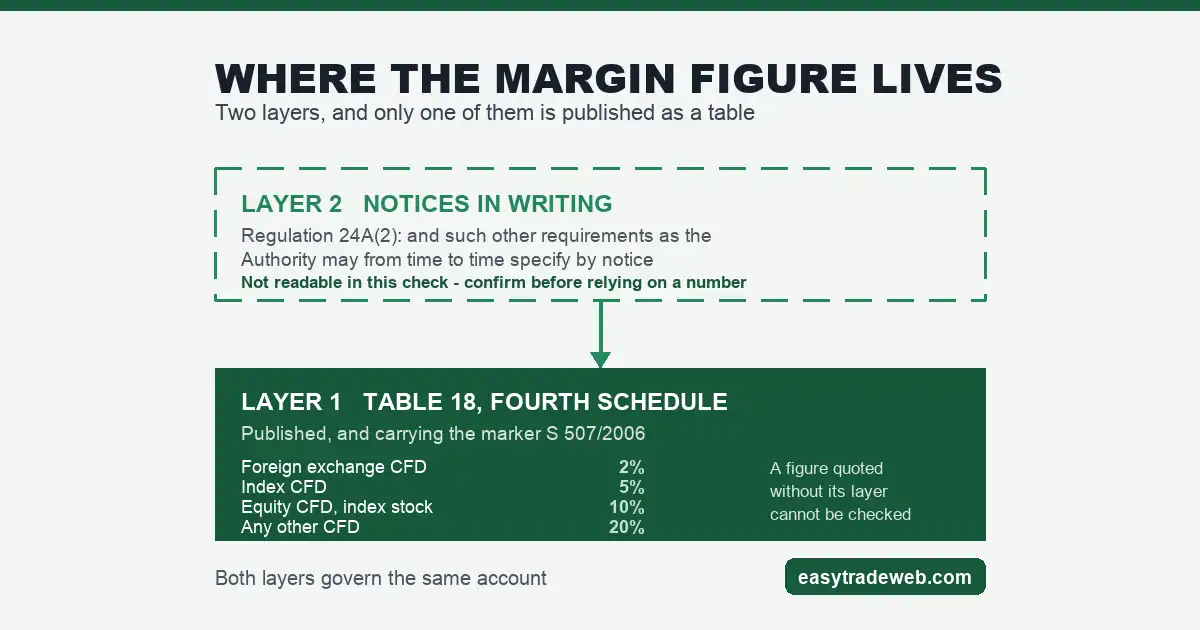
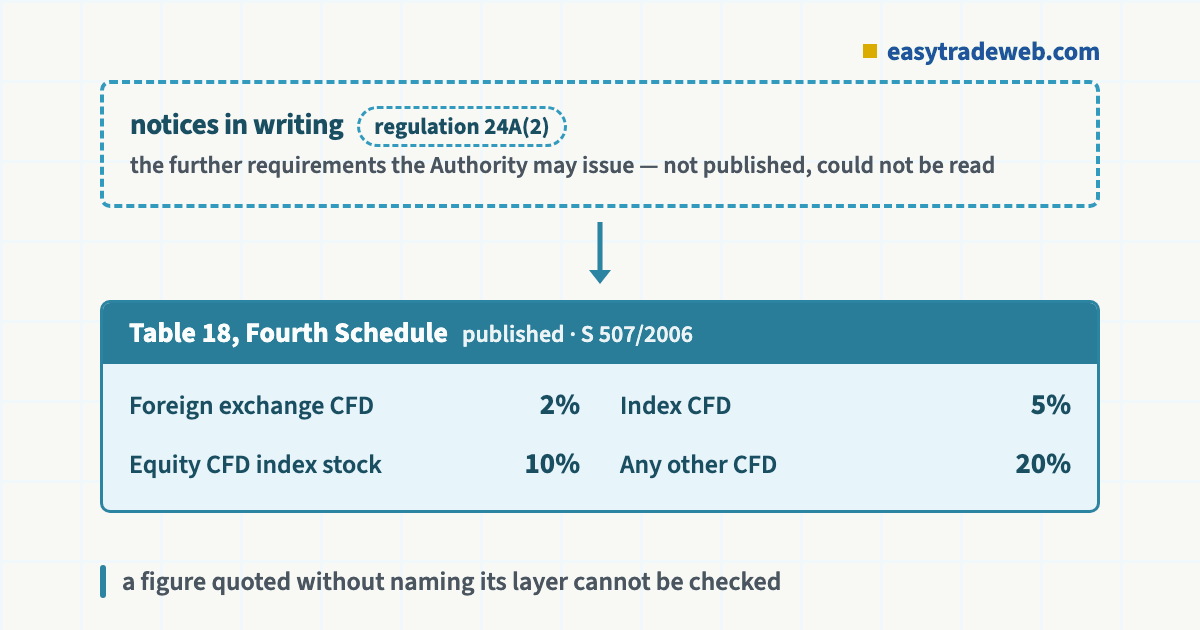
The published instrument is the Regulations on financial and margin requirements made under the Securities and Futures Act; the sources note at the end of this page gives its full name. Regulation 24A governs margin for contracts for differences, and it sends the reader to Table 18 of the Fourth Schedule for the figures. Table 18 reads as follows.
| Contract for differences | Minimum margin in Table 18 | Leverage that implies |
|---|---|---|
| Foreign exchange | 2 per cent | 50 to 1 |
| Index | 5 per cent | 20 to 1 |
| Equity, index stocks | 10 per cent | 10 to 1 |
| Equity, non-index stocks | 20 per cent | 5 to 1 |
| Any other | 20 per cent | 5 to 1 |
The right-hand column is arithmetic rather than regulation: a 2 per cent minimum margin permits a position fifty times the margin posted. The table itself carries the amendment marker S 507/2006 with effect from 28 August 2006, so the figures in it are long-standing rather than recent.
Two rows of Table 18 are not flat percentages at all. A contract for differences carrying a stop-loss is margined instead on what the table calls the amount at risk. The table defines that term itself, as the worst outcome the position can produce, measured from where the contract was struck to where the stop sits.
Where the stop is guaranteed the margin is the lesser of that amount at risk and the standard margin, with an additional 10 per cent where the contract is adjusted for dividend, interest or commission.
That is a structural point rather than a detail. The margin on a position can depend on how the position is protected and not only on what it is in, and a single headline leverage figure cannot express that.
Regulation 24A(2) is the sentence that reconciles the disagreement, because it makes the table one source of two. Margins follow Table 18, and they also follow anything further the regulator chooses to impose in a written notice. So there are two layers, and a figure quoted without saying which layer it came from cannot be checked by anyone.
Retail or Accredited Investor: Which Set of Rules Reaches You
Singapore does not apply one rulebook to every client of a licensed firm. The Securities and Futures Act distinguishes between retail clients and accredited investors, and a firm dealing with an accredited investor is relieved of a number of conduct requirements that apply when it deals with everybody else.
The consequence is that a leverage figure, a disclosure obligation or a documentation requirement can be entirely accurate for one client of a firm and wrong for the client sitting beside them. The four pages read for this page report a single number as though client classification did not exist, or mention the accredited category once without saying what changes.
What changes is the level of protection, and the direction is worth being clear about. Accredited investor status is a reduction in the protections a firm owes you, granted on the basis that you have the means to absorb losses. It is offered as a benefit because it usually comes with higher leverage and a wider product range attached.
Before accepting a classification, the question to ask a firm is which specific obligations it will stop owing you, in writing. Client money handling is the one that repays the most attention, and the general mechanics of it are covered in the page on client fund protection.
What a CMS Licence Does Not Automatically Include
A Capital Markets Services licence is an authorisation to carry on named activities, and everything outside those names sits outside the licence. That produces several gaps that a reader assuming a single blanket permission would not expect.
The first is the activity split already described. Leveraged foreign exchange trading, dealing in capital markets products and fund management are different entries, and a firm licensed for one is not thereby licensed for another.
The second is that the Regulations discussed above are mostly about the firm rather than about you. Regulation 11(1) reaches a licence holder in the leveraged foreign exchange business that does not belong to a futures exchange, and it puts a floor under the adjusted net capital of that firm: 2 million dollars, or its own calculated requirement where that comes out higher.
Regulation 16(1) caps aggregate indebtedness at 1,200 per cent of aggregate resources.
One provision in the same Regulations does reach the client directly. Regulation 24A(3) covers what happens once the collateral in a margin account drops under the requirement: the firm has to call for the shortfall straight away, and the client is given two business days to post it.
That is a floor on the firm conduct, not a grace period a trader can plan around, and a position can still be closed under the terms of the client agreement well inside it.
Those two floors are real protections and no page found during research mentions either. They are also indirect: they reduce the chance of a firm failing, which is a different thing from a promise about what happens to your money if one does. The distinction between a solvency rule and a client money rule is the one worth holding on to here.
If You Are Not Resident in Singapore, What Reaches You Instead
Most readers of an English page about MAS regulation are not in Singapore. This is the point at which the rules above may stop applying to them entirely, and it is the question the four pages read for this page do not address.
A licence granted by the Monetary Authority of Singapore authorises a specific company. Large brokerage brands operate several companies across several jurisdictions, and the one that accepts a client in a given country is decided by that group rather than by the client. A trader who opens an account through a global website may be onboarded to a company licensed somewhere else, under rules that are not the ones described here.
The practical test is the contract. The client agreement names the company you are dealing with, and that name, matched against the register of the regulator that licensed it, is what determines the rules covering your account. A Singapore entry in a website footer proves nothing about which entity holds your money.
Where the contracting entity turns out to be licensed in a jurisdiction with lighter obligations, the differences are set out in the page on offshore licence obligations.
What This Page Leaves to Our Broker Regulation Page
This page deliberately covers Singapore and stops there. How a licence attaches to a legal entity rather than a brand, what a regulator examines before granting one, how permissions such as hedging or order handling are recorded, and how to read a register entry in general are all covered in how a broker licence works, and repeating them here would help nobody.
The same relationship holds across the other jurisdiction pages on this site. The Saudi equivalent, including which authority licenses what, is set out in the page on SAMA licensing in Saudi Arabia, and the structure of the question is identical even though the answers are not.
Who This Page Is Not For
This page will not tell you which broker to open an account with, and it names none. It does not rank firms, and no figure here is a recommendation.
It is also not a current statement of every retail margin requirement in force. Table 18 is one layer and the notices the Authority may issue under regulation 24A(2) are the other.
The second layer could not be read during the preparation of this page: both the notices listing on the MAS website and the Singapore Statutes Online copy of the subsidiary legislation returned pages that render their contents through scripts rather than in the delivered HTML.
Anyone relying on a specific margin number for a live account should confirm it against the current notice, and against the firm they are contracting with.
Frequently Asked Questions
What does the Monetary Authority of Singapore do?
It is both the central bank of Singapore and the integrated regulator of the financial sector, so it conducts monetary policy and it licenses and supervises financial institutions. For trading firms, the relevant function is the granting of the Capital Markets Services licence that the Securities and Futures Act provides for, and the supervision of the firms holding one.
Is a CMS licence the same as permission to offer leveraged forex?
No. A Capital Markets Services licence is granted for named regulated activities, and leveraged foreign exchange trading is one activity among several. A firm may hold the licence for a different activity entirely, so the activity line in the register entry is what answers the question rather than the presence of the firm in the register.
What leverage can a retail client use with a MAS licensed broker?
Table 18 of the Fourth Schedule to the Financial and Margin Requirements Regulations sets a minimum margin of 2 per cent for foreign exchange contracts for differences, which permits a position fifty times the margin posted. Regulation 24A(2) also lets the Authority set other requirements by notice, and that notice layer could not be read while this page was prepared.
Who counts as an Accredited Investor in Singapore?
The category is defined in the Securities and Futures Act and rests on financial thresholds rather than on trading experience. The point that matters more than the definition is the direction of the change: accepting the classification reduces the conduct protections a licensed firm owes you, which is why it usually arrives packaged with higher leverage and a wider product range.
Does MAS protection reach a client outside Singapore?
Only where the company you actually contract with is the licensed Singapore entity. Brokerage groups operate several companies in several jurisdictions and decide which one accepts a client from a given country, so a client outside Singapore is frequently onboarded elsewhere. The client agreement names the contracting company, and that name determines which rules apply.
Risk warning: this page is educational and explains how one regulator licenses trading firms and where its margin figures are published. It is not advice to buy or sell any instrument, it makes no recommendation about any broker or platform, and nothing here is a signal or a prediction. Leveraged trading carries a high risk of losing money.