
Forex vs Crypto: What Actually Differs for a CFD Trader

Almost every comparison of these two markets sets the foreign exchange market against the cryptocurrency market. A retail trader holding a contract for difference is not buying either one.
What that trader holds is a contract on a price feed, opened in one account, under the terms of one regulated firm. The asset named in the contract changes what the price does. The entity behind the account changes what the contract is allowed to do, and that turns out to be the larger of the two effects.
This page separates the two. It sets out what genuinely differs between a forex CFD and a crypto CFD once both sit in the same account, which of those differences is imposed by a regulator rather than by the market, and how the cost of each behaves as a position is held for longer.
Key takeaways
- For a CFD trader the comparison is between two contracts in one account, not between two markets. Most of the published comparisons answer a question the reader is not in a position to act on.
- Under the leverage limits set by the European Securities and Markets Authority, a retail client receives 30:1 on a major currency pair and 2:1 on a cryptocurrency. The same person, the same account, a factor of fifteen.
- Under the rules of the Financial Conduct Authority, a firm operating in the United Kingdom may not sell a crypto derivative to any retail consumer, and has not been able to since 6 January 2021. On a UK retail account the crypto half of this comparison does not exist.
- Financing runs in one direction on a crypto CFD and in either direction on a forex pair, so the two costs separate as the holding period lengthens rather than at the moment of entry.
- Four comparison pages read for this article state their headline volume and volatility figures with no source. Two of them also state or imply that forex trades continuously through the weekend, which it does not.
Table of contents
- What the Comparison Actually Is: Two CFDs, One Account
- Market Structure: Who Sets the Price on Each Side
- Leverage and Protection Are Set by the Entity, Not by the Asset
- Hours: Continuous Against Sessions, and the Gap That Disappears
- Financing: Swap Against Daily Funding, Priced Over a Holding Period
- Volatility Is Not One Number
- Which of the Two You Can Actually Hold
- Frequently Asked Questions
What the Comparison Actually Is: Two CFDs, One Account
Open a crypto position at a forex broker and no coin moves. No wallet is created, no key is issued, and nothing settles on a network. The account holds a contract whose value tracks a quoted price, which is the same instrument type the account already holds for EUR/USD. How a CFD is priced and financed works identically on both sides.
That single fact removes much of what the comparison pages spend their length on. Custody, private keys, exchange failure, network fees and settlement finality belong to owning the asset. None applies to a contract, and a reader choosing between two symbols in one platform meets none of them.
What remains after that subtraction is short. The price behaves differently, the leverage cap is different, the financing is charged on a different basis and the trading calendar is different. Everything else the two share, because the wrapper is the same wrapper.
Market Structure: Who Sets the Price on Each Side
A forex quote reaches a retail account through a chain. Banks and non-bank market makers publish two-sided prices, a liquidity provider aggregates them, and the broker applies its own treatment before the number reaches the platform. The market is decentralised, and no single venue publishes a price everyone else must accept.
A cryptocurrency price is formed differently. Trading happens on named venues that each run their own order book, and those books can disagree with one another at the same moment. A crypto CFD quote is built from a selection of those venues, which means the broker is choosing which books to reference and how to combine them.
The consequence sits in the spread. On a major currency pair it is narrow because many participants quote the same instrument continuously and compete to do so. On a crypto contract it reflects a smaller and more fragmented set of sources, and widens more readily when those sources thin out.
Leverage and Protection Are Set by the Entity, Not by the Asset
This is the point the comparison pages skip, and it changes the answer more than any property of either market.
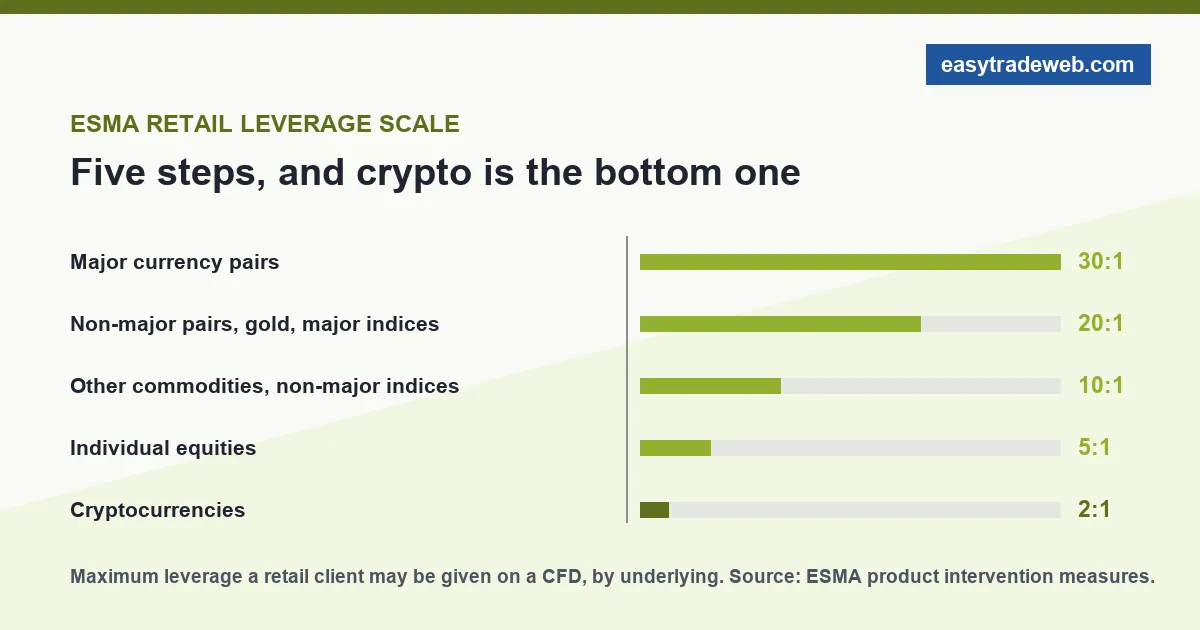
The European Securities and Markets Authority graded retail CFD leverage by how volatile the underlying is, and published a five-step scale. Major currency pairs take the top step at 30:1. Gold, the non-major pairs and the major indices take 20:1. Non-major equity indices and the remaining commodities take 10:1. Single shares take 5:1. Cryptocurrencies take the bottom step at 2:1.
Two protections travel with those caps, and both are measured across the account rather than position by position. A client cannot be left owing more than the account holds, and open positions are closed once margin falls through the level the rules set.
So a retail client under those measures does not face a choice between a high-leverage market and a low-leverage one. That client faces one account in which the same deposit controls fifteen times more notional exposure on a major pair than on a crypto contract, before any judgement about which market is riskier has been made. Leverage tiers by position size then apply on top of the regulatory cap, and the lower of the two governs.
The United Kingdom went further and closed the product outright. Under the final rules of the Financial Conduct Authority, a firm operating in the United Kingdom or serving clients out of it may not sell, market or distribute to any retail consumer a derivative written on an unregulated transferable cryptoasset.
Contracts for difference are named, as are options, futures and exchange traded notes on the same tokens. The prohibition has been in force since 6 January 2021.
A reader holding a UK retail account is therefore not choosing between forex and crypto. One side of the comparison is closed. The identical brand may offer crypto contracts through a different entity in a different jurisdiction, which is why the entity name on the account statement decides the question and the brand name does not.
| Retail account under | Major currency pair | Cryptocurrency contract | Negative balance protection |
|---|---|---|---|
| ESMA product intervention measures | 30:1 | 2:1 | Required, per account |
| FCA rules for retail consumers | Available as a CFD | Not permitted since 6 January 2021 | Not applicable to a banned product |
| Any other entity | Not disclosed here | Not disclosed here | Not disclosed here |
The final row is deliberate. Limits outside the two regimes above vary by regulator and by firm, and no figure belongs on this page unless the regulator or the firm publishes it. The document to read is the terms of the specific entity named on the account, not a comparison table.
Hours: Continuous Against Sessions, and the Gap That Disappears
Four comparison pages were read while preparing this article. One states that forex trades continuously through the week and the weekend. Another states the market runs six days in its opening paragraph and five days later in the same page, without reconciling the two. Neither cites anything.
The structure is not in doubt. Forex CFD trading runs continuously through the trading week and then stops, and the market is closed across the weekend. Crypto contracts may be quoted when the currency market is shut, subject to the hours the individual broker chooses to publish for them. Our page on how the crypto session actually runs covers those hours and the maintenance windows brokers apply to them.
What continuous quoting removes is the weekend gap in forex, where a position closes at one price on Friday and reopens at a different one. A crypto position held over a weekend has no gap because there is no closure, and the move that a forex trader meets as a jump is instead lived through tick by tick.
That is a change in shape rather than a reduction in exposure. The same distance can be travelled either way, and a stop that would have been jumped over on a Monday open is instead reached on a Saturday afternoon while nobody is watching. Continuous quoting also removes the weekly close, the point at which many traders review open risk, and nothing supplies it automatically once it is gone.
Financing: Swap Against Daily Funding, Priced Over a Holding Period
Both contracts charge for time, and the two charges do not work the same way.
A forex swap comes from the gap between what the two currencies in a pair earn, so it carries a sign. Be long the better paying one and the adjustment can credit the account; be long the worse paying one and it debits. Which way it falls depends on the pair, on the direction and on the rates in force, and it moves when those rates move.
Financing on a crypto contract has no equivalent differential to draw on, because the instrument is not a pair of interest bearing currencies. What the broker charges is a financing rate on the notional value of the position, and it runs in one direction. There is no configuration in which holding the contract longer reduces the cost.
That difference is invisible on the day of entry and decides the comparison over weeks. An intraday position on either instrument pays the spread and little else, so the choice at that horizon turns on spread and volatility. A position carried for a month meets a cost on the crypto contract that accumulates without interruption, while the forex position meets a cost that may accumulate, may be neutral, or may pay.
So price the intended holding period before the entry, using the rates the broker publishes for the specific symbol. Those rates also feed the margin arithmetic, since financing reduces equity and equity is what the margin call and stop out levels are measured against.
| Holding period | Forex CFD | Crypto CFD |
|---|---|---|
| Closed same day | Spread and commission only | Spread and commission only |
| Held overnight | Swap applied, sign depends on pair and direction | Financing applied as a charge |
| Held for weeks | Cumulative swap can be a credit or a cost | Cumulative charge, one direction only |
Volatility Is Not One Number
The comparison pages handle this part with round figures and no attribution. One states that daily moves of a given percentage are normal for cryptocurrencies. Another describes the currency market as one of small fluctuations. Neither figure is sourced, and a percentage stated without an instrument and a period does not describe anything a trader can size a position against.
Volatility belongs to a specific symbol over a specific window, and it moves. A major pair through a central bank decision and a large cryptocurrency through a quiet week can invert the ordering those pages assume is fixed.
The usable form is narrower. Measure the recent range of the symbol you intend to trade, take the stop distance that range implies, and let position size fall out of it. That calculation is the same on both instruments, which is why position sizing over a long horizon matters more than the label on the market.
The regulator has already expressed a view, and expressed it as a number rather than an adjective. Setting crypto contracts at 2:1 against 30:1 for a major pair is a statement about relative volatility, and it is the one figure on the subject that comes from an official source.
Which of the Two You Can Actually Hold
Three checks answer this faster than any list of market properties.
Start with the entity named on your account, not the brand. If it is a UK entity serving you as a retail consumer, crypto derivatives are not available and the question is settled. If it operates under the ESMA measures, both instruments are available at leverage caps that differ by a factor of fifteen, and the deposit required for a given exposure differs accordingly.
Then take your intended holding period. Inside a day, the two instruments are separated by spread and by how far the symbol moves, and financing barely registers. Beyond a few days, the crypto charge accumulates in one direction while the forex swap may run either way, and that gap widens for as long as the position stays open.
Finally, ask what supplies your review point. A forex position is closed out of by the weekly close whether you attend to it or not. A crypto position is not, and the discipline that the calendar imposes for free on one instrument has to be scheduled deliberately on the other.
Frequently Asked Questions
Is forex or crypto better for a beginner?
There is no general answer, and a page giving one is describing a preference rather than a fact. What can be stated is that the two are not equally available. A retail consumer under UK rules cannot open a crypto derivative at all, and a retail client under the European measures receives 2:1 on a crypto contract against 30:1 on a major currency pair.
Which market moves more, forex or crypto?
Volatility belongs to an individual symbol over a defined period rather than to a market as a whole, so the ordering reverses depending on which pair, which token and which week is measured. The nearest thing to an official ranking is the leverage scale set by the European Securities and Markets Authority, which places cryptocurrencies at the most restrictive step and major pairs at the least restrictive one.
Can one broker account trade both forex and crypto?
Frequently, yes, and that is the situation most comparisons overlook. Both arrive as contracts for difference in the same platform, under the same terms and the same margin arithmetic. Whether both appear depends on the regulated entity holding the account rather than on the brand.
How does leverage differ between forex and crypto CFDs?
Under the ESMA product intervention measures a retail client receives 30:1 on major currency pairs and 2:1 on cryptocurrencies, with intermediate steps for non-major pairs, gold, indices, other commodities and equities. Broker schedules that cut leverage as position size grows apply on top of the cap, and the lower ratio governs.
Does crypto trade at the weekend when forex is closed?
Crypto contracts can be quoted when the currency market is shut, subject to the hours each broker publishes. A crypto position therefore has no weekend gap, because there is no closure to gap across. The move still happens; it is lived through rather than met as a jump on Monday, and the weekly close that prompts many traders to review risk is absent.
Risk notice. This page is educational. It compares the contractual and regulatory treatment of two instrument groups and does not assess either as an investment. Nothing here is a recommendation to buy or sell any instrument, no price move is forecast, and no result is stated or implied. Leveraged trading carries a high risk of loss, and the rules that apply to you are those of the entity holding your account.