
GDP Deflator: The Inflation Number That Excludes Imports

Three inflation numbers reach a currency screen from the same economy, and they do not measure the same thing. One of them, the GDP deflator, prices only what the country itself produced. Everything bought from abroad is outside it by construction. A second of the three is core PCE, and the third is the consumer price index.
That single boundary decides when the deflator is the right series to read and when it is the wrong one. What follows is what the Bureau of Economic Analysis publishes under that name, how the number is built, and which question it answers that a consumer price measure cannot.
Key takeaways
- The Bureau of Economic Analysis states that the GDP deflator tracks price change across what the United States itself produces, output sold abroad included, and that import prices are excluded.
- The same agency states that the implicit price deflator and the GDP price index are calculated differently, so the two names are not interchangeable.
- There is no basket to look up. The agency builds its chain-type price indexes on a Fisher formula whose weights come from each pair of neighbouring periods, so they are recalculated every quarter and no fixed set exists.
- It is quarterly and revised. The agency published a second estimate of plus 6.4 percent for the second quarter of 2026 and plus 3.6 percent for the first, and dated the next release 30 September 2026.
- The World Bank publishes the same concept across countries with a base year that varies by country, so two national deflator series are not directly comparable.
Table of contents
- Which Inflation Number Answers Which Currency Question
- What the Deflator Covers, and What It Leaves Out
- The Deflator and the GDP Price Index Are Not One Series
- Why There Is No Fixed Basket to Look Up
- Where the Ratio Comes From, and What It Cannot Tell You
- Quarterly, Revised, and Late: Not a Release to Trade
- Comparing Countries: The Base Year Is Not the Same
- Which Series to Read for Your Question
Which Inflation Number Answers Which Currency Question
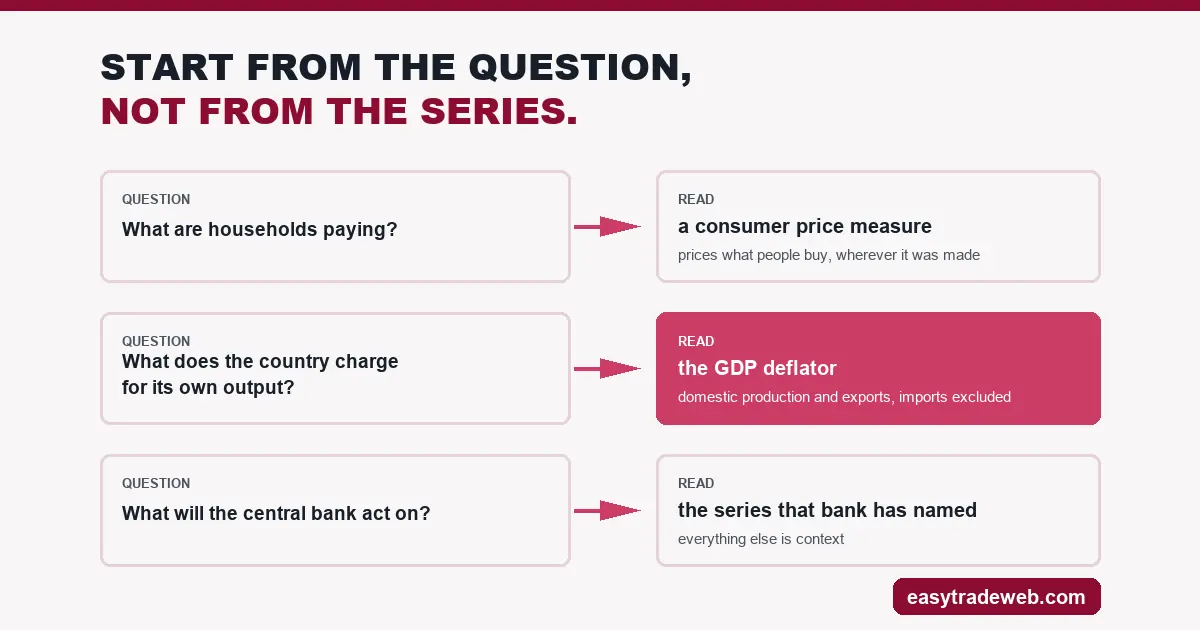
Start from the question rather than from the series. A trader watching an economy usually wants one of three different things, and each one points at a different measure.
The first question is what households are paying. That is a consumer price question, and the consumer price index report is where it is answered, because a consumer measure prices the things people actually buy regardless of where those things were made.
The second question is what the country itself charges for its own output. That is the deflator question. It covers domestic production, exports included, and it stops at the border in the other direction.
The third question is what a central bank is likely to respond to, and that is answered by whichever series that particular bank has named in its own mandate, not by whichever series moved most.
Confusing the first two is the common error, and it has a predictable consequence. When prices move because something imported got more expensive, the consumer measure carries the shock and the deflator does not have to. When prices move because domestic firms raised what they charge, both carry it. So the gap between the two is itself information about where the pressure came from.
What the Deflator Covers, and What It Leaves Out
The Bureau of Economic Analysis defines the series plainly on its own product page. The gross domestic product implicit price deflator measures price change across what the United States produces, and that coverage reaches output sold to buyers abroad. Import prices are excluded.
Read the exclusion as a scope rule rather than as an oversight. Gross domestic product counts what an economy produces. A barrel of crude bought from another country is not part of that production, so its price has no place in a price index built on top of it.
For a currency reader the practical effect is a filter. An energy or commodity shock that arrives through imports raises the cost of living without necessarily raising the price of anything the country makes, and the deflator is the series that will show that separation. A domestic wage-driven price rise, by contrast, is inside the boundary and shows up here.
The agency also notes that some firms use the deflator to adjust contract payments, which is a reminder that this series has users outside the trading screen and is not designed around release-day volatility.
| What the series does | As published by the Bureau of Economic Analysis |
|---|---|
| Output the United States itself produces | Covered |
| Output sold to buyers abroad | Covered |
| Prices of imports | Excluded |
| Fixed basket of items | None; chain weights move every quarter |
| Publication frequency | Quarterly, as percent change from the preceding quarter |
| Most recent published changes | Second quarter 2026 second estimate plus 6.4 percent; first quarter 2026 plus 3.6 percent |
| Next scheduled release | 30 September 2026 |
The Deflator and the GDP Price Index Are Not One Series
Most explanations of this topic treat the implicit price deflator and the GDP price index as two names for one number. The agency that publishes both says otherwise on the same page that defines the deflator: the two track each other closely, and they are calculated differently.
The distinction matters in a narrow but real way. Two series that move together most of the time will still disagree at the margin, and the margin is where a surprise lives. Quoting a figure from one while naming the other is the kind of error that survives unnoticed until the two diverge.
The safe habit is to name the series and the vintage together. A deflator figure without an estimate label is incomplete, because the same quarter is published more than once.
Why There Is No Fixed Basket to Look Up
A reader who has used a consumer price index expects a basket: a list of items with weights attached, published somewhere, updated occasionally. That expectation does not transfer here, and the reason is structural rather than administrative.
The agency describes its chain-type price and quantity indexes as resting on a Fisher formula whose weights come from each pair of neighbouring periods. Because the weighting is chained that way, they are recalculated every quarter and no fixed set is attached to the derivation at all.
Two consequences follow for anyone reading the number. The first is that asking which items are in the index has no stable answer, so the question to ask instead is what the mix of output was in the two periods being compared. The second is that the composition of the index shifts as the economy shifts, which is a feature when spending patterns change quickly and a complication when you want a like-for-like comparison across a long span.
This is also why the deflator can diverge from a consumer measure without either being wrong. They are not weighted the same way, they do not cover the same set of goods, and neither was built to reproduce the other.
Where the Ratio Comes From, and What It Cannot Tell You
The arithmetic behind the deflator is a ratio of two versions of the same output: what that output is worth at the prices actually charged, against what the same output is worth at the prices of a reference period. Whatever is left over after quantities have been accounted for is price, and that residue is the index.
Because it falls out of the accounts rather than being surveyed directly, the deflator inherits everything the accounts inherit. If output is revised, the price measure moves with it.
What the ratio cannot do is tell you which of its two inputs moved. A change here says the price component of national output shifted; it does not say whether the headline growth figure traders reacted to was a volume story or a price story.
That second question belongs to the release itself. It is handled on our page about the GDP release, which covers what the headline rate is measured in and which of the two versions it reports.
Quarterly, Revised, and Late: Not a Release to Trade
Three properties disqualify this series as a release-day instrument, and each one is visible on the publication page itself.
It is quarterly. Where a consumer measure gives twelve readings a year, this gives four, so it cannot describe a turn that happens inside a quarter.
It arrives in estimates rather than in a single print. The agency labelled its second-quarter 2026 figure a second estimate at plus 6.4 percent, against plus 3.6 percent for the first quarter, and published that on 26 August 2026 with the next release dated 30 September 2026. A number that carries an estimate label is a number that is expected to move.
And it is late relative to the events it describes. By the time a quarter is deflated, the monthly releases covering the same weeks have already been traded, which is why this series is better used to check an interpretation than to form one. If you want to know when each of the faster releases lands, that is what an economic calendar is for.
Comparing Countries: The Base Year Is Not the Same
The deflator exists outside the United States, and cross-country comparison is where it is most often misused. The World Bank publishes the series for a wide set of economies under the title GDP deflator with base year varying by country, and that qualification is the whole warning.
An index is a comparison against a reference period. If one country indexes to one year and its neighbour to another, the two index levels are answering different questions and putting them side by side produces a difference that is an artefact of the reference period rather than of prices.
The compiled series also draws on national statistical offices, central banks and international national-accounts files rather than on one agency applying one method, so methodology varies alongside the base year. Rates of change are the comparable quantity; levels are not. Comparing the price levels themselves across borders is a separate measure with separate limits, set out in our page on purchasing power parity.
The same caution applies to survey-based indicators read across borders, and the PMI surveys are the clearest example of two publishers producing the same-sounding number by different rules.
Which Series to Read for Your Question
If the question is what households are paying, read a consumer price measure. If it is what the domestic economy charges for its own output, and whether a price move came from inside the border or arrived from outside it, read the deflator and expect a quarterly, revisable answer. If the question is what a central bank will act on, read the series that bank has named, and treat everything else as context.
Risk warning: this page is educational and explains how one national accounts price measure is built, published and revised. It is not advice to buy or sell any instrument, it recommends no product, platform or broker, and nothing here is a signal, a performance claim or a prediction. Leveraged trading carries a high risk of losing money rapidly.