
How To Trade Cryptocurrencies

Trading cryptocurrency can feel like something reserved for the financial elite, but with the spread of online currency exchange and trading platforms, anyone can take part in market speculation. You just need to know how to trade.
Learn what matters before you start trading and before you try to profit from digital currencies. As adoption keeps rising, market trading volume grows with it, which in turn helps these currencies keep expanding.
Trading Cryptocurrency
Currency trading means exchanging a currency you hold for another type of currency, then exchanging it back when the price moves, hopefully at a profit. This is known as trading the forex market.
What Is Forex Trading?
Foreign exchange (forex) trading is, at its simplest, the buying and selling of currencies between traders. It involves exchanging a currency you own for another, then swapping it back later. Forex trading happens through a broker, usually using online trading platforms or desktop and mobile apps.
How Do You Make a Profit?
As an example, say that on October 2, 2018 you had $1,000 and exchanged it for euros (EUR) with another trader in the market at a rate of 0.9565 euros, giving you 956.50 euros. Then, on October 24, 2018, the value of the US dollar fell from 0.9565 euros to 0.8380 euros, so you decided to exchange your euros back into US dollars. After finding someone willing to sell US dollars for your euros, you make the exchange at the new rate: your 956.50 EUR is now worth $1,141.40, giving you a profit of a little over 14%.
Trading Cryptocurrency
Cryptocurrency trading works in exactly the same way, but instead of buying and selling fiat currencies like the euro or the US dollar, traders buy and sell digital assets such as Bitcoin, Ethereum, Ripple, and so on.
Just like forex trading, cryptocurrency trading works by exchanging one currency for another, and you usually swap fiat currency for a digital currency.
For example, let’s look at the Bitcoin-to-US-dollar chart for 2017:
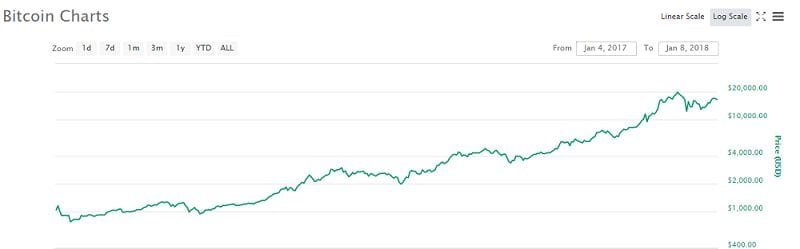
Here we can see that at the start of 2017, the value of Bitcoin against the dollar rose from under $1,000 on January 4, 2017 to more than $19,000 by the end of 2017.
Buying and Selling Cryptocurrency
There are two trading strategies available to traders interested in the cryptocurrency market.
Buying:
Long-term trading: buying cryptocurrency over an extended period, holding a digital currency for weeks, months, or even years.
Studying price trends over a long period lets long-term traders make informed decisions and avoid the pain of short-term dips.
If you believe a coin’s value will rise steadily over a long stretch of time and you don’t want the stress of short-term drops in value, this approach may be your best option.
Selling:
Taking advantage of short-term price swings: this involves buying and selling cryptocurrency over a few hours to a few days.
If you prefer to profit from the sharp swings that are typical of cryptocurrencies by entering and exiting a trade quickly, this approach may suit you.
Advantages of Trading Cryptocurrency
Cryptocurrency trading comes with a set of its own advantages.
Low Fees and Fast Exchange
For every trade, the exchange system you use takes a small percentage as a commission for the service it provides. This is unavoidable, and trades differ in the size of these fees. Because cryptocurrency transfer fees (usually through wallet payments) are cheaper than credit-card and bank-transfer fees, cryptocurrency trading fees are cheaper than foreign-exchange trading fees. Moving coins off the platform adds a second charge on top, and what a network fee is made of is decided by the blockchain rather than by the exchange.
High Volatility
Traders make profits when a currency’s price takes big steps upward, and cryptocurrencies often experience large price moves. While this increases risk, large price moves can turn a relatively small stake into a large gain, or into an equally large loss.
Leverage
With a small amount of money you can start trading cryptocurrencies, keeping in mind the risk that comes from using leverage.
Never invest more money than you are willing to lose, and you should treat any money you put into a trade as a loss. If you are not comfortable with that idea, you are trading with more money than you should. Finding the point at which you are comfortable with this concept is essential to help you trade without stress.
We recommend setting “take-profit” and “stop-loss” orders. These limits are offered by many professional trading platforms and will help you avoid losing more money than you are comfortable with if the trade fails.
Getting Started with Cryptocurrency Trading
Now that you know how trading in the market works, you have decided what kind of trader you want to be, you know what to look for, and you have studied the theory, you are ready to start trading cryptocurrencies. Let’s look at what you will need to get started.
Step 1. Find a broker
A broker that provides an online platform for trading cryptocurrencies is essential.
The following approved trading brokers are most often recommended for new and experienced traders alike:
- Tickmill
- Pepperstone
- XM
- IC Markets
- FXTM
All of these brokers are trusted and offer the most popular cryptocurrency trading.
Step 2. The trading platform
Cryptocurrency brokers usually offer their own trading platform, and each broker’s system will be a little different from the others. In time, you will need to learn how the platform works, where each feature is, and how to use it.
You can see the most widely used platforms here.
When you first log into a broker’s trading platform, you may feel confused. That is normal. Spending some time with it and continuing your research, you will get comfortable with it in no time.
Step 3. Is this the right time?
Don’t buy currencies when the price is at its all-time high. Cryptocurrency markets move up and down, and big moves often follow a sudden spike.
Step 4. Getting in
The best way to learn how to trade is to actually trade. There is no secret. Once you have learned, you will need to buy some cryptocurrency, set your stop, and get started.
What Affects the Price of a Cryptocurrency?
Cryptocurrencies are volatile by nature; they are not as stable as currencies with a long history. Bitcoin is the oldest cryptocurrency on the market, and it has only existed since 2009. Even so, there are a number of things that can affect cryptocurrency transactions:
Regulation: If a government issues a statement or calls for a particular regulation affecting cryptocurrency operations, you can bet the price will react to it (sometimes positively, and often negatively). When China banned ICOs, the price of Ethereum fell 41% over 15 days, from $386.83 to $228.06.
Media influence: Just like government regulation, media exposure heavily affects a cryptocurrency’s price. When a public figure makes a statement about cryptocurrency transactions, or a major retailer starts accepting a cryptocurrency as a payment method, you will see the market respond.
Changes to the technology: When the underlying technology of a cryptocurrency is affected (either by an update or by the discovery of a flaw), the price of the linked currency is affected too.
You Need to Be Careful
If you are not careful when it comes to trading a cryptocurrency, you may find yourself gambling more than trading, and in the end you could lose all your money. Trading is not a game; just as there is real money to be made, there is real money to be lost. Doing your research and keeping the following ideas in mind while trading can help you avoid the risks of cryptocurrency trading.
A Word on Risk Before Trading Cryptocurrency
Market trading is a risky endeavor, and cryptocurrencies are highly volatile; they rise and fall without warning. This means that the past performance of an asset is not an indication of its future, and profitability is never guaranteed. As always, you should never trade with capital you are not prepared to risk.
Risk disclaimer. This article is for educational purposes only and is not investment, financial, or trading advice. Cryptocurrencies and CFDs are highly volatile, and trading with leverage can quickly amplify both gains and losses; you may lose some or all of your capital. Past performance does not indicate future results, and profitability is never guaranteed.
Do your own research and consider consulting a licensed financial advisor before trading. Some links on this page are affiliate links: if you open an account through them we may earn a commission at no extra cost to you. This never affects which brokers we mention.