
CHIPS, CHAPS and Fedwire: Where a Currency Payment Lands

A wire payment leaves one bank and arrives at another, and somewhere between the two it passes through a system that decides how the money is actually moved. Three of those systems carry most of the wholesale dollar and sterling traffic: CHIPS, the Fedwire Funds Service and CHAPS.
They are not interchangeable. One offsets payments against each other before anything settles, two settle each payment on its own, and all three stop accepting customer payments at a published time of day that is rarely mentioned. This page sets out what each does, what the difference changes for a payment that has to arrive today, and where the money lands at the far end.
Key takeaways
- CHIPS is run by The Clearing House and clears more than 2 trillion dollars and 630,000 transactions on an average business day, across 43 direct participant banks.
- The Fedwire Funds Service is a real-time gross settlement system run by the Federal Reserve Banks, in which a transfer is immediate, final and irrevocable once processed.
- CHAPS settles across the Bank of England real-time gross settlement infrastructure, which the Bank reports settles over 800 billion pounds on an average working day.
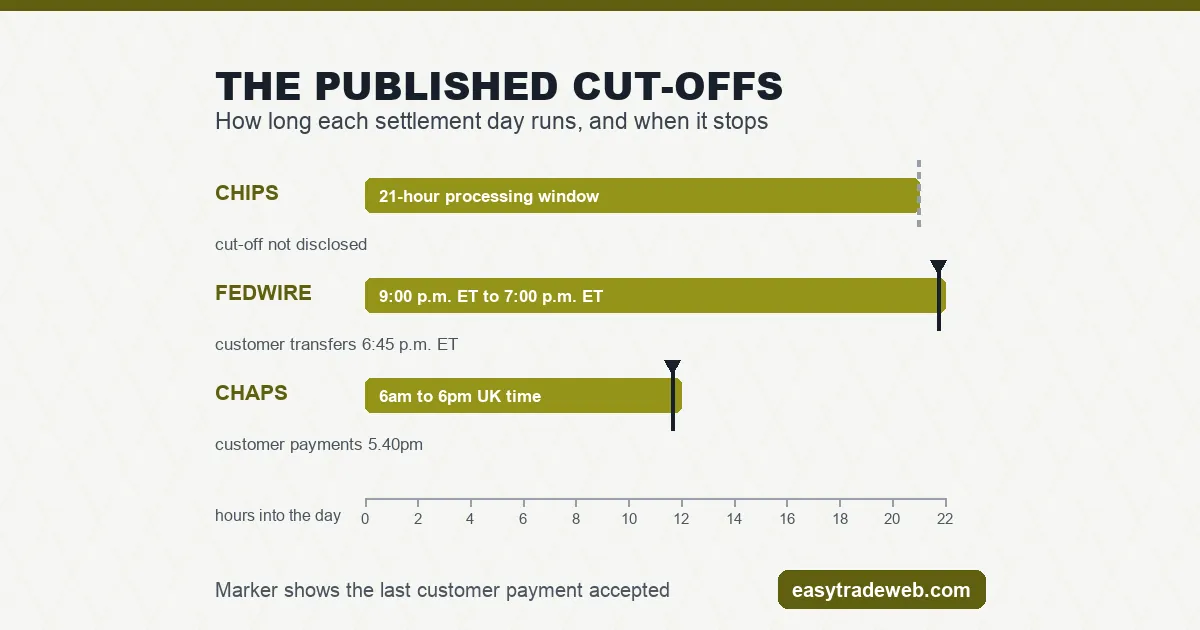
- The published cut-offs differ by hours: Fedwire stops taking customer transfers at 6:45 p.m. ET and CHAPS at 5.40pm UK time, while The Clearing House states a 21-hour CHIPS window without publishing clock times.
- None of these systems touches a retail trading deposit. They move money between banks, and a broker deposit travels a different route.
Table of contents
- What a Payment System Is, and What It Is Not
- Net Settlement Against Gross Settlement
- CHIPS: Netting Dollars in New York
- Fedwire: The Gross Alternative in the Same Currency
- CHAPS: The Sterling Equivalent
- How This Connects to the Account a Bank Holds Abroad
- Why None of This Reaches a Retail Trading Account
- Frequently Asked Questions
What a Payment System Is, and What It Is Not
A payment system is the shared plumbing a set of banks agrees to use for moving value between themselves. It is not a market, it sets no price, and it has no opinion about why a payment is made.
That distinction matters because the word system gets attached to several things at once. A messaging network carries the instruction, a payment system moves the balance, and a settlement account at a central bank or clearing house is where the balance sits. Swift is the messaging layer for most cross-border instructions and moves no money.
So the question a payment system answers is narrow: given an instruction that bank A owes bank B a sum today, how and when does bank B end up with it. The exchange rate and the reason for the payment belong to the market banks quote to each other in rather than to the plumbing underneath it.
Net Settlement Against Gross Settlement
Two designs exist, and the choice is a trade between how much cash a bank must hold ready and how soon a payment is beyond recall.
Gross settlement moves each payment on its own. Bank A sends 40 million, the full 40 million leaves its settlement account, and the receiving bank has it. Nothing waits for anything else, so the sending bank needs the whole amount available at the moment it sends.
Netting works the other way. Obligations running in both directions are offset first, and only the difference has to be funded. If two banks owe each other 40 million and 38 million on the same day, 2 million settles rather than 78 million. The saving in funding is large, and the cost is that the offsetting has to happen before anything is final.
The textbook version stops there, and it is now too clean. The systems described below run liquidity saving inside them, so a netting system can settle continuously through the day rather than once at the close, and a gross system can offset queued payments where it is able to. The label gives the default behaviour, not the whole of it.
For a trader the consequence is timing rather than mechanism. A payment that has to be final before a deadline behaves differently from one that merely has to be funded by the close, the same distinction that governs when a currency trade actually settles.
CHIPS: Netting Dollars in New York
CHIPS is the Clearing House Interbank Payments System. The Clearing House runs it as a private-sector network for clearing and settling high-value dollar payments, domestic and cross-border, for institutions with heavy wire activity, and a large share of correspondent banking dollar traffic lands there.
The Clearing House publishes the scale directly. More than 2 trillion dollars in average daily value is cleared and settled, more than 630,000 transactions are processed each business day, and 43 direct participant banks take part. Ninety-five per cent of payments settle with finality in seconds, subject to value, funding and the liquidity controls each participant configures.
The efficiency figure is the one worth carrying away. For 2025 The Clearing House reports a liquidity efficiency ratio of roughly 26 to 1, so a dollar of funding supports about 26 dollars of settled value. That is what offsetting buys, and it is why a bank with heavy two-way dollar flow routes through CHIPS rather than funding every payment in full.
On timing, the operator states a 21-hour processing window and publishes no opening and closing clock times on its public CHIPS pages. Those times are recorded here as not disclosed rather than filled in from a secondary description.
Fedwire: The Gross Alternative in the Same Currency
The Fedwire Funds Service is provided by the Federal Reserve Banks and settles in real time on a gross basis. The Federal Reserve describes a transfer through it as immediate, final and irrevocable once processed, which is the property a payment needs when finality matters more than funding cost.
Its day is long and does not line up with a calendar day. Each funds-transfer business day starts the evening before at 9:00 p.m. ET and runs through to 7:00 p.m. ET, so a Monday business day begins on Sunday evening.
The cut-offs inside that day are staggered by message type rather than applied once. Tax payments and special account payments stop at 5:00 p.m. ET. Customer transfers, the category most cross-border payments for a client fall into, stop at 6:45 p.m. ET. Bank transfers and other messages run to the 7:00 p.m. ET close.
That staggering is the operational point. A payment submitted at 6:50 p.m. ET is late for one message type and still inside the window for another, and which category it falls into is decided by who the payment is for. Exchange-traded contracts avoid the question, because currency futures against the spot market settle through a clearing house rather than through either of these systems.
CHAPS: The Sterling Equivalent
CHAPS is the United Kingdom high-value sterling system, and the Bank of England both operates it and supervises it. Payments settle across the Bank real-time gross settlement infrastructure, which the Bank reports settles over 800 billion pounds on an average working day and which more than 70 organisations now use for direct settlement in at least one system.
The daily timetable is published and specific. CHAPS settlement starts at 6am. Settlement for customer payments, carried in the pacs.008 message, ends at 5.40pm, and for financial institution payments, carried in pacs.009, at 6pm. A contingency extension can run to 8pm, but that is an exception rather than a second deadline.
Two dates sit behind the current shape of the system. CHAPS moved to ISO 20022 messaging in June 2023, and the Bank completed a multi-year renewal of the settlement engine in April 2025. The Bank has also enhanced the liquidity saving mechanism inside this gross system, the same softening of the net-against-gross line described above.
The timetable carries one detail a currency trader will recognise. Continuous Linked Settlement pay-in and pay-out deadlines fall hourly between 7am and 11am, so the sterling leg of a currency settlement has to be in place early in the CHAPS morning rather than by the customer cut-off.
How This Connects to the Account a Bank Holds Abroad
A payment system moves balances only between accounts held inside it. That is the constraint everything else follows from, and it is why a bank that wants to pay dollars keeps a dollar account with a bank that has direct access.
The sequence is short. A bank outside the United States instructs its correspondent to pay. The correspondent holds the account and has access, so it sends the payment through CHIPS or Fedwire. The receiving bank is credited and the instructing bank balance falls. The system moved money between two American banks; the account abroad is what let a foreign bank be one end of it.
What that account is, why it carries two names depending on which side is speaking, and how the exposure between the two legs of a currency settlement is handled are covered separately in the page on the account a bank holds abroad. This page stops at the rail; that one continues at the account.
Why None of This Reaches a Retail Trading Account
A deposit into a trading account does not enter any of these systems. Cards, domestic transfers and e-wallets run on retail rails with their own operators, and the sums involved sit far below the level at which a high-value system is used at all.
What does touch them is money moving between the banks a broker uses, above the level of any individual client and never as a payment identified with one. Whose money that is, and under which rules it is held, is answered in the page on where a client deposit is actually held.
| System | Operator | How it settles | When the day runs | Latest customer payment |
|---|---|---|---|---|
| CHIPS | The Clearing House | Offsetting with continuous intraday settlement | 21-hour processing window | Not disclosed |
| Fedwire Funds Service | Federal Reserve Banks | Real-time gross, final once processed | 9:00 p.m. ET previous day to 7:00 p.m. ET | 6:45 p.m. ET |
| CHAPS | Bank of England | Real-time gross, with liquidity saving | 6am to 6pm UK time | 5.40pm UK time |
Frequently Asked Questions
What is the difference between CHIPS and Fedwire?
Both move high-value dollar payments between banks, and they settle differently. CHIPS offsets obligations against each other and settles continuously through the day, so participants fund far less than the value they send. Fedwire settles each payment on its own in real time, and the Federal Reserve describes a processed transfer as immediate, final and irrevocable. CHIPS belongs to The Clearing House, Fedwire to the Federal Reserve Banks.
Does netting mean the money moves later?
Not in the way the word once implied. The Clearing House states that settlement on CHIPS runs continuously through the day alongside a mechanism for saving liquidity, and that 95 per cent of payments settle with finality in seconds, subject to value, funding conditions and the controls each participant sets. Offsetting reduces how much funding a payment needs, and on this system it does not push settlement to the end of the day.
Which system settles a sterling payment?
A high-value sterling payment between banks in the United Kingdom settles through CHAPS, across the real-time gross settlement infrastructure operated by the Bank of England. The published timetable opens CHAPS settlement at 6am, ends settlement for customer payments at 5.40pm and ends settlement for financial institution payments at 6pm, with a contingency extension available to 8pm.
Does any of this affect a retail forex trade?
Not directly. A retail position is a contract with a broker and involves no payment through any of these systems, and a deposit or withdrawal travels on ordinary retail rails instead. The connection is indirect: the banks behind a quoted price rely on these systems to settle the currency legs between themselves, and the published cut-offs are part of why liquidity thins at particular hours.
Risk warning: this page is educational and explains how high-value payment systems move money between banks. It is not advice to buy or sell any instrument, it makes no recommendation about any bank, broker or payment provider, and nothing here is a signal or a prediction. Leveraged trading carries a high risk of losing money.