
Nostro and Vostro Accounts: How Currency Actually Moves

A currency trade settles by two payments in two countries, and the accounts those payments land in have names. A nostro account is one of them: an account a bank holds at another bank, abroad, denominated in that other country currency.
Three explanations of the term were read while preparing this page. All three define it, two are published by payment companies, and all three end at a comparison of money-transfer services. None reaches the question a trading reader arrives with, which is whether the money in a trading account is sitting in one of these, and none names the risk the arrangement creates.
Key takeaways
- A nostro account is a bank account held at a bank abroad in that country currency; the same account seen from the other side is a vostro or loro account. One account, two names.
- The Committee on Payments and Market Infrastructures defines the arrangement as one bank holding deposits owned by other banks and providing payment services to them, with the accounts opened by the respondent in the correspondent books.
- The relationships usually run both ways, each bank doing the work for its counterpart in a different currency.
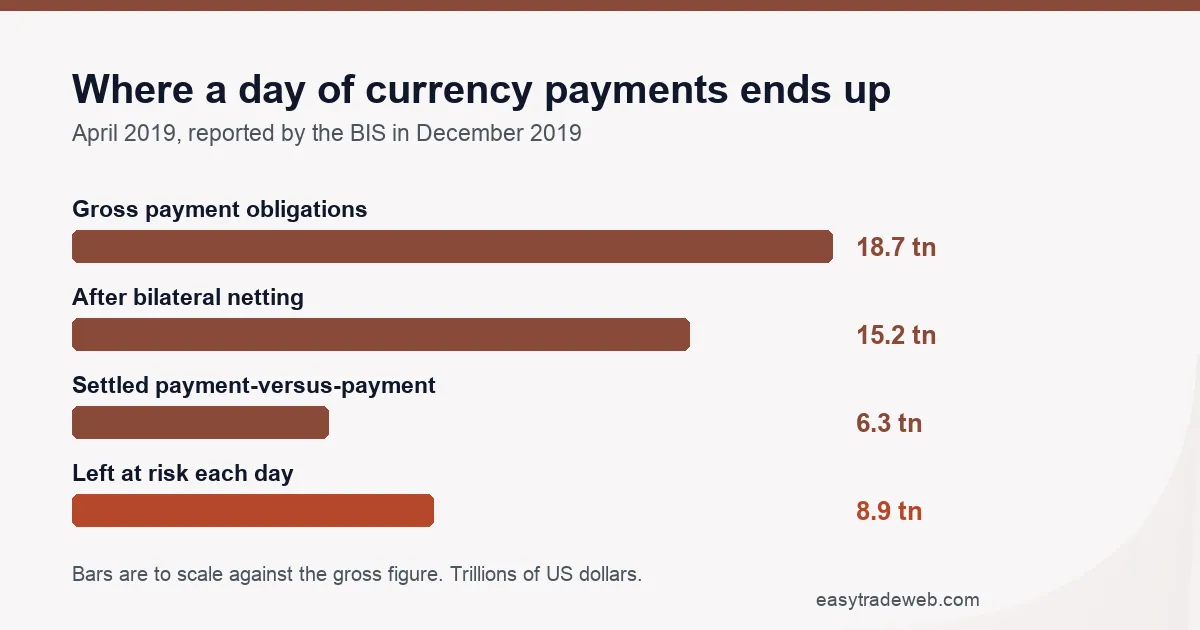
- The gap between the two legs of a currency settlement is a real exposure. The BIS estimated that of 15.2 trillion dollars in daily net payment obligations in April 2019, about 6.3 trillion settled with payment-versus-payment protection, leaving roughly 8.9 trillion at risk on any given day.
- A retail trading deposit is not a nostro account. It is client money at the broker bank, and the protections that apply to it are a different subject entirely.
Table of contents
- What a Nostro Account Is
- The Same Account From the Other Side
- Why a Bank Needs One at All
- What Happens Between the Two Legs of a Settlement
- Why a Retail Trading Deposit Is Not a Nostro Account
- Where This Sits Behind a Quoted Price
- What Knowing This Does and Does Not Change for a Trader
- Frequently Asked Questions
What a Nostro Account Is
Start with the arrangement rather than the word. In the CPMI account of it, one bank keeps deposits that belong to other banks and runs payment work for them.
The mechanics are simple. A respondent bank has an account opened for it on the books of its correspondent, and the two send each other messages that settle business by crediting and debiting that balance.
A nostro account is that account, named by whichever bank owns the money in it. A London bank needing to make and receive dollar payments opens an account at a New York bank, keeps a dollar balance there, and calls it a nostro.
Two properties do the work, and neither is optional: the account sits in another jurisdiction, and it is denominated in that jurisdiction currency. An account abroad in your own home currency is not what the term describes, and neither is a foreign-currency account held at home.
The reason is that payments in a currency clear inside that currency home system. To pay dollars, something has to move inside the dollar system, and a bank without a presence there needs a balance held by a bank that has one.
The Same Account From the Other Side
This is the part most explanations blur, and the blurring is what makes the pair confusing.
There is one account. The London bank calls it a nostro because the balance is its own money. The New York bank holding it calls it a vostro, or a loro in the terminology the CPMI payment-flow diagram uses. Nothing about the account changes; the name records which side you are standing on.
The CPMI adds a detail that makes the picture symmetrical: the relationships run both ways more often than not, each bank doing work for the other and usually in a different currency each time. So the New York bank may hold its own sterling account in London, a nostro to New York and a vostro to London, while the reverse arrangement runs alongside it.
Read that way the pair stops being two products and becomes a single balance with two labels, one used by the owner and one by the holder.
Why a Bank Needs One at All
A bank cannot simply pay a foreign currency the way it pays its own. Its access to a national payment system depends on being a participant in it, and no bank is a participant everywhere.
The CPMI puts the function plainly. These relationships are how a bank reaches financial services in a jurisdiction it has no presence in, and therefore how it offers customers a payment that crosses a border. The report calls the arrangement essential to the way global payments work, above all across borders.
It also records a change worth knowing. Correspondent banking matters far less for domestic payments than it did, because financial market infrastructures now handle those. Cross-border it remains essential.
That leaves it doing a narrower job, in the one place where no shared infrastructure spans the whole route, which is the backdrop to the market banks quote to each other in.
What Happens Between the Two Legs of a Settlement
None of the three explanations read for this page mentions settlement risk, and this is where the nostro arrangement stops being administrative.
A currency trade has two payments in two currencies. They do not happen at the same instant, and they clear in systems that keep different hours. The BIS describes the exposure directly: a currency trade creates real risk whenever one side pays out its leg and is then left waiting on the currency it bought.
The case that named the problem is on the record. The BIS recounts that Bankhaus Herstatt, a medium-sized German bank active in currency markets, was closed by the German authorities at 15:30 Central European Time on 26 June 1974, having taken in Deutsche marks from its counterparties without paying out the matching dollars in New York.
Banks then stopped outgoing payments until they were certain of the countervalue. The international payment system froze and credit was curtailed.
The response took decades. The BIS records a G10 central bank strategy against the risk in 1996, and the launch by market participants of Continuous Linked Settlement in 2002, settling currency transactions on a payment-versus-payment basis. The principle is exact: neither leg is paid unless the other one is.
The residue is measurable, and the figures are the ones no comparison of money-transfer providers will give you.
For April 2019 the BIS reported daily global currency trading of 6.6 trillion dollars, producing gross payment obligations of 18.7 trillion. Bilateral netting cut that to 15.2 trillion, of which roughly 6.3 trillion carried payment-versus-payment protection and about 8.9 trillion did not.
The protected share had fallen from 50 per cent in 2013 to 40 per cent in 2019, which the BIS attributed partly to growth in trading of currencies ineligible for that settlement.
| Daily figure, April 2019 | Amount | What it counts |
|---|---|---|
| Currency trading | 6.6 trillion dollars | Turnover, before any payment is made |
| Gross payment obligations | 18.7 trillion dollars | Payments those trades create, counted per instrument |
| After bilateral netting | 15.2 trillion dollars | What still had to be paid |
| Settled payment-versus-payment | 6.3 trillion dollars | Protected, both legs conditional on each other |
| Left at risk | 8.9 trillion dollars | Exposed between the two legs on any given day |
Those are April 2019 measurements published in December 2019, dated here because no later one was obtained.
When a currency trade is due to settle, and what a value date actually fixes, is covered under when a currency trade actually settles.
Why a Retail Trading Deposit Is Not a Nostro Account
Here is the question a trading reader actually arrives with, and none of the three explanations answers it.
A nostro account is a bank account owned by a bank, at another bank, for the purpose of making and receiving payments in a foreign currency. A retail trading deposit is none of those things. The account holder is a firm client rather than a bank, the money is held under client-money rules rather than as the firm own working balance, and its purpose is margin rather than payment settlement.
The confusion is understandable, because both arrangements involve one institution holding money at another. The difference is whose money it is and under what rules it sits there, which is set out under where a client deposit is actually held.
One consequence follows. Nothing in the nostro and vostro arrangement protects a retail client, and a broker holding accounts abroad says nothing about the safety of your deposit. That is answered by the client-money rules of the regulated entity you contracted with.
Where This Sits Behind a Quoted Price
The plumbing is invisible from a trading screen, and it should be, but it is not irrelevant to the price on it.
A quote in a currency pair is a price for exchanging balances that live in two national systems. The cost of moving those balances, the hours the systems keep, and whether a pair can be settled with both legs conditional on each other all sit behind the willingness of banks to quote it at a given size.
The BIS observation that ineligible currencies have grown as a share of trading is the visible edge of this. A pair that cannot be settled with both legs conditional carries an exposure a protected pair does not, and it is not the retail trader who carries it.
How a bank runs the desk that produces those quotes is described under how a bank runs a currency desk, and whether an order reaches that market at all is a separate matter, covered under whether an order reaches the market at all.
What Knowing This Does and Does Not Change for a Trader
It changes nothing about how a position is opened, sized or closed. No trading decision improves because the reader knows what a vostro account is called.
What it does change is the ability to read the rest of the market accurately. It explains why settlement is a two-day convention rather than instant, why some currencies are harder to deal in than their turnover suggests, and why correspondent banking appears in broker documentation at all. Plumbing knowledge stops other explanations from sounding arbitrary.
Frequently Asked Questions
What makes an account a nostro rather than an ordinary account?
Two conditions together. The account is held at a bank in another jurisdiction, and it is denominated in the currency of that jurisdiction. An account abroad in your own home currency does not qualify, and neither does a foreign-currency account held at a domestic bank. The purpose is to hold a balance inside the payment system of the currency concerned.
Are nostro and vostro two different accounts?
No. There is one account with two names, and the name records which side is speaking. The bank whose money it is calls it a nostro; the bank holding it calls it a vostro, or a loro in some documentation. The CPMI notes these relationships are frequently reciprocal, so two banks may each hold an account with the other in different currencies.
Does a retail trading deposit sit in a nostro account?
No. A nostro account holds a bank own funds for making and receiving payments in a foreign currency. A retail deposit is client money held by a regulated firm under client-money rules, for margin rather than for payment settlement. What protects that deposit is the rulebook of the entity you contracted with, and nothing in the correspondent banking arrangement.
Why does a bank need an account in another country at all?
Because payments in a currency clear inside the payment system of that currency, and no bank participates in every system. The CPMI describes correspondent banking as the route by which banks reach financial services in jurisdictions where they have no presence, which is what lets them offer cross-border payments to their own customers.
Risk warning: this page is educational and explains how banks hold accounts with each other to settle payments in foreign currencies. It is not advice to buy or sell any instrument, it makes no recommendation about any bank, broker or payment provider, and nothing here is a signal or a prediction. Leveraged trading carries a high risk of losing money.