
ISO 4217 Currency Codes: What the Three Letters Really Mean

Every price on a trading platform is quoted in something, and that something is almost always written as three capital letters. USD, JPY, CHF. The letters are not a broker convention: they come from an international standard called ISO 4217, and the same three letters identify the same currency in a bank message, a settlement instruction and a price feed.
What the standard settles is narrower than most traders assume, and what it leaves to the platform is wider. It names currencies. It does not decide how many decimals a quote carries, and it contains several codes that are not currencies at all. This page sets out what the standard defines, using its own published list, and marks the points where the symbol on a trading screen stops following it.
Key takeaways
- The current list published by the standard’s maintenance agency holds 280 country and entity entries sharing 178 distinct currency codes, because one currency can serve many countries: EUR appears against 37 entries and USD against 19.
- Each code carries a three-digit numeric code alongside the three letters, and a minor unit giving the number of decimal digits in the cash currency.
- The minor unit is not the quote precision. The list gives JPY a minor unit of 0 while platforms quote yen pairs to two or three decimals, so a decimal count read off the standard will not match the screen.
- Gold, silver, platinum and palladium each hold a currency code with a numeric code and no minor unit at all: XAU 959, XAG 961, XPT 962 and XPD 964.
- CNH does not appear in the current list. The code the standard gives the yuan renminbi is CNY, numeric 156.
Table of contents
- What the Standard Actually Defines
- Why the Third Letter Is Usually the Currency
- The Minor Unit, and What It Does to a Quoted Price
- Why Gold and Silver Have Currency Codes
- The Codes That Belong to No Country
- Where a Broker Symbol Stops Being an ISO Code
- The One Case a Trader Meets Most Often: CNH Against CNY
- Frequently Asked Questions
What the Standard Actually Defines
ISO 4217 assigns each currency three things: a three-letter alphabetic code, a three-digit numeric code, and a minor unit that states how many decimal digits the cash currency is divided into. The standard is maintained on a running basis rather than reissued. SIX Group runs the secretariat behind that maintenance work, publishing the current list and the amendments that change it.
The current list, published 1 January 2026, contains 280 entries. Those entries share only 178 distinct codes, because the list is organised by country and territory rather than by currency. The euro accounts for 37 of the entries under the single code EUR, the US dollar for 19 under USD, and sterling for 4 under GBP. A code therefore identifies a currency, never a country, which is what separates it from the country codes it partly borrows from.
That distinction matters as soon as two codes are written together. A pair such as USDCHF is two of these identifiers placed in an order that decides which one is being priced, a structure covered in more detail in the page on how a currency pair is named. The standard supplies the halves. It says nothing about the pairing.
Why the Third Letter Is Usually the Currency
The common explanation of the format is that the first two letters are the country and the third is the currency. USD reads as the United States and the dollar, CHF as Switzerland and the franc, AUD as Australia and the dollar. The pattern holds often enough to be worth knowing.
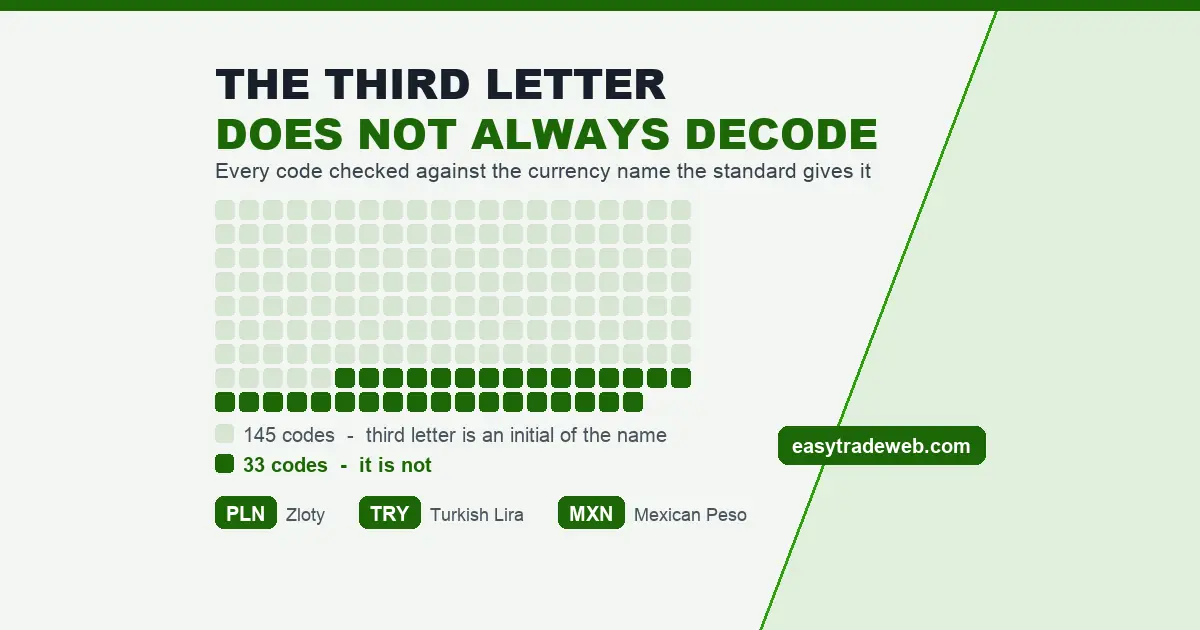
It is a convention rather than a guarantee, and the standard’s own list shows how far the exceptions run. Comparing every code against the currency name the list gives it, 33 of the 178 codes carry a third letter that is not the initial of any word in that name.
The Polish code is PLN and the currency is named Zloty. Turkey holds TRY against Turkish Lira, Mexico MXN against Mexican Peso, Russia RUB against Russian Ruble, Brazil BRL against Brazilian Real, Uganda UGX against Uganda Shilling.
A code and a currency name are maintained separately, and only the list decides which pairing is current. The letters are an identifier first and a mnemonic second, and reading them as though they must decode is how a trader ends up confident about a currency renamed years earlier.
The Minor Unit, and What It Does to a Quoted Price
Alongside each code the list records a minor unit: the number of decimal digits the currency divides into as cash. Across the 277 entries that carry a code, 224 carry a minor unit of 2, which is the familiar hundred subunits to the major unit. Thirty-one carry 0, seven carry 3, two carry 4, and thirteen carry no minor unit at all. The three remaining entries are territories the list records with no universal currency and no code.
| Minor unit | Entries in the list | Codes it applies to |
|---|---|---|
| 2 | 224 | The majority, including USD, EUR, GBP and CNY |
| 0 | 31 | JPY, KRW, ISK, CLP, VND, UGX and the CFA and CFP francs |
| 3 | 7 | BHD, IQD, JOD, KWD, LYD, OMR, TND |
| 4 | 2 | CLF, UYW |
| None recorded | 13 | XAU, XAG, XPT, XPD, XDR, XXX, XTS and the bond market units |
The trap sits in reading that column as the number of decimals a price will carry. It is not that. The minor unit describes the cash currency, and a quoted rate is a ratio between two currencies rather than an amount of either one. The list gives the yen a minor unit of 0, and no platform quotes USDJPY to zero decimals: the conventional quote runs to two decimals, and a broker offering fractional pricing shows three.
The same gap runs the other way for the three-decimal dinars. A minor unit of 3 tells a system how to store a cash balance in Kuwaiti dinar. It does not tell a trading platform how finely to quote a rate against it, and it has no bearing on what a position is worth per point, which is settled by contract size and the quote currency instead and worked through in what one pip is worth on your lot size.
Why Gold and Silver Have Currency Codes
Four precious metals sit in the currency list with codes of their own: XAU for gold at numeric 959, XAG for silver at 961, XPT for platinum at 962 and XPD for palladium at 964. None carries a minor unit.
They are in a currency standard because the market treats them as monetary assets held, lent and settled between institutions in the same message formats as money, and a settlement system that can only address currencies needs an identifier for them.
This is the reason a gold position is written the way it is. A platform showing XAUUSD is quoting one item from the currency list against another, which is why gold appears among currency pairs rather than in a separate class, and why it behaves like a pair in the platform’s arithmetic. The London benchmark prices for all four metals are published in dollars, sterling and euro, which is the same relationship expressed in three quote currencies.
The code explains the notation and nothing beyond it. What moves the metal, how it is sized and when it trades belong to the instrument rather than the standard, and those are set out in the page on trading silver as an instrument.
The Codes That Belong to No Country
Codes beginning with X are often described as the block reserved for things that are not currencies. The list does not support that reading. The X block holds two very different populations, and confusing them produces a wrong conclusion about real money.
| Code | What the list names it | Circulating money? |
|---|---|---|
| XOF | CFA Franc BCEAO, numeric 952 | Yes, across eight entries |
| XAF | CFA Franc BEAC, numeric 950 | Yes, across six entries |
| XCD | East Caribbean Dollar, numeric 951 | Yes |
| XDR | SDR, listed against the International Monetary Fund | No |
| XXX | Transactions where no currency is involved, numeric 999 | No |
| XTS | Reserved for testing, numeric 963 | No |
The first group is ordinary money that no single country owns. A supranational currency cannot take a two-letter country prefix because there is no one country to name, so the X marks the absence of a national issuer rather than the absence of a currency.
The second group is the standard describing situations instead of money: a unit of account, a placeholder for a transaction carrying no currency, and a code that exists so systems can be tested without touching a live one.
For a trader the practical value is XXX and XTS: either one appearing in an account statement or a platform field is a configuration or data problem, not an exotic instrument.
Where a Broker Symbol Stops Being an ISO Code
A trading platform stores currency identifiers, and it stores them as free text. In the MQL5 reference, a symbol carries separate base currency, profit currency and margin currency properties, each held as a string, alongside a digits property described simply as digits after a decimal point. Nothing in that structure requires a value from the standard, and nothing enforces one.
Three consequences follow, and each is visible on a live account. The instrument name is not a code: EURUSD is two codes concatenated by convention, and a suffix such as a micro or raw-spread marker appended by the broker is part of the instrument name only.
The decimal count is the broker’s setting, which is why the same pair can carry four decimals at one firm and five at another with no change in the currency. An instrument can also exist with no code behind it at all, as with an index or a stock CFD, where the fields hold the currency the contract settles in rather than the thing being traded.
The workable rule is to read a symbol as a broker label that usually embeds two codes, then confirm the currency from the contract specification rather than the letters.
The One Case a Trader Meets Most Often: CNH Against CNY
The gap between a code and a symbol has one everyday example. Brokers quote the Chinese yuan under CNH, and CNH is not in the current list. The code the standard assigns to the yuan renminbi is CNY, numeric 156, with a minor unit of 2.
CNH is a market convention rather than a standard identifier, used to distinguish yuan traded outside mainland China from yuan inside it. Two conventions therefore sit side by side: settlement systems and bank messages use the listed code, while a trading platform uses the market label for the thing it actually offers. Neither is an error, and a search for CNH in a code list will always return nothing.
Why the two trade at different prices, and what that means for a position, is a market question rather than a standards question, and it is answered in the page on the two codes for the yuan.
Frequently Asked Questions
What is an ISO 4217 currency code?
It is a three-letter identifier that the standard assigns to a currency, published with a three-digit numeric code and a minor unit giving the number of decimal digits in the cash currency. SIX Group runs the secretariat behind the list, and the version published on 1 January 2026 holds 280 country and entity entries sharing 178 distinct codes.
Which code does the US dollar use?
USD, with the numeric code 840 and a minor unit of 2. The same code covers 19 entries in the list, because several countries and territories beyond the United States use the dollar, and the standard identifies the currency rather than the country using it.
Why do gold and silver have currency codes?
Because they are held and settled between institutions in the same systems that move money, and those systems address value by currency code. Gold is XAU at numeric 959 and silver is XAG at 961, and neither carries a minor unit. This is also why a gold position on a trading platform is written as a pair, with the metal code on one side and a currency code on the other.
What does the minor unit in the standard mean for a quoted price?
Nothing directly. The minor unit describes how the cash currency subdivides, not how finely a rate is quoted. The clearest case is the yen, which the list records with a minor unit of 0 while trading platforms quote yen pairs to two or three decimals. Decimal precision on a quote is a platform setting and has to be read from the contract specification.
Codes are the naming layer under everything a platform displays, and the layer above them is how two of them get combined into something tradable. That step, including the pairs a broker builds rather than quotes directly, is covered in the page on a pair built from two others.
Risk warning: this page is educational and explains a currency identification standard and how trading platforms depart from it. It is not advice to buy or sell any instrument, it makes no recommendation about any broker or platform, and nothing here is a signal or a prediction. Leveraged trading carries a high risk of losing money.