
CNH vs CNY: Which Chinese Yuan Your Broker Actually Quotes

The Chinese yuan reaches trading platforms under two codes, CNY and CNH, and the two carry different prices at the same moment. Read one and trade the other and you are working from the wrong market.
Almost every published explanation of the pair is written for someone sending money to China. Those pages settle what the letters stand for and stop, which leaves the question a trader actually has unanswered: which of the two prices is the one on your own screen, and what sets it.
This page answers that from the contract specification on your platform and from the document that describes how the onshore rate is calculated each morning.
Key takeaways
- CNY and CNH are the same currency quoted in two separate markets, so they are two prices rather than two currencies, and neither is a conversion of the other.
- Which one your account quotes is a fact about your account, printed in the contract specification rather than in the instrument name, and it is the first thing to check.
- The onshore rate starts each business day from a central parity that the China Foreign Exchange Trade System calculates from market maker quotes and publishes before the market opens.
- The offshore rate has no such published starting point, which is the mechanism behind the two prices rather than the difference in demand that most explanations describe.
- The renminbi was on one side of 8.5 percent of global foreign exchange turnover in April 2025, and the US dollar against it was 8.1 percent of all turnover, up from 6.6 percent three years earlier.
Table of contents
- Which of the Two Codes Your Account Quotes
- One Currency, Two Markets, Two Prices
- The Onshore Rate Starts From a Parity Calculated Each Morning
- Why the Two Prices Differ, and What the Difference Is Not
- RMB, Yuan, CNY and CNH: Which Word Names Which Thing
- What This Page Could Not Verify, and Why It Is Blank
- Who This Page Is Not For
- Questions Readers Ask About CNH and CNY
Which of the Two Codes Your Account Quotes
Open the contract specification for the yuan symbol on your platform and read the code rather than the instrument name. A specification naming USDCNH describes the offshore rate. One naming USDCNY describes the onshore rate, or a rate derived from it, and the specification is where that is written down. Platforms label the same instrument differently, so the name in the market watch window settles nothing on its own.
Two things follow from the answer. The first is which quote your fill should be measured against. A headline yuan rate quoted for one code will not match the other at the same second, so a fill that looks wide against the wrong reference is not evidence of anything about your broker.
The second is which market the commentary you read is describing. An article about the yuan strengthening may be about either rate, and the two can move by different amounts on the same day. Both belong to the exotic end of how currency pairs are classified, where the exchange rate arrangement behind the quote matters more than the label the platform gives it.
One Currency, Two Markets, Two Prices
There is one Chinese currency. What the two codes separate is where it changes hands. CNY is the code used for the mainland market, which is an interbank market with a defined set of participating institutions. CNH is the code the market outside the mainland adopted so that the two prices could be quoted, charted and settled without being confused for each other.
That separation is why arithmetic between the two is meaningless. There is no exchange rate from CNY to CNH, because they are not two currencies, and there is no reason the two should agree on a price, because they are not one market. It is also the reason a non-deliverable forward exists for currencies of this kind, since a contract can price one without ever moving it. Everything else on this page follows from those two sentences.
Neither market is small. The Bank for International Settlements measured the renminbi on one side of 8.5 percent of all foreign exchange turnover in April 2025, with the US dollar against it at 8.1 percent of global turnover, up from 6.6 percent in the previous survey. It sits outside the G10 currencies while trading at a size most of them do not reach.
| Question | CNY | CNH |
|---|---|---|
| What the code names | The currency traded in the mainland market | The same currency traded outside it |
| Is there a published starting price each day? | Yes, a central parity against the US dollar | No equivalent is published |
| Who supplies the quotes behind that parity | Market makers polled before the open | Not applicable |
| Where you confirm which one you hold | The contract specification | The contract specification |
| Is one convertible into the other at a rate | No, they are one currency in two markets | No, they are one currency in two markets |
| What a gap between the two tells a reader | That the two markets priced differently | That the two markets priced differently |
The Onshore Rate Starts From a Parity Calculated Each Morning
The mechanism nearly every explanation leaves out is the one that produces the onshore price in the first place. The China Foreign Exchange Trade System, acting under authority from the central bank, calculates and publishes a central parity of the renminbi against the US dollar on every business day.
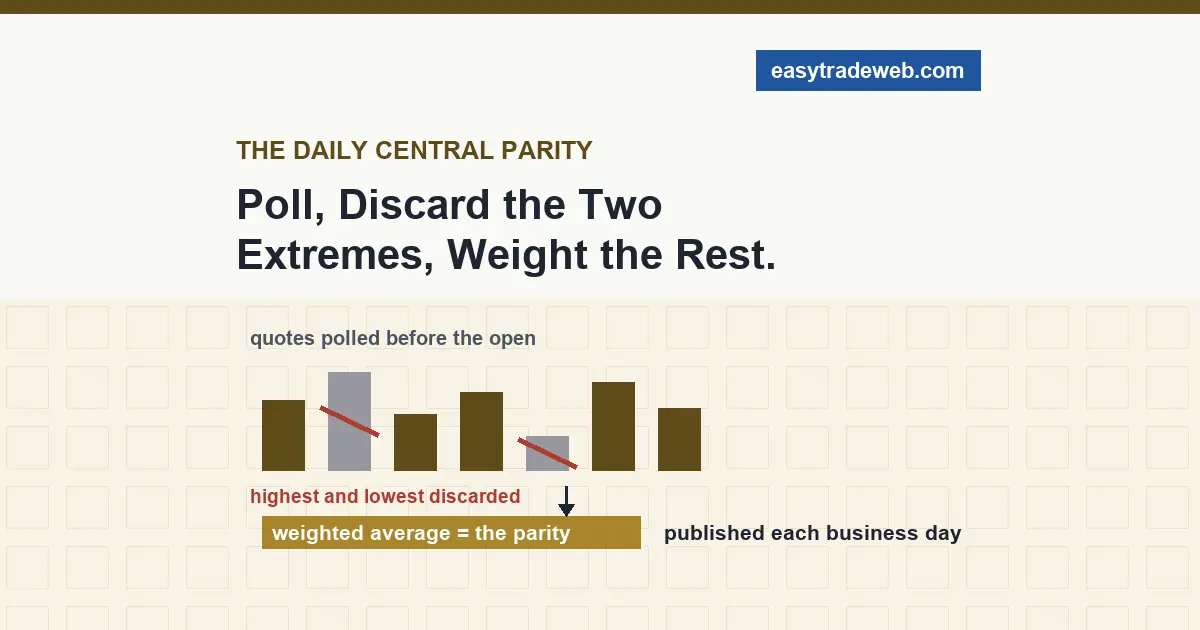
The calculation is documented rather than discretionary. Before the market opens, the system polls every market maker for a price. Those market makers are told to refer to the previous day closing rate in the interbank market, together with supply and demand conditions and the movement of the major currencies.
The highest and the lowest quotes are then discarded, and the parity is the weighted average of what remains, with the weights set by each market maker trading volume and by how it has performed as a market maker.
A rate that starts from a published number each morning is a managed rate, and the general case is covered in how a managed exchange rate is defended. This page stops at the fixing itself and hands the defence mechanics to that page rather than repeating them.
Why the Two Prices Differ, and What the Difference Is Not
Once the parity is on the table the difference stops being mysterious. One of the two rates begins each session from a calculated starting point published by the operator of that market. The other begins wherever it closed. Two prices for one currency are what you get when only one of the two markets has a daily anchor.
So the gap between the two is a reading about conditions in the offshore market relative to the onshore one, and nothing more than that. It is an observation, not a signal, not an entry, and not something a retail account can act on. The two markets are separate, and a price difference visible on a chart is not a price difference anyone with a trading account can collect.
The same caution applies to reading intent into a move. A parity calculated from polled quotes is not an announcement, and neither rate moving is a statement about policy. Where an authority steps into a market deliberately, that is central bank intervention, which is a different action and not what a daily fixing is.
RMB, Yuan, CNY and CNH: Which Word Names Which Thing
Four words circulate for what a reader is told is one thing, and only two of them are codes. Renminbi, abbreviated RMB, is the name of the currency. The yuan is the unit that currency is counted in, in the same way that sterling is the currency and the pound is the unit. Neither word distinguishes the two markets.
CNY and CNH do that work, and they are the only two that do. A headline saying the yuan fell has not said which of the two fell, and a converter offering renminbi has not said which market it priced from. When precision matters, use the code.
What This Page Could Not Verify, and Why It Is Blank
Two figures a reader might expect are missing on purpose. How far the onshore rate may move from the parity during a session is not stated on the page that documents the parity calculation, and the mainland session hours are not stated there either. Both circulate widely on comparison pages, and none of those pages is a source for a number.
The rule here is that a financial figure comes from the institution that publishes it or it does not appear at all.
Who This Page Is Not For
If your question is about sending money to or from mainland China, the answer sits with your payment provider rather than with which code a trading platform quotes. This page is for someone reading a yuan chart or quote who needs to know which market produced it. Nor does the currency appear in the dollar index basket, so a dollar index move says nothing about either rate.
Questions Readers Ask About CNH and CNY
Are CNH and CNY the same currency?
Yes. There is one Chinese currency, and the two codes separate the two markets it trades in rather than two currencies. CNY names it in the mainland interbank market and CNH names it in the market outside the mainland, which is why the same currency can carry two prices at the same moment.
Why do the two rates differ?
Because only one of the two markets starts the day from a published number. The China Foreign Exchange Trade System calculates a central parity against the US dollar before the mainland market opens each business day, and the market outside the mainland has no equivalent published starting point. Two markets with different starting conditions produce two prices.
Which of the two does a trading platform quote?
That is a fact about your own account and it is printed in the contract specification for the symbol, not in the instrument name. Read the code there: a specification naming USDCNH describes the offshore rate, and one naming USDCNY describes the onshore rate or a rate derived from it.
Is RMB a different currency from the yuan?
No. Renminbi, shortened to RMB, is the name of the currency, and the yuan is the unit it is counted in. The relationship is the same as the one between sterling and the pound. Neither word tells you which of the two markets a quote came from, which is what the codes are for.
Can one be converted into the other?
There is no exchange rate between them, because they are not two currencies. A quote for one is a price in one market and a quote for the other is a price in another market, and the difference between the two is an observation about those markets rather than a rate anyone trades across.
Risk warning: this page is educational and explains what two currency codes name and how one of the two rates is calculated. It is not advice to trade, not a view on the Chinese currency or on Chinese policy, and the difference between the two rates is described here as an observation about market conditions rather than as an opportunity. Leveraged trading carries a high risk of loss.