
The Jackson Hole Symposium: What It Can and Cannot Decide

Every August a group of central bankers, academics and officials meets in Wyoming, and for a week the financial press treats whatever is said there as though it were a policy decision. It is not one. No rate changes, no vote is taken, and the event appears nowhere on the calendar the Federal Reserve publishes for the meetings that do decide things.
What the week does carry is a timing condition, and that condition is the part most explanations leave out. This page sets out what the symposium is, what the official record shows about its standing, and why the position of the date in the calendar matters more to a currency trader than the content of any speech.
Key takeaways
- The symposium is an economic conference. Its sponsor is named as the Kansas City Federal Reserve Bank, and its location as Jackson Hole in Wyoming. It is not a meeting of the body that sets US policy rates.
- The Federal Reserve publishes eight scheduled committee meeting dates a year, with further meetings convened when required. Neither the words Jackson Hole nor the word symposium appear anywhere on that calendar page.
- Across 2023 to 2027 the published calendar contains no August meeting in any year. The gap between the July and September meetings runs 48 days in each of 2024, 2025, 2026 and 2027.
- The symposium sits inside that gap, which is why remarks made there are read so closely: there is no scheduled decision on either side of them for close to seven weeks.
- The last Monday of August is a public holiday in England and Wales, and the United Kingdom is the largest foreign exchange trading centre at roughly 38 percent of global turnover. The same sentence from the same speaker lands into a thinner market in late August than it would in October.
Table of contents
What the Symposium Actually Is, and Who Convenes It
The event is an academic economic conference. The Federal Reserve Board of Governors, in its own archive of speeches, records the chair’s appearances there as remarks given at an economic symposium whose sponsor it names as the Kansas City Federal Reserve Bank, at Jackson Hole in Wyoming.
That single description settles two things at once: the host is a regional Reserve Bank rather than the Board or the rate-setting committee, and the gathering is a symposium rather than a session of any decision-making body.
A regional Reserve Bank can convene a conference and invite whoever it wishes. It cannot change the federal funds target, and neither can a speaker standing at its lectern. Papers are presented, discussants respond, and officials from several countries attend. The output is a programme of research, not an instrument of policy.
One limit on this page is worth stating plainly. The host institution publishes its own material about the event, including the annual theme and the programme. That site did not respond when it was checked for this page, so nothing published there is reproduced here. No attendance figure, no theme and no programme detail appears below, because none of it could be read at the source rather than taken from a secondary account.
What can be established from the Federal Reserve’s own published record is enough for the question a trader is actually asking, which is whether the week carries a decision. It does not.
It Sets No Policy: What the Official FOMC Calendar Shows
The Federal Reserve maintains a page listing meeting calendars for the Federal Open Market Committee. It records that the committee holds eight scheduled meetings a year, with additional ones convened as required, and it carries the dates for each year alongside the statements and minutes those meetings produced. Four of the eight also carry a Summary of Economic Projections, the document behind how the projections are actually published.
Read that page for the symposium and nothing comes back. The phrase Jackson Hole appears zero times on it. The word symposium appears zero times on it. An event that decided anything about the target rate would leave a trace in the record of decisions, and this one leaves none, because the record is a list of committee meetings and the symposium is not one.
The 2026 dates on that page run 27 to 28 January, 17 to 18 March, 28 to 29 April, 16 to 17 June, 28 to 29 July, 15 to 16 September, 27 to 28 October, and 8 to 9 December.
Eight meetings, exactly as the page states. Four of them carry a Summary of Economic Projections, which is where the rate expectations of the committee members are recorded.
The distinction being drawn here is narrow and worth holding onto. A speech can change what market participants expect the committee to do. It cannot change what the committee has done, and it creates no statement, no implementation note and no minutes.
Tone read from a speech is an inference about a future vote, which is a different object from the vote itself, and our page on reading a hawkish or dovish tone sets out where that inference can and cannot be taken from.
Why the Last Week of August Is the Whole Story
Here is the part that almost no explanation of this event mentions, and it is visible in two public documents that take a minute each to check.
The first is the FOMC calendar again, read for what is missing rather than what is there. In 2023, 2024, 2025, 2026 and 2027 there is no August meeting at all. The committee meets in late July and does not meet again until the middle of September.
Measured from the closing day of the July meeting to the opening day of the September one, that interval is 48 days in 2024, 48 days in 2025, 48 days in 2026 and 48 days in 2027. Close to seven weeks pass with no scheduled decision anywhere in them.
The symposium falls inside that interval. That position, rather than any tradition of announcing things there, is why a paragraph from the week is parsed so heavily: it arrives when the calendar offers nothing else, and the only official document to land in the gap is the July minutes, released three weeks after the July decision. In 2026 those minutes came out on 19 August, inside the same stretch of the month.
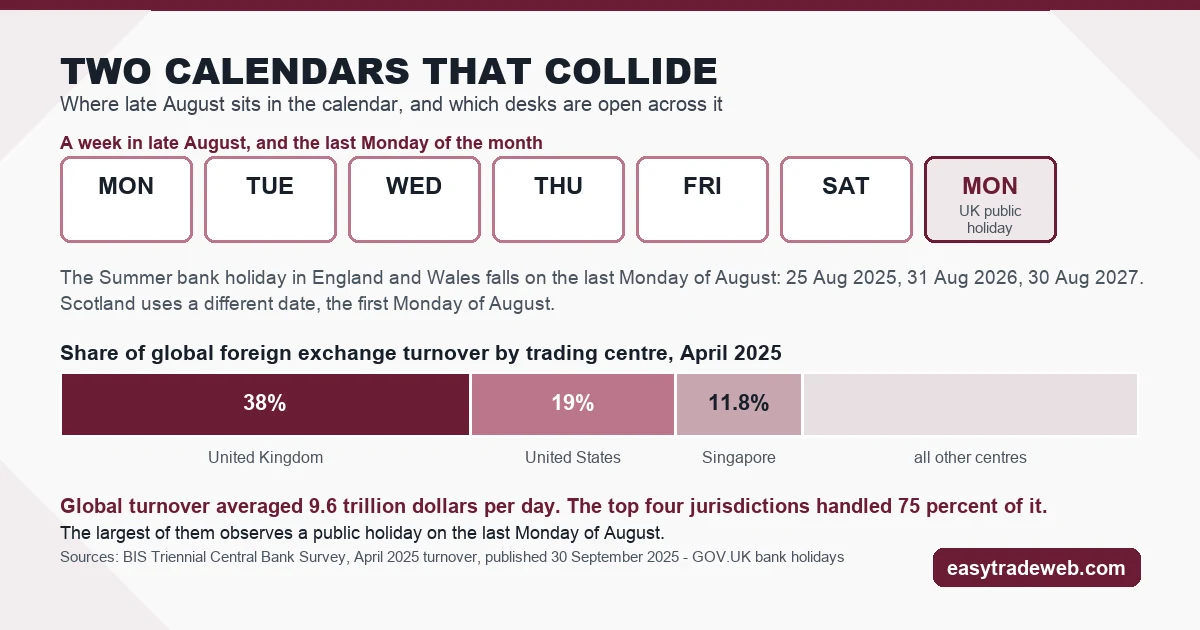
The second document is the list of United Kingdom bank holidays published by the government. The Summer bank holiday in England and Wales falls on the last Monday of August: 25 August 2025, 31 August 2026, 30 August 2027. Northern Ireland follows the same dates. Scotland does not, and this is the detail that catches people out, because the Scottish summer bank holiday falls on the first Monday of August instead, which was 3 August 2026.
Why a British public holiday matters to a market centred on an American conference comes down to where foreign exchange is actually traded.
The Bank for International Settlements measures this every three years, and its survey of turnover in April 2025 found global over-the-counter foreign exchange turnover averaging 9.6 trillion dollars per day, with the United Kingdom holding its position as the leading trading hub at approximately 38 percent of the total.
The United States accounted for approximately 19 percent and Singapore for 11.8 percent, and the top four jurisdictions together intermediated 75 percent of trading.
Put the two calendars beside each other. The symposium is held in the closing stretch of August, and the last Monday of that month is a public holiday in the jurisdiction that handles the largest share of global foreign exchange turnover. The days in which any remarks are absorbed therefore sit alongside a session the largest centre does not trade.
Desks in the other centres are staffed through what is, for many of them, the thinnest fortnight of the year. A remark that would be absorbed quietly in October arrives into a book with fewer participants standing behind it, and the size of the move that follows says as much about who was at their desk as about what was said.
What Moves and What Does Not
Nothing published moves, because nothing is published. There is no statement to compare against the previous one, no implementation note, no set of projections and no vote tally. Every effect the week produces travels through expectations rather than through a document.
That has a practical consequence for how the week reads on a chart. With a scheduled release there is a known instant when a number arrives, and the reaction can be timed against it. Our page on the non-farm payrolls release covers that case in full, including the revision behaviour that changes how the first print should be read.
The symposium has no such instant. Remarks are delivered, text is circulated, and the interpretation continues for hours in a market that is running short-staffed.
The instruments that respond are the ones that price expectations rather than outcomes: the dollar against its major counterparts, short-dated rate expectations, and anything whose valuation depends on a discount rate. Whether they respond at all depends entirely on whether the remarks differ from what was already assumed, and that is unknowable in advance.
The honest summary of the mechanism is short. The week can move prices without changing policy, because prices reflect what participants expect and expectations can shift on a sentence. Nothing has been decided when they do.
How This Differs From a Scheduled Rate Decision
A scheduled decision has a published architecture: a fixed date, a defined set of documents, and a known order in which they appear. The symposium has a date that no official calendar carries and no documents at all. That difference is what the table below sets out.
| Question | Scheduled FOMC meeting | The August symposium |
|---|---|---|
| On the official calendar | Yes, eight dates published for the year | No, zero mentions on that page |
| Who convenes it | The rate-setting committee | A regional Reserve Bank, as host |
| Documents produced | Statement, implementation note, minutes after three weeks | None |
| Can the target rate change | Yes, by vote | No |
| Timed reaction possible | Yes, against a known release instant | No fixed instant to time against |
The European case is worth naming for contrast, because the decision and the press conference that follows it are two separate events with two separate release times, and confusing them produces the same error in reverse. Our page on the scheduled rate decision in the euro area covers that release architecture; this page covers the opposite case, an event with no release architecture whatsoever.
What to Check Before the Week Opens
Five checks, each answerable from a public page in under a minute, and each of them about the calendar rather than about any forecast.
- Open the Federal Reserve meeting calendar and write down the July and September dates for the current year. The interval between them is the window the symposium sits in.
- Find the release date of the July minutes, three weeks after the July decision. That is the last official document before the symposium week and it is often overlooked.
- Check the United Kingdom bank holiday list for the Summer bank holiday date in England and Wales. Note that Scotland uses a different date in early August.
- Confirm with your own broker which instruments have altered trading hours or altered conditions on that Monday. Holiday schedules are published per venue and are not uniform.
- Decide before the week starts what you will do if nothing is said that changes anything, which is the most common outcome and the one least often planned for.
None of those five asks what will be said. That question has no reliable answer, and a plan that depends on one is a forecast wearing the clothes of a process.
Who This Page Is Not For
If you are looking for what a particular chair said in a particular year, or for a summary of a specific programme theme, this page does not carry it and is not going to. It describes a recurring calendar event and the conditions around it, not the content of any edition of it.
It is also not for anyone seeking a view on where a currency is heading during that week. No such view appears here, and the position taken throughout is that the direction of a reaction to remarks that have not yet been made is not knowable in advance.
What the page is for is a reader who wants to understand why one week in August draws attention out of proportion to its formal standing, and what the surrounding calendar does to the reaction when it comes.
Risk warning: this page is educational and explains what a recurring calendar event is and what official documents record about it. It is not advice to buy or sell any instrument, it recommends no product, platform or broker, and nothing here is a signal or a prediction. Leveraged trading carries a high risk of losing money.