
Who Needs a Legal Entity Identifier for a Trading Account

Most people who search for this term do not need one. A legal entity identifier attaches to companies, partnerships, trusts and similar structures. Someone trading a personal account in their own name is identified a different way entirely, and no amount of reading about registration fees and renewal cycles will apply to them.
The explanations available set out what the code is, what it costs and when it expires. They leave out the boundary: who is inside the requirement, who is outside it, and what the people outside it hand their broker instead.
This page starts at that boundary, then covers the identifier an individual supplies in place of a code, which instruments pull an account into the reporting regime, and what happens when a code lapses.
Key takeaways
- The code identifies legal entities and structures. An individual trading a personal account is identified by a national identifier instead, not by a twenty-character code.
- Under the FCA position, a broker inside the UK reporting regime has to turn away an order from an entity client that qualifies for a code but has never obtained one. Qualifying decides that, not account size.
- ESMA sets three identifier types for a natural person: a national client identifier, a passport number, or a constructed code built from nationality, date of birth and name.
- Spot foreign exchange sits outside the definition of a financial instrument. Currency forwards, swaps, options and contracts for difference sit inside it.
- ESMA states there is no requirement on an executing firm to check that a client identifier has been renewed, only its own. The renewal pressure comes from firm policy rather than from that rule.
Table of contents
- What the Identifier Actually Is, and Who Issues It
- Who Is Required to Have One, and Who Is Outside the Regime
- What an Individual Supplies Instead
- Which Instruments Pull an Account Into Scope
- What Happens When the Code Lapses
- What the Code Does Not Do
- Questions Readers Ask About Legal Entity Identifiers
- Checking Whether Your Own Account Needs One
What the Identifier Actually Is, and Who Issues It
The legal entity identifier is a twenty-character alphanumeric code that maps to exactly one entity. GLEIF, the body that administers the system, states that no code is ever reused: one code, one entity, permanently. The standard behind it is ISO 17442.
The code carries no meaning a reader can decode. It is a key into a public register holding the entity name, its country of formation and its ownership relationships. GLEIF treats that reference data as a public good, free to anyone who wants to use it.
Codes are not issued by GLEIF directly. They come from accredited issuers known as Local Operating Units, and the FCA notes that GLEIF also recognises registration agents. GLEIF is a not-for-profit foundation set up under Swiss law in 2014. The Regulatory Oversight Committee supervises it, and both the G20 and the Financial Stability Board stand behind the system.
The price of obtaining a code is not disclosed here, because it is set by each issuer rather than by GLEIF or by any regulator, and no official source states a single figure.
Who Is Required to Have One, and Who Is Outside the Regime
The requirement does not fall on the trader. It falls on the firm. Where a broker sits inside the UK reporting regime, the FCA position is that it cannot deal for a qualifying client until that client holds a code. A broker refusing to open or trade an account is passing that obligation down.
The word doing the work is eligible. In the FCA description the code belongs to legal persons and to structures such as trusts, alongside companies and charities. ESMA reaches further, listing what else qualifies under MiFIR Article 26(6) read with Article 5 of the delegated regulation that supplements it: associations, societies, partnerships, and a person dealing in a business capacity.
That last category is the one the general explanations skip. A person is not automatically outside the requirement because they are a person: a sole trader dealing on a business account can be eligible, while the same person dealing a personal account in their own name is not the same client for this purpose.
Two further points settle most remaining cases. A branch is identified with the code of its head office, ESMA states, even where the branch might itself be eligible in some circumstances. And eligibility is a separate question from whether a firm treats you as retail or professional, which is decided under different rules and covered in how a broker classifies a client.
Whether a particular account or structure falls inside the requirement is a question for the broker and the relevant regulator.
What an Individual Supplies Instead
A trader outside the eligible categories still has to be identified on every reportable transaction. The identifier is simply not a twenty-character code.
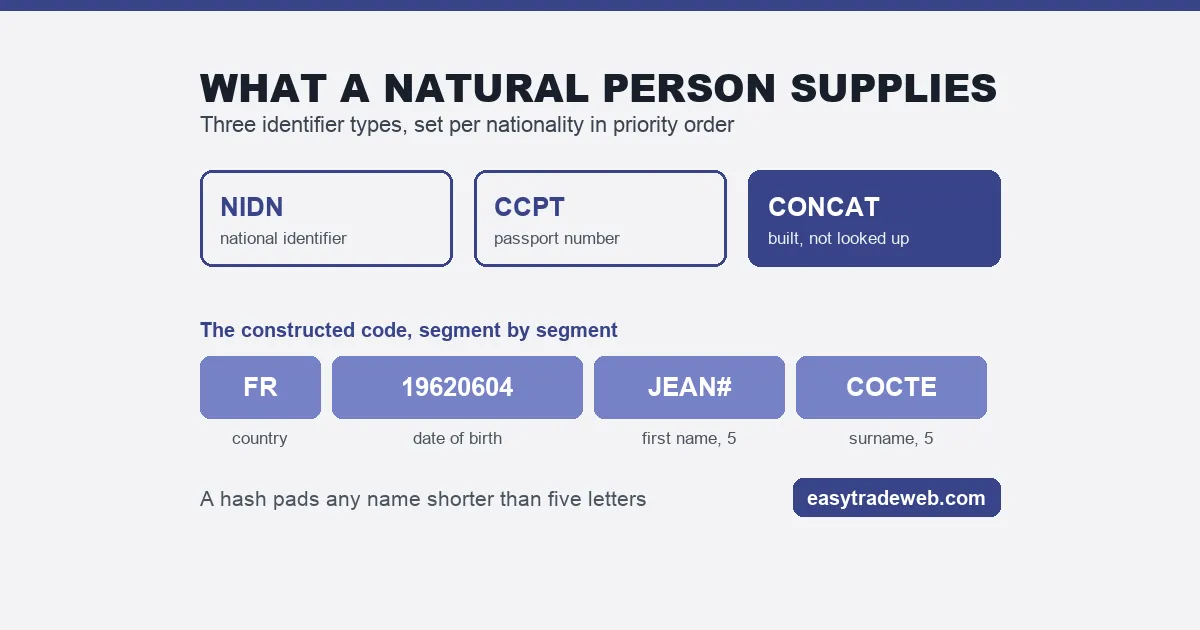
At Article 6, the delegated regulation identifies a natural person by whichever national identifier Annex II assigns to their nationality. That annex sets out, per nationality, up to three identifiers in priority order, and ESMA labels the three types that result:
| Scheme name | What is supplied | When it applies |
|---|---|---|
| NIDN | A national client identifier, such as a tax or national insurance number | Where Annex II lists one for that nationality at that priority |
| CCPT | A passport number | Where Annex II names the passport at that priority |
| CONCAT | A code built from nationality, date of birth and an abbreviation of the name | Only where Annex II names it for that country; never as a default |
The constructed code is the one worth understanding, because it is built rather than looked up. ESMA sets out a four-step method: take the correct full first name and surname with no abbreviations, remove titles such as dr or prof, remove a listed set of surname prefixes such as van, de and von, then transliterate so that diacritics, apostrophes, hyphens and spaces are stripped.
Only after all four steps are the first five characters of each name taken, which is what Article 6(4) specifies.
The result is the country code, the date of birth as eight digits, then five characters of the first name and five of the surname. The example ESMA gives for a French national born on 4 June 1962 is FR19620604JEAN#COCTE, where the hash character pads a name shorter than five letters.
ESMA is explicit that this constructed code is not a default and should never be used for a country that has not chosen it in any of the three priority possibilities. A trader who cannot obtain an entity code is therefore not left without an identifier, and is not expected to invent one.
Which Instruments Pull an Account Into Scope
None of this reaches an account unless what is traded on it counts as a financial instrument. That question comes before any identifier question, and for a currency account the answer is not uniform.
The FCA states plainly that not every foreign exchange contract is a financial derivative. Two exclusions apply. The first covers spot contracts, where delivery falls within a set number of trading days that depends on the contract type. The second covers a currency transaction connected to a payment for identifiable goods, services or a direct investment, which must be physically settled and not traded on a trading venue.
What remains inside is broad. The category takes in forward rate agreements, futures, options, swaps and any other derivative contract written on a currency, and the FCA adds that a currency swap or a currency option qualifies however long it runs and whether or not a venue lists it. Financial contracts for difference sit in their own separate category of the same list.
| What is traded | Financial instrument? |
|---|---|
| Spot currency, delivered inside the permitted window | Excluded |
| Currency forward beyond that window | Inside |
| Currency swap or option, any duration or venue | Inside |
| Contract for difference | Inside |
The practical consequence for an entity account is that the instrument set decides the exposure. An account dealing only genuine spot settlement sits outside; an account dealing what a contract for difference is or holding currency options and forwards is squarely inside, and the identifier question follows.
What Happens When the Code Lapses
A code is registered for a period and has to be renewed. The usual account of what follows a lapse is that trading stops, and that account is more absolute than the rule it describes.
ESMA draws a distinction here that is easy to miss. An executing firm has to keep its own registration current, which Article 5(2) of the delegated regulation requires of it. ESMA then removes the matching duty at the other end: under Article 13(3) the firm carries no obligation to confirm that a client, or a counterparty, has kept its own registration alive.
So the pressure a trader feels at renewal time is real, and it does not come from that rule. It comes from the firm, which sets its own onboarding policy and may decline to deal on a lapsed record whatever the reporting rule requires of it. That tells you who to ask when a code lapses: the broker, whose policy is the binding constraint, rather than the regulator.
A lapsed record also stays public, since the register marks the registration as lapsed rather than removing the entity. That is a separate question from what a firm must verify before it deals, which is closer to what a broker must ask before opening an account.
What the Code Does Not Do
The identifier is a reference key and nothing more. It confers no licence, no authorisation and no permission to deal, and holding one says nothing about whether an entity is regulated or solvent.
It also carries no protection. An entity code does not segregate money, does not extend a compensation scheme and does not change what happens to a balance if a firm fails, all of which is decided by the arrangements described in how client money is held.
And it is not a credential a counterparty can rely on for identity assurance on its own. It points at a public record; whether that record is current is a separate question, and the previous section is why.
Questions Readers Ask About Legal Entity Identifiers
What is a legal entity identifier?
A twenty-character alphanumeric code that maps to exactly one legal entity, issued under the ISO 17442 standard. GLEIF states that no code is ever reused, so one code means one entity permanently. It carries no readable meaning and works as a key into a public register of entity reference data, which GLEIF treats as a public good that is free to use.
Does an individual trader need one?
Generally no. In the FCA description the code belongs to legal persons and to structures such as trusts, alongside companies and charities. ESMA adds associations, societies, partnerships and a person dealing in a business capacity, so the same person can fall inside the requirement on a business account and outside it on a personal one. Any specific account is a question for the broker and the regulator.
What is a national client identifier?
It is how a natural person is identified on a transaction report instead of an entity code. At Article 6 the delegated regulation points to Annex II, which sets out per nationality up to three identifiers in priority order. ESMA labels the three types NIDN for a national identifier such as a tax number, CCPT for a passport number, and CONCAT for a code built from nationality, date of birth and name.
Which trades require one?
Only trades in something that counts as a financial instrument. The FCA states that not every foreign exchange contract is a financial derivative, and excludes spot contracts settled inside a permitted window, along with currency transactions connected to a payment for goods or services. Currency forwards beyond that window, currency swaps and options, and financial contracts for difference sit inside the definition.
What happens if a code is not renewed?
Less than is usually claimed, as a matter of the reporting rule. ESMA states that an executing firm has to keep its own registration current under Article 5(2) of the delegated regulation, while Article 13(3) places no matching duty on it to confirm that a client, or a counterparty, has kept its own registration alive. The practical constraint comes from the policy of the firm, which may decline to deal on a lapsed record.
Checking Whether Your Own Account Needs One
Four checks settle the question for a specific account, in order.
First, establish the client. Read the account application and see whether the holder is a person in their own name or an entity, since that fact decides most cases on its own.
Second, establish the instrument. Confirm whether the account deals contracts for difference, currency forwards, swaps or options, or only genuine spot settlement, because an account outside the definition does not reach the reporting rule.
Third, ask the broker which identifier it will record, and if it is a national identifier, which of the three types applies to your nationality.
Fourth, if an entity code is required, ask which accredited issuer the broker accepts and what its policy is on a lapsed registration.
Risk warning: this page is educational and describes a reporting identifier and the rules that reference it. It is not legal or regulatory advice, and whether a particular entity, account or arrangement falls inside the requirement is a question for your broker and the relevant regulator. Nothing here is a recommendation of any broker, issuer or instrument. Leveraged trading carries a high risk of loss.