
Non-Deliverable Forwards: What They Are and Who Trades Them

A non-deliverable forward fixes an exchange rate for a future date and then pays out in one currency only. Neither side ever hands over the currency being priced.
The pages that explain this are written almost entirely for corporate treasurers hedging an invoice, which leaves the question a trader arrives with unanswered: what the words non-deliverable mean beside an instrument on a platform, and whether a trading account can hold any of this.
The answers below come from the official measurement of the market and from the margin standard that treats these contracts differently from ordinary forwards.
Key takeaways
- A non-deliverable forward settles as a single cash payment in a convertible currency, and the currency it prices never moves between the two parties.
- The contract exists because the priced currency cannot be freely moved across the border, so it is a response to a restriction rather than a product feature.
- Outright forwards were 1,846.5 billion US dollars of daily turnover in April 2025, and the retail-driven share of that was 21.4 billion, or 1.2 percent.
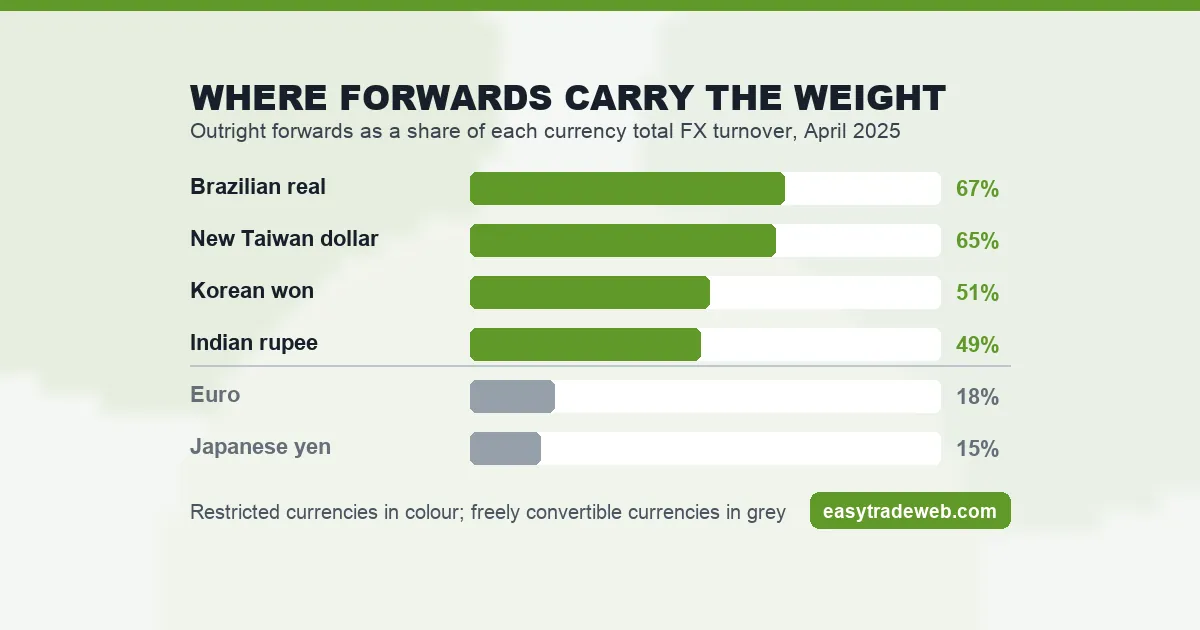
- In the currencies these contracts are built for, forwards dominate: 67 percent of all Brazilian real turnover and 65 percent of New Taiwan dollar turnover, against 18 percent for the euro.
- Cash settlement is what pulls the contract inside the initial margin standard for uncleared derivatives, because that standard carves out forwards that deliver.
Table of contents
- Whether You Can Hold One, and What Non-Deliverable Means on an Instrument List
- What Settles When Nothing Is Delivered
- Why the Currency Cannot Cross the Border in the First Place
- The Fixing Date Decides the Payment, Not the Forward Price
- Who Owes Whom on the Fixing Date, and Who Stands Behind It
- How Big the Market Is, and the Line the Survey Does Not Publish
- Questions Readers Ask About Non-Deliverable Forwards
- Which of the Three Contracts Applies to You
Whether You Can Hold One, and What Non-Deliverable Means on an Instrument List
Start with the answer, because no comparable page states it. A non-deliverable forward is a bilateral contract between institutions, and the official turnover survey puts the retail-driven share of all outright forward trading at 1.2 percent. A retail trading account is not the venue for one.
That matters because the same two words appear in a second place and do not mean the same thing there. When a platform describes an instrument as non-deliverable or cash-settled, it is describing how your own position closes: in money, against your account balance, with no delivery of either currency. That is equally true of a spot foreign exchange contract for difference.
So the phrase does two jobs. On a dealing desk it names a specific forward contract on a restricted currency. On a platform it is a settlement style. Reading the second as the first is the error this page exists to prevent, and the place to check is the contract specification for the symbol, the same document that tells you when a spot trade settles.
What Settles When Nothing Is Delivered
Two parties agree a rate now for a fixed amount of a restricted currency on a fixed future date. Nothing about that first step is unusual. The difference arrives at the end.
On the agreed date, the rate they wrote down is compared with a published reference rate for the same currency. The gap between the two, applied to the agreed amount, is a single sum of money. One party pays it to the other, in a convertible currency, and the contract closes. The restricted currency stays where it is throughout.
The notional amount is therefore a measuring stick rather than a quantity anyone moves. It sizes the payment and is never paid, and that is the whole mechanical distinction between this contract and an ordinary forward.
Why the Currency Cannot Cross the Border in the First Place
These contracts are not an invention aimed at convenience. They exist where a currency cannot be freely moved out of its home jurisdiction, because the authorities there restrict it. A deliverable forward needs both currencies to be movable on the settlement date, and where one is not, the contract cannot be written that way at all.
The response was to keep the price and drop the delivery. Banks outside the jurisdiction quote the restricted currency among themselves and settle the difference in dollars, which needs no access to the home market. The Bank for International Settlements described this in December 2019, finding that restrictions on capital movement pushed trading offshore rather than reducing it.
The same separation is what produces two prices for one currency, which is treated in full on our page on the onshore and offshore split. This page takes the instrument side of that separation and leaves the price side there.
The Fixing Date Decides the Payment, Not the Forward Price
The forward rate is agreed at the start. What the fixing date settles is the other half of the comparison: which published reference rate the contract is measured against, and on which day it is read.
That date usually sits shortly before the settlement date, so the payment can be calculated and sent. The reference source is named in the contract, and it is typically a rate published by a central bank or a recognised industry body rather than a price either party quotes. Neither side controls it.
None of this determines the forward rate itself. That comes from the interest rate difference between the two currencies, which is set out on our page on how forward points are calculated. The fixing decides only what is paid at the end.
Who Owes Whom on the Fixing Date, and Who Stands Behind It
A contract that settles in cash leaves one party owing the other a sum on a known date, and nothing in the agreement guarantees it arrives. That exposure is why the regulatory treatment splits the two kinds of forward apart.
The margin framework for derivatives that are not centrally cleared, published by the Basel Committee on Banking Supervision with IOSCO, excludes foreign exchange forwards and swaps that deliver physically from its initial margin requirement. A forward settling in cash is not excluded, so it obliges the parties to post collateral where the delivered version does not. The final phase of that regime took effect on 1 September 2022.
Clearing moved the same way. The Bank for International Settlements noted in December 2019 that these were the only foreign exchange derivatives with a meaningful share of trades passing through a central counterparty.
Where that route is used the clearing house stands between the two sides. Where it is not, each side carries the other as a credit exposure, which is a different position from holding a margined instrument on a managed exchange rate through a broker.
How Big the Market Is, and the Line the Survey Does Not Publish
The Bank for International Settlements measured 1,846.5 billion US dollars of outright forward turnover per day in April 2025, which was 19.2 percent of the 9,595.5 billion daily total across all foreign exchange instruments. Forward turnover grew 59.5 percent from the previous survey three years earlier, against 28.5 percent for the market as a whole.
One number is missing, and the absence is worth knowing. The survey reports outright forwards as a single instrument and publishes no separate line for the non-deliverable kind, so any figure quoted for the size of this market on its own was estimated by someone rather than measured. What the currency breakdown does show is where forwards carry the weight.
| Currency | Outright forwards, US dollars per day | All instruments, US dollars per day | Forwards as a share of that currency |
|---|---|---|---|
| Brazilian real | 60.6 billion | 89.9 billion | 67 percent |
| New Taiwan dollar | 75.2 billion | 116.1 billion | 65 percent |
| Korean won | 87.2 billion | 170.9 billion | 51 percent |
| Indian rupee | 91.5 billion | 185.0 billion | 49 percent |
| Euro | 488.3 billion | 2,773.2 billion | 18 percent |
| Japanese yen | 236.0 billion | 1,609.6 billion | 15 percent |
The four currencies at the top of that table are the ones these contracts were built for. In a convertible currency the forward is a minority instrument. In a restricted one it is most of the market, because it is the part outsiders can reach.
Questions Readers Ask About Non-Deliverable Forwards
Can a retail trading account hold a non-deliverable forward?
In practice no. These are bilateral contracts arranged between institutions, and the official turnover survey records retail-driven activity as 21.4 billion US dollars a day out of 1,846.5 billion in outright forwards, which is 1.2 percent. If a platform describes one of its instruments as non-deliverable, that is a statement about how the position settles rather than an offer of this contract.
What is settled if no currency changes hands?
One payment, in a convertible currency, usually the US dollar. The agreed rate is compared with a published reference rate on the fixing date, the difference is applied to the agreed amount, and whichever party is behind pays the other. The restricted currency is priced but never moved.
Which currencies are traded this way?
Currencies that cannot be moved freely out of their home jurisdiction. The turnover data shows the pattern clearly: forwards are 67 percent of all Brazilian real trading, 65 percent of New Taiwan dollar trading, 51 percent of Korean won and 49 percent of Indian rupee, against 18 percent for the euro.
What does the fixing date decide?
Which published reference rate the contract is measured against, and the day it is read. It sits shortly before the settlement date so the payment can be worked out. It does not decide the forward rate, which was agreed when the contract was written and comes from the interest rate difference between the two currencies.
How is this different from an ordinary currency forward?
An ordinary forward ends with both currencies changing hands at the agreed rate. This one ends with a single cash payment and no exchange at all. The difference is not only mechanical: the initial margin standard for uncleared derivatives carves out forwards that deliver physically, so a contract settling in cash falls inside a collateral requirement that the delivered version escapes.
Which of the Three Contracts Applies to You
Three different things carry overlapping language, and which one applies depends on what you are doing.
If you are hedging a real commercial exposure in a restricted currency, the contract on this page is the relevant one, and it is arranged through a bank rather than a platform. If you are reading a rate for such a currency, this instrument is often where that rate is formed, which is reason enough to know it exists.
If you hold a position on a trading platform and saw the words non-deliverable in its specification, you are looking at a settlement style. The practical question there is which quote your instrument tracks and how currency pairs are classified for cost purposes.
Risk warning: this page is educational and describes what a contract is and how it settles. It is not advice to trade, not a recommendation to seek access to any instrument named here, and not a view on any currency or on the policies of any country. The gap between a forward rate and a later reference rate is described here as the outcome of a hedge rather than as a gain. Leveraged trading carries a high risk of loss.