
Open Interest: What the Number Counts and What It Cannot

Open interest is printed beside volume on most futures screens and read as though it were a second volume figure. It is not. It counts positions that are still open, and it changes only when a contract is created or destroyed.
That distinction decides what the number can tell you. Volume says how much changed hands today. Open interest says how much is still standing at the end of it, which is a statement about commitment rather than about activity.
Three explanations of the term were read while preparing this page. All three define it and all three contrast it with volume in a line or two. None of them says what happens to the reader most likely to be looking it up: someone holding a spot forex or CFD position, for whom no central open interest figure exists at all.
Key takeaways
- The Commodity Futures Trading Commission defines open interest as the total of futures and option contracts entered into and not yet closed out, delivered against or exercised.
- Total long open interest and total short open interest are always equal, so the figure counts contracts, not a balance of opinion.
- Volume resets every session; open interest carries forward, which is why the two answer different questions.
- A spot forex or CFD position creates no exchange open interest at all, because it is an agreement with a broker rather than a cleared exchange contract.
- Every figure and definition here comes from the CFTC Commitments of Traders explanatory notes, read on 22 August 2026. No exchange contract figures are quoted, because the exchange pages carrying them returned an access error.
Table of contents
- What Open Interest Counts, and What It Does Not
- Why It Is Not Volume
- Reading Price Against Open Interest: The Four Cases
- Where the Number Comes From and When It Is Published
- Why a Spot Forex or CFD Position Has No Open Interest
- The One Open Interest Figure a Currency Trader Can Read
- What Happens to the Number at Expiry
- What This Indicator Cannot Tell You
- Frequently Asked Questions
What Open Interest Counts, and What It Does Not
The Commodity Futures Trading Commission gives the working definition in its explanatory notes to the Commitments of Traders report: open interest is the total of futures and option contracts that have been entered into and not yet closed out by an offsetting transaction, by delivery, or by exercise.
Read that list of endings carefully, because it is the whole mechanism. A contract leaves the count in one of three ways and no others. Nothing else a trader does removes it.
The second official statement matters just as much: the aggregate of all long open interest equals the aggregate of all short open interest. Every open contract has someone on each side of it. So the number is a count of contracts, never a measure of how many participants are bullish, and a rising figure never means buyers are winning.
The CFTC also removes one category from the figure it uses: contracts already caught up in the delivery process, once the clearing organisation has issued a notice or a trader has stopped one. Those are on their way out of the market and stop being counted as open.
One more piece of vocabulary comes from the same source: the open interest a single trader holds or controls is that trader’s position. Position and open interest are the same quantity at two scales.
Why It Is Not Volume
Every explanation of open interest contrasts it with volume, usually in one sentence. The sentence is correct and it is not enough, because the difference is mechanical and the mechanics decide what each figure can be used for.
Volume counts transactions in a session. Every trade adds to it, whatever it does to the participants’ positions, and at the start of the next session it begins again at zero.
Open interest counts contracts still standing. It carries forward from one session to the next and only moves when the population of open contracts changes. A trade between two people who are both opening a position raises it by one. A trade between two people who are both closing lowers it by one. A trade where one opens and the other closes leaves it exactly where it was, even though volume rose.
That last case is the one that matters, and it explains a pattern that confuses people: a heavy session in which open interest barely moves. Nothing is wrong with the data. Positions changed hands rather than being created. What a volume figure on a chart is counting is set out separately under what a volume figure on a chart is counting.
Reading Price Against Open Interest: The Four Cases
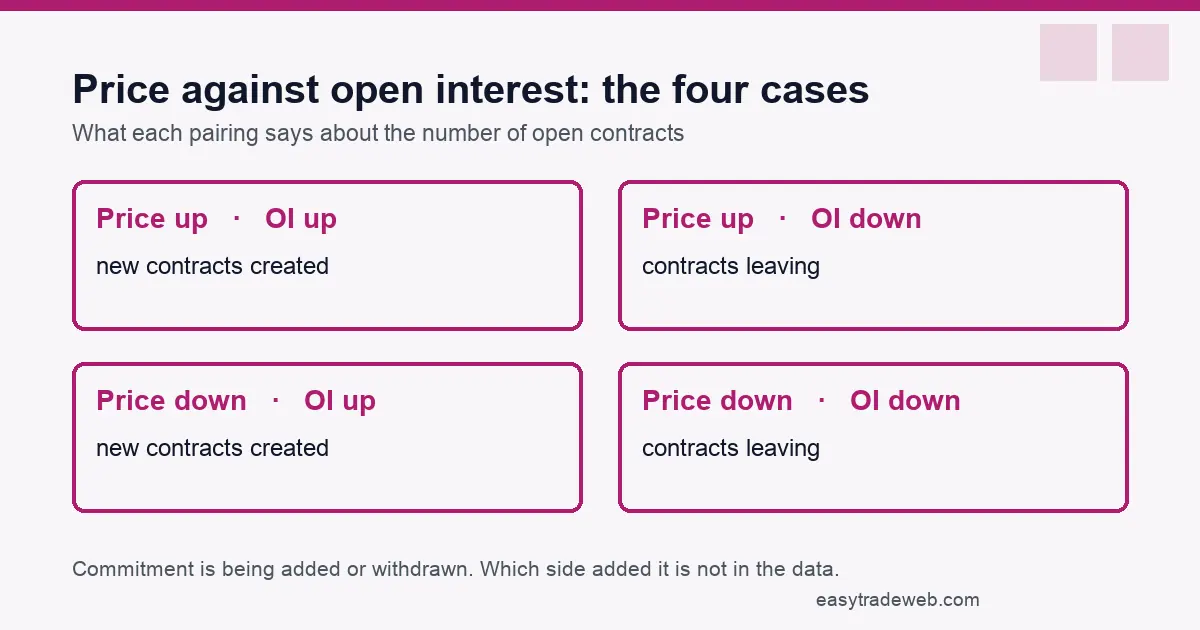
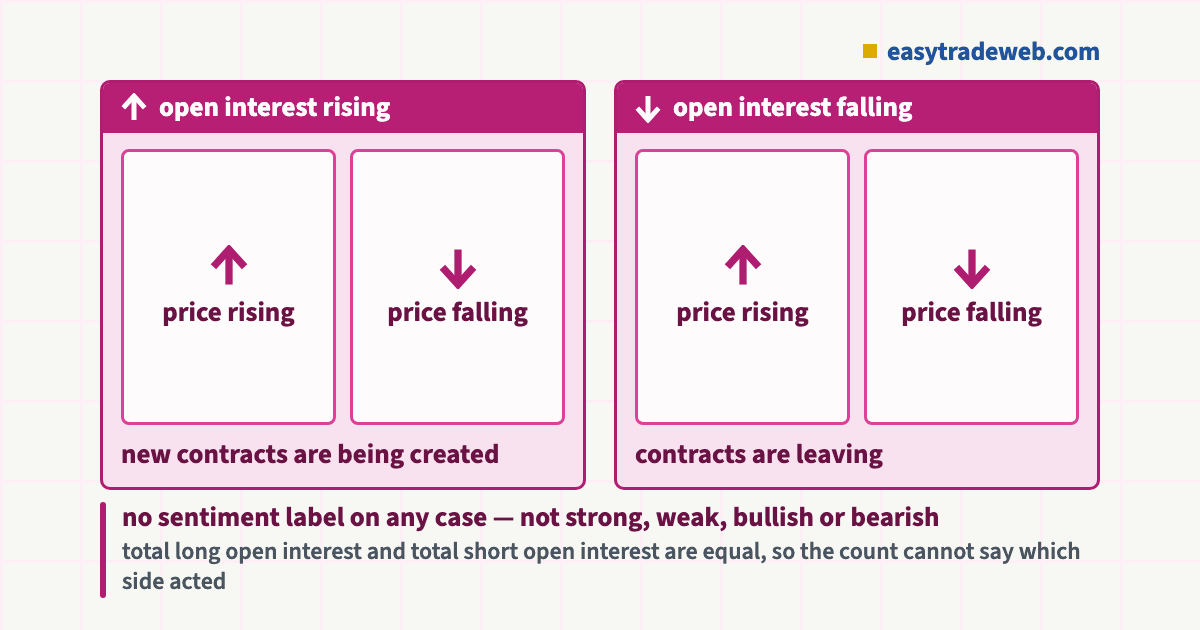
The indicator is read as a pair with price, and there are exactly four combinations. The table below groups them by the thing the data actually reports, which is whether the contract population is growing or shrinking, rather than by the direction of price.
| What the contract population is doing | Open interest | Price | What that means mechanically |
|---|---|---|---|
| Growing | Rising | Rising | Contracts are being created while price advances, so the move carries fresh commitment |
| Growing | Rising | Falling | Contracts are being created while price declines, so commitment arrives on the way down |
| Shrinking | Falling | Rising | Contracts are leaving, so the advance runs on positions being closed rather than opened |
| Shrinking | Falling | Falling | Contracts are leaving as price declines, so the population empties on both counts |
The right-hand column is deliberately mechanical. It says what is happening to the number of open contracts and stops there, because that is all the data supports.
Grouping the rows this way makes one thing visible: the two cases sharing an open interest direction share a mechanism, and price is what varies inside each pair.
The step usually taken next is to attach a sentiment word to each row: strong, weakening, bullish, bearish. That step is not in the data. Since long and short open interest are equal by definition, a rise in the count cannot tell you which side created the new contracts, and neither can a fall tell you which side closed. The four cases describe whether commitment is being added or withdrawn, and nothing about who is adding it.
Used that way the pair is still worth reading. A trend accompanied by a growing contract population is being fed by new money; a trend accompanied by a shrinking one is running on positions being unwound, which is a different thing with a different natural end.
Where the Number Comes From and When It Is Published
Open interest is produced by the clearing house, because only the clearing house knows how many contracts it stands behind. Exchanges publish a daily figure per contract. That is the raw number.
The public breakdown, the one that shows who holds it, comes from the CFTC. Its explanatory notes describe the mechanism. Brokers and clearing firms send the Commission daily filings covering any trader whose position reaches the reporting level the regulations set.
Crossing that level in one contract month, or in a single option expiry, pulls in everything else: the firm then has to report that trader’s whole position in the commodity, at every maturity, however small the rest of it is.
One consequence is worth carrying: the CFTC states that the aggregate of all reported trader positions usually represents 70 to 90 per cent of the total open interest in a given market. The published breakdown therefore covers most of the number but never all of it, and the remainder belongs to traders below the reporting level.
The report itself, its four versions, its trader categories and its publication lag are covered separately under the Tuesday snapshot the CFTC publishes. This page stops at what the figure is and where it originates.
Why a Spot Forex or CFD Position Has No Open Interest
This is the section none of the three explanations contains, and it is the one most readers of this site actually need.
Open interest exists because a clearing house stands between the two sides of an exchange contract and keeps a register of every contract outstanding. That register is the number. A spot forex trade and a contract for difference are not registered anywhere central. They are bilateral agreements between a client and a broker, and each broker knows only its own book.
So there is no open interest figure for EUR/USD spot, and none for a CFD on any instrument. A broker can show you its own client positioning, which is a sample of that broker’s customers rather than a market-wide count, and it is not the same statistic even when it is labelled similarly.
The structural reason sits in how the two instruments are built, which is set out under how a CFD differs from the futures contract behind it. The short version is that a futures position is a cleared contract in a central register and a CFD position is an entry on one firm’s ledger.
Anyone reaching for open interest as a sentiment gauge on a spot forex account is reaching for something that does not exist for the instrument in front of them.
The One Open Interest Figure a Currency Trader Can Read
There is a way to see published open interest on currencies, and it is not the spot market.
Currency futures are exchange-traded and cleared, so they carry open interest like any other futures contract, and they fall inside the CFTC reporting regime described above. That makes the Commitments of Traders report the one published, market-wide open interest figure covering currencies that a retail reader can obtain without a data subscription.
It comes with two limits that have to be stated alongside it. It measures the futures market, not the far larger spot market, so it is a window rather than a census. And its coverage is the 70 to 90 per cent of open interest that sits at or above reporting levels.
What currency futures are, and how they differ from the spot position most retail accounts hold, is covered under currency futures against the spot market. Read together, the two pages answer the question this section raises: the figure is real, it is published, and it is about a different market from the one you are trading.
What Happens to the Number at Expiry
Open interest falls into every expiry, and the fall carries no signal at all.
The reason is in the definition. A contract leaves the count when it is offset, delivered against or exercised, and expiry forces all three. Holders close out, deliveries are made, options are exercised or abandoned, and the contract month empties. The CFTC notes separately that contracts against which delivery notices have been stopped or issued are already excluded from the figure, so part of the decline happens before the final day.
The same money often reappears in the next contract month, which is why a series drawn on a single expiring month looks like collapsing commitment while the market as a whole has not changed. Read the aggregate across months near an expiry, or compare the same point in the cycle a year apart.
This is the most common misreading of the indicator, and it is entirely avoidable once the mechanism is clear.
What This Indicator Cannot Tell You
Four things, stated plainly, because the value of this figure depends on not asking it for more than it holds.
It cannot tell you direction. Long and short open interest are equal by definition, so no reading of the count identifies which side is committed.
It cannot tell you who holds the contracts. That needs the CFTC breakdown, which arrives with a lag and covers 70 to 90 per cent of the total rather than all of it.
It cannot be applied to an instrument that has none. There is no open interest on spot forex or on a CFD, and a broker sentiment gauge is not a substitute.
And it cannot be read near an expiry without adjusting for the roll, since the decline there is structural. A figure that has been used as a liquidity comparison rather than a signal, which is one of its more defensible uses, appears on the comparison of two metals by market depth.
Frequently Asked Questions
Does open interest count buyers and sellers separately?
No. The CFTC states that the aggregate of all long open interest equals the aggregate of all short open interest, because every open contract has one party on each side. The figure counts contracts, so it can show whether commitment is growing or shrinking, and it can never show which side of the market is larger.
Is rising open interest bullish on its own?
No. A rise means more contracts are outstanding than before, which says new positions are being created. It does not say who created them or in which direction, because the long and short totals move together. Reading it alongside price tells you whether a move is being funded by new commitment or by positions closing, and that is the limit of what the pair supports.
Can a spot forex trader see open interest?
Not for the spot position itself, because a spot trade is a bilateral agreement with a broker rather than a cleared contract in a central register, so no market-wide count exists. Currency futures do carry open interest, and the CFTC Commitments of Traders report publishes it, which makes that report the one published figure on currencies available without a data subscription.
Why does open interest fall near expiry?
Because expiry removes contracts by all three of the routes in the definition at once: positions are offset, deliveries are made, and options are exercised or abandoned. The decline is structural rather than a signal, and the same exposure often reopens in the next contract month, so a series drawn on one expiring month understates what the market is actually doing.
Risk warning: this page is educational and explains what an open interest figure measures and where it is published. It is not advice to buy or sell any instrument, it states no view on any future price, and nothing here is a signal or a prediction. Leveraged trading carries a high risk of losing money.