
How to Trade Platinum: The Routes, Supply and Sizing Rules

Platinum is grouped with gold and silver as a precious metal, and priced by a demand base that has almost nothing in common with either. Most of it is bought by industry, and the largest single use is a component in vehicles.
That gap between the label and the demand is where positions go wrong. A trader reaching for platinum as a store of value is holding an industrial-demand position, and its risks are industrial: substitution by a cheaper metal, a supply base concentrated in a way gold is not, and a futures market holding a fraction of the metal.
Three guides on this topic were examined while preparing this article. All three describe the industrial demand and all three compare the metal with gold, and not one joins the two into a consequence for a position. One of the three puts a rounded share on the leading producer and stops there; none sets out the rest of the distribution, and none puts any figure at all on the liquidity difference.
Key takeaways
- Platinum demand is led by catalytic converters, so the position responds to vehicle production and emissions rules rather than to the reasons gold moves.
- South Africa produced an estimated 120,000 kilograms of the 170,000 kilograms of platinum mined worldwide in 2024, and South Africa, Zimbabwe and Russia together accounted for about 92 percent of it.
- Palladium does the same job in an emissions catalyst, and the routine swap proportion in diesel units runs at about 25 percent and reaches about 50 percent in certain uses. Gold has no equivalent demand risk.
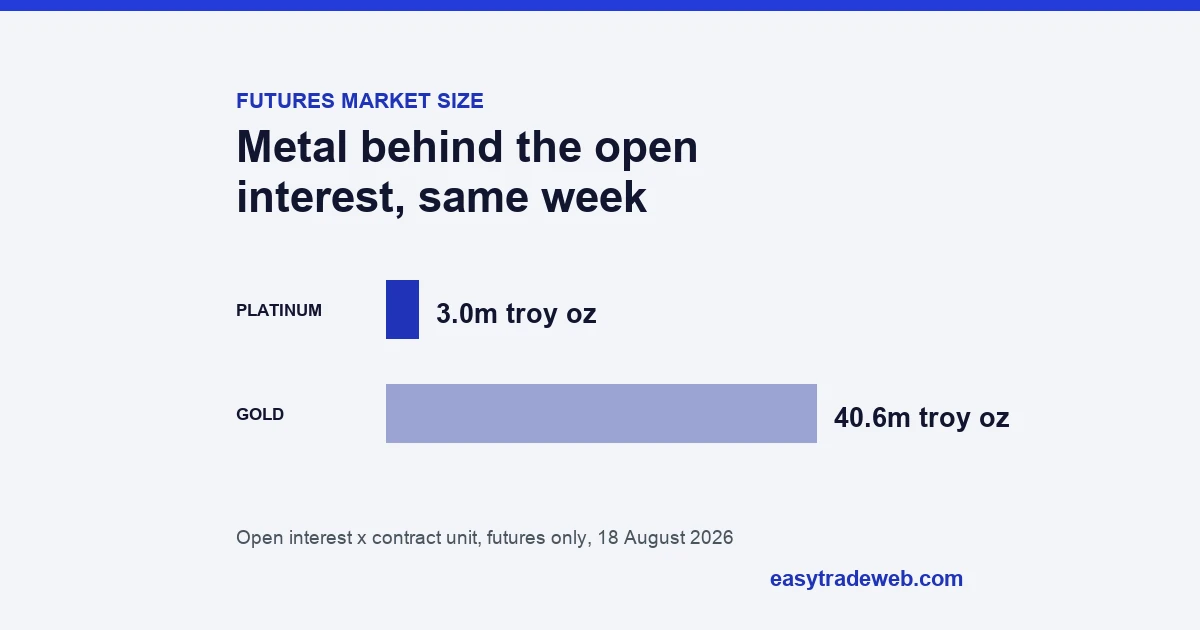
- The NYMEX platinum futures contract is 50 troy ounces, and open interest of 60,129 contracts on 18 August 2026 represented about 3.0 million troy ounces against about 40.6 million for gold.
- Two official bodies supplied every number below, the United States Geological Survey and the Commodity Futures Trading Commission, both read on 22 August 2026. Contract margin, trading hours and broker dealing costs could not be obtained officially and are marked not disclosed rather than estimated.
Table of contents
- Why Platinum Is Priced as an Industrial Metal
- Where the Supply Comes From, and What That Concentrates
- The Gold Correlation Traders Assume, and When It Breaks
- What a Platinum Futures Contract Commits You To
- The Retail Routes Compared: CFD, ETF, Mining Share, Bullion
- Why Thin Liquidity Moves the Stop, Not Just the Spread
- What a Platinum Position Should Be Sized Against
- Who Should Leave Platinum Alone
- Frequently Asked Questions
Why Platinum Is Priced as an Industrial Metal
The United States Geological Survey records the leading use of the platinum-group metals as catalytic converters, fitted to cars to cut exhaust emissions. Beneath it the same survey lists catalysts used in refining and in making bulk chemicals, then medical and dental equipment, electronic components including hard disks and multilayer ceramic capacitors, glassmaking, laboratory apparatus, and only after all of those, investment and jewellery.
Investment and jewellery sit at the end of that list rather than the front.
Read that list in the order it is given and the pricing follows from it. The demand that sets the marginal buyer is a manufacturer meeting an emissions standard, and that buyer responds to vehicle output, engine mix and regulation.
This puts platinum on the industrial side of a divide the site has already drawn between a precious metal and an industrial one. Copper sits plainly on one side and gold on the other. Platinum carries the vocabulary of the first group and the demand structure of the second, which is why it is the metal most often mislabelled by the people trading it.
One consequence follows immediately. A shock to vehicle production is a platinum event and a shock to real interest rates is a gold event, so a position opened for the second reason will be repriced by the first.
Where the Supply Comes From, and What That Concentrates
Supply concentration is described on all three guides, and one of them rounds the leading producer to a share. The survey publishes the whole distribution, and it is tighter than any of those descriptions suggests.
| Country | Platinum mine production, 2024 estimate | Share of world total |
|---|---|---|
| South Africa | 120,000 kilograms | About 71 percent |
| Zimbabwe | 19,000 kilograms | About 11 percent |
| Russia | 18,000 kilograms | About 11 percent |
| Canada | 5,200 kilograms | About 3 percent |
| United States | 2,000 kilograms | About 1 percent |
| World total, rounded | 170,000 kilograms | 100 percent |
Three countries account for about 92 percent of mine supply. One of them accounts for about 71 percent on its own, and the reserves are more concentrated still: the survey puts South African reserves at 63,000,000 kilograms against a world total it states as more than 81,000,000 kilograms, with the largest deposits in the Bushveld Complex.
What that concentrates is a set of risks that are local rather than financial. The survey attributes the 2024 fall in South African output to declining prices, the higher costs of deep-level mining, labour disputes and continuing disruption to electricity supply. Three of those four are specific to one country.
The demand side carries a mirror-image concentration. Because the leading use is a vehicle component, an emissions rule change or a shift in engine mix reaches a large share of demand at once, in the way that a change in one jewellery market does not reach gold.
The Gold Correlation Traders Assume, and When It Breaks
Platinum is traded as a gold proxy more often than the demand structure justifies, and the assumption is usually inherited rather than tested. It comes from the shared label, from both being quoted per troy ounce, and from long stretches where the two do move together.
The mechanism that breaks the link is substitution, and it is measurable. Palladium does the same job in an emissions catalyst, and the survey records that in gasoline engines the swap has already happened across most of the fleet, driven by palladium having been the cheaper of the two metals for years. For diesel units it puts the routine swap proportion at about 25 percent, rising to about 50 percent in certain uses.
Nothing equivalent exists for gold. A large share of platinum demand can be switched to a different metal by a manufacturer responding to a price gap, which means a rising platinum price carries a built-in brake that a rising gold price does not. Reading two metals against each other has limits that are worth understanding directly, and how two metals are read against each other covers where a ratio between them stops describing anything.
Recycling adds a second channel. United States recovery from scrapped vehicle catalysts came to about 8,500 kilograms of platinum in 2024 on the same survey, so scrap supply answers the price with a lag and answers the age of the vehicle fleet independently of it.
What a Platinum Futures Contract Commits You To
The exchange-traded contract is the reference the other routes are priced from, so it is worth knowing before choosing a route that is not it.
The Commodity Futures Trading Commission publishes platinum futures under the New York Mercantile Exchange in its weekly Commitments of Traders report, and the report states the contract unit in its own heading: contracts of 50 troy ounces. At that size, a one dollar move in the quoted price per troy ounce changes the value of one contract by 50 dollars.
Two figures a reader would reasonably want next are not stated here, and the reason is worth being explicit about. The exchange page carrying the margin requirement and the daily trading hours returned an access error to every request made while preparing this page, and no broker contract specification could be read either. Those figures are therefore recorded as not disclosed rather than carried across from a trading guide.
A margin number taken from a secondary page is a number with no date on it, and margin is changed by the exchange without notice.
The other thing a futures position commits you to is a curve rather than a price, since the contract expires and holding exposure beyond that means moving to a later month at whatever that month costs. What a futures curve costs to hold sets out how that rollover adjustment works and why a trader should not read it as money lost.
The Retail Routes Compared: CFD, ETF, Mining Share, Bullion
The four routes are usually presented as four ways to do one thing. They commit capital to four different claims, and the difference decides what a position is actually exposed to.
| Route | What the capital buys | What it adds beyond the metal price | What it removes |
|---|---|---|---|
| CFD on spot platinum | A contract with the broker, referencing the price | Counterparty exposure to that broker and a financing charge to hold | Any claim on metal, and any delivery |
| Physically backed ETF | A share in a fund holding allocated metal | A management fee and equity-market trading hours | Storage of your own, and leverage unless borrowed |
| Mining share | A claim on a company, not on the metal | Operating cost, electricity supply, labour relations and jurisdiction | Any reliable one-to-one link to the metal price |
| Bullion | The metal itself, held or vaulted | A dealing spread on both sides, plus storage and insurance | Leverage, and same-day exit at a screen price |
The mining share is the row that surprises people. Buying a producer in a country supplying about 71 percent of world output attaches the position to that country rather than to the metal, and the survey names electricity supply and labour disputes among the reasons output fell in 2024. A metal view expressed through a miner is a metal view plus an operating business.
What each route costs to deal and to hold at a particular broker is the half of this question this page cannot answer from an official source, and the mechanics of reading those figures off a specification sheet are set out for the neighbouring metal in the same routes priced for silver, including what one lot represents, what an overnight position costs and when the market is open.
Why Thin Liquidity Moves the Stop, Not Just the Spread
Every guide to this metal notes that platinum is less liquid than gold. The figure behind the claim is public, and it is larger than the phrasing suggests.
The Commitments of Traders report for 18 August 2026 records open interest of 60,129 platinum contracts of 50 troy ounces each, which is about 3.0 million troy ounces. The same week records 406,260 gold contracts of 100 troy ounces each, about 40.6 million troy ounces. The gold futures market carried roughly 13.5 times the metal that week.
The reporting trader count differs by less than that, at 206 in platinum against 292 in gold, so the gap is mostly in size per participant rather than in the number of participants.
The usual conclusion drawn from this is that the spread is wider, and it is. The consequence that changes a decision is a different one. A thinner book means price moves further between resting orders, so the distance a stop must sit from entry to survive ordinary noise is larger than on gold.
That is a change in the stop, and the stop is the input to position size rather than an output of it. A wider spread costs a fixed amount at entry. A wider stop changes every position on the instrument, permanently.
What a Platinum Position Should Be Sized Against
Position size on this instrument falls out of the stop distance, not out of an account-risk percentage applied to a habit formed elsewhere. The percentage decides how much a losing trade may cost. The stop distance decides how many units that permits, and on platinum the stop distance is set by the thin book described above.
Run the two in that order and the size that comes out is smaller than the one a gold habit would suggest, for the same risk in currency terms. Run them in the other order and the risk taken is larger than the number written down, because the stop was placed where the account-risk figure allowed rather than where the instrument required.
There is a second sizing question, about scaling a metal position against a gold position already held, and it is answered for the neighbouring metal rather than repeated here. Commodity exposure of any kind has a starting point in where commodity exposure starts, which covers account setup and the market groups.
Who Should Leave Platinum Alone
A trader looking for a store of value or an inflation hedge is looking at the wrong metal, because the demand that prices it is industrial and the substitution channel is real.
A trader who cannot widen the stop without the resulting size becoming too small to be worth holding is better off on a deeper market. And anyone whose thesis is a view on vehicle production or emissions policy should say so, because that is what the position is, whatever the metal is called.
Frequently Asked Questions
How can a retail account get exposure to platinum?
Through four routes that commit capital to different things: a contract for difference referencing the price, a physically backed exchange traded fund, a share in a mining company, or the metal itself. The contract for difference and the fund track the price most closely, the mining share attaches the position to an operating business, and bullion removes leverage and same-day exit at a screen price.
Why does platinum trade below gold when it is scarcer?
Because scarcity in the ground is not what sets the price. Platinum is bought mainly by industry, led by catalytic converters, so demand rises and falls with vehicle production and emissions rules. Gold is bought largely to be held, and holders do not consume it, so a much larger stock of it exists above ground relative to what is mined each year.
What makes a platinum position harder to exit than a gold one?
The size of the market. Platinum futures open interest on 18 August 2026 was 60,129 contracts of 50 troy ounces, about 3.0 million troy ounces, against about 40.6 million troy ounces for gold in the same week. A thinner book means price travels further between resting orders, so exits at a chosen level are less reliable and stops need more room.
What moves the platinum price most?
Two things with no equivalent in gold. The first is anything affecting vehicle manufacturing and emissions regulation, since catalytic converters lead demand. The second is supply disruption in southern Africa, because South Africa produced an estimated 120,000 of the 170,000 kilograms mined worldwide in 2024, and mining costs, labour disputes and electricity supply were all named as reasons output fell that year.
Risk warning: this page is educational and explains how platinum is produced, priced and accessed. It is not advice to buy or sell platinum or any other instrument, it states no view on any future price, and nothing here is a signal or a prediction. Leveraged exposure to commodity markets carries a high risk of losing money.