
Trend Following Strategy: The Bet You Are Actually Making

Trend following is usually introduced as a way to stay in a move for as long as it lasts. That is what the method does. It is not what makes it pay, and the gap between the two decides whether it belongs on your account at all.
The design is built around being wrong more often than right. Profit arrives through a small number of positions that travel much further than the losing ones cost, and the losing ones arrive in runs. What follows is the shape of the return this design produces, the kind of vehicle the published record belongs to, the rule that can close a correct position on a retail account, and a test for whether any of that fits your situation.
Key takeaways
- The method is not designed to be accurate. It is designed so that the trades it gets right are worth more than the trades it gets wrong, which is a different property and demands different behaviour from the trader.
- Most of the long-run track records quoted for trend following belong to registered managed-futures programmes, and the National Futures Association publishes the registration category that defines them.
- A retail contract-for-difference account is governed by a mandatory close-out rule, so a position can be closed while the direction it was opened for is still intact.
- Long runs of losing trades are part of the design rather than a sign it has stopped working, which is exactly why the method is abandoned at the point it costs the most to abandon.
- The entry rule is the smallest part of the problem. Position size, the exit and the number of trades you will sit through decide the outcome long before the signal does.
- The method suits a specific situation. This page ends with the three situations it does not suit.
Table of contents
- Before the Method: Three Things Your Account Has to Be Able to Do
- Accuracy Is Not the Edge, and That Is the Whole Design
- The Record Behind the Phrase Belongs to a Registered Vehicle
- Right About the Direction and Closed Out Anyway
- What a Long Run of Losing Trades Does to the Decision
- The Signal Is the Small Part of the Problem
- Who Trend Following Is Not For
- Which of These Three Situations Is Yours
Before the Method: Three Things Your Account Has to Be Able to Do
Most explanations of trend following begin with the entry rule. That order is backwards, because the entry rule is the part that transfers between accounts unchanged and the rest is not. Three account-level conditions decide whether the method can be run at all, and each of them can be checked before a single chart is opened.
The first is trade count. A method whose profit sits in a minority of its positions needs enough positions for that minority to appear. Whether an instrument has historically suited this family at all is a separate question, and one way of framing it is measuring persistence in a series. An account taking two trades a month is not running the method; it is taking two trades and calling them by its name.
The second is position size small enough that a run of losses changes nothing structural. If a losing sequence forces the size down, the winners that were supposed to pay for the sequence arrive on smaller positions than the losses were taken on, and the arithmetic that justified the method no longer holds.
The third is the ability to leave a position alone while it moves against you inside its plan. This is a behavioural condition, not a technical one, and it is the condition most often assumed rather than tested. Whether your rules or your judgement hold the position open is a separate question, and one worth settling first through whether the rules or the trader decides.
None of the three is about markets. All three are about the account and the person operating it, and all three can be answered honestly in an afternoon.
Accuracy Is Not the Edge, and That Is the Whole Design
A reader arriving from the usual explanations comes away believing that trend following works by identifying trends correctly. That belief is the single most expensive misunderstanding attached to the method, because it sets the wrong expectation about what a normal week looks like.
The method takes many small losses in conditions that do not trend, and holds a few positions through moves that go much further than any of those losses. The profit is not produced by a high proportion of correct calls. It is produced by the size difference between the trades that work and the trades that do not, while the proportion of correct calls stays low enough to feel like failure.
That distinction has a practical consequence.
Judged by hit rate, the method looks broken during the periods it is working exactly as designed. Judged by the relationship between average win and average loss across a large number of trades, the same period reads normally.
The arithmetic that converts those two figures into a single answer is set out in the arithmetic that decides whether a low hit rate still pays, and it is worth working through before the method is judged on a month of results.
The second consequence is that the losses are not a defect to be filtered away. Filters that remove the flat periods remove entries indiscriminately, and the entries removed include the ones that would have become the outsized winners. The small losses are the cost of holding the ticket for the moves that pay, and a method that stops paying that cost stops receiving what it was buying.
The Record Behind the Phrase Belongs to a Registered Vehicle
The long track records quoted in support of this method almost never come from individual accounts. They come from managed programmes that trade futures across many markets at once, and those programmes sit inside a defined regulatory category.
The National Futures Association publishes the registration requirement for the category. A commodity trading advisor, in that framework, is anyone paid to tell other people whether and how to trade four things: futures, options written on futures, retail forex traded away from an exchange, and swaps.
Registration of that category was delegated to the National Futures Association by the Commodity Futures Trading Commission in 1984. Exemptions exist and are set out in Commodity Futures Trading Commission Regulation 4.14, one of which covers advice given to fifteen or fewer persons over the preceding twelve months.
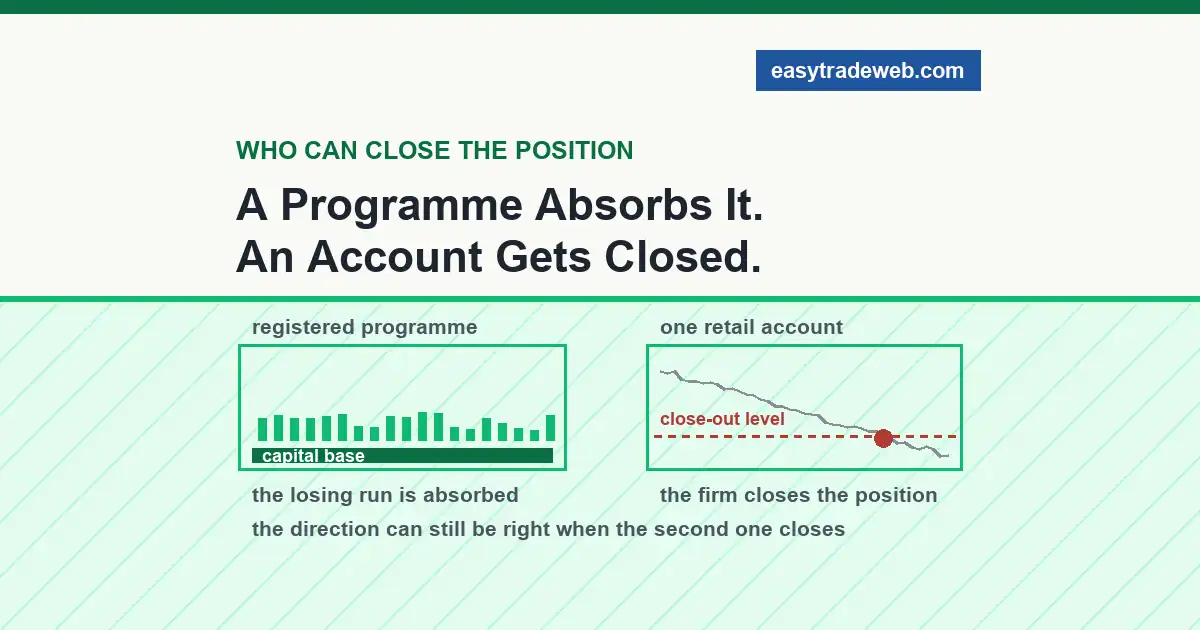
None of that is a detail about paperwork. It describes the operating conditions behind the numbers: dozens of markets held simultaneously, futures rather than contracts for difference, and a capital base that lets a losing run pass without changing anything.
A single retail account carries none of those conditions, so the record is evidence that the design can work rather than evidence of what it will do on one account with a handful of instruments.
| Condition | Registered managed programme | One retail account |
|---|---|---|
| Instrument traded | Exchange-traded futures and options on futures | Contracts for difference or spot positions with a single firm |
| Number of markets held at once | Many, across unrelated sectors | However many the account can margin |
| Who may close the position | The programme, under its own rules | The trader, or the firm under COBS 22.5.13R |
| Effect of a losing sequence | Absorbed by the capital base | Reduces the equity the close-out rule is measured against |
| Registration status | Registered category published by the National Futures Association | None; the account holder advises nobody |
One published rule set from that world has been written out in full and is worth reading against your own constraints rather than admiring at a distance. It is set out in one published trend-following rule set, along with what changes when its unit sizes are moved onto an account that is not a futures account.
Right About the Direction and Closed Out Anyway
A trend position is held for weeks or months, which puts it in contact with a rule that a short-term position rarely meets. On a retail account governed by the Financial Conduct Authority Handbook, the firm has an obligation about how far the account may fall before positions are closed.
The rule sits at COBS 22.5.13R. It puts a floor under the account and hands the firm the job of enforcing it. Once what the client actually owns has fallen to half of the margin supporting the open positions, the firm has to close them.
The floor is measured against that margin requirement, not against the deposit and not against the size of the trade. The obligation belongs to the firm, not the client, which means it operates whether or not the client agrees with the timing.
For a trend position that is correct but early, this is the failure that matters. Direction, entry and thesis can all be intact while the account equity has fallen far enough to trigger the requirement, and the position is closed anyway. The move that follows is then no longer yours.
A second rule in the same section, COBS 22.5.17R, caps what a retail client can owe at whatever the account holds, so a closed-out trend position cannot leave a debt behind it.
What this changes is the sizing decision, not the method. A position sized so that an ordinary adverse excursion approaches the close-out threshold is not a long-hold position, whatever the plan says. The cost of holding a leveraged position over long periods is developed separately in what a position costs while you wait.
What a Long Run of Losing Trades Does to the Decision
Between the moves that pay, the method produces sequences of losing trades that can run for months. Those sequences are not a malfunction, and a reader who has understood the previous two sections already knows why they must exist. Understanding them and sitting through them are different problems.
The decision they force is always the same one, and it always arrives at the worst moment: continue, reduce, or stop.
Every option is defensible in isolation. Reducing size protects the balance and shrinks the winner that ends the sequence. Stopping ends the losses and forfeits the payoff the losses were purchased for. Continuing risks that the method has genuinely stopped suiting the market, which does happen and cannot be distinguished from a normal sequence while it is running.
The only defence available before the fact is deciding, in advance and in writing, what would count as evidence that the method has stopped working, expressed as a number of trades rather than a feeling. A rule stated in advance is not a guarantee, but it converts the question from one asked under pressure to one already answered.
How the depth of such a sequence is measured, and why the same account can produce several different figures for it, is covered in how a drawdown figure is measured. The question here is not the measurement. It is whether the sequence will still be tolerable in month four.
The Signal Is the Small Part of the Problem
Discussions of trend following spend most of their length on entry tools: moving averages, breakout channels, momentum readings. The tools are real and they do the job of defining a trend mechanically. They are also the most replaceable component in the method.
Two traders can run the same entry rule on the same instrument and produce results that share nothing, because the entry rule does not set position size, does not set the exit, and does not determine how many trades the account will sit through before judging the result. Those three decisions carry the outcome.
Where a tool does matter is in defining the trend without leaving the definition open to interpretation. The channel used by the earliest published breakout rules is described in the channel the original breakout rules used, including why two platforms can draw it differently on the same instrument. The broader choice between a mechanical rule set and a judged one is treated in whether the rules or the trader decides.
Who Trend Following Is Not For
The method is unusually specific about who it suits, and the pages that promote it are unusually quiet about the rest.
It is not for an account that needs regular income from trading. Its returns arrive irregularly and the gaps between them can span calendar quarters, which is incompatible with drawing on the account.
It is not for a trader who judges a method over ten or twenty trades. That sample is far too small for a low-hit-rate design to show anything, and the conclusion drawn from it will be wrong in a predictable direction.
It is not for an account whose size forces positions large enough that an ordinary losing sequence threatens the close-out requirement described above. In that situation the method has not failed. It was never able to run.
And it is not for anyone who cannot watch a position give back a substantial part of an open gain without intervening, since giving back part of the move is how every trend exit works.
Which of These Three Situations Is Yours
If the account can carry enough positions for a minority of winners to appear, the size is small enough that a losing run changes nothing structural, and the sequence can be sat through, the method fits and the remaining work is choosing a rule set and holding to it.
If the account meets the first two conditions but the third is untested, the honest next step is a small number of positions run at a size that cannot damage anything, judged on whether the rules were followed rather than on the result.
If the account fails the first condition, the method is not available at that size, and no entry rule changes that. Recognising which of the three describes your situation is worth more than any refinement to the signal, and it is the one decision none of the material ranking for this term will make for you.
Risk warning: this page is educational and describes how a category of trading method is constructed. It is not advice to open, hold or close any position, and no method described here produces a profit. Leveraged trading carries a high risk of loss, and a method that holds positions for long periods carries the risk that positions are closed by the firm before the intended exit.