
Yield Curve Control: When a Central Bank Pins a Bond Yield

A central bank normally sets one price and lets the market set the rest. Yield curve control is the arrangement in which it names a second one further out along the curve, and then buys whatever quantity of government paper is needed to hold that number.
Japan ran the best-known version of it, and stopped. Most published explanations of the idea were written while it was still running and have not been revised since, so they describe a live policy in the present tense. What follows is what the Bank of Japan itself decided, in the two documents that opened and closed the framework.
Key takeaways
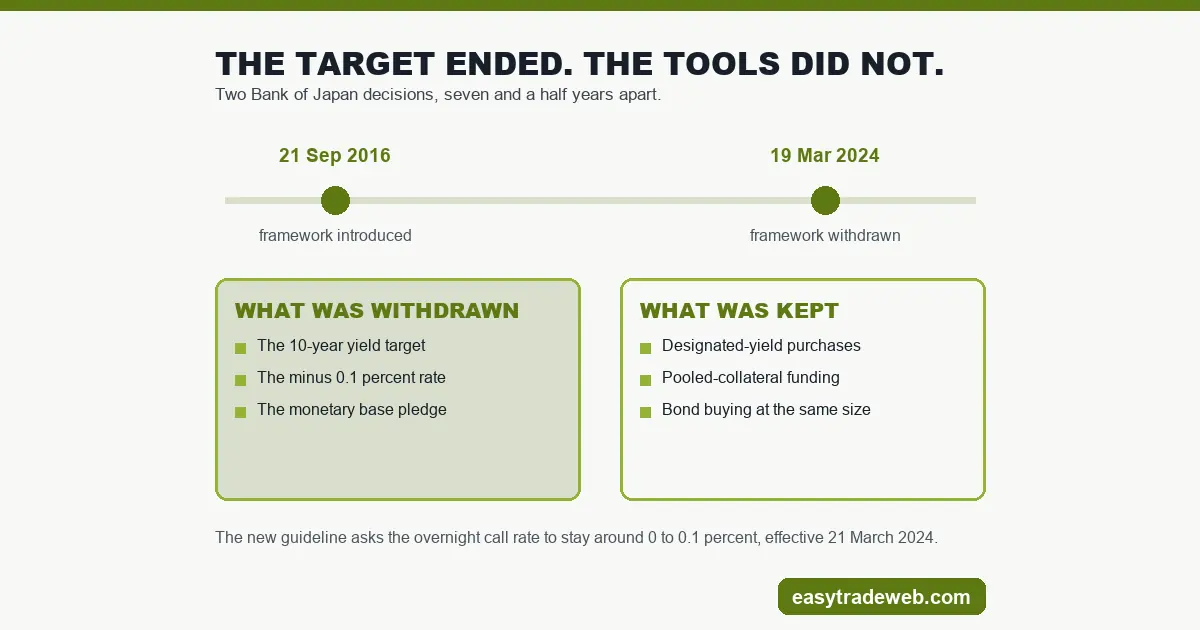
- The framework ended. On 19 March 2024 the Bank of Japan judged that it and the negative interest rate policy had done their work, and moved to a guideline for the overnight call rate that took effect on 21 March 2024.
- It was never a long-rate policy alone. The 2016 guideline named a short-term policy rate of minus 0.1 percent and a target for 10-year government bond yields of around zero percent in the same instruction.
- The enforcement mechanism has a name. The Bank introduced outright purchases at yields it designated, and extended a fixed-rate funding operation from one year to as long as ten.
- A separate promise came with it: to keep expanding the monetary base until observed annual consumer price inflation ran above the 2 percent target and stayed there.
- The target went, the tools stayed. The 2024 decision keeps those same operations available in case long-term rates rise rapidly.
Table of contents
The Policy Most Explainers Describe Ended in March 2024
At the meeting of 19 March 2024 the Bank’s Policy Board looked at the loop running between wages and prices, and judged a 2 percent inflation target to be in sight on a durable footing.
On that reading it recorded that curve control, together with the negative rate policy that had run beside it, had done the job each was introduced to do.
What replaced them is ordinary by comparison. The Bank now guides a short-term interest rate as its main instrument, and the new guideline asks that the uncollateralised overnight call rate stay in a range of around 0 to 0.1 percent. That guideline took effect on 21 March 2024.
This matters for reading anything else about the subject. A page describing the Bank as currently holding a bond yield at a target is describing the world before that meeting, and the gap is now more than two years wide.
The distinction to hold on to is between the idea and the episode. The technique is not abolished by one central bank standing down, and a version of it can be reintroduced anywhere.
But the running example that almost every explanation is built on is finished, and any figure attached to it is now a historical figure. For the current setting rather than the historical one, read the Bank of Japan decisions as they are published, not a glossary entry.
What the Guideline Specified, at Both Ends of the Curve
The framework arrived on 21 September 2016 carrying a name that spelled out what it combined: the easing programme already running, quantitative and qualitative in the labelling the Bank used for it, now with a curve-control component bolted on.
The Bank set that component out as taking charge of rates at the near end of the curve and the far end alike, and its guideline for market operations put a figure on each.
At the short end, a negative rate of minus 0.1 percent was applied to a defined tier of the balances financial institutions hold in their accounts at the Bank. At the long end, the Bank undertook to buy Japanese government bonds so that 10-year yields would sit more or less where they already were, which it put at around zero percent.
Both instructions were in the same guideline, adopted on a split board by seven votes to two. That is the part almost universally dropped. The technique is usually presented as a way of reaching further out along the yield curve than a policy rate can reach, which is true, but in the version that actually ran the near end was being set at the same time and in the same sentence.
The quantity side is the other half of the reframing. The Bank said it would keep buying at roughly the pace already in place, an annual increase in its bond holdings of about 80 trillion yen, and in the same decision it abolished the guideline governing the average remaining maturity of those purchases.
So the quantity did not become irrelevant. It became the residual: the number that moves to whatever the yield target requires, with one of the constraints on how it could be spread across maturities removed to allow that.
The Operations That Enforced the Target
Announcing a target is not the same as holding one. The decision that introduced the framework also introduced two operations, described as new tools for controlling the curve smoothly, and they are what turned an announcement into a mechanism.
The first is an outright purchase of government bonds at a yield the Bank itself designates rather than one the market discovers. The Bank names the level at which it will buy, which converts the target from a statement of intent into a standing offer.
The second extended an existing funding operation. Fixed-rate loans against collateral had previously run to a maximum of one year; the Bank stretched that to as long as ten, putting a fixed-rate funding source alongside the tenor it was targeting.
Set that against how the technique is usually summarised. The common phrasing is that the central bank buys enough bonds, or buys without limit, to defend the level. Neither names an operation, and the difference is not pedantic: a standing offer to purchase at a designated yield is a specific market instrument with a specific counterparty behaviour attached, and it is the thing a trader would actually watch for.
The Commitment That Came Bundled With It
The 2016 framework had two components, and the yield target was only one of them. The second was a separate undertaking about the size of the central bank balance sheet.
The Bank committed to going on expanding the monetary base until the observed year-on-year rate of consumer price inflation had gone past the 2 percent target and stayed above it in a stable way. Note what that promise is built on: an inflation rate already recorded, not one forecast. A commitment keyed to observed data is a harder thing to walk away from than one keyed to a projection.
That is a different instrument from the yield target, and it is closer in spirit to quantitative easing than to a price peg. The two were introduced together and are routinely described apart, which leaves the framework looking simpler and weaker than it was.
The 2024 decision closes that half of it too, recording that the conditions attached to the monetary base commitment had been met.
Where Yield Curve Control Reaches a Currency
A currency trader does not deal in bond yields directly, and the transmission is worth being exact about rather than assuming.
Holding a domestic yield at a fixed level while yields elsewhere move means the differential between the two does all of the adjusting. The domestic side is pinned by policy, so every change in the gap comes from abroad. A rate differential that would normally widen and narrow from both ends now moves from one.
That is what makes a pegged curve visible in a currency at all. The exchange rate becomes the variable carrying the pressure that the bond market is no longer allowed to express.
There is a second consequence for anyone reading the release calendar. When a target is being defended by a standing offer, the meeting that could change the target matters far more than the daily prints around it, because between meetings the pinned number is not free to respond to anything.
| Under the 2016 framework | Under the March 2024 guideline | |
|---|---|---|
| Primary instrument | A short-term rate and a long-term yield target together | A short-term interest rate |
| Short end | Minus 0.1 percent on a defined tier of balances at the Bank | Overnight call rate guided to around 0 to 0.1 percent |
| Long end | 10-year yields held around zero percent | No yield target |
| Bond purchases | Whatever the target required, maturity guideline abolished | Broadly the same amount as before |
| Designated-yield purchases | The enforcement tool | Retained as a contingency |
| Balance sheet promise | Expansion until observed inflation ran above target | Conditions recorded as met |
What Replaced It, and What the Bank Kept
The most useful detail in the 2024 decision is not the ending. It is what was deliberately left in place.
The Bank said it would carry on buying government bonds in broadly the amount it had been buying, and that if long-term rates rose rapidly it would respond quickly, naming exactly the instruments the old framework had used: larger bond purchases, purchases at a designated yield, and the funding operation against pooled collateral. It added that those responses need not wait for the scheduled monthly purchase timetable.
So the yield target was retired and the machinery that defended it was not. That is a meaningful distinction for anyone judging what a central bank could do next, because reintroducing a target is a much smaller step when the operations already exist and the board has said it is prepared to use them.
The bond-market half of this is one subject and the currency half is another. If the question is how a scheduled policy meeting turns into movement on a pair, that mechanism is set out for a different central bank in the page on how a rate decision is read, and the same reading applies wherever the meeting is held.
Risk warning: this page is educational and explains how one central bank policy framework was defined, operated and withdrawn. It is not advice to buy or sell any instrument, it recommends no product, platform or broker, and nothing here is a signal, a performance claim or a prediction. Leveraged trading carries a high risk of losing money rapidly.