
The Bank of Japan Decision: No Published Time, Late Minutes

Most central banks tell you when the decision will land. The Bank of Japan does not. Its published meeting calendar carries an exact release time for the Summary of Opinions, an exact time for the minutes and an exact time for the full Outlook Report. Beside the policy decision itself there is no time at all, only a sentence saying it goes out once the meeting has finished.
That one omission is why a Bank of Japan meeting day behaves differently from a Federal Reserve or European Central Bank one, and why the far end of the same calendar, the column holding the minutes, is worth more attention here than anywhere else.
Key takeaways
- The Bank of Japan holds eight Monetary Policy Meetings a year, each running two days, and publishes the dates about two years ahead. The full 2027 calendar is already out.
- That calendar prints a release time for three documents. It prints none for the policy decision, which the Bank describes only as being announced once the meeting ends.
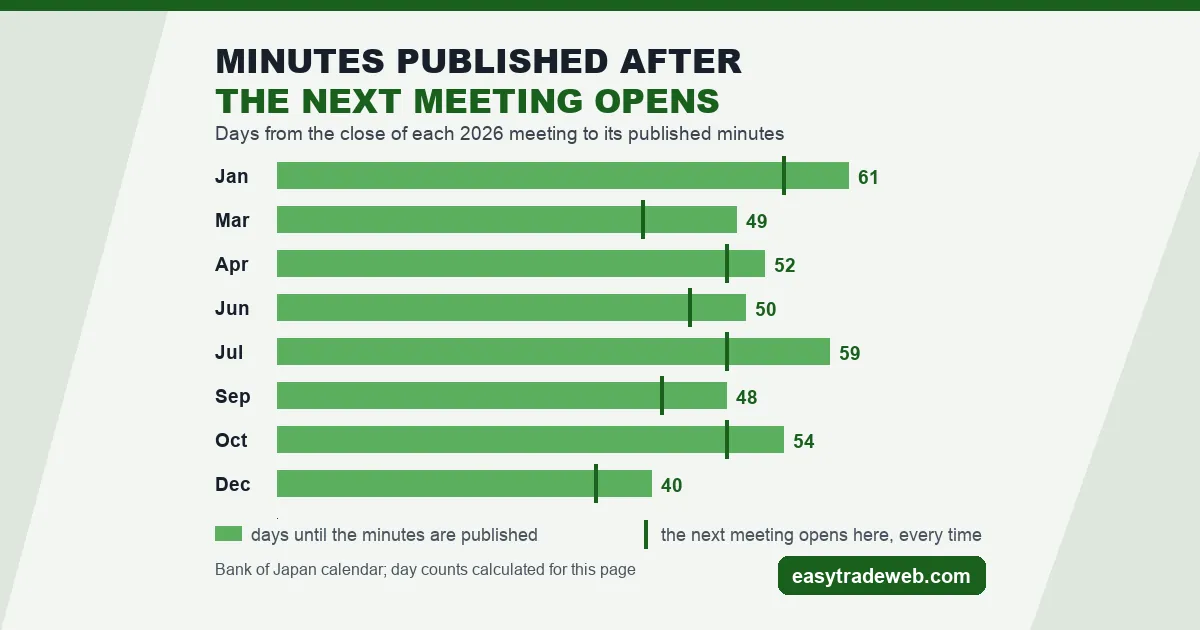
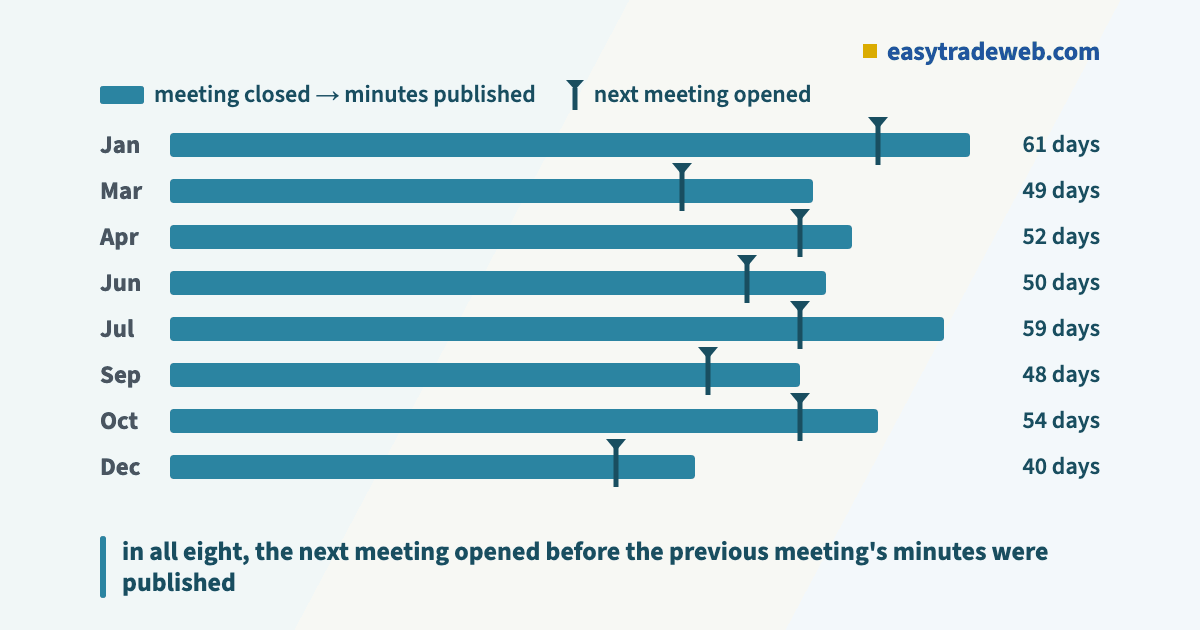
- Across all eight meetings scheduled for 2026, the minutes appear between 40 and 61 days after the meeting closes.
- In all eight cases the minutes land after the following meeting has already opened, by 4 to 11 days. The Federal Reserve fixes its own minutes at three weeks, which always falls before the next meeting.
- Four of the eight 2026 meetings carry an Outlook Report and four do not. The calendar shows which four, and a dash marks the rest.
Table of contents
- What the Monetary Policy Meeting Actually Decides
- The Calendar: Eight Two-Day Meetings, Published Two Years Ahead
- The Decision Has No Published Release Time
- Every Other Document From the Same Meeting Does
- The Minutes Arrive After the Next Meeting Has Opened
- Four Meetings Carry an Outlook Report and Four Do Not
- How the Publication Schedule Differs From the Fed’s
- What to Check Before a Meeting Week
What the Monetary Policy Meeting Actually Decides
The Monetary Policy Meeting, shortened to MPM in every Bank of Japan document, is the sitting at which the Policy Board settles the stance of monetary policy. The Board has nine seats: the Governor, two Deputy Governors and six other members. Decisions carry on a majority of those nine votes.
What the Board actually agrees is the guideline for money market operations. The Bank then works to that guideline day by day, supplying funds to financial institutions against collateral or draining funds back out, depending on which direction the guideline points. Between 2016 and 2024 that guideline also carried a target for a bond yield, the arrangement known as yield curve control.
Alongside the guideline the Bank publishes its reading of economic activity and prices and its stance for the period immediately ahead. The frame around all of it is statutory: the Bank of Japan Act ties monetary policy to price stability, and in January 2013 the Bank fixed that in numbers as a 2 percent target for the year-on-year change in the consumer price index.
The Governor chairs the Board and holds a press conference after each meeting to take questions on the decision. For anyone watching from outside Japan, the meeting and the conference both fall inside the Tokyo hours covered in our guide to when each currency market session opens.
The Calendar: Eight Two-Day Meetings, Published Two Years Ahead
Eight meetings a year, two days each, is the fixed pattern. In 2026 they fell on 22 to 23 January, 18 to 19 March, 27 to 28 April, 15 to 16 June, 30 to 31 July, 17 to 18 September, 29 to 30 October and 17 to 18 December.
The Bank publishes the following year in the same place well before it starts, and the 2027 dates are already listed: 21 to 22 January, 17 to 18 March, 27 to 28 April, 10 to 11 June, 21 to 22 July, 21 to 22 September, 28 to 29 October and 16 to 17 December. Anyone building a calendar of event risk more than a quarter out can take the Japanese dates straight from the source rather than waiting for a broker calendar to fill them in.
The table itself has four columns. One holds the meeting dates. The other three are release dates for documents that come out of that meeting, and it is those three columns, not the first, that carry the timing information most readers are looking for.
The Decision Has No Published Release Time
Under each yearly table the Bank prints a short note headed with the words that the time of release will, in principle, be as follows. Three entries follow it. None of them is the decision.
The decision is covered instead by a line on the Bank’s outline of monetary policy, which says the Board announces what it has decided immediately after the meeting concerned. That is a sequencing statement, not a clock time. It tells you the announcement follows the close of the second day, and it deliberately commits to nothing narrower.
The practical consequence is that a Bank of Japan decision cannot be diarised the way a European Central Bank decision can. There, the rate announcement and the press conference are two separately scheduled events with their own published times, which is the structure set out in our page on how the euro area decision is released. A Japanese meeting has a known day and an unknown hour inside it.
Third-party calendars fill the gap with an estimate, and the estimate is usually presented with the same styling as a confirmed time. It is worth knowing which of the two you are reading, because the Bank has published one and not the other.
Every Other Document From the Same Meeting Does
The contrast is sharp once the three published times are set out. Two of them are the same clock time on a stated later date, and the third is tied to the meeting itself.
| Document from the meeting | Published release time | When it appears |
|---|---|---|
| Policy decision | None published | Once the second day of the meeting ends |
| Outlook Report, the Bank’s View | None published | Straight after the four meetings that carry one |
| Outlook Report, full text | 2:00 p.m. | The following business day |
| Summary of Opinions | 8:50 a.m. | 8 to 14 days after the meeting closed in 2026 |
| MPM Minutes | 8:50 a.m. | 40 to 61 days after the meeting closed in 2026 |
The Summary of Opinions is the document with no close equivalent elsewhere. It collects the views expressed around the table, unattributed, and in 2026 it reached the public between 8 and 14 days after each meeting closed. Every one of those eight releases came out before the next meeting opened.
What the Summary of Opinions contains is a set of views put forward during the meeting, printed without saying who said what. Attribution comes much later and in a different form: the Bank releases the transcripts of its meetings ten years after the event, which places them well outside any trading horizon and firmly in the archive.
The minutes are a different matter, and they are the reason the last column of the calendar repays a second look.
The Minutes Arrive After the Next Meeting Has Opened
Reading the 2026 table across all eight rows produces a result that no explainer states and that the Bank never comments on: the minutes of a meeting are always published after the following meeting is already under way.
| Meeting closed | Minutes published | Days after the close | Days after the next meeting opened |
|---|---|---|---|
| 23 January 2026 | 25 March | 61 | 7 |
| 19 March 2026 | 7 May | 49 | 10 |
| 28 April 2026 | 19 June | 52 | 4 |
| 16 June 2026 | 5 August | 50 | 6 |
| 31 July 2026 | 28 September | 59 | 11 |
| 18 September 2026 | 5 November | 48 | 7 |
| 30 October 2026 | 23 December | 54 | 6 |
| 18 December 2026 | 27 January 2027 | 40 | 6 |
The shortest wait in the year is 40 days and the longest is 61. The narrower figure is the one in the final column: by the time a set of minutes is public, the Board has been sitting on the next decision for somewhere between 4 and 11 days.
The 2027 schedule shows the same thing before the year has begun. Seven of its eight rows already carry a minutes date, and in all seven the date falls after the following meeting has opened, by 6 to 10 days. The lags themselves widen slightly, running from 43 to 68 days. Only the December 2027 meeting is still marked as to be announced, and there is nothing in the seven published rows to suggest it will break the pattern.
That changes what the document is for. Minutes released before the next meeting are a guide to what might happen at it. Minutes released after it has begun are a record of a decision the Board has already moved past, and on two occasions in 2026 they arrived after the next decision had been announced.
It also means the Summary of Opinions carries the load that minutes carry at other central banks. It is thinner, it names nobody, and in 2026 it was the only account of a meeting available before the following one started.
Four Meetings Carry an Outlook Report and Four Do Not
The Outlook for Economic Activity and Prices, called the Outlook Report throughout the Bank’s material, is attached to half the meetings. In 2026 it came from the January, April, July and October meetings. Beside the other four the calendar prints a dash.
The 2027 schedule keeps the same shape, with the report attached to the January, April, July and October meetings again. So the pattern is stable enough to plan around, and the calendar states it explicitly rather than leaving it to be inferred.
The report is released in two pieces. The section headed the Bank’s View goes out with the decision itself at the four meetings that carry one, and the full document follows at 2:00 p.m. the following business day.
This half-the-meetings asymmetry has a direct parallel at the Federal Reserve, where the projections that make up the quarterly dot plot are also published at four meetings out of eight. Two central banks, the same split, and in both cases a meeting without the document is a smaller event than a meeting with it.
How the Publication Schedule Differs From the Fed’s
The Federal Reserve fixes its minutes at three weeks after each policy decision. That is a rule rather than a range, and three weeks always lands inside the gap between two meetings, so a Federal Reserve meeting is fully documented before the next one opens.
The Bank of Japan publishes no such rule and the observed range in 2026 ran from 40 to 61 days. Nothing in either central bank’s material calls one approach late and the other prompt. They are simply different systems, and a reader who assumes the American timetable applies in Tokyo will look for a document that is still weeks away.
The wider question of what each major central bank releases on decision day, and in what order, is handled separately in our page on how central bank tone is read across the Fed, the Bank of England and the ECB. This page covers the Japanese schedule only, and does not repeat that comparison.
One more Federal Reserve document has no Japanese counterpart at all: the survey of business conditions that always sits a fixed number of days before the meeting. The Bank of Japan publishes nothing on a comparable pre-meeting schedule.
What to Check Before a Meeting Week
Five checks, each answerable from the Bank’s own calendar in a couple of minutes.
- Confirm the two meeting dates from the Bank’s own schedule page rather than a third-party calendar, and note that the announcement follows the second day.
- Treat any clock time shown for the decision as an estimate supplied by whoever published the calendar, because the Bank publishes none.
- Check whether the meeting is one of the four in the year that carries an Outlook Report, since the volume of material released differs sharply between the two cases.
- Find the Summary of Opinions date for the meeting. That is the first account of the discussion you will be able to read, and it is normally a week or two out.
- Look up the minutes date as well, and check it against the following meeting date. In 2026 it fell after that meeting had opened every single time.
None of this predicts what the Board will decide, and none of it is meant to. It sets out when each piece of information becomes available, which is a question with a published answer.
Risk warning: this page is educational and describes the publication schedule of a central bank. It is not advice to buy or sell any instrument, it recommends no product, platform or broker, and nothing here is a signal or a prediction about interest rates or any currency. Leveraged trading carries a high risk of losing money.