
FOMC Minutes Explained: Three Records of One Fed Meeting

One Federal Open Market Committee meeting produces three separate published records, and they do not arrive together. The statement lands on the afternoon of the decision. The minutes follow three weeks later. The full transcript is held back for about five years.
Most explanations of the minutes describe them as the record of the meeting. They are one of three, they are the only one written to be read while the decision still matters, and what they contain is narrower and more formal than the phrase committee discussion suggests.
Key takeaways
- Minutes of a regular FOMC meeting appear three weeks on from the decision date, at 2:00 in the afternoon Eastern time.
- Across the five 2026 meetings that have produced minutes, the interval was exactly 21 days from the second day of the meeting, every time.
- The minutes are an official record: they identify every attendee and give a complete account of the policy actions taken, including how each voting member voted.
- The most detailed record is the transcript, and the committee releases transcripts after roughly five years.
- The Federal Reserve is comparatively quick on that point. Only a few G-20 central banks publish transcripts at all, and those that do wait longer: ten years at the Bank of Japan, eight at the Bank of England.
Table of contents
- What the Minutes Actually Are
- Three Records of One Meeting, on Three Clocks
- The Three-Week Rule, Measured Against Every 2026 Meeting
- What the Minutes Identify That the Statement Does Not
- Why the Transcript Waits Five Years
- Reading the Minutes Against a Decision You Already Traded
- Which of the Three Records You Should Be Reading
What the Minutes Actually Are
The Federal Reserve describes the minutes as a timely summary of the discussion at the meeting and of the decisions taken there, setting out the views policymakers expressed and the reasoning behind what the committee decided.
Two words in that description carry most of the weight. Summary means the document is not a transcript and was never meant to be one: positions are attributed by role rather than by name, so a reader learns that some participants held a view without learning which ones. Timely means it is written to reach the public while the decision it explains is still the operative one.
The rest is procedural and is the part traders tend to skip. Because the minutes are the official record of the meeting, they carry the full account of policy actions and the individual votes behind each of them. That is not commentary and it is not open to interpretation; it is the register of what the committee did.
The document is therefore two things stapled together. The first half is discursive and is where the market looks for a change of tone. The second half is administrative and is where the arithmetic of the committee sits, including any dissent. A reader who treats the whole thing as tone reading will miss the half that is not.
Three Records of One Meeting, on Three Clocks
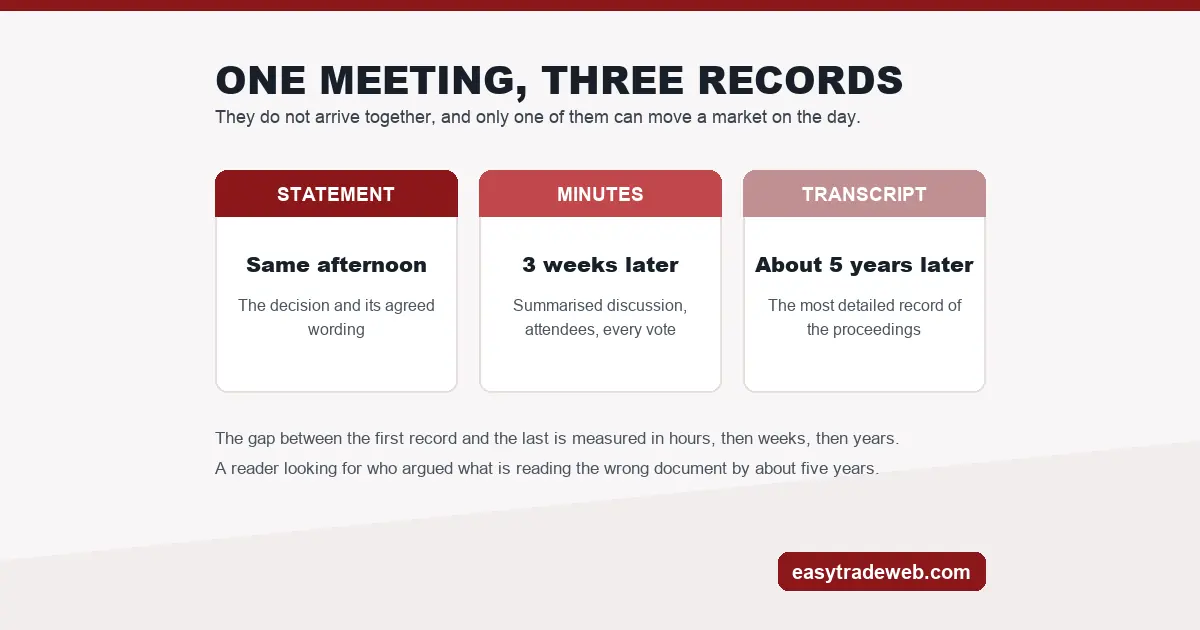
The confusion around the minutes comes from treating them as the meeting record rather than as one of several. Each regular FOMC meeting generates three published documents, and the gap between them is measured in hours, weeks and years respectively.
| Record | When it appears | What it gives you |
|---|---|---|
| Statement | The afternoon of the decision | The decision itself and the agreed wording around it |
| Minutes | Three weeks after the decision | The summarised discussion, the attendee list and every vote |
| Transcript | About five years later | The most detailed record of the proceedings |
The three clocks are the whole point. Only the statement can move a market on the day. Only the minutes can revise the reading of a decision while that decision is still in force. And only the transcript can settle what was actually said, by which time the rate it concerned has usually changed several times.
A reader hunting for who argued what in the room is reading the wrong document by five years. That material exists, it is public, and it is simply not available yet for any meeting held recently.
The same-day package is also larger than the statement alone. The calendar entry for each 2026 meeting lists an implementation note alongside the statement, and a press conference after every one of them, so a good deal of explanation is already public before the minutes are written.
That matters for expectations. The minutes are not the first explanation of the decision, and they are not filling a silence; they are adding the committee-level detail that a prepared statement and a question session cannot carry.
The quarterly meetings add a fourth document, the Summary of Economic Projections, which is published with the statement rather than with the minutes. Its rate chart is covered in the guide to the dot plot.
The Three-Week Rule, Measured Against Every 2026 Meeting
The rule as published carries a qualifier. Minutes of a regular meeting normally appear three weeks on from the date the decision was taken, and normally is the word that invites a check against the record.
| Meeting | Minutes released | Days after the decision |
|---|---|---|
| 27 to 28 January 2026 | 18 February 2026 | 21 |
| 17 to 18 March 2026 | 8 April 2026 | 21 |
| 28 to 29 April 2026 | 20 May 2026 | 21 |
| 16 to 17 June 2026 | 8 July 2026 | 21 |
| 28 to 29 July 2026 | 19 August 2026 | 21 |
Five meetings, five identical intervals, with no exception and no drift. The release time is equally fixed at 2:00 in the afternoon Eastern time, which is the same hour the statement itself appears on decision day.
This is worth knowing because it is unusual. Most of the releases a currency trader watches sit on a statistical calendar whose spacing varies through the year, so the distance between one print and the next has to be looked up rather than assumed. The three remaining 2026 meetings are scheduled for 15 to 16 September, 27 to 28 October and 8 to 9 December, and the published record so far says where their minutes will fall.
A release that is genuinely on rails can be diarised once. That is the practical value of establishing the rule rather than repeating the word generally.
What the Minutes Identify That the Statement Does Not
The statement is short, agreed line by line, and deliberately says less than the committee knows. The minutes are where the surrounding material becomes public, and three specific things appear there and nowhere else at that stage.
The first is the attendee list. The minutes name everyone present, which includes participants who hold no vote in that year. Their views are inside the summarised discussion even though their names are not attached to the ballot.
The second is the complete record of policy actions with the individual votes. A decision reported as a rate change on the day becomes, three weeks later, a tally with names against it and any dissent written into the record.
The third is the reasoning the statement compresses. The statement gives the conclusion in agreed language; the minutes give the range of views underneath it, which is where a reader can see how settled or unsettled that conclusion actually was.
Three things are equally absent, and expecting them is the common way to be disappointed by the document. There is no attribution of arguments to named individuals, because that is what the transcript is for.
There are no economic projections either. Those appear with the statement at the four meetings that produce them, not three weeks later, so the minutes of a projection meeting are commenting on numbers the market has already had for three weeks.
And there is no forecast of the next decision. The document looks backwards at one meeting by design, which is the constraint the following section turns on.
The reason the minutes can move a currency at all is that the middle item and the third item together tell a reader how firm the policy stance is, rather than only what it currently is. That distinction is the substance of hawkish and dovish policy readings.
Why the Transcript Waits Five Years
Transcripts are held back for roughly five years before they are published. The stated purpose of the delay is to let participants speak candidly about conditions and about policy options the committee may not end up choosing.
Whatever one makes of that reasoning, the consequence for a reader is definite. Everything said in the room in the last five years exists in a document that has been written and archived and will eventually be public, and none of it is available now. Transcripts going back to the first FOMC meetings in 1936 are already on the Federal Reserve website.
The five-year wait is also short by the standards of the institutions that do this at all. Only a few G-20 central banks publish transcripts, and those that do wait longer: ten years at the Bank of Japan, eight at the Bank of England.
Most central banks do not publish transcripts in any form, which is the fact that gives the comparison its shape: the choice is not between fast and slow disclosure but between disclosure and none. The Bank of Japan decision and the ECB interest rate decision each publish their own account of a meeting on a different schedule again.
Reading the Minutes Against a Decision You Already Traded
By the time the minutes appear, three weeks of data have landed on top of the meeting they describe. The document contains none of it, and the Federal Reserve says so directly. Every description of conditions inside the minutes rests only on what the committee had in front of it on the day.
That single sentence is the most useful thing on the page for a trader. A minutes release cannot be a reaction to anything that happened after the meeting, so a market move on the day of publication is a repricing of the meeting itself, not new information about the present.
It also sets the ceiling on what the document can tell you. If the data since the meeting has clearly moved against the tone in the minutes, the minutes are not stale so much as answering a question that has already been superseded.
The nearest comparison on the calendar is the Beige Book, which is also anecdotal, also pinned to the meeting cycle, and also describes a window that has closed by the time it is read.
Which of the Three Records You Should Be Reading
The choice is settled by what the question is, and the three documents do not overlap much.
For the decision and the agreed wording, the statement on the day is the whole answer and the minutes add nothing to it. For how firm that decision was, how the votes fell and who was in the room, the minutes are the only document that carries it and they arrive on a fixed 21-day clock. For what was actually argued, the transcript is the only source, and for any recent meeting it does not exist publicly yet.
Anyone trying to extract a forecast from the minutes is asking the wrong document. It is a record of a meeting held three weeks ago, written from information available on that day, and its value is precise rather than predictive.
Risk warning: this page is educational and explains how one central bank publication is produced and timed. It is not advice to buy or sell any instrument, it recommends no product, platform or broker, and nothing here is a signal, a performance claim or a prediction. Leveraged trading carries a high risk of losing money rapidly.