
The Beige Book: What an Anecdotal Fed Report Cannot Tell You

Eight times a year the Federal Reserve publishes a report that contains no data series, no forecast and no vote, and financial media covers it as though it did. The document is a collection of what business contacts across twelve districts have said recently. What makes it worth a trader’s attention is not its contents but its position in the calendar, and that position turns out to be fixed to the day.
Key takeaways
- The Beige Book is a nickname. The document is published under the title Summary of Commentary on Current Economic Conditions by Federal Reserve District, and the Federal Reserve describes the material in it as anecdotal.
- It appears eight times a year, which is also the number of regularly scheduled meetings the rate-setting committee holds. The two counts match because the report is prepared ahead of each of them.
- Across all eight releases scheduled for 2026, the gap between the report and the first day of the meeting that follows it is exactly 13 days in every case, with no exceptions.
- Every one of those eight releases falls on a Wednesday, and every meeting it precedes opens on a Tuesday. The widely repeated approximation of two weeks is a day out.
- There is no consensus figure to beat or miss, because the report publishes no figure. The reaction model most traders bring to a scheduled release has nothing to operate on here.
Table of contents
- What the Beige Book Actually Is, in the Fed’s Own Description
- Eight Reports a Year, and Where Each One Falls
- The 13-Day Rule: Measured Across All Eight 2026 Releases
- Why a Report With No Numbers Still Gets Read
- What Anecdotal Means for a Reaction You Can Trade
- How It Differs From the Data Releases You Already Watch
- Who This Page Is Not For
What the Beige Book Actually Is, in the Fed’s Own Description
The colour is the cover, not the content. The Federal Reserve publishes the document under the title Summary of Commentary on Current Economic Conditions by Federal Reserve District, and notes on the same page that it is commonly known as the Beige Book.
The description that follows is the part worth reading closely, because it sets the limits of what the report can be used for. Each of the Reserve Banks assembles material on conditions in its own district, drawing on reports from its bank and branch directors and on interviews with business contacts, economists and market experts. The Federal Reserve calls that material anecdotal.
The word is theirs, not a characterisation applied from outside, and it carries a specific meaning here. What is gathered is testimony rather than measurement. Nobody is counting anything, and no series is being extended by one observation.
The individual district accounts are then summarised by district and by sector, and one Reserve Bank, chosen on a rotating basis, writes the overall summary that sits at the front. So the twelve accounts are not merged by a central statistical office; one of the twelve takes a turn at drafting the top-level view of the other eleven alongside its own.
Eight Reports a Year, and Where Each One Falls
The report appears eight times a year. That is the same number of regularly scheduled meetings the Federal Open Market Committee holds, with further meetings convened as needed, and the match is not a coincidence: one report is prepared ahead of each scheduled meeting.
The dates are published in advance on both sides. The Federal Reserve lists the Beige Book release dates for the year on the report page, and it lists the committee meeting dates on the meeting calendar page, which also carries the statements, the minutes and, for four of the eight meetings, the projections the committee publishes.
The same calendar page carries a second scheduled interval that is worth holding alongside the first. Minutes of a regularly scheduled meeting are released three weeks after the decision, so every meeting sits between two published documents: the report that arrives before it and the account that arrives after it.
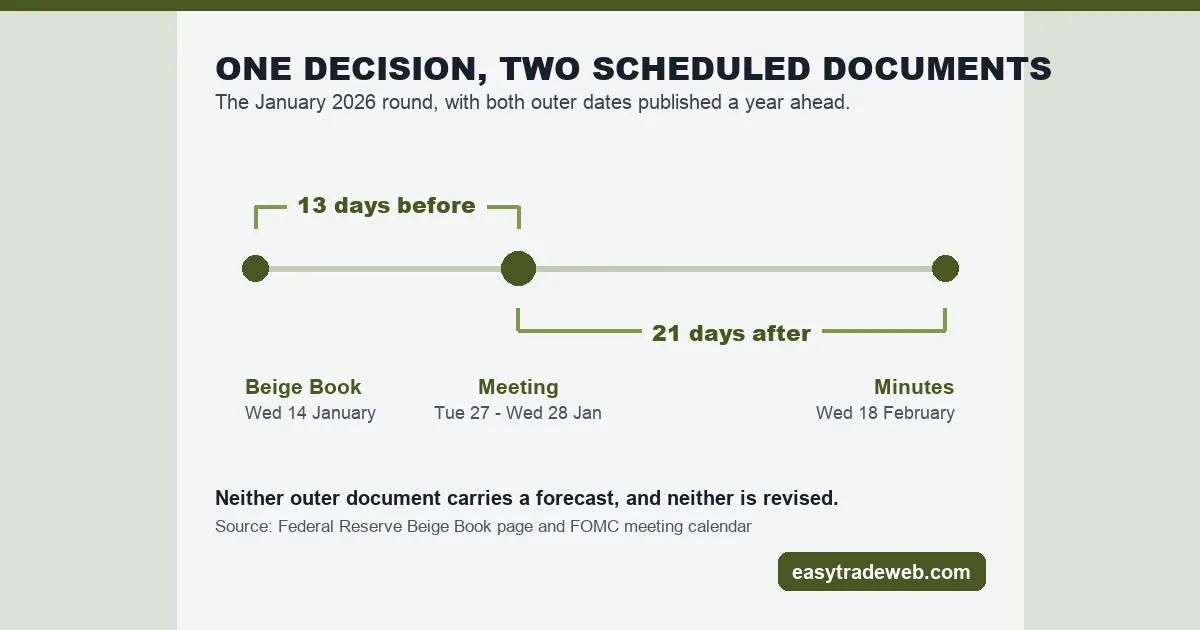
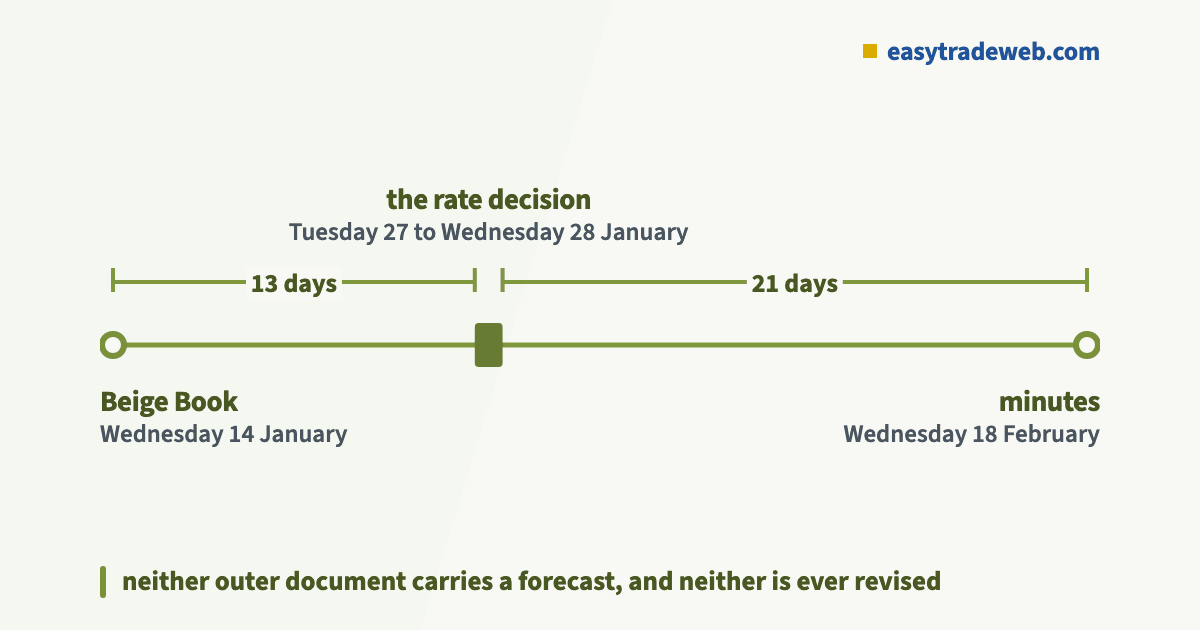
The January 2026 round shows the shape. The report was published on 14 January, the meeting ran on 27 and 28 January, and the minutes were released on 18 February, which is 21 days after the second day. Both of the outer dates were known long before either happened.
Putting the two lists beside each other is the only work required to see the pattern, and it is work nobody appears to have published. Both lists are free, both cover the whole year, and neither page mentions the other.
The 13-Day Rule: Measured Across All Eight 2026 Releases
Set the eight 2026 release dates against the eight 2026 meeting dates and one interval appears in every row.
| Beige Book release, 2026 | First day of the meeting that follows | Days between |
|---|---|---|
| Wednesday 14 January | Tuesday 27 January | 13 |
| Wednesday 4 March | Tuesday 17 March | 13 |
| Wednesday 15 April | Tuesday 28 April | 13 |
| Wednesday 3 June | Tuesday 16 June | 13 |
| Wednesday 15 July | Tuesday 28 July | 13 |
| Wednesday 2 September | Tuesday 15 September | 13 |
| Wednesday 14 October | Tuesday 27 October | 13 |
| Wednesday 25 November | Tuesday 8 December | 13 |
Eight rows, one number. The November pairing crosses a month end and still lands on 13, since November runs to 30 days: five days to the end of the month and eight into December.
Two things follow that the usual description misses. The first is the weekday: every release is a Wednesday and every meeting opens on a Tuesday, so the interval is not merely close to two weeks, it is one day short of two weeks, every time. The approximation in general circulation is wrong in the only direction that matters for a calendar.
There is a practical use in that. One visit to each of the two pages, once a year, is enough to write down every Beige Book date and every meeting date for the whole year, and the interval between each pair needs no checking afterwards because it does not vary.
The second is what the interval is for. Thirteen days is long enough for the material to be read and used in preparation, and short enough that conditions described in it are still current when the meeting opens. It is the same structural role that the August week without a meeting plays for an August event that publishes nothing: the position in the calendar carries the meaning, not the content.
Why a Report With No Numbers Still Gets Read
A document with no series in it can still carry information, and the reason is timing rather than substance.
Official statistics arrive with a lag. A labour market reading describes a month that has closed, and a price index describes a month that closed earlier still.
The material in the Beige Book was gathered from people who were living through the conditions when they described them, which makes it the earliest description of the current quarter available from an official source.
It is also the only regular Federal Reserve publication that reports the country by district rather than as one aggregate. Twelve separate accounts appear, and a divergence between them is visible on the page in a way that no national figure can show.
And it is a document the committee has in front of it. That is a weak claim and it should stay weak: nothing establishes what weight any participant gives it, and nobody outside the room knows. What can be said is that it exists, that it is prepared for the meeting, and that it is public before the meeting, which is more than can be said for most of what is discussed there.
What Anecdotal Means for a Reaction You Can Trade
Here is where the report parts company with everything else on an economic calendar, and it is the part no general explanation of it addresses.
A scheduled data release is tradable in a mechanical sense because it produces a number at a known instant, and because a survey of forecasters has produced an expected number in advance. The reaction is a function of the difference between the two. That is what a surprise is, and it is why a release that does carry a number can be traded against a published consensus at all.
The Beige Book produces no number. There is no consensus to compare it against, because there is nothing to forecast. Whatever moves after it is a reading of prose, and readings of prose differ between readers in a way readings of a figure do not.
That has a practical consequence worth stating plainly. Any strategy built on a threshold, a beat-or-miss rule or a fixed reaction window cannot be specified for this release, because the input it needs does not exist. A plan that says what to do if the figure comes in above expectations is describing a different report.
What can be planned is the calendar. The release date is known a year ahead, the meeting it precedes is known a year ahead, and the 13-day interval between them holds across all eight. That is a schedule, and a schedule can be worked with even when the content cannot be predicted.
How It Differs From the Data Releases You Already Watch
The contrast is easiest to see set out directly.
| Question | A scheduled data release | The Beige Book |
|---|---|---|
| Produces a headline number | Yes | No |
| Has a published consensus forecast | Yes, from surveyed forecasters | Nothing to forecast |
| Source of the material | A statistical survey or census | Interviews and directors’ reports, described as anecdotal |
| Geographic detail | Usually one national figure | Twelve district accounts, plus a rotating overall summary |
| Revised later | Often, on a published schedule | No, there is nothing to revise |
| Fixed position before the rate meeting | No, dates float against it | Yes, 13 days in all eight 2026 cases |
The fixed distance also has no equivalent everywhere. At a central bank whose minutes arrive far later, the account of a meeting reaches the public only after the following meeting has already opened, so nothing about that schedule can be filed as pre-meeting reading.
The last row is the one that changes how the release should be filed. A payrolls print or an inflation print lands wherever the statistical calendar puts it relative to the meeting, and the distance varies through the year. This report does not move.
Who This Page Is Not For
Anyone looking for what a particular edition said, or for a summary of current conditions in any district, will not find it here. This page describes a recurring publication and its place in the calendar. It carries no account of any individual release and takes no view on what the next one will contain.
It is also not for a reader wanting a direction. No claim appears here about where any currency, rate or index is going before, during or after one of these releases, and the position taken throughout is that a reaction to a document nobody has read yet is not knowable in advance.
What the page is for is the reader who wants to know why a report with no data in it sits on every economic calendar, and what its fixed distance from the rate decision is doing there.
The natural next step is the language the committee uses when it does decide something, which is set out in our page on reading a central bank’s tone. Read the two together and the eight-times-a-year rhythm of the Federal Reserve calendar stops looking like a series of separate events.
Risk warning: this page is educational and describes what a recurring Federal Reserve publication contains and where it falls in the calendar. It is not advice to buy or sell any instrument, it recommends no product, platform or broker, and nothing here is a signal or a prediction. Leveraged trading carries a high risk of losing money.