
Executing Broker: The Role Your Forex Account Does Not Have

Executing broker is a term borrowed from institutional trading, where the firm that fills an order, the firm that settles it and the firm that finances the account can be three separate companies with three separate contracts. A retail forex account has none of that structure.
One entity is the counterparty, the venue and the account provider at the same time, so the question of who the executing broker is has no separate answer. What follows is the institutional meaning, the retail reality behind it, and the one published rule a regulator actually sets about how long an execution may take.
Key takeaways
- Executing broker names a function performed on a particular order, not a category of firm that appears on a licence or an about page.
- The term only separates from clearing and prime brokerage in markets where those services are bought from different companies. A retail forex account buys all of them from one.
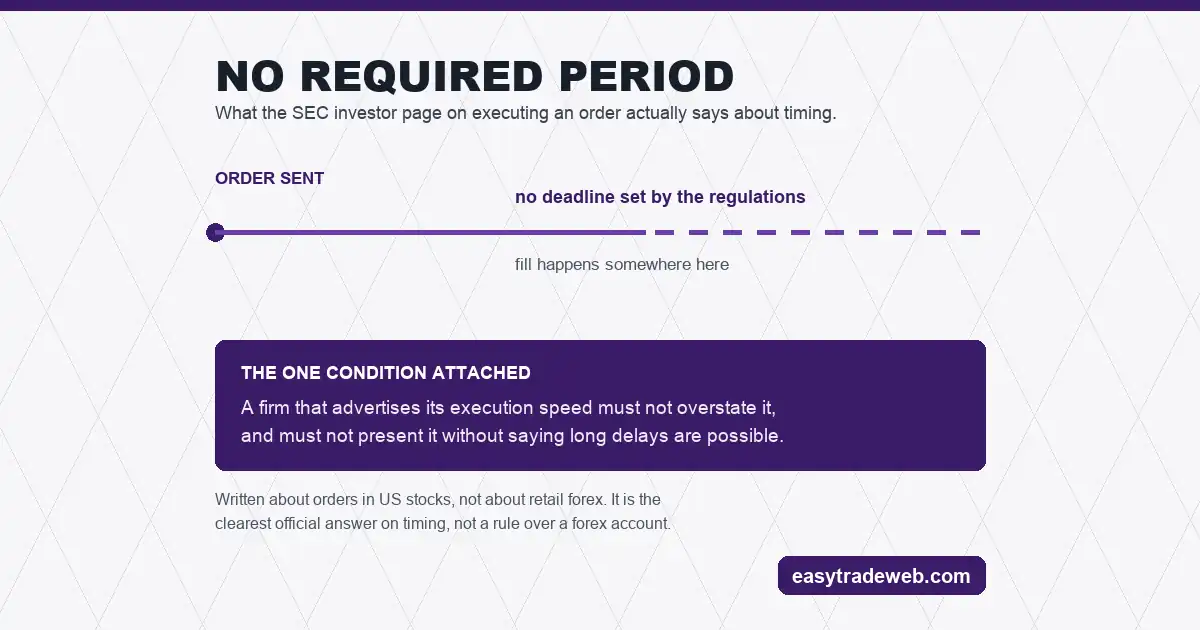
- The clearest official statement on execution timing is the SEC page on executing an order, and it says regulations set no required period for a trade to be completed.
- The same page attaches one condition to advertised execution speed: a firm making the claim must not overstate it and must not leave out the chance of long delays.
- What a retail trader can verify is the record of the fill, not the identity of a separate executing firm, because on that account there is not one.
Table of contents
What an Executing Broker Is, in the Market Where the Term Comes From
In institutional trading a fund does not usually hold its assets, its financing and its market access at the same firm. It keeps the account with one company and sends individual orders to others, choosing whichever has the access or the specialism that order needs.
The firm handling that particular order is the executing broker for that order. The label attaches to the job, not to the company: the same legal entity can be the executing broker on one trade in the morning and hold no role at all in the next one.
That is why the term behaves so badly when it is lifted into retail material. It is not a permission, a licence class or a business model, and no regulator publishes a register of executing brokers a reader could check a firm against. It describes a division of labour that only exists where the labour has been divided.
Retail firms are described by what they are permitted to do and how they take on client business, which is a different axis entirely and the one used on our page about the types of brokerage firm. Nothing on that axis maps onto an executing broker, because the institutional term is not answering the same question.
Which firm gets a given order is a decision the client makes trade by trade. Access to a particular venue, the cost of routing there, and the willingness of a desk to work a large order quietly are all reasons to send one order to one firm and the next order somewhere else.
Retail material then uses the same two words in a much looser sense, meaning simply the firm that filled the trade. Both uses are in circulation, neither announces which one is in play, and the confusion the term creates comes almost entirely from that.
This page asserts no formal definition of the term. Several of the pages that rank for it do, and none names the document the definition comes from.
The Three Roles the Term Sits Between
The vocabulary arrives as a set. Executing broker is only meaningful next to clearing broker and prime broker, and the set is usually presented as though every trading account contains all three somewhere.
The clearing broker is the firm through which a trade is settled and positions are recorded. The prime broker is the firm that holds the assets, lends against them and consolidates the reporting across everywhere else the fund trades. An introducing broker sits outside the set: it brings the client and passes the account on, and it never touches the order.
Each of the three fails in a different way, which is the reason the roles were split apart in the first place. If the executing firm gets the order wrong, one trade is wrong. If the clearing firm and the executing firm disagree about what was traded, the trade sits unmatched until somebody reconciles it. If the prime broker withdraws financing, the whole book is affected at once.
The set is presented as universal in most material written about it, and there is a reason for that. Much of the writing on these terms comes from firms selling execution and clearing technology, and the customer for that technology is a broker assembling exactly this structure.
Laid out against a retail forex account, the set collapses.
| Role | What it does with the order | Separate on a retail forex account |
|---|---|---|
| Executing broker | Handles the fill for that specific order | No |
| Clearing broker | Settles the trade and records the position | No |
| Prime broker | Holds assets, lends against them, consolidates reporting | No |
| Introducing broker | Nothing; it introduces the client and stops there | Sometimes |
Three of the four rows read the same way, and the fourth is the only one a retail trader may genuinely encounter as a separate company. That is the whole practical content of the three-role vocabulary for this reader.
Why a Retail Forex Account Has None of This Split
Retail forex is quoted, not exchanged. The price comes from the broker, the position is opened against the broker, and the money sits in an account the broker controls. There is no third party the order is handed to and no separate books it settles into.
Spot forex has no central order book and no exchange that a retail order is delivered to, and a retail position is not settled through a clearing house the way a listed contract is. The position exists as an open contract on the books of the firm the account is with, and it is closed against that same firm.

So the three contracts an institutional client signs with three companies are one contract here. Asking which firm executed a fill is asking which department of a single company did it, and that is not a distinction the account statement is built to expose.
What the broker did with the exposure afterwards is a real and separate question, and it is not this one. Whether the firm held the other side itself or passed the risk out to a liquidity provider is covered in full on our page about what happens to your order after the click, which is where that decision, its incentives and its disclosure belong.
The distinction worth holding on to is this: the institutional set describes who performs which service. The retail question describes what the single firm does with the risk. Those are different questions, and answering the second with the vocabulary of the first is where most explanations of the term go wrong.
The SEC Sets No Time Limit on Executing an Order
The most specific official statement available on execution timing comes from the SEC investor education page on executing an order. It says there is no rule fixing how long a broker may take before the trade is done.
Then it attaches one condition, and the condition is the useful half. A firm that advertises how fast it executes must not overstate the speed, and must not present it without mentioning that significant delays are possible.
Read those two together and an execution-speed claim changes character. It is not a firm meeting a published standard, because there is no published standard to meet. It is a marketing statement carrying an obligation not to mislead, which is a much weaker thing than it looks on a comparison page.
The same document describes a duty of best execution as a duty about terms rather than about milliseconds, assessed across orders in aggregate and reviewed periodically. It is not a promise attached to the order in front of you.
The same page is also worth reading for what it says about routing. Even in the market it describes, the destination is picked by the broker: a listing exchange, a rival exchange, a market maker, a dealer in over-the-counter stock, an electronic matching network, or the broker firm itself filling the order from what it already holds. Some of those destinations pay the broker for sending orders their way.
None of that structure exists on a retail forex account, and the point of reading it is the contrast. In the market with the most published detail about where an order can go, the client still does not choose, and there is still no time limit.
Two limits on all of this. The document is written about orders in US stocks and not about retail forex, and it is an investor education page rather than a rule text. It is quoted here because it is the clearest official answer to the timing question that a reader can go and read, not because it governs a forex account. The gap between an advertised speed and an actual fill has its own mechanics, set out on our page about slippage.
Who Needs This Vocabulary and Who Does Not
The three-role set earns its keep for a fund or a professional trading operation that has actually separated the services, and for anyone reading institutional documentation where the terms carry contractual weight.
It is also worth knowing for a reader working out what a business-to-business vendor is selling. Much of the material that ranks for the term is written by firms selling execution infrastructure to brokers, and the audience it addresses is the broker, not the broker client.
For someone comparing retail forex accounts it settles nothing. No account will offer a choice of executing broker, no statement will name one, and no support desk will have a different answer than the firm itself.
There is one retail case where the vocabulary starts to bite. A trader who has been categorised as a professional client, or who trades through an institutional account rather than a retail one, may genuinely deal with more than one firm, and then the distinctions above stop being theoretical.
A reader who arrived here trying to find out who filled their last trade is asking a good question in borrowed words. The next section is that question in the words the account actually uses.
What You Can and Cannot Verify About Execution Itself
Verifying the broker model before depositing is a separate exercise, and the checks for it are set out on our page about what happens to your order after the click. What follows is narrower: what the record of a fill can and cannot tell you once the account is open.
Five checks, in the order they cost the least.
- Read the execution timestamp on the closed order against the timestamp on the order ticket. The difference is the only measured execution latency available.
- Compare the filled price with the price on the ticket, on several orders rather than the one that annoyed you, and keep the sample by session.
- Check whether the platform records requotes and rejections separately from fills. A firm that reports only completed orders is reporting the easy half.
- Read any published execution statistics for the date the figures cover and the account types included, then treat anything undated as unverified.
- Ask the broker in writing which entity is the counterparty to the position. That is answerable and it is the question the executing broker vocabulary was standing in for.
The first two checks are the ones that produce a number. The other three produce a yes or a no, and a no is as informative as anything a broker publishes about its own speed.
What none of these produce is the name of a separate executing firm. There is not one to find, and a support agent who supplies a name in response to the term is describing a liquidity provider or a technology vendor rather than a broker acting on the order.
Risk warning: this page is educational and explains a piece of market-structure terminology. It is not advice to buy or sell any instrument, it recommends no product, platform or broker, and nothing here is a signal, a performance claim or a prediction. Leveraged trading carries a high risk of losing money rapidly.