
TradeLocker Brokers Compared: Entities, Costs and Access

TradeLocker is trading software, not a brokerage. The account, the money and the client agreement belong to whichever firm licenses the platform, and that firm is what a reader is actually choosing. Twelve brokers appear on TradeLocker’s own directory, read on 18 September 2026, and eight of them carry a founding date in 2025 or 2026.
The published comparisons rank these firms without naming a single legal entity or licence number between them, which leaves out the one detail that changes the leverage cap, the complaints route and the protections attached to a deposit.
Key takeaways
- TradeLocker’s own directory listed twelve brokers on 18 September 2026. Eight record a founding date in 2025 or 2026; only three predate 2024.
- Eightcap is the only firm named by all three published comparisons. Its own legal-documents page lists four entities, including a Bahamas, a Seychelles, a Mauritius and a Saint Vincent registration.
- Minimum deposits on the directory run from 5 to 100 US dollars, and every one of the twelve entries reports no deposit fee, no withdrawal fee and no inactivity fee.
- Five of the twelve publish a restricted-country list. Seven publish none at all.
- The three published lists name thirteen brands between them and agree on one. Four brands they name are not on the directory today.
Table of contents
- The Entity You Are Onboarded To Is Not the Entity in the Marketing
- Every Broker on TradeLocker’s Own Directory, Read 18 September 2026
- Where the Published Broker Lists Disagree
- Who Cannot Open an Account: the Country Restrictions
- Broker or Prop Firm: Two Directories, Two Products
- What the Directory’s Fee Columns Do Not Tell You
- When a TradeLocker Broker Is the Wrong Choice
- How to Check a TradeLocker Broker Before You Deposit
- Frequently Asked Questions
The Entity You Are Onboarded To Is Not the Entity in the Marketing
Eightcap is the one broker every published TradeLocker comparison names, so it is the clearest case. The front page of eightcap.com, read on 18 September 2026, presents the group as regulated across several jurisdictions and names ASIC, the FCA and CySEC. Its legal-documents page sets out which companies actually sign a client agreement, and they are not those three:
- Eightcap Global Limited — licence SIA-F220, Securities Commission of The Bahamas
- Eightcap International Ltd — company number 8427413-1, Seychelles Financial Services Authority, SD100
- Eightcap International Trading — company number 227050, Mauritian Financial Services Commission, GB25204603
- CLMarkets Limited — company number 24750, Saint Vincent and the Grenadines, trading as Eightcap International
Those are four regulators with four rulebooks, and the one that applies is decided by which company signs the account rather than by the acronyms on the home page. The directory entry for the same broker restricts the United Kingdom and the United States, the jurisdictions behind two of those acronyms.
What moves with the entity is not cosmetic. The maximum leverage, whether client money sits in a segregated account, whether a compensation scheme covers a default, and the address a complaint has to be sent to are all set by the licence the signing company holds.
A page that ranks brokers on spreads and execution claims, and never prints a company name or a licence number, has skipped the variable with the largest effect on what a deposit is worth if something goes wrong.
None of the three independent comparisons read for this page names an entity or a licence number for any broker on its list. Each presents the brand as the counterparty. On this platform the brand is a marketing layer sitting above between one and four registered companies, and the directory does not print those companies either.
Every Broker on TradeLocker’s Own Directory, Read 18 September 2026
The platform publishes its own broker list, and it is the only list that is not a third party’s ranking. The figures below are what that directory records, read on 18 September 2026. They are the directory’s entries, not readings taken from each broker’s own terms, and the distinction matters because a directory entry is supplied for the listing rather than filed with a regulator. How this platform sits against the mainstream alternatives is covered separately under CFD trading platforms compared.
What TradeLocker’s directory records for each listed broker
| Broker | Founding date recorded | Minimum deposit, US dollars | Free demo | Restricted countries listed | Spread type |
|---|---|---|---|---|---|
| Eightcap | May 2015 | 50 | No | 43 | Variable and raw |
| GatesFX | August 2015 | 25 | Yes | 5 | Raw |
| Focus Markets | January 2019 | 100 | No | 41 | Variable |
| HeroFX | April 2021 | 5 by crypto, 30 by card | Yes | 0 | Raw |
| ClarityFX | January 2024 | 10 | Yes | 0 | Raw |
| Risen | January 2025 | 10 | Yes | 5 | Raw |
| Crucial Markets | September 2025 | 10 by crypto, 50 by card | Yes | 6 | Raw |
| Elyon Markets | November 2025 | 5 | Yes | 0 | Raw |
| Restro FX | December 2025 | 25 | Yes | 0 | Raw, zero spread and variable |
| LivvFX | January 2026 | 20 | Yes | 0 | Raw |
| Pulse Markets | March 2026 | 10 | Yes | 0 | Raw |
| Gale Prime | April 2026 | 25 | Yes | 0 | Raw |
Figures as published in TradeLocker’s own broker directory, read on 18 September 2026. They are the directory’s own entries and have not been re-read at each broker’s site. Eightcap’s entity and licence details in the section above were read at eightcap.com on the same date.
Where the Published Broker Lists Disagree
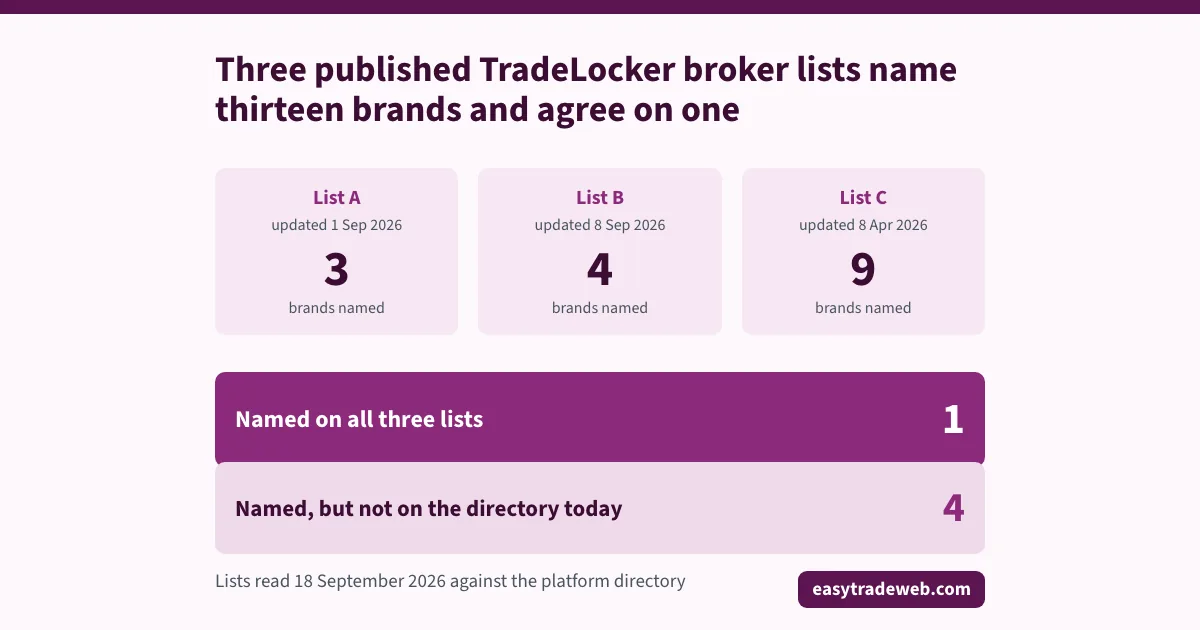
Three independent comparisons rank TradeLocker brokers. Between them they name thirteen brands, and they agree on one. The dailyforex page, updated 1 September 2026, names three. The daytrading.com page, updated 8 September 2026, names four. The fxleaders page, updated 8 April 2026, names nine. Eightcap is the only brand on all three.
Four of the thirteen do not appear on the platform’s directory at all when it is read on 18 September 2026. Two of them sit on a page updated seventeen days earlier, and one sits on a page updated ten days earlier. Working in the other direction, three brands on the directory today appear on none of the three lists.
Two founding dates also disagree with the platform’s own record. One comparison gives Eightcap a founding year of 2009 and a minimum deposit of 100 US dollars, where the directory records May 2015 and 50 US dollars.
The same comparison gives Focus Markets a founding year of 2014, where the directory records January 2019. Neither page cites a source and neither does the directory, so the disagreement can only be recorded, which is what a reader needs before treating any of these numbers as fixed.
A list that moves this fast describes the roster rather than the brokers. Firms join and leave a platform partnership on commercial terms, so each page is a snapshot of the day its author last checked.
Who Cannot Open an Account: the Country Restrictions
Five of the twelve directory entries publish a restricted-country list. Seven publish none, and an empty list is not the same claim as an open door: it means the entry carries no restriction data, not that the broker accepts everyone.
Eightcap’s entry is the only one whose countries are readable in full from the page as served. It lists 43 restrictions, among them Iraq, Lebanon, Iran, Libya, Sudan, Syria, Yemen, Pakistan, Japan, Cyprus, Russia, Ukraine, the United Kingdom and the United States. Saudi Arabia, the United Arab Emirates, Kuwait, Qatar, Bahrain and Oman are not on it.
Focus Markets lists 41 restrictions, Crucial Markets six, and GatesFX and Risen five each, though the country names behind those counts are not readable from the directory page.
For a reader in the Gulf the practical consequence is narrow but real. The two oldest firms on the directory, and the two publishing the longest restriction lists, are the two that exclude the United Kingdom and the United States, which is the signature of an offshore entity serving clients outside its group’s regulated markets.
A reader in Iraq or Lebanon is excluded from the one broker on the list whose entities and licence numbers are published in full.
Broker or Prop Firm: Two Directories, Two Products
TradeLocker runs two separate directories, one for brokers and one for proprietary trading firms. They are different products and the money works in opposite directions. With a broker, the deposit is the trader’s own capital and the account holds it. With a proprietary firm, the payment is an evaluation fee, the capital is the firm’s, and what is being bought is the chance to trade a simulated or firm-funded balance under rules the firm sets.
One of the three comparisons places evaluation fees and funded-account sizes for two brands in the same table as minimum deposits for a third, without marking which column belongs to which product. A reader who picks a row from that table expecting a trading account can end up paying a non-refundable assessment fee instead. The two brands carrying those evaluation figures are not on the platform’s broker directory today.
The check is quick. If the page quotes a profit split, an evaluation fee or a funded-account size, the product is a proprietary-firm assessment. If it quotes a minimum deposit, a spread and a withdrawal method, the product is a brokerage account. The distinction is covered in more depth under prop firm funded accounts and minimum deposit across forex brokers.
What the Directory’s Fee Columns Do Not Tell You
All twelve directory entries report the same three answers: no deposit fee, no withdrawal fee, no inactivity fee. A column on which every row is identical separates nothing, and it is worth asking why it reads that way rather than treating it as twelve independent confirmations.
Several of the entries carry qualifying text alongside the zero. One states that the broker charges no internal fee for deposits or withdrawals but that the payment provider used may charge one. Another states the same for withdrawals only. That is a different claim from a free withdrawal, and it is the one that shows up on a bank statement: card, wire and crypto rails each take a cut that the broker never sees and never reports.
The directory also publishes no methodology and no statement that any figure was independently verified. It carries no spread figure, no commission figure and no swap figure for any of the twelve, which are the three charges that decide what trading actually costs. For those, the account documents at each broker are the only source, and the comparison has to be rebuilt from them one firm at a time.
When a TradeLocker Broker Is the Wrong Choice
Someone who runs an expert advisor written in MQL4 or MQL5 cannot bring it across. TradeLocker is a separate platform with its own scripting environment, so an existing automated system has to be rewritten rather than copied, and every optimisation result behind it was produced on a different engine against different tick data.
For that trader the platform question is settled before the broker question, and the list that matters is the one covering brokers offering MetaTrader 4 or the comparison under MT4 or MT5.
Someone who needs a home regulator with a compensation scheme is choosing from a short list here, and possibly from none of it. Nine of the twelve entries publish no entity, and the one whose companies are published in full holds Bahamas, Seychelles, Mauritius and Saint Vincent registrations for the clients this directory serves.
A trader who wants a claim route into a domestic statutory scheme will not find it by picking a different row on this table; that requirement rules out the platform rather than the broker.
Someone depositing a large balance is weighing a five-dollar entry point against an eight-month trading history. Eight of the twelve firms opened in 2025 or 2026, and a minimum deposit of 5 or 10 dollars is set to remove friction at sign-up, not to indicate what the firm can absorb. The size of the account and the age of the counterparty move in opposite directions on this list, and the deposit minimum says nothing about the second.
How to Check a TradeLocker Broker Before You Deposit
Open the broker’s own website rather than a comparison page, and scroll to the footer. The registered company name, the registration number and the regulator sit there or on a legal-documents page linked from it. If no company name appears anywhere on the site, that is the finding, and it is enough on its own.
Take the licence number to the regulator’s public register and search it. The register states whether the licence is current, what activities it covers and which company holds it. A licence number that returns nothing, or returns a different company, is the single cheapest check available and the one that the ranked lists never run.
Then read the client agreement for the entity named, not the summary on the account page. Withdrawal conditions, dormancy handling, negative balance treatment and the complaints route are set there. Where those documents are missing or exist only as a summary, the comparison is over regardless of what the spread column says.
easytradeweb.com may be compensated if an account is opened through a link elsewhere on this site. No broker on this page pays this site anything, and nothing above is a recommendation to open an account with any of them.
Frequently Asked Questions
Which brokers offer TradeLocker right now?
TradeLocker’s own directory listed twelve on 18 September 2026: Eightcap, GatesFX, Focus Markets, HeroFX, ClarityFX, Risen, Crucial Markets, Elyon Markets, Restro FX, LivvFX, Pulse Markets and Gale Prime. The roster changes, so the date on any list matters as much as the names on it.
Is TradeLocker itself a broker?
No. It is trading software licensed to brokers and to proprietary trading firms. The client agreement, the deposit and the regulatory protection all come from the firm that licenses it, which is why the company behind the brand decides what an account is worth.
What is the lowest minimum deposit among TradeLocker brokers?
Five US dollars, recorded by the directory for HeroFX by crypto and for Elyon Markets, read on 18 September 2026. HeroFX’s entry sets 30 US dollars for card payments. The highest on the same directory is 100 US dollars at Focus Markets.
Can I open a TradeLocker account from the Gulf?
Eightcap’s directory entry lists 43 restricted countries and none of Saudi Arabia, the United Arab Emirates, Kuwait, Qatar, Bahrain or Oman appears among them. Iraq and Lebanon do appear. Seven of the twelve entries publish no restriction list, which means no data rather than no restriction.
Why do published TradeLocker broker lists disagree with each other?
Three comparisons name thirteen brands between them and agree on one. Four of those brands are not on the platform’s directory today. Partnerships start and end on commercial terms, so each page reflects the roster on the day its author last checked it.
Is a newer broker on the directory a problem?
It is a fact to weigh rather than a verdict. Eight of the twelve entries record a founding date in 2025 or 2026, which means there is little trading history, few published terms and no record of how the firm handled a withdrawal dispute. Whether that matters depends on the size of the deposit.
Sources checked 18 September 2026: TradeLocker Hub, Brokers, the platform operator’s own broker directory, for the twelve listed brokers and for each entry’s founding date, minimum deposit, demo availability, spread type, restricted-country count and deposit, withdrawal and inactivity fee fields. TradeLocker Hub, Prop Firms, for the separate proprietary-firm directory. Eightcap Legal Documents, and the company information block on eightcap.com, for the four signing companies named above with their licence and company numbers. Publication and update dates for the three comparison pages were read from the pages themselves on the same date.
Disclaimer: This article is educational only and is not investment advice, and it is not a recommendation of any broker, platform or account type. Trading leveraged products carries a high risk of losing money rapidly. Protections, costs and access depend on the entity holding the account, and every figure here is a dated reading rather than a standing value.