
Trading Price Gaps Methods

Price gaps are areas on the chart where a currency’s price (or any other financial instrument) moves sharply up or down, with little or no trading in between. As a result, the chart shows what is called a price gap. An adventurous trader can interpret and take advantage of these gaps. Not every gap named on a chart is this kind, and a fair value gap is named for a space between two candle ranges that price traded straight through. This approach helps you understand how gaps happen and why, and how you can use them in your trading. For more, read about Price Action Trading.
Types of gaps
Gaps happen because of fundamental factors, such as the release of a statement or a surprise news item. This means a currency’s price opened higher or lower than it was the previous day, leaving a gap behind. In the forex market this often happens at the market open, due to a statement or surprise news released while the market was closed.
Gaps can be classified into four groups:
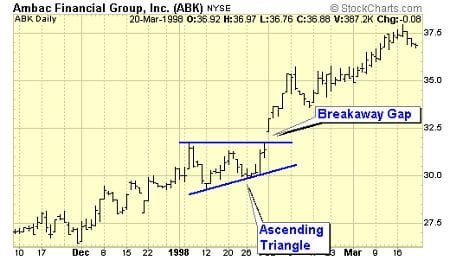
1. Breakaway gaps are those that happen at the end of a price pattern and signal the start of a new trend.
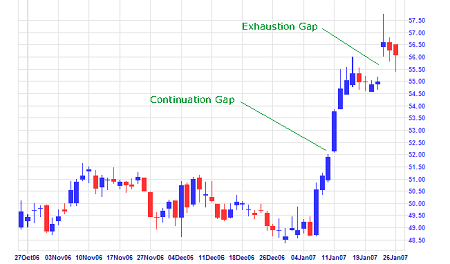
2. Exhaustion gap happens near the end of a price pattern and signals a last attempt to reach new highs or lows.
3. Continuation gap happens in the middle of a price pattern and shows a surge of buyers or sellers who share a common belief about the future direction of the price.
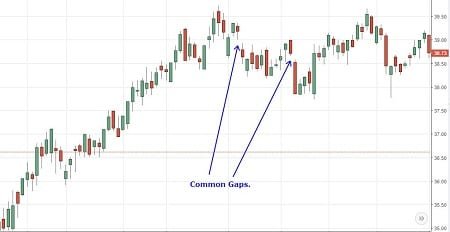
4. Common gaps are those that cannot be placed within a price pattern. They simply represent an area where price has more than one gap in a single zone, and they mostly occur in a sideways price range.
When someone says a gap has been “filled”, it means price has returned to the original pre-gap level. This return of price is very common and is therefore a correction.
Resistance and support: when price moves sharply up or down and forms a gap, it leaves behind support or resistance that this gap represents.
Price pattern: price patterns are used to classify gaps, and can tell you whether a gap will be filled or not. Usually the exhaustion gap is the most likely to be filled, because it points to the end of a price trend, while breakaway and continuation gaps are much less likely to be filled, since they are used to confirm the current trend.
How to trade price gaps
There are many ways to make use of these gaps, along with some of the more popular strategies. Some traders will buy when the technical factors lean toward a gap on the next trading day. For example, they buy currencies after hours in the hope of a gap on the next trading day.
Here are the basics you will need to remember when trading gaps:
- Once price starts to close the gap, it rarely stops, because there is often no support or resistance.
- Exhaustion gaps and continuation gaps expect price to move in two different directions, so make sure you classify the gap you are going to use correctly.
- It is traders who behave irrationally; even so, institutional investors can play along to help their portfolios, so be careful when using this indicator and be sure to wait until price starts to break out before taking a position.
- High volume should be present in breakaway gaps, while low volume should occur in exhaustion gaps.
To tie these ideas together, let’s look at a gap-trading system built for the forex market. This system uses gaps to anticipate corrections back to a previous price. The rules are as follows:
- Trades should always be in the general direction of the price (check the hourly charts).
- The gap should be well above or below the main resistance level on the 30-minute chart.
- Price should bounce back to the original resistance level. This signals that the gap has been filled, and price has returned to the previous resistance that turned into support.
- There should be a candle showing price continuing in the direction of the gap.
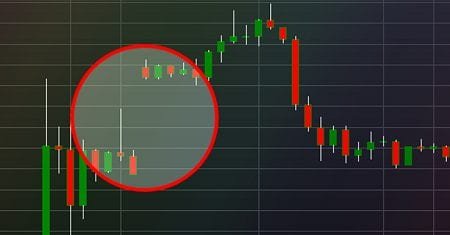
Note that because the forex market runs around the clock (it is open 24 hours a day), gaps in the forex market show up on the chart as large candles. These large candles often happen because of a report release that causes sharp price moves with little or no liquidity. In forex, the only visible gaps that appear on the chart occur when the market opens after the weekend. A reversal shape built from two of those gaps, one on each side of an isolated group of bars, is the island reversal.
Anticipating price gaps
Those who study the factors behind a gap and correctly identify its type can often trade the setup with a clearer read, though there is always a risk that a trade turns out badly. You can reduce that risk. First, if you see large-volume resistance preventing a gap from forming, re-check the thesis behind your trade and set it aside if you are not fully sure it is valid.
Second, prices can sometimes stay at a very high valuation for a long time and trade high on the gaps without correcting. Always use a stop-loss when trading. It is best to place the stop-loss below the main support levels, or at a set percentage, such as -0.5% of the account.
Remember that gaps carry risk (because of low liquidity and higher volatility). If they are traded appropriately they can present short-term opportunities, but outcomes vary and losses are possible.
Finally, in volatile markets traders can make use of large price gaps in asset prices if these can be turned into opportunities. Price gaps are areas on the chart where the price of a stock, or any other financial instrument, moves sharply up or down with little or no trading in between.
As a result, the asset’s chart shows price gaps within the normal price pattern, and an adventurous trader can interpret and use these gaps. The contents of this article above help you understand how and why gaps happen, and how you can use them in your trades.
Try this strategy on a demo account first
A strategy that looks clear in an article can behave very differently under real spreads and volatility. Testing it on a demo account shows you how it performs before you commit any capital.
Advertising disclosure: partner link. Easy Trade may receive compensation. Educational content, not financial advice. CFDs carry a high risk of losing your capital.
Frequently asked questions
What are price gaps?
A price gap is a term used when a stock’s price jumps in a direction away from its recent price range — for example, a stock whose trading range runs from $10 to $12, closes at $12, and then rises to $14 the next day.
What is swing trading?
Swing trading is a stock-market technique that aims to capture short-term gains by buying a financial instrument and selling it after several weeks or months. Swing trading is short-term only and requires investors to hold positions for a maximum of about one month.