
CFD Trading Platforms: What the Rankings Do Not Compare

Comparing CFD trading platforms means answering two questions, not one. The first is which software you place orders in. The second is which firm holds the account, sets the costs and publishes its own loss figure. A ranked list of platforms answers the first and leaves the second untouched.
Key takeaways
- The platform and the firm are separate choices. The same terminal is sold by many firms on different terms, so the software name settles almost nothing about what an account costs.
- A regulated CFD firm must publish, as a percentage, how many of its own retail client accounts finished the preceding twelve months down. That figure is about that firm, not about CFD trading.
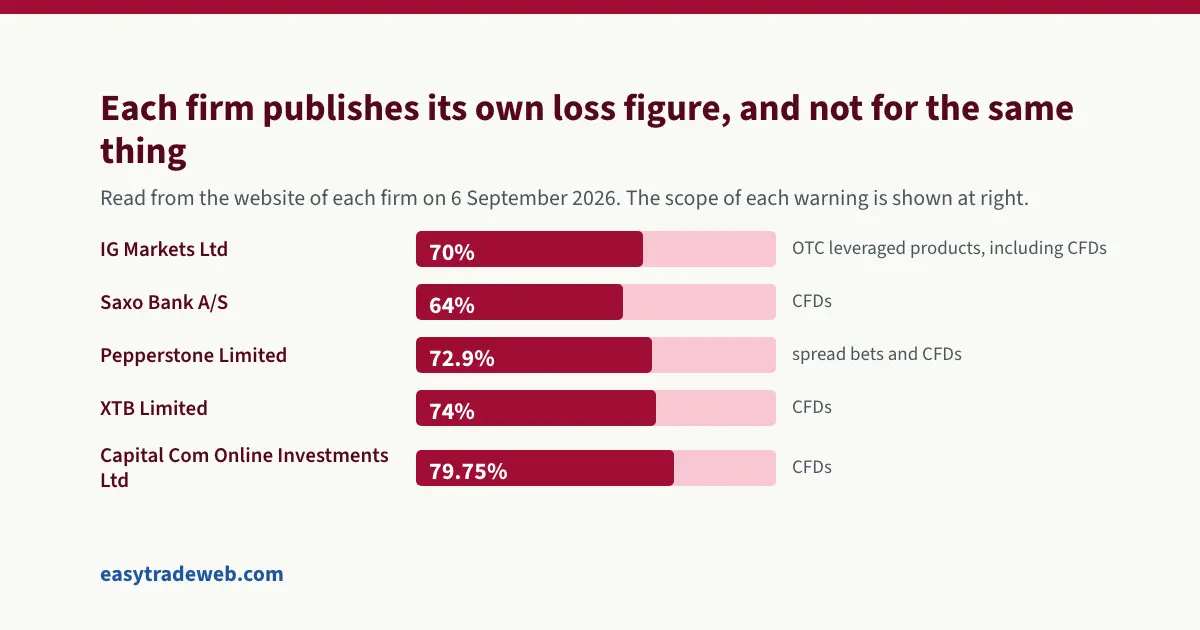
- Five firms read on 6 September 2026 published 64%, 70%, 72.9%, 74% and 79.75%, and they do not all measure the same product set.
- Under the rules the FCA finalised in PS19/18, an active retail account that ends a period unchanged is counted as profit-making, so the published figure is not the share of accounts that made money.
- Instrument counts are self-reported and each firm counts differently, which is why a bigger number is not a better platform.
Table of contents
- The two choices hiding inside one question
- The same platform, sold on different terms
- The one number every firm must publish about itself
- Side by side: what the firms themselves publish
- Why instrument counts do not compare
- Checking a firm before you fund it
- When a CFD platform is not what you need
- Four checks before you fund an account
The Two Choices Hiding Inside One Question
Search for a CFD trading platform and the results return ranked lists. Read them closely and the entries are not the same kind of object. Some are pieces of software. Others are companies. A few lists mix both in one table and rank them against each other.
The distinction matters because the two are bought separately. The software is the terminal: the charts, the order ticket, the automation. The firm is the counterparty that opens the account, quotes the price, holds the money and is answerable to a regulator for how it does all three.
One is a tool. The other is a legal relationship. A comparison that treats them as a single ranked list cannot tell you what either one costs, because the cost belongs to the firm and the interface belongs to the software.
A concrete case makes the split obvious. Two readers can both open an account on the same version of the same terminal, on the same day, and pay different spreads, different commission and different overnight financing, because they signed with different firms or different account tiers at one firm. Nothing about the software explains the gap.
If the underlying contract is unfamiliar, what a CFD contract is is the prior question, and it is worth settling before any platform comparison is useful.
The Same Platform, Sold on Different Terms
The clearest way to see the split is to notice how many firms sell the same terminal. MetaTrader 4 and MetaTrader 5 are licensed from a software vendor by hundreds of firms, and cTrader is licensed to brokers on the same basis. So a reader who decides on MetaTrader 5 has narrowed nothing about spreads, commission, execution or who is holding the deposit.
The same is true in the other direction. A single firm commonly offers several platforms at once, and its own account tiers change the pricing underneath all of them. The interface stays identical while the cost of using it moves.
This is why a platform ranking cannot be acted on directly. It answers a question about software, and the money question is decided by the firm and the account type. The same split shows up on newer platforms: the brokers that offer TradeLocker are a different set from the brokers that offer this one, and they are compared under brokers that offer TradeLocker. That second layer is where the published figures live, and it is the one the rankings skip.
The One Number Every Firm Must Publish About Itself
There is one number a regulated CFD firm cannot choose to withhold. When European regulators intervened in the CFD market, one of the measures forced every provider to display a warning in a fixed format carrying a loss rate calculated on its own client base.
The FCA set out how the figure is built when it finalised its own rules. A firm must work out how many of its retail clients held accounts that finished the preceding twelve months down, and show that share as a percentage. It is a trailing measure, it counts accounts rather than people, and it is recalculated rather than fixed.
Two details in those rules change how the number should be read, and neither appears on the comparison pages that quote it.
The first is what counts as a loss. The FCA aligned its methodology with the European one, so an active retail account that ends the period with no change in value is counted as profit-making. The published percentage is therefore not the share of accounts that made money.
The second is what a missing percentage means. A firm without twelve months of retail client trading data shows no number at all. Its warning carries a fixed sentence saying most such accounts end up down, with no figure attached. A page without a percentage on it may be a new firm rather than a safer one.
Ranges quoted as facts about CFD trading come from somewhere else entirely. The 2018 European analysis across national regulators found that 74% to 89% of retail accounts typically lost money. That was a supervisory finding about a market at a point in time, not a property of the product, and it is not what any individual firm is disclosing today.
The figure also moves. Because it is recalculated on a trailing basis, the percentage on a site today is not the one that was there a year ago, and a screenshot of it in a comparison article ages quietly. That is the mechanism behind the mismatched numbers on pages that quote these warnings: they are often correct readings taken on different days and never dated.
Side by Side: What the Firms Themselves Publish

Every figure below was read from the website of the firm itself on 6 September 2026, not from any comparison page. The entity column matters because the disclosure belongs to the company that signs the account, and a brand can operate several.
| Firm, as named on the site read | Retail loss figure it publishes about itself | What the warning covers | Signing entity named on the pages read |
|---|---|---|---|
| IG | 70% | OTC leveraged products, including CFDs | IG Markets Ltd, registered in England and Wales, number 04008957, FCA register number 195355 |
| Saxo | 64% | CFDs | Saxo Bank A/S, named as the parent company to which the international site relates |
| Pepperstone | 72.9% | Spread bets and CFDs | Pepperstone Limited, registered in England and Wales, number 08965105, FCA registration 684312 |
| XTB | 74% | CFDs | XTB Limited, named as authorised and regulated on the page read; no registration number stated there |
| Capital.com | 79.75% | CFDs | Capital Com Online Investments Ltd, Commonwealth of The Bahamas, SCB licence SIA-F245 |
Figures read from the published risk warning of each firm on 6 September 2026. Each percentage belongs to the entity that publishes it and changes as that entity recalculates it.
Read across the third column and the comparison stops being arithmetic. One warning covers CFDs. Another covers spread bets and CFDs together. A third covers OTC leveraged products more broadly. Those are different populations of accounts, so the gap between 64% and 79.75% is not a clean ranking of firms.
What the column does support is a narrower and more useful reading. Each figure is a statement a firm makes about its own book, kept current under a rule, and it is the only comparable-in-kind number a firm is obliged to keep honest about itself.
Why Instrument Counts Do Not Compare
The headline number on most platform comparisons is not the loss figure. It is the instrument count, presented as a straightforward measure of how much a platform offers.
Two problems sit under it. The count is self-reported, with no external source verifying it, and no rule standardises what an instrument is. One firm may count every share on every exchange it touches. Another may count a market once.
Capital.com states more than 5,500 instruments on its own site, read on 6 September 2026. That is a claim by the firm about its own catalogue, and the honest thing to say about it is that it cannot be set against another firm number without knowing that both counted the same way. Neither firm publishes its counting method.
The practical version of the question is not how many instruments exist on a platform. It is whether the specific markets you intend to trade are listed, at what cost, and on which account type. That is checkable in minutes and a headline count is not.
Checking a Firm Before You Fund It
The check that matters is short, and it runs in a fixed order because each step depends on the one before it.
Start with the entity, not the brand. Find the company name on the account documents rather than the logo in the header. Groups often run several companies, and the terms follow the company that signs.
Then look that company up on the public register of the regulator it names, rather than trusting a badge image on the page. Confirm the permissions on the register match the service being offered to you.
Then find the loss percentage on the site of the firm and note the date you read it. If there is no percentage, establish whether the firm is new rather than assuming the warning was omitted by choice.
Only then compare costs, and compare them at the account type you would actually open. How broker regulation works covers the register step in more depth, and how client money is held covers what the entity choice changes if a firm fails.
When a CFD Platform Is Not What You Need
This page compares CFD platforms and the firms that sell them, and there are readers for whom that is the wrong comparison entirely.
The first is anyone who wants to own the underlying asset. A CFD settles in cash against a price and confers no ownership, no shareholder rights and no dividend entitlement, so a reader buying shares to hold is comparing the wrong product and should be looking at an investment account instead.
The second is anyone resident where retail CFD trading is not offered. Availability is set by country of residence, not by the platform, and the United States is the clearest case: firms offering CFDs restrict access there, so no amount of platform comparison produces an account.
The third is anyone choosing on the loss percentage alone. It is a trailing measure of accounts at one firm and it says nothing about the cost of a specific trade, so treating the lowest figure as the best firm reads a disclosure as a ranking. Spread betting against CFDs is the comparison to make first if the tax and product treatment is the open question.
easytradeweb.com may be compensated if you open an account through a link on this page. That does not change anything stated above, which comes from the documents and dates given.
Exness publishes its account types and its trading conditions before registration, so the account-type layer described above can be read before any money is deposited.
Four Checks Before You Fund an Account
Each of these is answerable from the site of the firm and the register of its regulator, before any deposit.
- Name the entity. Read the company name off the client agreement, not the brand in the header, and note the jurisdiction it is registered in.
- Verify it on the register. Look the company up on the public register of the regulator it names and check the permissions cover the service offered to you.
- Read the loss percentage and date it. Record the figure and the day you read it. Note whether the warning covers CFDs alone or a wider product set, because that decides what it can be compared with.
- Price the account you would open. Check the spread, commission and overnight financing on that specific account tier, and confirm the markets you intend to trade are listed on it. Published minimum deposits vary by entity as well.
FAQ
What is a CFD trading platform?
It is the software used to place and manage contract for difference orders, such as a desktop terminal, a web trader or a mobile app. The platform is licensed or built by one party and sold to clients by a firm, and that firm sets the costs and holds the account.
How do you compare CFD trading platforms?
Separate the software from the firm and compare each on its own terms. For the software, check the order types, charting and automation you need. For the firm, check the entity name on the register of its regulator, the loss percentage it publishes about itself, and the cost of the account tier you would open.
Can traders in the United States trade CFDs?
Retail CFD accounts are not offered in the United States. Firms that offer CFDs restrict access by country of residence, so a comparison of CFD platforms does not lead to an account for a US resident regardless of which platform is chosen.
Where do you find the loss percentage a firm publishes?
It appears as a standardised risk warning on the website of the firm, usually on the home page and on the pages describing its CFD products. It states the percentage of retail investor accounts that lost money with that provider, and it is recalculated on a trailing twelve month basis.
Risk warning. CFDs are leveraged products, and most retail accounts that trade them end up losing money. Losses can exceed the amount deposited. Nothing on this page is a recommendation to open an account, to choose any firm, or to trade any instrument.
Sources checked. ESMA agrees to prohibit binary options and restrict CFDs to protect retail investors, European Securities and Markets Authority, read 6 September 2026. Financial Conduct Authority Policy Statement PS19/18, titled Restricting contract for difference products sold to retail clients, July 2019, read 6 September 2026. Published risk warnings and corporate information read on 6 September 2026 from the websites of IG, Saxo, Pepperstone, XTB and Capital.com.