
Pattern Day Trader Rule: What It Means for a Forex Account

Traders arriving at this question usually want one of two answers: whether a rule will stop them trading, or how much has to sit in the account before it will not. Both answers depend on something the question leaves out, which is which regulator wrote the rules the account is opened under.
The pattern day trader rule belongs to one particular rule book. It governs margin accounts at United States securities brokers, it is being replaced, and it has never been the constraint on a spot forex or contract-for-difference account. What follows is what the rule tested, what has taken its place, and which rule does the equivalent job on a leveraged currency account.
Key takeaways
- The Securities and Exchange Commission states that a fresh set of intraday margin standards from FINRA now stands in place of the older day-trading margin rules, the pattern day trader requirements among them.
- The replacement took effect on 4 June 2026, with a transition period running to 20 October 2027 for firms that need longer to comply.
- During that transition a firm may still be running the older requirements or may have moved to the new standards already, so the answer differs from one broker to the next.
- The old test counted trades rather than money: four day trades inside five business days, where those trades made up more than six percent of everything traded in that margin account over the same period.
- A designated pattern day trader had to hold at least $25,000, and only a margin account could carry the activity.
- A retail contract-for-difference account is governed by a different rule book entirely, and the constraint there is an equity floor rather than a trade count.
Table of contents
- Which Rule Book Your Account Sits Under
- What the Pattern Day Trader Rule Actually Tested
- What Replaced It, and the Transition Window That Is Still Open
- Why a Spot Forex or CFD Account Was Never in Scope
- What Does Limit a Leveraged Day Trader Instead
- Your Broker May Not Be On the Same Rules as the Next One
- Who This Page Is Not For
- Four Things to Confirm on Your Own Account
Which Rule Book Your Account Sits Under
Almost every page written about day trading limits treats them as a single subject with a single threshold. They are not. An account is bound by the rules of whoever authorised the firm that holds it, and those rule books do not contain stricter and looser versions of one idea. They contain different tests.
A United States securities margin account is examined on trading behaviour: how many times a position was opened and closed inside a day, measured against everything else the account did. A retail contract-for-difference account authorised in the United Kingdom is examined on equity: what the account is worth against the margin holding its positions open. Neither test would recognise the other.
That is why the question of whether a rule applies cannot be answered from the trading style. Someone opening and closing positions many times a day is a day trader in every ordinary sense of the phrase, and whether any counting rule reaches them depends entirely on the instrument and the licence. A short description of the activity itself is on what day trading involves.
What the Pattern Day Trader Rule Actually Tested
The rule set a definition and attached consequences to meeting it. Under FINRA rules, as the Securities and Exchange Commission describes them, a customer became a pattern day trader by making four day trades inside five business days, provided those trades represented more than six percent of the total trades in that margin account across the same five days.
Two details in that definition matter more than the numbers. The first is that it is a ratio as well as a count. An account trading heavily in other ways could make four day trades and stay outside the definition, because the proportion test was not met.
The second is that the definition is a floor and not a ceiling. The Commission states plainly that this is a minimum requirement and that some broker-dealers apply a broader one of their own. A firm may also apply the label ahead of the behaviour, where it has grounds to expect the customer will trade that way. The example the Commission gives is a customer who was put through day-trading training by the firm before the account was ever opened.
Once designated, the requirement was capital and account type together: at least $25,000 had to be held, and the trading had to happen in a margin account rather than a cash one.
What Replaced It, and the Transition Window That Is Still Open
The rule is not the current position. The Securities and Exchange Commission describes the position as already settled: FINRA has put a fresh set of intraday margin standards in place of the older day-trading margin rules, and the pattern day trader requirements sit inside the set being retired.
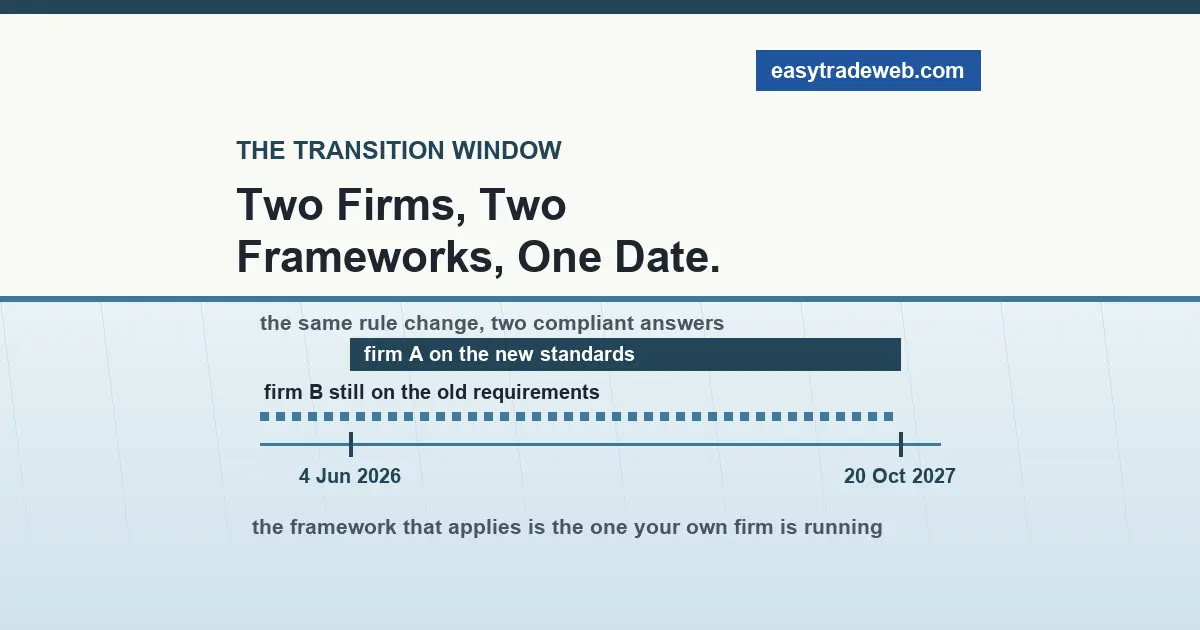
The effective date is 4 June 2026. Firms needing longer get until 20 October 2027, and the Commission spells out what that means on the ground: one firm may keep running the older rules for the whole window while another moves across early.
The Commission points readers to two FINRA publications for the detail, a Regulatory Notice titled Margin Standards and an Investor Insight titled Understanding the New Intraday Margin Requirements. Both are named here rather than summarised, because the figures inside them come from FINRA and not from any secondary description of them.
The practical consequence for anyone reading an older explanation is that it may be accurate about a framework their own broker has already left, or accurate about a framework their broker has not yet adopted. Neither is a mistake by the writer. The transition is designed to produce exactly that.
Why a Spot Forex or CFD Account Was Never in Scope
The rule reaches securities margin accounts at United States broker-dealers. That scope is what excludes a spot currency position: it is not a security bought on margin at a broker-dealer, and the account holding it is not the kind of account the requirement was written for.
The same reasoning covers a contract for difference, which is not available to retail customers in the United States at all and is regulated elsewhere under a separate regime. A trader running twenty currency positions a day through a retail forex or CFD account will never meet the pattern day trader definition, because none of the trades are of the type being counted.
None of that means the account is unconstrained, and this is where the useful part of the question begins rather than ends. A firm can impose its own limits whatever the regulator requires, and the regime the account does sit under has a constraint of its own that bites harder than any trade count.
What Does Limit a Leveraged Day Trader Instead
On a retail account authorised in the United Kingdom, the binding rule is an equity floor. The Financial Conduct Authority Handbook, at COBS 22.5.13R, requires the firm to keep a retail client above half of the margin supporting the open positions, and to close positions out once the account falls under that level.
The difference in kind is worth stating carefully. The pattern day trader rule restricted future activity once behaviour crossed a line. The close-out requirement acts on positions already open, and it acts on a number that moves every time the market does. A day trader never approaches it by trading too often. They approach it by being wrong on size.
A second rule, COBS 22.5.17R, caps what a retail client can owe at whatever the account holds, so the loss is bounded by the balance. How the close-out point relates to the levels a platform displays is set out in how a margin call and a stop out differ, and how the margin figure itself is arrived at in how leverage tiers change the margin required.
Traders who want a trade-count rule will find one in a different place entirely. Funded-account programmes routinely impose them by contract, along with loss limits that have no regulatory equivalent, and those terms are described in the rules a funded account imposes instead.
| Account | What the rule measures | What happens when it is met |
|---|---|---|
| US securities margin account, old framework | Day trades made and their share of total trades | Designation, a $25,000 minimum and margin-account-only trading |
| US securities margin account, new framework | Intraday margin, under standards published by FINRA | Stated in the FINRA notices named above, not here |
| UK retail CFD or spread bet account | Account equity against the margin on open positions | The firm must close positions out at the 50 percent floor |
| Funded or evaluation account | Whatever the programme contract specifies | Breach of contract terms rather than a regulatory step |
Your Broker May Not Be On the Same Rules as the Next One
The transition period turns a single question into a per-firm one. Two customers trading identically at two United States brokers can be under different requirements today, and both firms are compliant.
That makes the broker, not the internet, the authority on this. The Commission says so directly, advising customers to contact their brokerage firm to understand how the changes affect the account. It gives the same advice about the definition itself, since a firm applying a broader one of its own will not announce that in a page about the regulator minimum.
For a forex or CFD account the equivalent question is which entity holds it. Large brokers operate several licensed entities, and the leverage cap, the close-out floor and the protections attached differ by entity rather than by brand. The account type documents rather than the marketing pages carry that, and the account types a forex broker offers covers how those are laid out.
Who This Page Is Not For
This page will not settle a United States securities question. It states what the Commission publishes about the framework and its replacement, and everything beyond that belongs to the FINRA documents named earlier and to the firm holding the account.
It is also not for a trader looking for a rule that permits more frequent trading. No rule discussed here makes frequent trading safer, and the constraint that reaches a leveraged currency account is triggered by size and adverse movement rather than by how often the account trades.
And it is not for anyone hoping to find the current intraday margin figures stated here. They are published by FINRA, whose own pages did not return to an automated request on the date below, so no figure from them appears on this page rather than one taken from a secondary source.
Four Things to Confirm on Your Own Account
Each of these is answerable from documents the firm already publishes or from a message to its support desk, and together they replace guessing which framework applies.
- Establish the instrument. Securities bought on margin at a United States broker-dealer, or a contract for difference or spot currency position elsewhere. This single answer decides which rule book is even relevant.
- Ask which framework the firm is operating. During the transition the answer is either the older day trading margin requirements or the new intraday margin standards, and the firm can say which.
- Ask whether the firm applies a broader definition than the regulator minimum. The Commission states some do, and a firm-level definition is the one that will act on the account.
- Read the close-out level in the account terms. On a retail CFD or spread bet account that number, not any trade count, is the figure that ends positions.
The answer to the original question is short once the account is identified. On a spot forex or CFD account the pattern day trader rule is not the constraint, has never been the constraint, and is in any case being retired where it did apply. What deserves the attention it was getting is the close-out floor and the size that determines how far away it sits.
Risk warning: this page is educational and describes how regulatory requirements apply to different account types. It is not advice to open, hold or close any position, and it is not a statement of what any particular firm requires. Rules change and firms apply their own terms on top of them, so the account documents and the firm itself are the authority. Leveraged trading carries a high risk of loss.