
Best Scalping Indicators

The best scalping indicators are the key topic to cover when explaining scalping, since scalping is often regarded as one of the most active and profitable styles of trading in the forex market. When we talk about scalp trades, we can’t ignore the role technical indicators play in this style of trading. That’s the focus of this article — the best scalping indicators — along with the best timeframes for scalp trading.
Best Timeframe for a Day Trader
The timeframe a scalper or day trader uses depends on their trading method, but it will typically fall somewhere between the 1-minute and the 30-minute chart. The 30-minute timeframe can be classified as day trading — a style one step up from scalping — or it can be considered a timeframe shared by both styles.
Most scalpers prefer the 5-minute or 1-minute timeframe, because price moves faster on these charts.
Best Scalping Indicators (the Best Indicator for Buy and Sell Signals)
As mentioned above, trading on short timeframes moves fast, so you need a helping factor to keep up with it — trading indicators. There are many of these available on trading platforms, and we can’t list them all here, but we can cover three of the best scalping indicators:
- Moving Averages
- Bollinger Bands
- Relative Strength Index (RSI)
Most traders already know these indicators, or at least one of them, so in looking for the best scalping indicators we should walk through the most important ones.
Moving Averages
Notice that we’re using the plural here — we don’t mean one specific moving average, because there are many different settings for moving averages, and each one serves its own purpose. For example, moving averages can be used to identify the trend by using a longer setting, such as the 200-period moving average, on small timeframes.
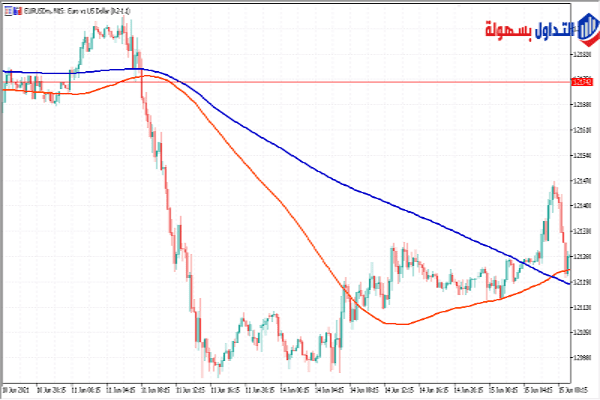
Moving averages can also be used to spot entry and exit points, by combining two moving averages and watching for the crossovers between them, along with many other uses, such as treating them as support and resistance.
Read also: Learn about the best Moving Average settings (Moving Average)
Bollinger Bands
Bollinger Bands may be the most well-known indicator among traders who like price breakouts, which happen more often on the short timeframes we’re discussing here. Bollinger Bands can also be used for range trading, when we’re talking about the 30-minute timeframe.
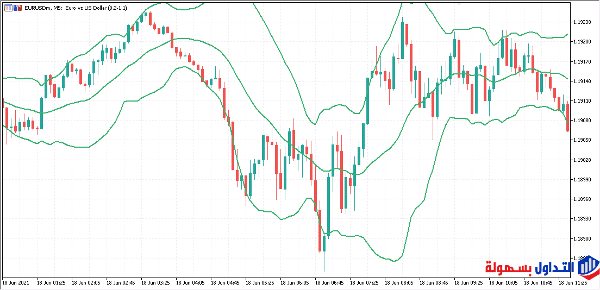
Whatever timeframe is used with Bollinger Bands, no one can deny how useful it is for signaling entries during price breakouts, as well as in range trading.
Read also: A scalping strategy using Bollinger Bands and Stochastic
Relative Strength Index (RSI)
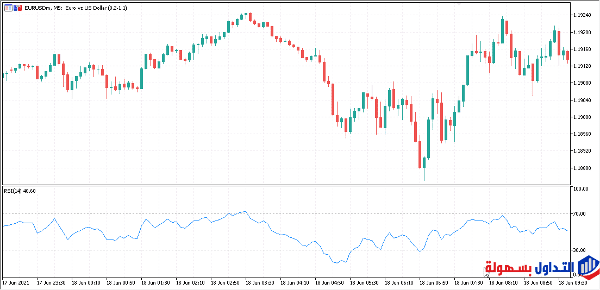
The last indicator on our list of the best scalping indicators is the Relative Strength Index (RSI), which falls under the oscillator category. It has many uses, such as showing overbought and oversold zones, showing divergence, and identifying good entry and exit areas.
Note that we haven’t gone into a detailed explanation of each indicator individually here — you can find a full explanation of these indicators, along with some strategies for using them, in the education section of our site, Easy Trade.
Tips for Using the Best Scalping Indicators in Forex:
- When scalping, traders should focus on one currency pair or position at a time, for a better chance of success.
- Trading multiple positions at the same time can make it hard to properly monitor the technical charts, and focus often gets split.
- It’s recommended to use the best scalping indicators and trade only currency pairs where liquidity and volume are higher.
- Scalping moves fast, so major currency pairs need enough liquidity to let a trader enter and exit the market quickly.
- Scalpers often have a particular temperament or personality that fits this higher-risk style of trading.
- Scalping requires using the best scalping indicators, along with focus, analytical skill, and a fair amount of patience, which lets scalpers make fast decisions and take profits.
Test this indicator without risking capital
Reading about an indicator is not the same as watching it behave on a live chart. A demo account lets you apply the settings above to real market data and see how the signals form before any money is involved.
Advertising disclosure: partner link. Easy Trade may receive compensation. Educational content, not financial advice. CFDs carry a high risk of losing your capital.
Scalping is considered one of the more profitable styles of trading in the forex market, and it generally relies on the best scalping indicators more than some other trading styles do, since those can sometimes get by without them. But which indicators work best for scalping? That’s what this article answers.
What Are Scalping Indicators
Scalping indicators are tools that can be combined into an overall plan to look for larger returns in short-term trading. It’s fair to say that in scalp trades it’s difficult to trade using price action alone, because of the sharp volatility involved, so you need another solid guide — which is what some of the technical indicators covered here provide.
Read also: What Are Technical Indicators | An Explanation of the Best 7 Indicators That Will Help You Trade
What Are the Benefits of Scalping Indicators
There are too many benefits of technical indicators to cover in a single article, but here are a few of them:
- They help a trader understand the state of the currency market and make better decisions about profits.
- They help in understanding market direction.
- They point to existing momentum, or the lack of it, in the securities market.
- They help gauge how popular a security is by measuring volume.
- They help show whether the market is moving or not.
What Are the Best Scalping Indicators?

Now we get to the subject of this article — the best scalping indicators. We’ll classify each one by its function, which can be summed up as follows:
- Trend indicators
- Oscillators
Trend Indicators
The first group of indicators we’ll cover here are trend indicators, the most widely used in scalping. There are many trend indicators, but we’ll cover two of the most commonly used here:
- Moving Averages
- Bollinger Bands
Moving Averages
One of the first indicators on our list of the best scalping indicators is the moving average, which can be defined as a line on the price chart that connects the average closing prices of the market, calculated over a set period.
Moving average indicators help traders understand the main direction of price movement in a currency market that is volatile by nature. This indicator smooths out price fluctuations and helps traders read the main trend in price action.
There are several ways to identify the trend using moving averages, but the most common is using a long-period moving average alongside price action, such as the 200-period moving average — when it sits below the price, that points to an uptrend, and when it sits above the price, that points to a downtrend.
Read also: How to Identify Support and Resistance Using Moving Averages
Bollinger Bands
The second indicator here, classified as one of the best scalping indicators, is Bollinger Bands, which help give a picture of the price’s trading range through 3 bands — each representing the moving average line, the upper and lower price levels, and the standard deviation of price.
When trading Bollinger Bands, if a currency pair is trading below the lower band, traders often watch for the price to move back up from these levels, and in that scenario may consider buying the pair. Conversely, if the pair’s price sits above the upper band, traders may consider selling.
Read also: The Strengths of Bollinger Bands
Oscillators
Now we come to the second type on our list of the best scalping indicators — oscillators, which show the strength of demand for a given currency pair at a given price. If a pair’s price is rising while the oscillator shows momentum fading at the same time, that suggests demand for the pair is weakening, which can lead to the pair’s price falling later on.
There are many oscillator indicators, but we’ll cover just one here — the Relative Strength Index (RSI), which shows the strength of a currency pair’s price by tracking the last 14 periods by default. It helps compare the pair’s gains and losses, then turns that data into a line inside the indicator.
The key points about oscillators, among the best scalping indicators, are:
- Oscillators are chart indicators that can help a trader identify overbought or oversold conditions in the markets.
- Most traders use several oscillators, among the best scalping indicators, to confirm the extremes of a price range and to identify important entry and exit points.
- The RSI is an oscillator among the best scalping indicators that measures the extent of recent price changes to identify overbought or oversold conditions in an instrument’s price.
Frequently Asked Questions:
What is scalping in forex trading?
Scalping is a trading technique based on technical analysis, used in short-term trading styles through buying and selling within a short period of time.
What is scalping in the stock market? What is stock scalping?
It’s a technical approach traders use in stock markets to analyze price movement over a short period. This technique is preferred by traders who follow a short-term trading strategy.
What is the best strategy for day trading?
The range strategy is considered one of the best for day trading, since it relies on a watch-and-wait approach. In this case, the market takes the shape of ranges where money positions concentrate — trading points aimed at accumulating trades.
Is scalping suitable for beginners?
For beginners, scalping means buying a given stock and selling it within a short period, to take advantage of price fluctuations and aim for a quick profit. Because of this, it’s considered one of the riskier trading strategies, since it relies on betting on price movement.
What is scalping (day trading)?
Day trading means buying and selling stocks within the same day. The trader arranges the trade on the same trading day and doesn’t take actual delivery pricing. The aim is to profit from price fluctuations. Trading stocks, currencies, and commodities within the day serves as an income source for the day trader.
Disclaimer: This article is for educational purposes only and is not investment advice. Trading forex and CFDs with leverage carries a high level of risk and can result in losses that exceed your deposit. Some links on this site may be affiliate links, meaning we may earn a commission if you sign up through them, at no extra cost to you.