
Iceberg Orders: Where You Can Place One and What It Costs

A large order resting in full view of the order book changes the book it is resting in. Other participants can see the size, price around it, and step away from it. The iceberg order is the response: show a slice, keep the balance in reserve, let the venue top the slice up as it trades.
Most published explanations stop at that description. They do not say which platforms actually offer the order, who fixes the size of the visible slice, or what each top-up does to your place in the queue.
Those three answers decide whether the order type is available to you at all, and whether using it helps or quietly costs you. All three are settled in venue and platform documentation rather than in theory.
Key takeaways
- Availability is a platform question first. MetaTrader 5 documents market orders, six pending types and the Stop Loss and Take Profit orders, and no iceberg appears in that documentation.
- Every top-up costs time priority. TSX Alpha states that a replenished iceberg takes a fresh time stamp, letting orders already resting at that price move ahead of it.
- Undisclosed size ranks behind disclosed size at the same price, so an iceberg carries two queue penalties rather than one.
- Iceberg, fully hidden and platform-synthetic are three different orders. A TT Iceberg is a synthetic parent order releasing child orders from the platform, so the balance never rests at the venue.
- The floor under the visible slice belongs to the venue. Kraken requires at least one fifteenth of the total order; TSX Alpha accepts as little as one board lot.
- Where a retail account is filled by a dealing broker rather than routed to a central order book, there is no public queue to hide from and the order type is generally absent.
Table of contents
- Can You Actually Place an Iceberg Order? Start With Your Platform
- What an Iceberg Order Is, Read in the Book Rather Than in Theory
- The Refresh Is Not Free: Queue Priority Resets Each Time
- Iceberg, Hidden and Reserve Are Three Different Orders
- Who Sets the Minimum Visible Size, and Why It Differs by Venue
- When Hiding Size Helps, and When It Only Slows the Fill
- Questions Readers Ask About Iceberg Orders
- Who This Order Type Is Not For
- What We Checked, and Where
Can You Actually Place an Iceberg Order? Start With Your Platform
Before any question about when to use one, there is a question about whether the field exists on your ticket. For a large share of retail traders it does not, and the reason has nothing to do with account size.
The MetaTrader 5 documentation that describes how orders work on the platform divides them into market and pending, then lists the six pending types: Buy Limit, Buy Stop, Sell Limit, Sell Stop, Buy Stop Limit and Sell Stop Limit. Stop Loss and Take Profit are handled separately. Across that entire document, no iceberg or disclosed-quantity order appears.
That absence is structural rather than an omission. An iceberg is a property of an order resting in a central limit order book run by a venue that ranks competing orders and publishes the sizes at each price. Where a broker fills you against its own book, no public queue exists to conceal size from, so there is nothing for the order type to do. The order types a retail platform actually offers follow from that routing model.
The order type lives where the routing runs to an order book: equity exchanges such as TSX Alpha, crypto venues such as Kraken, and professional execution platforms that assemble their own version on top of an exchange connection.
The practical check takes a few seconds. Open the order ticket for the instrument you trade and look for a second quantity field, usually labelled display or disclosed quantity. If the ticket carries one total size and nothing else, the venue or the platform in front of it does not offer the order type, and no setting elsewhere will produce it.
What an Iceberg Order Is, Read in the Book Rather Than in Theory
An iceberg is a single order carrying two quantities: the full size you want to trade, and the smaller portion you are willing to show. Only the second figure reaches the public book. The rest is held by the venue and is invisible to everyone watching the price.
As the shown portion trades away, the venue rebuilds it from the remainder. Kraken describes that rebuild as happening in steps the size of the displayed quantity, repeating until the total is exhausted. So the book shows a small order that keeps reappearing at one price rather than a single large one.
What separates this from slicing an order by hand is that the entire balance is booked at the venue from the outset. You are not watching for a fill and sending the next piece; the balance is already there and is eligible to trade. That also makes the iceberg visible in depth of market only as the tip it chooses to show.
One consequence is easy to miss. Kraken notes that its iceberg is a standalone order and is not linked to any position, so closing the position by some other route leaves the iceberg working. It has to be cancelled by hand.
The Refresh Is Not Free: Queue Priority Resets Each Time
This is the mechanism that decides whether the order type is worth using, and it is the one most explanations leave out.
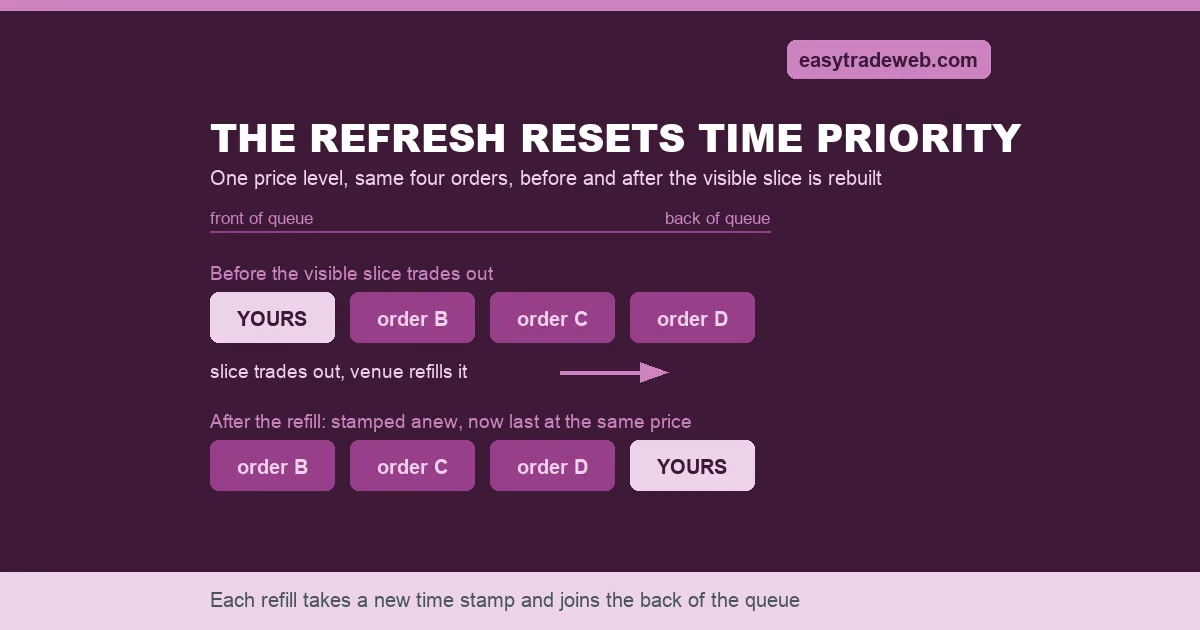
TSX Alpha states it plainly in its own order-type documentation: when the disclosed portion of an iceberg is replenished, that portion receives a new time stamp, and orders sitting at the same price are given the chance to move up the time queue ahead of it. The exchange records the behaviour and draws no conclusion from it.
The conclusion is worth drawing. Time priority at a price level is normally earned by arriving early and kept by staying put. An iceberg gives that up on a schedule. Each time the visible slice is exhausted and rebuilt, the rebuilt slice goes to the back of the line at its price, behind everything that was already waiting there.
A second penalty sits underneath the first. At TSX Alpha the undisclosed balance becomes eligible to trade only once all other disclosed volume at that price has been satisfied. Hidden size is ranked behind shown size regardless of when it arrived.
Put together, an iceberg of a given total size will generally fill later than one fully displayed order of the same size at the same price. And the relationship runs the wrong way from intuition: the smaller you set the visible slice, the better the concealment and the more often you surrender your place.
Concealment is bought with time, and the price is paid once per refill. This is the cost that never shows up in level 2 market data, because the book displays position and size rather than the history of how a resting order got there.
Iceberg, Hidden and Reserve Are Three Different Orders
The terms are used as though they name one idea. They do not, and the confusion is not confined to third-party explainers. The Kraken support page introduces its iceberg as an order also known as a hidden order, which merges two order types that behave differently in the book.

An iceberg always displays something. A fully hidden order displays nothing at all, and at venues that rank by visibility it sits behind displayed size at its price for that reason. Reserve is simply the name several venues use for the iceberg itself.
A synthetic version, such as the TT Iceberg documented by Trading Technologies, is different again: it is a parent order held by the platform that submits child orders to the venue, so the balance is never resting at the exchange waiting to be revealed.
The distinction matters at the moment you choose, because it changes both what the book shows and where you sit relative to everyone else at your price.
| Order | What the book shows | Where the balance sits | Effect on your place in the queue |
|---|---|---|---|
| Iceberg (also called reserve) | A slice you choose, refilled as it trades | At the venue, undisclosed | Fresh time stamp on every refill; hidden balance ranked behind shown volume |
| Fully hidden | Nothing | At the venue, undisclosed | Ranked behind displayed size at the same price where the venue prioritises visibility |
| Fully displayed limit | The whole size | At the venue, disclosed | Priority earned on arrival and held until filled or cancelled |
| Synthetic, platform-managed | Only the child order currently working | On the platform, not at the venue | Each child order queues on its own from the moment it is sent |
Who Sets the Minimum Visible Size, and Why It Differs by Venue
You choose the displayed quantity, but only inside a floor the venue sets. That floor is not a market-wide standard, and the published figures differ enough to look like a contradiction when two pages are read side by side.
Kraken applies two conditions at once: the displayed amount cannot fall below the minimum order size for the trading pair, and it cannot be smaller than one fifteenth of the total order. A large order therefore has a proportional floor rather than a fixed one. TSX Alpha expresses its rule in the unit an equity market trades in, permitting a disclosure as small as one board lot.
Neither figure is wrong and neither travels. Each belongs to one venue, and a reader who takes a number from a crypto exchange to an equity market, or the reverse, is applying a rule that does not exist there. The venue is also what decides whether the order reaches a book at all, which is a function of how your broker routes the order.
| Venue or platform | Floor under the visible slice | What the rule is expressed in |
|---|---|---|
| Kraken | The pair minimum order size, and no less than one fifteenth of the total order | A proportion of your own order size |
| TSX Alpha | As little as one board lot | The trading unit of the equity market |
| MetaTrader 5 | Not applicable, the order type is not documented | No disclosed-quantity field exists |
When Hiding Size Helps, and When It Only Slows the Fill
The decision reduces to one comparison: whether showing your size would move the price against you by more than the queue delay costs you.
Concealment earns its keep when the order is large next to the volume displayed at the top of the book, when the instrument is thin enough that a visible block invites others to reprice, and when you can wait. In those conditions the alternative is worse, because a fully displayed order announces the interest that then trades away from you. Concealing size this way is a published order type rather than the conduct the statutes call spoofing, which turns on entering an order there is no intention to fill.
It works against you when the order is small enough to sit inside the volume already showing at your price. Nobody was going to notice it, so nothing is being concealed, and the refill still sends you to the back of the queue each time. It also works against you when the fill matters more than the price, since the two penalties both delay execution and neither can be switched off.
The thin-book case cuts both ways and is worth separating. A thin book is exactly where a large order would be conspicuous, and also exactly where your own order may be most of the resting volume at that price. Hiding it there can leave you waiting for participation that never arrives. How long you are prepared to wait belongs with the order lifetime you set, which is what time in force controls.
Questions Readers Ask About Iceberg Orders
What does an iceberg order actually do?
It splits one order into a visible portion and a concealed balance held at the venue. Only the visible portion appears in the public book, and the venue rebuilds it from the balance each time it trades away, repeating until the full size is done.
Can you place an iceberg order in MetaTrader?
The MetaTrader 5 documentation covering order types describes market orders, six pending order types and the Stop Loss and Take Profit orders, and contains no iceberg or disclosed-quantity order. Where an account is filled by a dealing broker rather than routed to a central order book, there is no public queue to hide size from.
Is an iceberg order the same as a hidden order?
No, although several venues describe them as one thing. An iceberg always displays a slice. A fully hidden order displays nothing, and at venues that rank by visibility it waits behind displayed size at the same price. The choice changes both what the book shows and where the order sits in the queue.
Are iceberg orders legal?
The order type is published in the order-type documentation of regulated venues, TSX Alpha among them, which is where the conditions for using it are defined. Permitted use is set by each venue and the authority that oversees it, so the venue rulebook for the market being traded is the place that settles it.
Can you tell when someone else is running an iceberg?
Not from the public book, which carries only the disclosed amount. What can be observed is the pattern the refill leaves behind, where a modest quantity at one price is repeatedly consumed and reappears. That pattern is an inference rather than confirmation, and other activity produces it too.
Who This Order Type Is Not For
If the account is filled by a dealing broker rather than routed to an order book, the field will not appear on the ticket and no workaround produces it. That covers most retail forex and CFD accounts.
If your usual size fits inside the volume already displayed at the top of the book, there is nothing to conceal, and the refill penalty is paid for a benefit that was never available.
If the fill matters more than the price, the order type runs against you on both counts, because the hidden balance queues behind displayed size and every refill resets the time stamp.
What remains is a narrow case: an order large relative to displayed liquidity, at a venue that operates a ranked public book, held by someone who would rather wait than be seen.
What We Checked, and Where
Every figure and rule above was taken from the documentation of the venue or platform it belongs to, rather than from a general article. Where the sources disagree on a minimum, both were kept and attributed to their own venue, since neither applies to the other.
No day count, fee or fill-probability figure appears anywhere on this page, because none of the documents read for it states one.
Risk warning: this page is educational and describes how iceberg orders are defined in published venue and platform documentation. It is not advice to place any order, to use any order type, or to trade any instrument, and nothing here states that concealing order size is appropriate for any reader. Venue rules differ by market and by entity, and leveraged trading carries a high risk of loss.