
The Disposition Effect and Why Traders Hold Losing Trades

A trader closes a position that is 30 pips up and leaves one that is 60 pips down open. Asked why, they will describe the market. The pattern is older than the market they are describing, it has a name, and it has been measured on real brokerage accounts.
What the general explanations of it leave out is the part that matters on a margin account. They are written about someone holding shares, who can wait indefinitely for a loser to recover. A leveraged position does not offer that. The account has a floor, the position accrues a cost every night it stays open, and the decision the bias makes hardest is one an order type can take away entirely.
Key takeaways
- The disposition effect is the tendency to realise gains readily and postpone realising losses. Shefrin and Statman named it in 1985.
- Odean measured it across 10,000 brokerage accounts from 1987 to 1993: gains were realised at 0.148 against 0.098 for losses, a gap of 0.050 with a t-statistic above 35.
- On a leveraged account the bias meets a hard limit no share investor faces, because the broker closes the position when equity falls far enough.
- A losing position held open on a currency or CFD account accrues overnight financing for every night it stays open, so delay carries a running cost and not only an opportunity cost.
- A stop order set before the position is opened removes the decision at the moment the bias is strongest. It does not guarantee the exit price.
Table of contents
What the Disposition Effect Is, and the Numbers Behind It
The disposition effect is the tendency to close winning positions readily while leaving losing ones open. Shefrin and Statman attached the label in 1985, and the behaviour it describes is a preference about which positions get closed, not a view about which way a market is going.
The measurement that made it concrete came from Odean, who worked from seven years of trading records, 1987 to 1993, covering 10,000 accounts held at one discount brokerage. Rather than count trades, that study compared two proportions. One is the share of the gains available in an account that were actually taken. The other is the same share for losses.
Across the full period the proportion of gains realised came to 0.148 and the proportion of losses realised to 0.098. The gap of 0.050 carried a t-statistic above 35, which puts it far beyond the range where a run of luck explains it.
Read those two numbers carefully, because the comparison is the point. Both are small, since most positions simply stay open on any given day. What the study established is that when something was closed, a winner was around half again as likely to be the position chosen than a loser the same trader was holding at that moment.
Why the Bias Happens
The usual explanation traces to prospect theory, set out by Kahneman and Tversky in 1979, which describes people valuing outcomes against a reference point rather than in absolute terms. Above that point they behave cautiously and take the certain result; below it they accept risk to avoid settling for a certain loss.
A position in profit and a position in loss therefore present two different problems, and the reference point that separates them is usually the entry price.
A second mechanism sits alongside it. Odean describes people segregating separate bets into separate mental accounts and judging each one on its own. Closing a position at a loss shuts that account permanently on a negative number, which is a different act from watching an open position show the same figure. Leaving it open keeps the outcome undecided.
Both explanations point the same way: the resistance attaches to the act of closing, not to the size of the number, which is why the bias survives contact with a trader who can see the loss perfectly clearly, and why it belongs with the other patterns in how emotion shapes a trading decision.
The Case the General Explanations Miss
Almost every account of this bias is written about someone who owns shares outright. That reader can hold a losing position for as long as they choose. The position costs nothing to keep, nobody can close it for them, and waiting is a genuine option however unwise it may be.
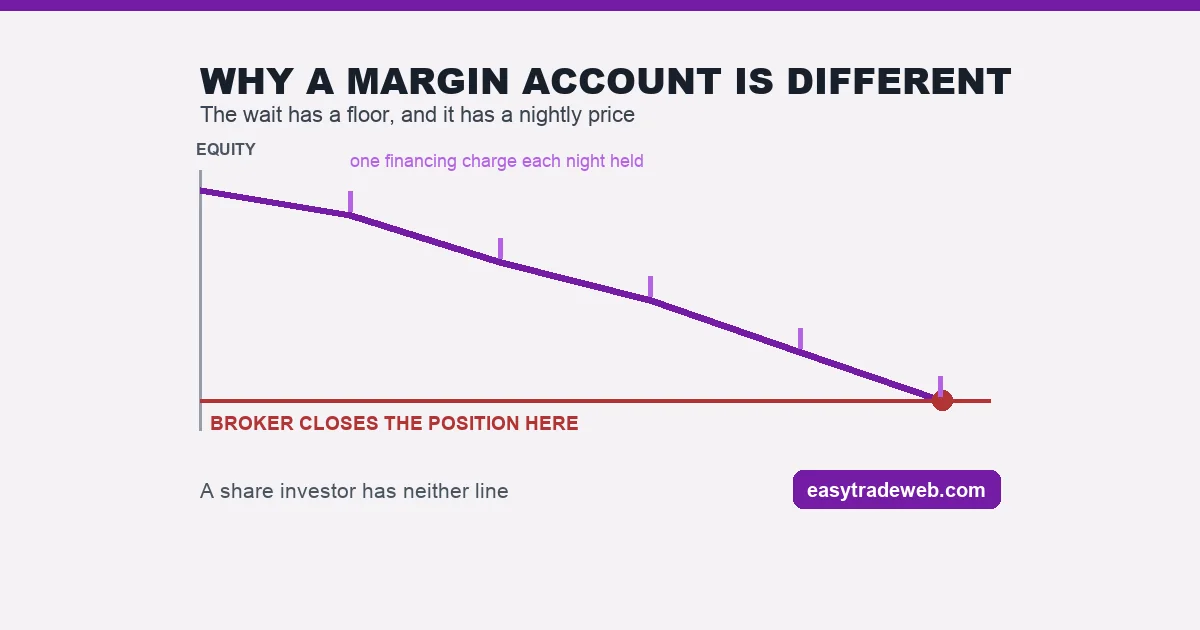
A leveraged position is a different object. The trader has posted margin rather than paid the full value, and the account is monitored continuously against that margin. As an open loss grows, free margin falls, and once equity drops far enough the broker closes positions itself. The specific levels are set by the firm and, for retail accounts in some jurisdictions, by rule, and they are covered under when a broker closes a position for you.
That changes what the bias actually does. For a share investor the disposition effect delays a decision. On a margin account it delays a decision that has a deadline attached, and the deadline is enforced by someone else.
| Holding a loser | Shares owned outright | Leveraged currency or CFD position |
|---|---|---|
| Who decides when it closes | The holder alone | The holder, until the broker does it instead |
| Cost of waiting | Opportunity cost | Opportunity cost plus overnight financing |
| Effect on other positions | None directly | Consumes free margin across the account |
| Can the wait be indefinite | Yes | No |
The third row is the one traders underestimate. A single loser left open does not only wait for its own recovery; it holds margin that every other position on the account shares. The bias therefore reaches trades it was never applied to, which is a connection sizing a position before it is opened is meant to prevent.

What Holding a Loser Costs Overnight
The second difference is a price rather than a limit. A currency or CFD position carried past the daily rollover is financed, and that financing is applied for each night the position stays open. Whether it is charged or credited depends on the instrument and the direction, and the rate is set by the broker.
For the trader holding a loser, this converts a psychological delay into an accumulating charge. Waiting three weeks for a recovery is not a free option; it is roughly fifteen or more financing applications against the position, on top of whatever the market does.
None of the general treatments of this bias mention it, because a share bought outright is not financed. It is the clearest case of a behaviour whose cost is genuinely higher in one instrument class than in the one the research was written about.
The practical consequence is that a recovery has to cover more ground than the original loss. The position must retrace far enough to erase the market loss and the financing accrued while waiting, and the longer the wait the further that target moves.
The Order Type That Removes the Decision
Every explanation of this bias describes it. Almost none names the mechanism that defeats it, which is odd, because the mechanism is ordinary and sits in the order ticket.
A stop order attached when the position is opened fixes the exit while the position is still flat and the reference point has not yet formed. The decision is made at the only moment the bias is not operating, which is before there is a loss to refuse to accept. Nothing has to be decided later, so nothing has to be resisted later.
Two honest qualifications belong with that. A stop is an instruction to close at market once a price is reached, so the fill can be worse than the level set when the market gaps or moves quickly, and the price that triggers it is not always the one displayed on the chart, as which price triggers a stop sets out. A stop is protection against indecision rather than a guarantee about the exit.
The second qualification is behavioural. Moving a stop further away as price approaches it reproduces the bias exactly, using the order ticket instead of avoiding it. The value of the stop is that it was set before the position existed; a stop that gets edited under pressure has surrendered that.
Where the Effect Reverses
The pattern is not constant through the year, and the exception is instructive. In the same data, December runs the other way: the proportion of losses realised rises to 0.128 and the proportion of gains falls to 0.108.
The explanation is tax. Where losses can be set against taxable gains there is a calendar reason to realise them before the year ends, and that incentive is strong enough to overturn a bias that holds for the other eleven months. Odean notes the same records show tax-motivated selling concentrated in December.
Which is worth holding onto, because it shows the bias is not a fixed trait. A sufficiently concrete external reason to close a loser overrides it. A stop order is that reason, supplied deliberately rather than by the calendar.
Questions Readers Ask About the Disposition Effect
What is the disposition effect?
It is the tendency to close positions that are in profit while leaving positions that are in loss open. Shefrin and Statman gave the pattern that name in 1985. It describes which position a trader chooses to close rather than any view about market direction, which is why it can operate on someone who can see the losing position perfectly clearly.
Why do traders hold losing trades?
Two explanations are usually offered together. Prospect theory, set out by Kahneman and Tversky in 1979, describes people accepting risk to avoid a certain loss while taking the safe outcome when they are ahead. The second is mental accounting: closing a position at a loss shuts that particular account permanently on a negative number, whereas an open position leaves the outcome undecided. The resistance attaches to the act of closing.
Is the disposition effect the same as loss aversion?
No, although they are related. Loss aversion describes losses weighing more heavily than equivalent gains. The disposition effect is a specific behaviour that follows from how gains and losses are valued against a reference point: gains get realised sooner and losses get postponed. One is a property of how outcomes are weighed, the other is an observed pattern in which positions actually get closed.
Does it affect professional traders too?
The measurement most often cited covers 10,000 accounts at a discount brokerage from 1987 to 1993, so it describes individual investors rather than professionals. What that study established is that the pattern is real and large in that population. Treat any claim about a specific group of professional traders as needing its own evidence rather than assuming the finding transfers.
How do you avoid the disposition effect?
By deciding the exit before the position exists, which is what a stop order attached at entry does. The decision then gets made at the one moment the bias is not operating, because there is no loss yet to refuse to accept. A stop does not guarantee the exit price, since the fill can be worse when a market gaps, and moving it away as price approaches reproduces the bias through the order ticket.
Reading Your Own Trade History
The two proportions in this page can be computed for any account: take the trades closed in profit against the profitable positions that were open at the same time, then do the same for losses, and compare. A platform statement carries everything the calculation needs.
If the gap shows, the useful next step is not more resolve but the arithmetic that sits underneath it, which is where how deep a losing run goes continues from here.
Risk warning: this page is educational and describes a documented behavioural pattern and the mechanics that interact with it. It is not advice to open, hold or close any position, and avoiding a bias is not a method of producing a profit. A stop order does not guarantee an exit price. Leveraged trading carries a high risk of loss.