
Best Broker for Swing Trading: What Holding Overnight Costs

A broker suits a multi-day hold when the charge applied at every rollover is small enough that it does not overtake the one-off cost of opening and closing. Commission is paid once. Swap is paid every night, and on one night of the week it is charged three times. That ratio, not the spread, decides the account.
The comparison pages ranking for this question sort brokers by instrument counts, user numbers and spread samples they measured themselves. Every one of those is a cost a position pays once, or no cost at all. The strategy itself is covered separately under what swing trading is, and the mechanics of the charge under how a swap is calculated.
Key takeaways
- Commission is charged once per round turn. Swap is charged at every rollover, so the number of nights held is what decides which account is cheaper.
- Round-turn commission on the raw accounts checked here runs from 6.00 to 7.00 US dollars per standard lot, which is 0.6 to 0.7 of a pip on one standard lot of a pair quoted against the US dollar.
- The triple-swap day is a per-symbol setting on the trade server. MetaQuotes documents it as any day of the week, not as Wednesday.
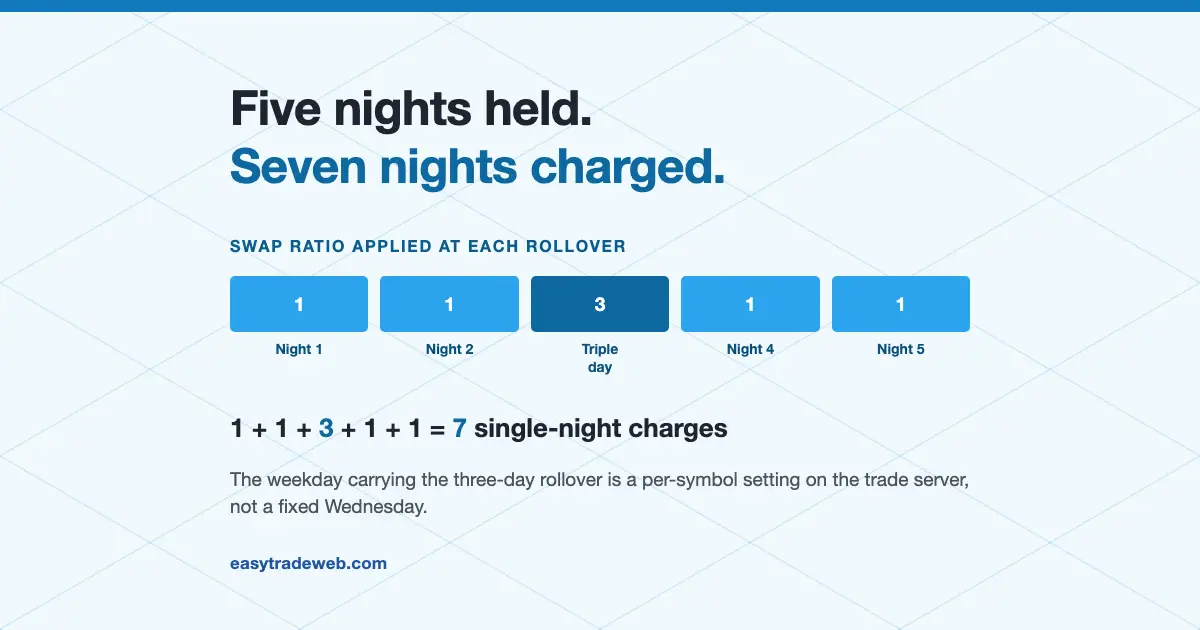
- A five-night hold that spans the triple day is charged for seven nights, because that one rollover carries a ratio of three.
- None of the four brokers compared here publishes a swap figure that could be verified from an official page, so every swap cell reads Not disclosed.
Table of contents
- The Holding Period Where Swap Overtakes Commission
- Commission and Overnight Cost at Four Brokers, From Their Own Documents
- The Triple-Swap Day Is a Broker Setting, Not a Rule
- Ten Ways One Platform Can Calculate the Same Swap
- The Rollover That Can Reset a Stop Loss
- How to Read the Swap Figures for Your Own Account
- When a Swing-Trading Account Is the Wrong Choice
- Frequently Asked Questions
- Which of These Applies to You
The Holding Period Where Swap Overtakes Commission
Two costs sit on every position and they behave differently. Commission is a fixed amount charged when the position opens and again when it closes, and it does not grow afterwards. Swap is applied at each rollover for as long as the position stays open, so it grows in a straight line with the number of nights.
That makes the comparison arithmetic rather than opinion. Take the round-turn commission on the account being considered and divide it by the nightly swap the platform shows for the symbol being traded.
The answer is the number of nights at which the two are equal. Below that number the commission dominates and a raw account is the expensive half of the decision. Above it, the nightly charge dominates and the commission difference between two brokers stops mattering.
The scale of that is easy to underestimate. On the raw accounts compared below, a round turn runs from 6.00 to 7.00 US dollars on one standard lot.
If the nightly charge on the symbol is one tenth of the round turn, the tenth night is where they are equal. If it is half, the second night is. A trader deciding between two accounts on a commission difference of 1.00 dollar per round turn is arguing about a figure that a single rollover can outweigh.
An account built for a different holding period gets this backwards in the other direction. An account built for scalping is chosen on stop distances and cost per round turn, because a position that closes inside the session never reaches a rollover at all. Nothing on that page transfers here, and the reverse is also true.
Commission and Overnight Cost at Four Brokers, From Their Own Documents
The table below carries what four brokers publish, with the legal entity named against each figure because the terms are set by the company that signs the client agreement rather than by the brand. The swap row is the point of the table: it is empty at every one of them.
| Published item | IC Markets | Tickmill | FXTM | Exness |
|---|---|---|---|---|
| Account compared | Raw Spread, MT4 and MT5 | Raw | Advantage | Raw Spread |
| Legal entity publishing the terms | Raw Trading Ltd | Tickmill Ltd | Exinity Limited | Exness (SC) Ltd |
| Commission, round turn, per standard lot | 7.00 | 6.00 | 7.00 on forex | Up to 7.00 |
| That round turn as a share of one pip | 0.7 | 0.6 | 0.7 | Up to 0.7 |
| Swap per lot per night on a named symbol | Not disclosed | Not disclosed | Not disclosed | Not disclosed |
| Day the triple swap is charged | Not disclosed | Not disclosed | Not disclosed | Not disclosed |
| Zero-commission account at the same broker | Standard | Classic | Edge, Micro, Advantage Plus | Standard, Standard Cent, Pro |
Figures verified against each broker’s own published terms on 5 September 2026. All amounts are US dollars per standard lot. The pip share assumes one standard lot of a pair quoted against the US dollar, where one pip is 10 US dollars. Swap and triple-swap day read Not disclosed because no official page carrying either figure could be reached on that date.
The Triple-Swap Day Is a Broker Setting, Not a Rule
The convention that swap triples on a Wednesday is repeated everywhere and is not what the platform documents. In the MQL5 reference the property is SYMBOL_SWAP_ROLLOVER3DAYS, described as the day of the week on which the three-day swap rollover is charged, and its type is the day-of-week enumeration. Any of the seven values is legal, and the value is held per symbol rather than per account.
MetaTrader 5 goes further than a single day. Alongside that property the reference lists a separate ratio for each weekday, and it documents exactly three permitted values for each one: zero for no swap charged, one for a single swap, three for a triple swap. A symbol can therefore be configured to charge nothing on one night and three times on another, and the pattern is readable rather than assumed.
The consequence for a multi-day position is direct. A hold of five nights that includes the triple day is charged for seven, because four of those rollovers carry a ratio of one and the fifth carries three. Planning a trade around a five-night cost and meeting a seven-night charge is a forty per cent error introduced by one setting nobody looked up.

Ten Ways One Platform Can Calculate the Same Swap
A swap number means nothing until the unit is known, and the unit is a separate property. The MQL5 reference lists ten values for the swap calculation model.
Swaps can be disabled entirely, charged in points, charged as money in the base currency of the symbol, in the margin currency, in the deposit currency or in the profit currency, or charged as an annual interest rate applied either to the current price or to the price the position opened at, on a 360-day banking year.
The last two are different in kind. In both reopen modes the position is closed at the end of the trading day and opened again the next day at the close price or the current bid, adjusted by the number of points held in the swap fields. The charge is expressed as a price adjustment rather than as a line on the statement.
MetaTrader 4 documents four methods against the ten in MetaTrader 5: points, the base currency of the symbol, interest, and the margin currency. So the same broker running both platforms can express the same charge in two ways, and two brokers quoting the same numeric swap can be charging different amounts. Comparing swap figures without the mode is comparing labels.
The Rollover That Can Reset a Stop Loss
The MetaTrader 5 help draws a line that matters more to a multi-day position than any cost on this page. Forex sits on the over-the-counter side, where the daily transfer into the following session leaves both protective levels as they were, and that holds even under the reopen models. The exchange side is the opposite: the same transfer resets them.
An intraday position never meets this. A position held across nights meets it at every rollover, and the difference is not a setting the trader chooses. It follows from which market the symbol belongs to, and a single account can hold both kinds.
The check is short and belongs before the position is opened rather than after. Establish which market the symbol trades on, then confirm on a live account that a protective order survives a rollover on that symbol. A stop that has quietly gone is indistinguishable from a stop that was never placed until the price reaches it, and a position held over several nights is the case where a gap over the weekend can arrive first.
How to Read the Swap Figures for Your Own Account
Every figure the table calls Not disclosed exists on the trade server and is readable from the terminal, per symbol, on the account actually held. That is the reason the absence on the broker website is worth so little argument: the number is not secret, it is simply not published in a form that can be compared before funding.
Open the symbol specification for the exact symbol to be traded, on the account type being considered, and read four things rather than one: the long swap value, the short swap value, the swap calculation mode that gives those two their unit, and the weekday carrying the three-day rollover.
A demo server may carry different values from the live server of the same broker, so the reading is only meaningful on the account that will hold the position.
Direction matters as much as size. Long and short swaps are separate fields and are frequently opposite in sign, so a strategy that trades one direction of a pair can face a cost where the other direction earns a credit. The account types offered by one broker can also carry different swap treatment on the same symbol.
When a Swing-Trading Account Is the Wrong Choice
Someone closing every position before the daily rollover is paying attention to the wrong figure. No swap is charged on a position that does not survive the rollover, so the entire comparison on this page collapses to commission and spread, and the account chosen for tight stops and low cost per round turn is the correct one instead.
Someone holding one small position for a few nights a month is unlikely to recover the cost of the choice. On a raw account the round turn is 7.00 US dollars per standard lot against nothing beyond the spread on a zero-commission account at the same broker, so at a low trade count the commission account has to win back that amount on spread alone, and no published per-pair spread exists at any of the four brokers here to show that it does.
Someone whose position size is set by a fixed margin allocation rather than by risk is choosing on a different constraint entirely. Swap scales with volume and with nights, so a larger position held longer moves the cost faster than any difference between two brokers, and the size decision outranks the account decision.
easytradeweb.com may be compensated if you open an account through a link on this page. That does not change anything stated above, which comes from the documents and dates given.
Exness publishes commission per side on its raw account and offers zero-commission account types alongside it, so both halves of the crossover above can be read from the symbol specification under one login.
Frequently Asked Questions
Does every forex broker charge swap on a position held overnight?
Not on every account and not on every symbol. The platform documents a swap calculation model whose first permitted value disables swaps for the symbol entirely, and swap-free account types apply the same result at account level. Where swaps are enabled, the charge is applied at each rollover for as long as the position stays open.
Is the triple swap always charged on a Wednesday?
No. The platform property that sets it takes any day of the week and is held per symbol, so the day is chosen by the broker for that symbol rather than fixed by a rule. MetaTrader 5 also carries a separate ratio for each weekday, with permitted values of zero, one and three.
How many nights does it take for swap to cost more than commission?
Divide the round-turn commission by the nightly swap for the symbol and the account. On the raw accounts compared here on 5 September 2026 the round turn is 6.00 to 7.00 US dollars per standard lot, so a nightly charge of one tenth of that reaches it on the tenth night and a nightly charge of half reaches it on the second.
Can a stop loss disappear when a position rolls into the next trading day?
It can, and the market the symbol belongs to is what decides it. For the exchange market the MetaTrader 5 documentation records both levels as reset at the daily transfer into the following session. For the over-the-counter markets that forex sits in, the same documentation records both as unchanged, even where the swap is applied by reopening.
Is a zero commission account cheaper for a trade held for a week?
It depends on the swap on each account rather than on the commission, because seven rollovers are charged either way. The commission saved is a single amount of up to 7.00 US dollars per standard lot, and a swap difference between the two accounts is charged again at every one of those rollovers.
Which of These Applies to You
If positions close before the rollover, none of this decides anything. The account is chosen on stop distance and cost per round turn, and the swap fields can be ignored until the holding period changes.
If positions are held for several nights, read the four symbol-specification fields before funding rather than after the first statement. The swap value, its mode, the weekday ratios and the direction traded settle the cost, and a commission difference of one dollar per round turn will not change the answer.
If the symbol sits on an exchange market rather than over the counter, check what a rollover does to a protective order on a live account first. A cost comparison on a position whose stop does not survive the night is answering the wrong question.
Sources checked 5 September 2026: MQL5 Reference, Symbol Properties, for the day-of-week property that sets the three-day swap rollover, the per-weekday swap ratios and their permitted values, the ten swap calculation models including the two reopen models, and the long and short swap value properties. MQL4 Reference, MarketInfo constants, for the four swap calculation methods available on that platform. MetaTrader 5 Help, General Concept of Trading Operations, for what happens to stop loss and take profit at the daily transfer into the following session, on the over-the-counter markets and on the exchange market. The EasyTradeWeb broker verification log, entries marked confirmed, for the commission figures, account names and legal entities of Raw Trading Ltd, Tickmill Ltd, Exinity Limited and Exness (SC) Ltd.
Disclaimer: This article is educational only and is not investment advice, and it is not a recommendation of any broker or account type. Trading leveraged products carries a high risk of losing money rapidly. Costs, settings and protections depend on the account held and on the entity holding it, and the figures here are dated readings rather than standing values.