
Best Futures Brokers: What the Account Actually Requires

No published commission tells you what a futures trade costs. Each of the three brokers checked here states a per-side figure and then excludes exchange, clearing and NFA fees without quantifying any of them. The comparison that decides the account is the breakeven between plan fee and per-side rate, the day margin, and which company carries the money.
A page advertising 0.09 dollars per side and one advertising 0.75 are not describing the same product: one figure assumes a subscription, and neither includes the pass-through fees that arrive on the statement. The comparison below sets the three against the dimensions that survive that problem.
Key takeaways
- All three brokers checked on 4 September 2026 state commissions that exclude exchange, clearing and NFA fees, and none of the three puts a number on those fees.
- On the published Tradovate figures, the 99 dollar monthly plan repays itself at 330 sides a month on standard contracts, which is about 165 round turns.
- Day-trading margin ranges from 10 to 750 dollars across the three, and it is set by the broker rather than by the exchange.
- One of the three names the clearing firm that carries the account, one names an introducing-broker relationship, and one names neither.
- Stated account minimums run from any funding amount to 2,000 dollars, and two of the three publish no minimum for their standard contracts.
Table of contents
- What a Futures Account Requires That a CFD Account Does Not
- What One Contract Costs, and the Part No Broker Quantifies
- The Margin the Broker Shows You Is Not the Margin the Exchange Sets
- Commission Tiers and the Subscription That Buys Them
- Which Firm Actually Carries Your Account
- What the Account Minimum Is Actually For
- Who Futures Brokers Are Not For
- Frequently Asked Questions
- What To Check Before You Fund An Account
What three futures brokers published on 4 September 2026
| Published item | Tradovate | Optimus Futures | E-Futures |
|---|---|---|---|
| Company named on the page | NinjaTrader Clearing, LLC, NFA ID 0309379 | Optimus Futures, LLC. No clearing firm named | Cannon Trading Company, Inc., NFA ID 0216708 |
| Micro contract, per side | 0.39 free plan, 0.29 monthly, 0.09 lifetime | 0.25 | 0.49 |
| Standard contract, per side | 1.29 free plan, 0.99 monthly, 0.59 lifetime | 0.75 | 0.89 |
| Plan or subscription fee | 0, or 99 a month, or 1,499 once | Platform stated as free | Platform stated as free |
| Day-trading margin, micro | 50 | 50 on MES, MYM and M2K, 100 on MNQ | 50 |
| Day-trading margin, standard | 500 | 500 | 750 on the E-mini S and P 500 |
| Stated account minimum | Any funding amount on the nano tier, none stated for the other three | 500 for micros, 2,000 for E-minis | Not disclosed |
| Exchange, clearing and NFA fees | Stated to apply, not quantified | Not disclosed | Stated to be excluded from the commission, not quantified |
Figures verified against each broker’s own published terms on 4 September 2026. All amounts are US dollars. Companies are named because the terms are set by the company that signs the agreement, not by the brand on the website.
What a Futures Account Requires That a CFD Account Does Not
A futures position is an exchange contract of a fixed size, and the account that holds it sits inside a clearing chain that has no equivalent on the contract-for-difference side. That structural difference is set out in our comparison of how a futures contract differs from a CFD, which deals with who stands on the other side of each one.
The consequence for the account is narrower and more practical. Cost arrives in separate line items rather than inside the price, so a statement shows a commission, then fees charged by the exchange and the clearing firm, then a regulatory assessment. A CFD account normally shows the dealing spread and a financing adjustment, and nothing else.
What One Contract Costs, and the Part No Broker Quantifies
Every one of the three pages read for this article leads with a commission and then removes the rest of the cost from view. Tradovate states that exchange, clearing and NFA fees apply, and puts no figure on any of them. E-Futures states that its commissions exclude exchange, clearing and NFA fees, and puts no figure on them either. Optimus Futures itemises no exchange or data charge at all beyond describing Level 1 CME market data as free.
So the advertised number is a component, not a total. On the published figures a standard contract costs 0.75 dollars a side at Optimus Futures, 0.89 at E-Futures, and between 0.59 and 1.29 at Tradovate depending on the plan. What arrives on the statement is each of those plus an exchange fee, a clearing fee and an NFA assessment that none of the three states.
The gap is widest on the smallest contracts, because the pass-through fees do not shrink with the commission: a trader paying 0.09 dollars a side pays the same exchange fee as one paying 0.49. Our page on currency futures against spot forex describes that itemised model in general terms.
The CME performance bond schedule and the NFA assessment fee page were both requested on 4 September 2026 and neither returned readable content, so no figure for either is stated here rather than an estimate.
The Margin the Broker Shows You Is Not the Margin the Exchange Sets
The margin figures on all three pages are day-trading margins, which is a different quantity from the requirement the exchange sets for the same contract. The exchange requirement applies to a position carried past the close. The day-trading figure is a concession the broker extends during the session, and it exists at the discretion of the firm carrying the account.

The published spread on that concession is wide. Tradovate lists 10 dollars on nano contracts, 25 on smalls, 50 on micros and 500 on standard futures. Optimus Futures lists 50 dollars on the micro E-mini S and P 500, the micro Dow and the micro Russell, 100 on the micro Nasdaq, and 500 on the E-minis. E-Futures lists 50 on micros and 750 on the E-mini S and P 500.
Two things follow. A concession can be withdrawn, usually before an event the firm expects to be volatile. And none of the three states an overnight requirement, so the capital needed to hold the same contract past the close cannot be read off these pages. What happens when an account falls short is covered on our page about what happens when margin runs out.
Commission Tiers and the Subscription That Buys Them
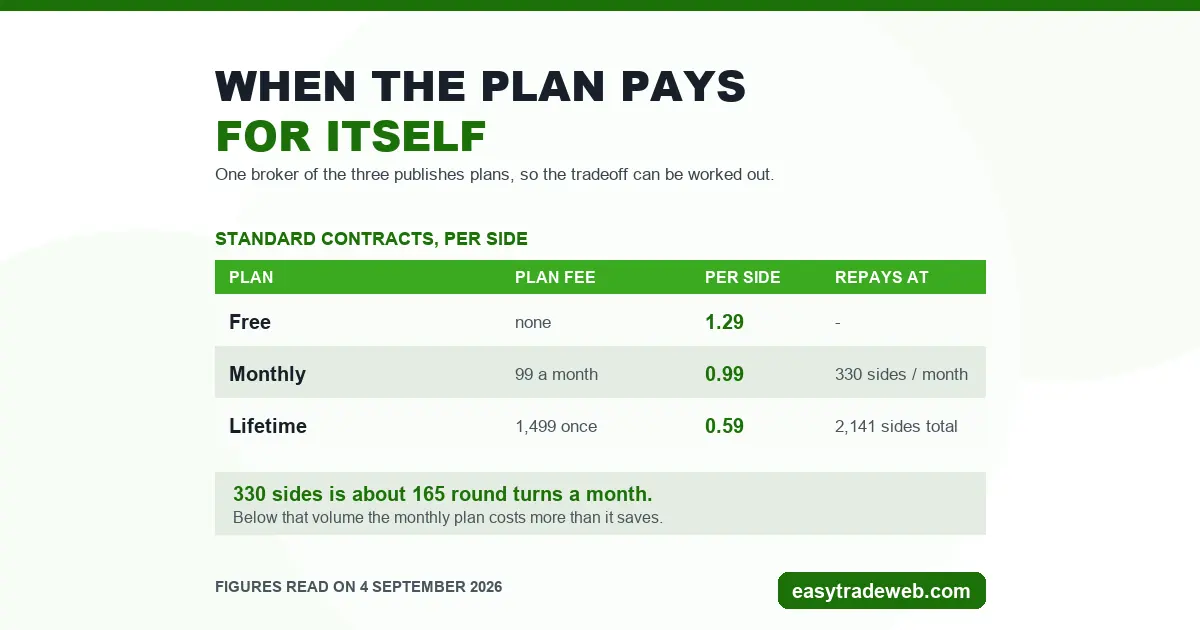
Tradovate publishes three plans, and the per-side rate falls as the plan fee rises. On standard contracts the rate is 1.29 dollars a side with no plan fee, 0.99 on the 99 dollar monthly plan, and 0.59 on the 1,499 dollar lifetime plan. The plans are the only case among the three where the published figures make the tradeoff computable.
Working it through on those figures: the monthly plan saves 0.30 dollars a side against the free plan, so it repays its 99 dollars at 330 sides a month, which is 165 round turns. The lifetime plan saves 0.70 dollars a side against the free plan, so it repays its 1,499 dollars at 2,141 sides, or about 1,070 round turns, spread over as long as it takes.
On micro contracts the gaps are smaller and the answers move accordingly: the monthly plan saves 0.10 dollars a side and needs 990 sides a month, or 495 round turns, and the lifetime plan saves 0.30 a side and needs 4,996 sides in total.
Neither Optimus Futures nor E-Futures publishes a plan structure, so on those two the per-side rate is the rate. Comparing the headline numbers across all three without accounting for the plan fee compares three different things.
Which Firm Actually Carries Your Account
The three pages disclose this very differently. Tradovate names NinjaTrader Clearing, LLC, trading as Tradovate, with NFA ID 0309379. E-Futures describes itself as an independent introducing broker and names Cannon Trading Company, Inc., NFA ID 0216708. Optimus Futures names Optimus Futures, LLC and refers to the NFA and the CFTC in general terms, and the page names no clearing firm.
The difference is not cosmetic, because the firm that carries the account is the firm holding the money and keeping the records, and it is not always the firm whose name is on the website. What that split means, which firm answers for what, and how an arrangement backed by the clearing firm differs from an independent one are set out on our page on which firm carries your account.
What the Account Minimum Is Actually For
Optimus Futures publishes 500 dollars for micro contracts and 2,000 dollars for E-minis. Tradovate states that its nano tier accepts any funding amount and publishes no minimum for the other three tiers. E-Futures publishes no minimum on the page read here.
Read against the margin figures, the pattern is that a minimum tracks the contract class rather than the account. A 500 dollar minimum next to a 50 dollar micro margin leaves room for the position to move against you several times over. The same 500 dollars against a 500 dollar standard margin leaves none, which is why the second number exists separately.
Who Futures Brokers Are Not For
A trader who wants to size a position freely is in the wrong instrument. Contract sizes are set by the exchange, so the smallest available position is the smallest listed contract, and someone whose risk plan calls for a fraction of that has no way to express it. On a contract-for-difference account the size is chosen; here it is not.
Someone trading a handful of contracts a month should not pay for a plan. On the published Tradovate figures the 99 dollar monthly plan needs 165 round turns a month on standard contracts before the lower rate covers the fee, so a trader placing twenty round turns pays the plan fee and receives about 12 dollars of commission saving against it.
Anyone who needs the full cost of a trade before placing it will not get it from these pages. All three exclude exchange, clearing and NFA fees from the figure they advertise, so the total has to be obtained from the firm directly or read off a statement after the fact.
easytradeweb.com may be compensated if you open an account through a link on this page. That does not change anything stated above, which comes from pages read on the dates given.
Exness offers contracts for difference on index and commodity markets, where the position size is chosen rather than set by an exchange.
Frequently Asked Questions
How much money do you need to open a futures account?
It follows the contract class rather than the account. Of the three brokers checked on 4 September 2026, one published 500 dollars for micros and 2,000 for E-minis, one accepted any funding amount on its smallest tier, and one published no minimum at all.
What does one futures contract cost to trade all in?
None of the three pages allows that total to be worked out. Each states a commission per side and then excludes exchange, clearing and NFA fees without quantifying them, so the advertised figure is one component of the cost rather than the cost.
Why is the day-trading margin lower than the exchange margin?
Because it is a different requirement. The exchange sets what a position carried past the close must be backed by, while the day-trading figure is a concession the firm carrying the account extends during the session, and that concession can be reduced or withdrawn.
Which company actually holds the money in a futures account?
Not always the company named on the website. Of the three pages read here, one named a clearing firm with its NFA identifier, one described an introducing-broker arrangement and named the firm behind it, and one named no clearing firm at all.
Does a platform subscription make the commission cheaper overall?
Only above a volume. On the figures published by the one broker of the three that offers plans, the monthly plan repays its fee at about 165 round turns a month on standard contracts, and below that volume the plan costs more than it saves.
What To Check Before You Fund An Account
Ask the firm for the exchange fee, the clearing fee and the NFA assessment on the specific contract you intend to trade, in writing. None of the three publishes them, and they are part of every fill.
Ask what the overnight requirement is on that contract, separately from the day-trading figure, and ask under what conditions the intraday concession is withdrawn. Then confirm which company will carry the account and check that identifier against the regulator rather than against the website.
Sources checked 4 September 2026: Tradovate, Pricing, for the three plan fees, the per-side rates on nano, micro and standard contracts, the day-trading margin tiers, the nano account minimum, the clearing company name and NFA identifier, and the statement that exchange, clearing and NFA fees apply. Optimus Futures, home page, for the per-side rates on micro and standard contracts, the day-trading margins by symbol, the two account minimums and the description of Level 1 CME market data as free. E-Futures by Cannon Trading, home page, for the micro and standard commissions, the liquidation fee, the two day-trading margins, the introducing-broker description, the company name and NFA identifier, and the statement that commissions exclude exchange, clearing and NFA fees. The CME Group performance bond schedule and the National Futures Association assessment fee page were both requested on the same date and neither returned readable content, so no exchange margin or assessment figure is stated here.
Disclaimer: This article is educational only and is not investment advice, and it is not a recommendation of any broker or platform. Trading leveraged products carries a high risk of losing money rapidly. Costs, margins and protections depend on the account you hold and on the regulator of the company holding it, and the figures here are dated readings rather than current quotes. Verify current terms with your provider and its regulator before funding an account, consider your objectives and, if needed, seek independent advice.