
Best Broker for Algorithmic Trading: The Four Constraints

Every retail forex broker on this list allows an expert advisor to run. That is not the decision. What decides an automated account is whether the position model keeps your trades separate, whether the server accepts the orders your code sends, and what it costs to keep the machine running.
Key takeaways
- Permission to run an expert advisor is not a differentiator. Rejection happens at the position model and the order rules, not at a policy switch.
- An MT5 netting account merges two trades on one symbol into a single position, which ends any strategy built on separate tickets.
- MetaQuotes prices MetaTrader VPS at 15 USD per month on a one-month term and 10 USD per month on a twelve-month term, with a 24-hour trial.
- The Strategy Tester reads price history supplied by the broker server, so one expert advisor produces two different test results at two brokers.
- Exness publishes up to 3.50 USD each side per lot on its Raw Spread account; XM Global Limited does not publish a commission figure at all.
Table of contents
- What disqualifies a broker before any comparison starts
- Two brokers, their own documents, and what an algorithm pays
- Netting or hedging decides whether the strategy runs at all
- The backtest runs on price history the broker supplies
- What continuous operation costs, from the platform vendor price list
- The order rules the server applies before your code does
- When an automated account is the wrong choice
- Check these four things before you fund
What Disqualifies a Broker Before Any Comparison Starts
Comparison pages for this question open with a ranked list of brokers and a column for platform support. That column separates nothing, because MetaTrader 4 and MetaTrader 5 both ship with an expert advisor engine, cTrader ships an automation framework of its own, and almost every retail broker offers at least one of them.
The reason the platform column survives on every comparison page is that it is easy to fill. Whether a broker offers MetaTrader 5 is a yes or a no that can be read from a marketing page in seconds. Whether that broker default account nets positions has to be read out of the account specification, and it changes the answer for a whole class of strategies.
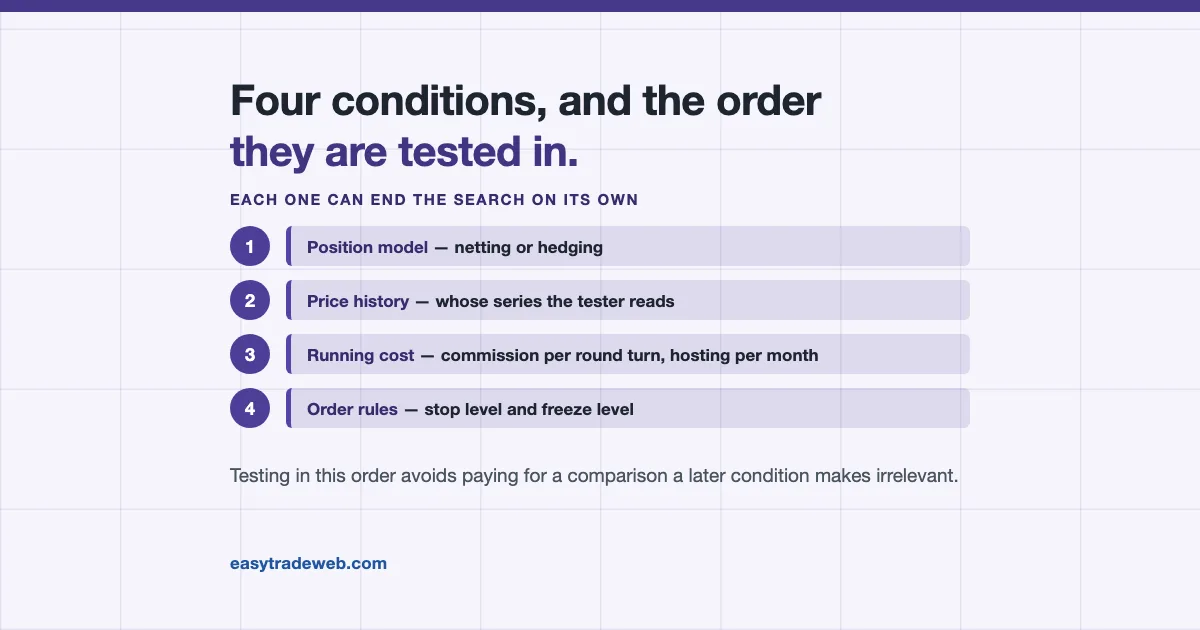
Four conditions do separate accounts, and they apply in a fixed order. Each one can end the search on its own, so testing them in order avoids paying for a comparison that a later condition would have made irrelevant.
First, the position model: does the account keep two trades on one symbol as two positions, or does it net them into one. Second, the historical data: whose price series does the tester read, and how far back does it go.
Third, the running cost: what the strategy pays per round turn and what the hosting costs per month. Fourth, the order rules the server enforces, which decide whether a stop distance the code calculates is an order the server will accept.
A broker that fails the first condition cannot be fixed by a low commission on the fourth. That is the practical value of the order: it is cheapest to disqualify early.
Two Brokers, Their Own Documents, and What an Algorithm Pays
The figures below come from each company published terms, with the legal entity named, because terms differ between entities of the same brand. A blank is written as not disclosed rather than filled with an estimate.
| What an automated account depends on | Exness (SC) Ltd | XM Global Limited |
|---|---|---|
| Platforms a strategy can run on | MetaTrader 4, MetaTrader 5, Exness Terminal, Exness Trade app, MetaTrader WebTerminal | MetaTrader 4, MetaTrader 5 for Windows, Mac, WebTrader and mobile, plus the XM app |
| Account types offered | Standard Cent, Standard, Pro, Zero, Raw Spread | Standard, Ultra Low, Shares |
| Commission per trade | No commission on Standard Cent, Standard and Pro; up to 3.50 USD each side per lot on Raw Spread | Not disclosed for this entity; the contract refers to a commission schedule shown inside the platform |
| Minimum first deposit | Not disclosed as a fixed figure on Standard Cent and Standard, where it varies by payment method and location; from 200 USD on Pro, Zero and Raw Spread | 5 USD on Standard and Ultra Low; 10,000 USD on Shares |
| Swap-free status | Assigned automatically to accounts registered from the countries on the published Islamic-country list | Offered as a standard option on all account types |
Figures verified against each broker own published terms on 2026-09-05.
Read the commission row against the strategy rather than against the other column. A system that opens forty round turns a month pays commission forty times, so the difference between a published per-lot figure and a figure only visible after funding is the difference between costing the strategy in advance and discovering it afterwards.
Netting or Hedging Decides Whether the Strategy Runs at All
MetaTrader 5 offers two position models. On a hedging account, each order opens its own position with its own ticket, and two buys on the same symbol sit side by side. On a netting account, the second order changes the first: the two merge into one position carrying a combined volume and a single average price.
For discretionary trading that distinction is a preference. For an automated strategy it is a hard constraint, because a large share of published expert advisors assume separate tickets. A grid system places staggered orders on one symbol and manages each one against its own entry. A basket system opens several positions and closes them on a combined result. Both read position tickets to know what they are managing.
Run either on a netting account and the code finds one position where it expected several. It does not throw an error and stop. It keeps trading against a position map that does not describe the account, which is the failure mode that costs money rather than time.
MetaTrader 4 has no netting model at all, so the question only arises on MetaTrader 5, and the answer is set when the account is opened rather than in the platform settings afterwards. The mechanics are covered separately under netting and hedging accounts on MT5. Before funding anything, confirm which model the specific account type uses, because a broker can offer both.
Ask the question as a specification rather than as a policy question. Support desks answer whether expert advisors are permitted, and the answer is almost always yes. The answer that matters is which position model a named account type uses, and it is worth getting in writing before a deposit rather than discovering it from a position list that has quietly merged two trades.

The Backtest Runs on Price History the Broker Supplies
The Strategy Tester built into MetaTrader 4 evaluates an expert advisor against historical quote data, and includes an optimisation function for selecting parameters. What the vendor documentation states plainly is where that data comes from: the history is downloaded into the terminal, and the terminal is connected to one broker server.
Two consequences follow, and neither appears on any of the comparison pages ranking for this question. The first is that a test result belongs to the broker whose history produced it. The same expert advisor, the same settings and the same date range at a second broker produce different trades, because the two price series differ in their tick detail, their spread record and the hours they cover.
The second is that a published performance record for a commercial expert advisor was produced somewhere, on somebody history, and the seller rarely says where. A number without that context is not a claim you can reproduce on your own account.
This makes the depth and quality of a broker history a selection criterion rather than a technical footnote, and it is worth checking before a subscription is bought rather than after. The wider method is set out under backtesting a strategy.
What Continuous Operation Costs, From the Platform Vendor Price List
An expert advisor only acts while its terminal is running and connected. A home machine that sleeps, updates or loses its connection stops the strategy mid-position, which is why hosting is a running cost of automation rather than an optional extra.
MetaQuotes sells hosting for its own platforms and publishes the price. On the terms listed on 2026-09-05, MetaTrader VPS costs 15 USD per month on a one-month term, 13 USD per month on a three-month term, 10.83 USD per month on a six-month term and 10 USD per month on a twelve-month term, with a discount of up to 33 per cent for the longer commitments and a free trial period of 24 hours.
Set that against the strategy rather than against a competitor. At 10 USD a month the hosting alone is 120 USD a year, which a system trading one standard lot a month on a raw-spread account will not notice and a system trading a cent account very much will.
Many brokers also provide hosting to clients above a volume or balance threshold, which changes the arithmetic but is a broker term to confirm rather than assume. Wider options are compared under a VPS for automated trading.
Hosting is also only half of the running cost. The other half is the spread the strategy pays at the hours it actually trades, which is not the average a broker advertises: a system that trades the hour around the daily rollover pays a spread recorded at that hour, not the daily mean. A tester run over the strategy own trading hours reports that number for the account being considered, and reports it before any money is committed.
The Order Rules the Server Applies Before Your Code Does
An expert advisor calculates a stop-loss distance and sends it. The server then decides whether that order is valid, and two settings govern the answer. The minimum stop level sets how close to the current price a stop or limit may sit. The freeze level sets how close to the current price an existing order may no longer be modified or cancelled.
Both are broker settings, both are published per symbol in the platform specification, and both can change. A strategy that calculates a fifteen-point stop on a symbol whose minimum stop level is twenty points does not place a smaller stop. Its order is rejected, and what happens next is whatever the code was written to do with a rejection, which is often nothing useful.
The practical check costs nothing. Open the symbol specification in the terminal on a demo account of the broker being considered, read the stop level and the freeze level for the symbols the strategy trades, and compare them with the smallest distance the code can generate. Running several strategies at once adds a second limit, covered under running several expert advisors on one account.
Where a strategy needs to place orders faster or in greater volume than a terminal allows, the connection itself becomes the question, and that is a different route into the market described under what a broker trading API is.
When an Automated Account Is the Wrong Choice
Two situations make this whole comparison the wrong one to be reading, and both are common enough to name.
The first is wanting to write the strategy in a language of your own choosing. MetaTrader automation means MQL4 or MQL5 and nothing else; a strategy written in Python or C-sharp cannot be loaded into the terminal as an expert advisor. Reaching the market from another language means a broker API, and retail brokers that publish one generally gate it behind an account tier or a balance requirement, so the language decision becomes an account-size decision.
The second is buying a finished expert advisor and expecting the broker choice to carry it. If a purchased system was developed and tested on another broker price history, the account you open determines the spread it pays, the stop distances it is allowed and the position model it manages.
None of those were part of the result advertised to you, and choosing a broker cannot repair a strategy whose only evidence came from somewhere else.
easytradeweb.com may be compensated if you open an account through a link on this page. That does not change anything stated above, which comes from the documents and dates given.
Exness publishes its account types and its per-side commission on the Raw Spread account, so the commission half of the cost check above can be read before an account is funded.
Check These Four Things Before You Fund
Each step below is answerable on a demo account of the broker being considered, in the order the conditions disqualify.
- Open the account type in MetaTrader 5 and place two buys on one symbol. Two positions in the terminal means hedging. One position with a combined volume means netting, and any strategy that manages separate tickets is finished there.
- Open the symbol specification and read the stop level and the freeze level for every symbol the strategy trades. Compare each with the smallest stop distance the code can produce.
- Download the history and check how far back it reaches for those symbols, then run the tester once. A short or gapped series is the result you will be optimising against.
- Add the commission and the hosting to one monthly figure at the trade frequency the strategy actually runs, and read it against the account size rather than against another broker.
Four answers, one demo account, and no deposit required to get them.
Risk warning. Leveraged forex and CFD positions expose an account to substantial loss, and what is lost can exceed the sum paid in. Automation does not reduce that exposure; it applies a strategy faster and without supervision. Nothing on this page is a recommendation to open an account or to trade any instrument.
Sources checked. Exness Trading account types, Exness Professional accounts and Exness Standard accounts pages, and the Exness help centre articles on minimum first deposit and on swap-free status for Islamic countries, verified 2026-09-05. XM Account Types page, XM Global Limited, verified 2026-09-05. MetaTrader VPS pricing page, MetaQuotes, read 2026-09-05. MetaTrader 4 Strategy Tester documentation, MetaQuotes, read 2026-09-05.