
Best Broker for Scalping: The Account Rules That Decide It

A broker suits scalping when two platform settings allow the stop distance the system needs and the cost of a round turn stays below the move it targets. Those are the minimum stops level and the freeze level, plus commission per round turn. Execution-speed claims decide nothing, because none of them can be checked.
The five comparison pages ranking highest for this question sort brokers by latency figures and spread samples they measured themselves. Neither number is reproducible, and neither is the constraint that stops a five-pip stop-loss being accepted at all. The strategy itself is covered separately under what scalping is, and a broker for positions held for days is decided on a different set of figures entirely.
Key takeaways
- The minimum stops level sets how far, in points, a stop must sit from the current price. Where it is wider than the target, the order is rejected before cost matters.
- A stops level of zero does not prove there is no restriction: MetaQuotes documents zero as either no minimum distance or a dynamic server-side mechanism.
- Round-turn commission on the raw accounts checked here runs from 6.00 to 7.00 US dollars per standard lot, and the entity publishing it differs from the brand in every case.
- At twenty round turns a day on one lot, a 1.00 dollar difference per round turn is 420 dollars a month.
- None of the brokers here publishes a spread for a named pair on a named account, so the raw-against-standard comparison cannot be completed from published sources.
Table of contents
- The Two Account Settings That Decide Whether a Five-Pip Scalp Can Be Placed
- How to Read Your Own Stops Level and Freeze Level
- What Twenty Round Turns a Day Actually Costs
- Commission Per Round Turn at Five Brokers, From Their Own Documents
- Execution Speed: The Numbers You Cannot Check, and the One You Can
- Order Execution Mode, and Why It Outranks Latency
- What the Client Agreement Can Still Do to a Scalping Account
- When a Scalping-Optimised Account Is the Wrong Choice
- Frequently Asked Questions
- Which of These Applies to You
What four brokers publish about the cost of a round turn
| Published item | IC Markets | Tickmill | FXTM | Exness |
|---|---|---|---|---|
| Account compared | Raw Spread, MT4 and MT5 | Raw | Advantage | Raw Spread |
| Legal entity publishing the terms | Raw Trading Ltd | Tickmill Ltd | Exinity Limited | Exness (SC) Ltd |
| Commission, one side, per standard lot | 3.50 | 3.00 | 3.50 on forex | Up to 3.50 |
| Commission, round turn, per standard lot | 7.00 | 6.00 | 7.00 on forex | Up to 7.00 |
| Published spread on a named pair | Not disclosed | Not disclosed | Not disclosed | Not disclosed |
| Zero-commission account at the same broker | Standard | Classic | Edge, Micro, Advantage Plus | Standard, Standard Cent, Pro |
| Minimum stops level | Not disclosed | Not disclosed | Not disclosed | Not disclosed |
Figures verified against each broker’s own published terms on 4 September 2026. All amounts are US dollars per standard lot. The entity is named because the terms are set by the company signing the client agreement, not by the brand. The minimum stops level is a per-symbol platform value that no broker here publishes.
The Two Account Settings That Decide Whether a Five-Pip Scalp Can Be Placed
Before cost matters at all, an order has to be accepted. Two per-symbol values on the trade server decide that, and both are documented by MetaQuotes rather than by any broker marketing page.
The first is the minimum stops level: the smallest distance, in points, that a pending or protective order may sit from the current price. A system placing a stop five pips away on a symbol whose minimum distance is thirty points has not found an expensive broker. It has found one where the order will be refused.
The second is the freeze level, a distance around the execution price inside which an order can no longer be modified, cancelled or closed. For a strategy that moves a stop as price advances, this is the setting that determines whether the adjustment lands or is rejected at the moment it matters most.
Neither value appears on any of the five comparison pages ranking for this question. Both are read from the terminal in one step, and both change by symbol, so a value checked on EURUSD says nothing about gold. Our page on stops level and freeze level sets out how the two produce different failures.
How to Read Your Own Stops Level and Freeze Level
In MetaTrader, open the symbol specification for the instrument the system trades. The minimum distance for stop orders and the freeze distance are both listed there in points, alongside the contract size and the execution mode.
One reading needs care. A value of zero is documented as meaning either that no minimum distance is enforced or that the trade server applies a dynamic mechanism instead. A zero is therefore not a guarantee; it is an instruction to test with a live pending order at the distance the system actually uses.
Test on a funded account rather than a demo. Demo servers often carry different symbol settings from the live server behind the same brand, which is why a strategy that placed every order in testing starts collecting rejections in the first live session.
What Twenty Round Turns a Day Actually Costs
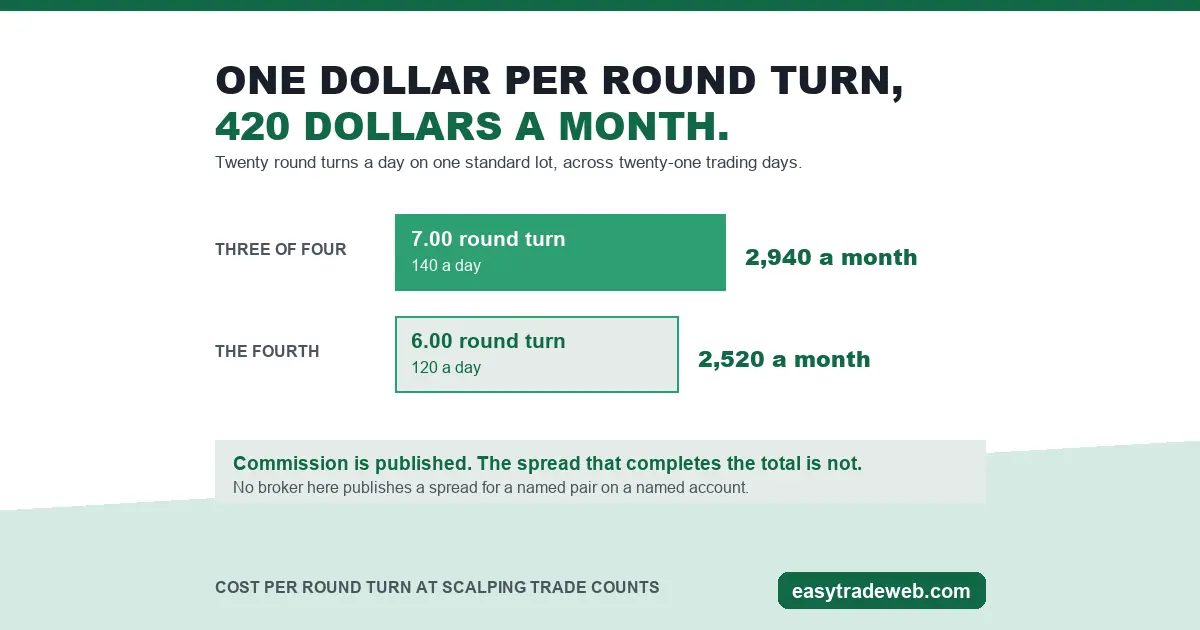
A round turn is one entry and one exit, and commission is charged on both. On the accounts in the table above, that is 7.00 dollars per standard lot at three of the four brokers and 6.00 at the fourth.
Twenty round turns a day on one standard lot is 140 dollars a day at 7.00, and 120 dollars at 6.00. Across twenty-one trading days that is 2,940 dollars against 2,520 dollars: the same volume, the same instrument, a difference of 420 dollars a month arising from a single dollar per round turn.
Against price, a 7.00 dollar round turn on one standard lot of a pair quoted in US dollars equals 0.7 of a pip, since one pip on that size is 10 dollars. A system targeting five pips gives up about fourteen per cent of its target to commission before the spread is counted.
That is what decides raw against standard: a zero-commission account is cheaper only where its spread is narrower by more than 0.7 of a pip on the pair traded. The general break-even is worked through on our comparison of raw against standard accounts.
Commission Per Round Turn at Five Brokers, From Their Own Documents

The break-even in the previous section cannot be completed from published figures, and the table shows why. Every spread cell reads Not disclosed, because not one of these brokers publishes a spread for a named currency pair on a named account type. What is published is an account-level claim, of the form starting from a figure, unattached to any pair.
The commission side is different. Those figures are published, and they are published by entities whose names do not match the brands. Terms differ between entities of the same broker, so a commission read from one entity page does not describe an account opened under another.
Two figures were excluded rather than estimated. One broker publishes two conflicting commission rates for the same account across its own pages, so that cell would misstate the cost whichever value it carried. Another publishes a per-value commission for its European and United Kingdom entities only, while the entity accepting most international clients refers the question to a schedule inside the platform.
The consequence is narrow: the commission half of the cost is knowable in advance and the spread half is not, so a total-cost comparison has to be measured on the pair and at the hours the system trades.
Execution Speed: The Numbers You Cannot Check, and the One You Can
All five comparison pages read for this article rank brokers partly on execution speed, quoting figures between fifteen and one hundred milliseconds. None states the sample size, the instrument, the hours, the order type or the date, and no broker publishes a matching figure of its own.
A latency figure without those conditions cannot be reproduced or compared. It also describes the wrong quantity for most retail scalping: the distance from a home connection to the broker server dominates anything happening inside the server.
The figure that can be checked is the round-trip time from the terminal to the trade server, shown in the connection status of the platform, on the connection and at the hours the system runs. That number is specific to one trader, and it moves when the server region or the hosting arrangement changes.
Count rejections and requotes alongside it: a fast connection to a server that refuses orders near the price is not fast execution. What arrives at the fill is treated separately under slippage.
Order Execution Mode, and Why It Outranks Latency
Each symbol carries a documented deal execution mode, and it decides what happens when the price moves between the click and the fill. Under market execution the order is filled at the available price. Under instant execution the server may return the order for confirmation instead.
For a strategy holding a position for seconds, that difference is larger than any millisecond figure on a comparison page. A returned order is not a slow fill; it is no fill, and the setup it was written for has usually gone by the time the second attempt is sent.
The mode sits in the same symbol specification as the two distance settings, so all three are read in one place. How a firm routes what it accepts is covered in our explanation of how the broker fills an order.
What the Client Agreement Can Still Do to a Scalping Account
Platform settings decide what can be placed. The client agreement decides what can be done afterwards, and it is a separate document from the account comparison page.
Terms in this area typically reserve a right to review trading the firm considers abusive, and the definitions are broad rather than numeric: latency arbitrage, systematic exploitation of pricing errors, or trades held below a stated duration. Where a minimum holding time exists it is usually stated in the agreement rather than on the account page.
These terms are readable before funding and are rarely read. A broker whose settings permit a five-pip stop and whose commission is competitive can still hold a right to close positions it classifies that way, and the classification is the firm’s to make.
When a Scalping-Optimised Account Is the Wrong Choice
Someone placing two or three trades a week is paying for a structure they do not use. A raw account charges 7.00 dollars per round turn where a zero-commission account charges nothing beyond the spread, so at ten round turns a month the raw account is justified only by a spread difference above 0.7 of a pip on every trade, which no published figure demonstrates.
Someone whose stop sits fifty pips away gains nothing from the settings this page is about. The minimum stops level never binds at that distance, and commission at that trade frequency is a rounding error against the swap charged for holding the position overnight.
Someone trading from a connection with variable latency, over residential wireless or across a long distance to the server region, is choosing the wrong variable. The delay introduced before the order leaves the terminal is larger than the difference between any two brokers in this table, and it is fixed by changing where the terminal runs rather than by changing broker.
easytradeweb.com may be compensated if you open an account through a link on this page. That does not change anything stated above, which comes from the documents and dates given.
Exness publishes commission per side on its raw account and offers zero-commission account types alongside it, so both sides of the break-even above can be compared under one login.
Frequently Asked Questions
Do all forex brokers allow scalping?
No, and the restriction is usually two separate things. The trade server may enforce a minimum distance for stop and pending orders, which can refuse a short-stop order outright, and the client agreement may reserve a right to review trading the firm classifies as abusive. Both are readable before funding, in the symbol specification and in the agreement.
What is a minimum stops level, and why does it block a scalp?
It is the smallest distance in points that a stop or pending order may sit from the current price, set per symbol on the trade server. Where the system needs a five-pip stop and the server enforces thirty points, the order is rejected rather than filled at a worse price.
How much does one round turn cost on a raw-spread account?
On the four raw accounts compared here on 4 September 2026, commission runs from 6.00 to 7.00 US dollars per standard lot for the entry and exit together. That is roughly 0.6 to 0.7 of a pip on one standard lot of a pair quoted against the US dollar, before any spread.
Is a zero-commission account cheaper for a scalper?
Only where the wider spread costs less than the commission it replaces. With a round turn at 7.00 dollars on one standard lot, the zero-commission account wins when its spread is no more than 0.7 of a pip wider on the pair traded. None of the brokers here publishes a per-pair spread, so that comparison has to be measured in the terminal.
Can a broker close a scalping account after the trades are placed?
Client agreements commonly reserve a right to review or restrict trading the firm considers abusive, with definitions that cover latency arbitrage and pricing errors rather than trade duration alone. The wording sits in the agreement rather than on the account page, and it applies after the trades are placed.
Which of These Applies to You
If the system places stops inside ten pips, the first check is the minimum stops level and the freeze level on the exact symbols traded, on a live account. A broker that fails that check is out regardless of its commission, and no cost comparison rescues it.
If the stops clear and the trade count is high, the decision moves to cost, and only half of it is published. Take the commission from the entity that will sign the agreement, then measure the spread on the pair and at the hours the system runs.
If the trade count is low, none of this changes the outcome. The account matters less than whether the strategy has an edge at the frequency it runs.
Sources checked 4 September 2026: MQL5 Reference, Symbol Properties, for the minimum distance in points for placing stop orders, the distance that freezes trade operations, and the deal execution mode property. MQL4 Reference, MarketInfo constants, for the meaning of a zero stop level and for the freeze level condition under which an order cannot be modified, cancelled or closed. MetaTrader 5 Help, General Concept of Trading Operations, for the distinction between market and instant execution. The EasyTradeWeb broker verification log, entries marked confirmed, for the commission figures and entity names of Raw Trading Ltd, Tickmill Ltd, Exinity Limited and Exness (SC) Ltd, and for the not-disclosed status of every per-pair spread.
Disclaimer: This article is educational only and is not investment advice, and it is not a recommendation of any broker or account type. Trading leveraged products carries a high risk of losing money rapidly. Costs, settings and protections depend on the account held and on the entity holding it, and the figures here are dated readings rather than standing values.