
Funded Account vs Live Account: The Costs Nobody Prices

A funded account is cheaper to open and more expensive to keep. The evaluation fee buys a simulated account at both firms checked here, and reaching a real brokerage account carries a monthly market data charge that a retail broker account does not impose at all.
Key takeaways
- Passing an evaluation does not put a trader in the live market. TradeDay and MyFunded Futures both publish a simulated funded stage that comes first.
- TradeDay states the professional market data feed required for its Funded Live account costs 156 USD per month, per Exchange, so a trader on two markets pays it twice.
- A Funded Sim account at TradeDay carries no professional market data fee at all, which is why the monthly figure depends on the stage rather than the firm.
- Losing a TradeDay Funded Live account starts a three-month period during which the trader cannot enter another TradeDay evaluation.
- Raw Trading Ltd publishes no minimum deposit on three IC Markets account types, XM Global Limited publishes 5 USD, and Tickmill Ltd publishes 100 USD.
Table of contents
- What you are actually buying in each route
- Passing the evaluation does not mean you are trading live
- The monthly cost of staying live, and who publishes it
- Side by side: what each route costs to open and to keep
- What it costs to lose the account
- The broker side: what a live account actually requires
- When a funded account is not for you
- Common questions
- Which route fits your situation
What You Are Actually Buying in Each Route
The two routes are usually described as a choice between using someone else money and using your own. That framing is accurate about the risk and misleading about the cost, because it stops before the part where the two routes start to differ.
A funded account is bought with a fee. That fee buys entry to an evaluation, and passing it buys access to an account the firm controls, on terms the firm sets and can change. The trader supplies skill and pays for the attempt.
A live broker account is bought with a deposit. The deposit is not a fee: it stays the property of the trader and can be withdrawn. What the broker charges instead is embedded in the spread and the commission on each trade.
That difference explains why the entry comparison is so lopsided in favour of the funded route, and why the comparison stops being useful the moment the account is running. One route charges to begin and again to continue. The other charges per trade and returns the balance on request.
The mechanics of the evaluation itself, the drawdown rules and the payout structure are covered separately under how prop firm funded accounts work. This page stays on the two cost structures and what each one leaves the trader holding.
Passing the Evaluation Does Not Mean You Are Trading Live
The most common statement about funded accounts is that they run on simulated capital. It is written as a property of the whole category, and it is not one. Whether an account is simulated is a property of the firm and of the stage the trader has reached within it.
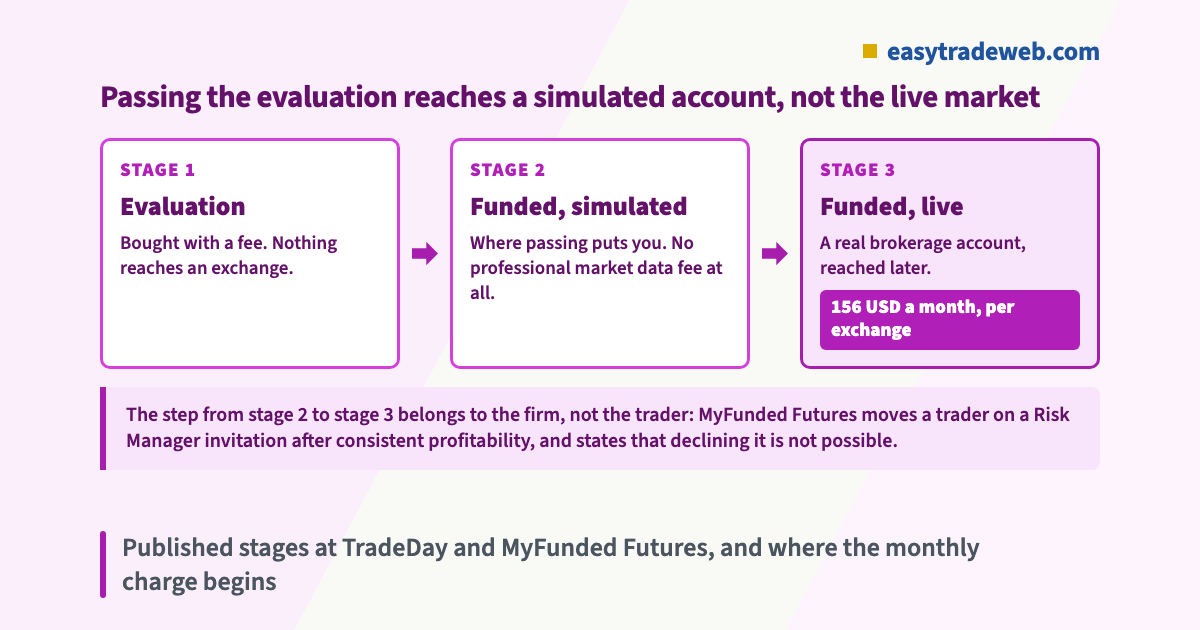
TradeDay publishes both stages in its own support documentation. A trader who completes the evaluation is placed in a Funded Sim account, which the firm describes as a simulation carrying simulated commissions, designed to reflect the experience of the live account rather than to be one. The firm also states it has no control over those simulated environments, which are run by third-party brokers and platforms.
The second stage is a different object. TradeDay describes its Funded Live account as a sub-account of the company master account at its broker, over which the trader is given authority to trade. Those orders reach the exchange. Because the money belongs to the firm, the exchange treats the trader as a professional.
MyFunded Futures documents the same two-stage shape and is explicit about the gate between them. Completing the evaluation moves a trader to a Sim Funded Account; a Risk Manager reaches out with an invitation to a Live Funded Account only after consistent profitability has been demonstrated. The firm also states that declining that move is not possible.
So the question of whether a funded account trades in the live market has no general answer. It has a per-firm, per-stage answer, and both firms publish theirs. A programme that funds an account immediately, described under instant funding programmes, removes the evaluation but not this distinction.
The Monthly Cost of Staying Live, and Who Publishes It
Comparison pages that price a funded futures account put the monthly platform and data charge somewhere between one and two hundred dollars. None of them names the firm the figure belongs to, and none cites a source, which makes the range impossible to check and impossible to use.
TradeDay publishes an actual number. To trade its Funded Live account, the trader must purchase the professional market data feed, which the firm states currently costs 156 USD per month, per Exchange. That single figure changes the comparison in two ways.
It sits above the top of the ranges in circulation, so the cost is understated wherever those ranges are repeated. More importantly, it is charged per exchange rather than per account. A trader taking positions on contracts listed on two exchanges pays it twice, and the monthly cost of the account scales with the number of markets traded rather than with the size of the account.
The reason the charge exists is the professional classification described above. Retail market data is priced differently from professional market data, and trading firm money moves the trader into the second category.
TradeDay is equally clear about where the charge does not apply: a Funded Sim account carries no professional market data fee, and the trader keeps the same data feed used during the evaluation. The monthly cost of a funded account therefore depends on which stage the trader has reached, not on the firm alone.
MyFunded Futures publishes the categories without amounts. A live trader covers the CME professional data subscription, round-trip commissions and fees, and a platform licence or subscription, all deducted directly from the account balance. The costs are named and the figures are not, which is worth knowing before the account is running rather than after.
Side by Side: What Each Route Costs to Open and to Keep
Each cell below is taken from the named company own published terms. A firm that puts no number on a row gets a cell that says exactly that, with no invented substitute standing in for it.
| Dimension | Funded account | Live broker account |
|---|---|---|
| Cost to open | An evaluation fee. Not disclosed as a single figure by TradeDay or MyFunded Futures on the pages checked | A deposit that remains yours. No minimum on IC Markets Standard, Raw Spread and cTrader Raw (Raw Trading Ltd); 5 USD on Standard and Ultra Low (XM Global Limited); 100 USD on Classic, Raw and TradingView Raw (Tickmill Ltd) |
| Where you trade after passing | A simulated account first: Funded Sim (TradeDay), Sim Funded Account (MyFunded Futures) | The live market from the first trade |
| How the live stage is reached | Risk Manager invitation after demonstrated consistent profitability (MyFunded Futures); TradeDay describes placing someone straight into a live account on passing as a rare decision it may take, weighed against that trader own record with the firm | Not applicable |
| Recurring monthly charge | 156 USD per month, per Exchange for professional market data on a TradeDay Funded Live account; none on a TradeDay Funded Sim account. MyFunded Futures names a CME professional data subscription, commissions and a platform licence without publishing amounts | Not disclosed as a standing monthly charge by any of the three brokers above; cost is taken in spread and commission per trade |
| Setup time after passing | Around five days for a TradeDay Funded Live account, because of broker and clearing firm KYC and AML checks; a Funded Sim account is set up instantly | Not disclosed |
| Exchange classification | Professional, on a TradeDay Funded Live account, because the capital belongs to the firm | Retail by default |
| Share of profits kept | 90 percent on a TradeDay Funded Live account, paid at a 90/10 split in favour of the trader | All of it |
| Cost of losing the account | A three-month period during which a trader who loses a TradeDay Funded Live account cannot take part in TradeDay evaluations | No lockout. The account can be funded again immediately |

Figures verified against each company own published terms on 2026-09-05.
What It Costs to Lose the Account
Every comparison of these two routes prices the entry. Not one of the comparable pages surveyed for this article puts a number on the exit, which is where the two routes pull furthest apart.
A retail trader who loses the balance in a live broker account has lost that balance. The account stays open, the relationship with the broker is unchanged, and a new deposit can be made the same afternoon. The loss is financial and it is bounded by what was deposited.
TradeDay publishes a different consequence. A trader who loses a Funded Live account enters a three-month cooling-off period, during which they cannot take part in TradeDay evaluations at all. After it ends, the trader can write to the firm to reapply.
The firm also states that traders returning to it after a Funded Live account are placed back in the Funded Sim stage, so the route to a live account is walked a second time rather than resumed. The cost of the loss is therefore the account, plus three months, plus the simulated stage again.
That is a real cost and it does not appear in any entry-fee calculation. A trader comparing an evaluation fee against a deposit is comparing the price of starting, while the thing that differs most is the price of failing. How much the account can lose before that happens is set by the drawdown rule, covered under maximum drawdown.
The Broker Side: What a Live Account Actually Requires
Comparisons of this kind describe the broker route in general terms, as though every retail account required a meaningful sum to open. The published figures do not support that, and they vary by legal entity rather than by brand.
Three IC Markets account types carry no published minimum at all under Raw Trading Ltd: Standard, Raw Spread and cTrader Raw. Two others under the same entity are gated much higher, at 5,000 USD and at 100,000 USD, which is why describing the brand as having no minimum is accurate only for the first three.
XM Global Limited publishes 5 USD on its Standard and Ultra Low accounts. Tickmill Ltd publishes 100 USD across its Classic, Raw and TradingView Raw accounts, varying with the account currency.
Naming the entity matters because the same brand operates under several of them and the terms are not identical between them. A figure quoted without the entity it belongs to cannot be checked, which is the same problem as the unsourced monthly range earlier on this page. A fuller set of published figures sits under broker minimum deposits.
One further difference is structural rather than numerical. Money deposited with a regulated broker is the client money, held under the rules of the regulator that licenses the entity, and the arrangements are described under how client money is held. Money in a funded account was never the trader money at any point, so the protections that apply to a client balance do not apply to it.
When a Funded Account Is Not for You
Two situations make this route the wrong one, and both are ordinary rather than unusual.
The first is trading on more than one exchange with a small account. The professional data charge on a TradeDay Funded Live account is levied per exchange, so a trader whose strategy spans two markets carries that cost twice every month regardless of whether the account traded at all. On a modest account the fixed monthly charge becomes the largest single cost of running it, and it is charged in months that produce nothing.
The second is needing access to be reliable. Both firms publish gates that the trader does not control: MyFunded Futures moves a trader to the live stage on a Risk Manager invitation and states that declining is not possible, and TradeDay imposes a three-month exclusion after a lost live account. A trader who depends on being able to trade continuously is buying an arrangement that can pause for a quarter on a rule they did not set.
Common Questions
Are funded accounts trading in the live market?
Not at the first stage. TradeDay places a trader who completes the evaluation into a Funded Sim account, which it describes as a simulation, and MyFunded Futures places them into a Sim Funded Account. Both firms publish a separate live stage that is reached later, so the answer depends on the firm and on the stage rather than on the category.
What does a funded account cost each month?
TradeDay states that a Funded Live account requires the professional market data feed at 156 USD per month, per Exchange, and that a Funded Sim account carries no such fee. MyFunded Futures names a CME professional data subscription, round-trip commissions and a platform licence, all deducted from the account balance, without publishing the amounts.
What happens to the account when a trader breaches the rules?
At TradeDay, a trader who loses a Funded Live account cannot take part in the evaluations of that firm for three months, and may then write to the firm to reapply. Traders returning after a Funded Live account are placed back into the Funded Sim stage rather than resuming where they stopped.
Is a funded account cheaper than opening a live broker account?
It is cheaper to start and it can be more expensive to keep. Two of the three brokers named on this page publish a minimum deposit of 5 USD or 100 USD and one publishes none at all on three account types, and that deposit stays the property of the trader, while the recurring charge on a funded live account does not come back.
easytradeweb.com has commercial relationships with some brokers and may be compensated when a reader opens an account through a link elsewhere on this site. No link on this page is a paid placement, and every figure above comes from the company documents and dates named.
Which Route Fits Your Situation
The route that fits depends on which of the two costs you can absorb. If capital is the binding constraint and the strategy trades one market, the funded route converts an amount you do not have into a fee you do, and the simulated stage costs nothing per month while it lasts.
If the constraint is predictability, the broker route is the one that behaves the same every month. The deposit is recoverable, the cost is taken per trade rather than per calendar month, and no rule outside your control can suspend access for a quarter.
The comparison worth making is not the entry fee against the deposit. It is the fee plus the monthly charge plus the cost of a failed account, against a deposit that stays yours.
Risk warning. Leveraged forex, CFD and futures positions expose an account to substantial loss, and what is lost can exceed the sum paid in. Trading an account funded by another party does not remove that exposure; it transfers whose capital is at risk while leaving the trading outcome unchanged. Nothing on this page is a recommendation to open an account, to enter an evaluation, or to trade any instrument.
Sources checked. TradeDay support documentation, article on the Funded Sim and Funded Live accounts, read 2026-09-05. MyFunded Futures help centre, article on the Live Funded Account, read 2026-09-05. Broker minimum deposits from the EasyTradeWeb broker verification record, entries marked confirmed for Raw Trading Ltd, XM Global Limited and Tickmill Ltd, verified 2026-09-05.