
Choosing a Gold Broker: What XAU/USD Actually Costs You

Gold is sold to traders on the strength of a spread, and the spread is the one number most brokers holding gold clients do not publish.
Of nine entities whose gold quote was checked against their own official pages, eight publish no gold spread that can be treated as final, and one publishes a figure. So the honest answer to which broker is cheapest for gold is that it depends on how long you hold, and that for most brokers the number you would need to settle it is not disclosed.
Key takeaways
- A standard gold contract is quoted per ounce but sized in hundreds of ounces, so a spread that looks like small change is multiplied before it reaches your account.
- Eight of the nine entities checked publish no XAU/USD spread on their own site. One, Equiti Securities Currencies Brokers LLC, publishes 0.28 typical with no commission.
- Published gold leverage ranges from 20x at Amana Core to 1:2000 at Raw Trading Ltd and Equiti Brokerage (Seychelles) Limited.
- Holding overnight introduces a swap charge on the full contract value, which can overtake the spread on a position held for days.
- Gold terms differ by entity inside one brand: Equiti publishes 1:500 on gold under its UAE entity and up to 1:2000 under its Seychelles entity.
Table of contents
- What brokers actually publish about gold
- What a gold lot actually is
- Turning a quoted gold spread into money
- The cost that only appears if you hold overnight
- Where your position closes: margin and stop-out
- Why the cheapest gold broker depends on how long you hold
- What the ranking tables measure, and what they leave out
- Who should not trade gold at a broker
- Frequently asked questions
What brokers actually publish about gold
The table below records what each broker states on its own site about the gold quote, and under which legal entity. Terms differ by entity, so the entity is named in every row. A cell reading Not disclosed means the broker publishes no figure for gold specifically, not that the cost is zero. The same published-versus-claimed exercise across other instruments is in comparing broker spreads.
| Broker (entity) | Published XAU/USD spread | Published gold leverage |
|---|---|---|
| Equiti (Equiti Securities Currencies Brokers LLC, UAE) | 0.28 typical, no commission | 1:500 on gold |
| Equiti (Equiti Brokerage (Seychelles) Limited) | Not disclosed | Up to 1:2000 on selected products including precious metals and gold; up to 1:500 on Micro |
| IC Markets (Raw Trading Ltd) | Not disclosed | 1:2000 on metals |
| FBS (FBS Markets Inc.) | Not disclosed for gold specifically; named only inside a collective starting-from claim | 1:500 on metals |
| Amana (Amana) | Not disclosed | Gold 20x on Core, 100x on Plus, 200x on Max |
| Exness (Exness (SC) Ltd) | Not disclosed | Not disclosed |
| XM (XM Global Limited) | Not disclosed | Not disclosed |
| FXTM (Exinity Limited) | Not disclosed | Not disclosed |
| Tickmill (Tickmill Ltd) | Not disclosed. Two readings of the broker’s own page did not agree, so no figure is treated as published here | Not disclosed |
Figures verified against each broker’s own published terms on 2026-07-26. Entities are named because gold terms differ by entity within the same brand.
What a gold lot actually is
Gold is quoted as a price per troy ounce, which is why the number on the chart looks like a share price. The contract is not one ounce. On the standard retail gold contract the quote is per ounce while the position is sized in hundreds of ounces, and the multiplier between the two is set by the broker, not by the market.
That gap between the quoted unit and the traded unit is where most gold cost surprises live. It is the same arithmetic as any other instrument, but the multiplier is larger than a currency pair’s, so a small quoted difference arrives as a large one. If contract sizes are unfamiliar, the mechanics carry over directly from lot sizes and contract size.
Before comparing two brokers on gold, read the contract size off each one’s own specification page. Two brokers quoting an identical spread are not charging the same amount if their contracts differ, and nothing on the chart tells you that.
Turning a quoted gold spread into money
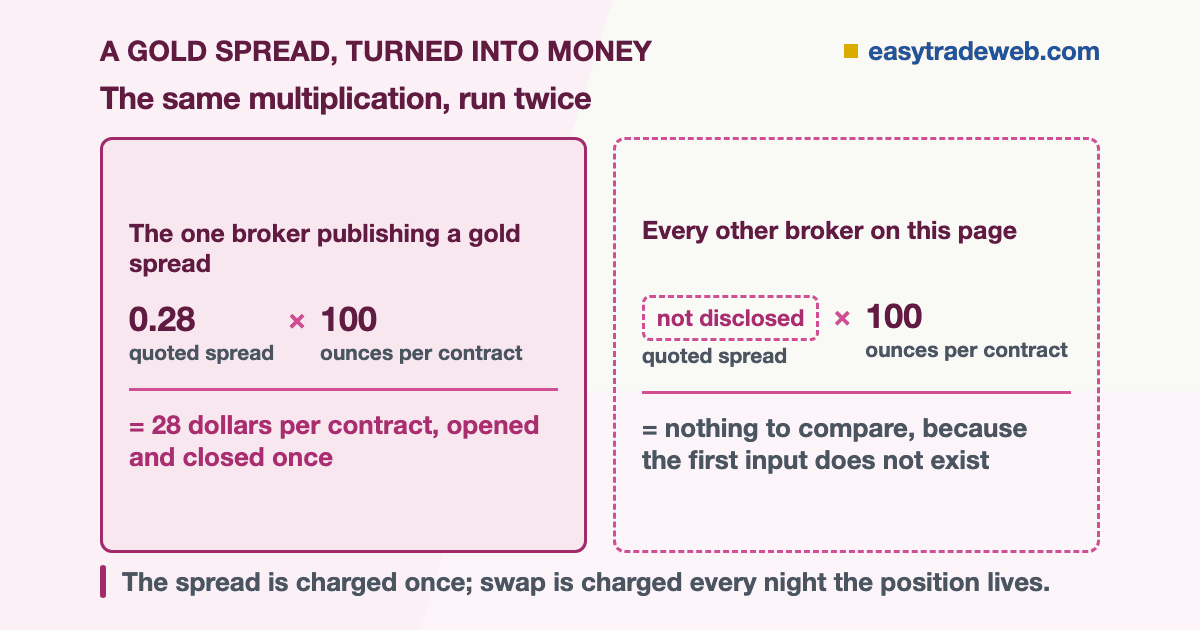
A spread is a price difference until it is multiplied by the contract size, at which point it becomes a debit. The calculation is deliberately simple: the quoted spread, multiplied by the number of ounces in the contract, multiplied by the number of contracts. Nothing else enters it.
Run it with the only published figure available. Equiti Securities Currencies Brokers LLC states a typical gold spread of 0.28 with no commission. On a contract of one hundred ounces that is 28 dollars per contract to open and close once, before any other cost. The same 0.28 on a contract of ten ounces would be 2.80.
The rest of the table cannot be run through this arithmetic at all, because the first input is missing. That is the finding, not an inconvenience: a spread nobody publishes cannot be compared, and a comparison built on it is comparing marketing copy. Our pip value calculator does the same multiplication for whichever contract size your broker actually states.
The cost that only appears if you hold overnight
The spread is charged once. Swap, the financing adjustment applied to positions still open at the daily rollover, is charged for every night the position lives. It is calculated on the full contract value rather than on the margin posted, which is why it scales with the leverage the position was opened at.
On a position held for a week, a swap debit repeated five times can exceed a single spread crossing. On a position held for an afternoon it is zero. The same broker is therefore expensive or cheap depending entirely on the holding period, and neither figure describes the other.
Swap-free accounts do not remove this cost so much as change its shape. Admirals Europe Ltd publishes a swap-free account available on Trade.MT5 only, with no swap but a fixed administration fee on positions held longer than three days, reduced to one day for metals, energy, cryptocurrencies and rare pairs. Gold sits in the shortened window. The mechanism behind the nightly charge is set out in overnight swap and carry.
Where your position closes: margin and stop-out
Leverage decides how much margin a gold position ties up, and the stop-out level decides at what point the broker closes it for you. The published leverage figures differ enormously: 20x on Amana’s Core tier against 1:2000 on metals at Raw Trading Ltd, a hundredfold difference in how much of your balance a position consumes.
Higher leverage does not make gold cheaper. It makes the same account balance survive a smaller adverse move, because the position is larger relative to the equity behind it. Gold moves in dollars per ounce rather than in fractions of a cent, so the distance between opening a position and being closed out of it is shorter than the equivalent currency trade at the same nominal leverage.
Stop-out levels were not published by any of the nine entities checked. That number, more than the spread, determines whether a position survives a normal gold session, and it is the one to ask for directly before funding an account.
Why the cheapest gold broker depends on how long you hold
There is no single cheapest broker for gold, because the costs that dominate change places depending on the trade. Two readers with the same balance at the same broker can be paying almost unrelated amounts.

If positions are opened and closed inside a session, the spread and the quality of execution are close to the entire cost. Swap never applies. A broker publishing a tight gold spread with no commission is genuinely cheaper for this reader, and the leverage figure barely matters beyond meeting the margin.
If positions are held for days or weeks, the arithmetic inverts. The spread is paid once and becomes a rounding error against a swap debit charged nightly on the full contract value. Here the swap rate and the administration terms on any swap-free variant decide the outcome, and a headline spread is close to irrelevant.
This is the question to settle before comparing anything: how long will the position be open. Answer it first, and most of the comparison table stops mattering, because a cost that is never incurred does not need comparing.
What the ranking tables measure, and what they leave out
Published gold broker rankings sort brokers by spread and present the result as an order of merit. The measurement above is what makes that difficult to accept: for most of the brokers checked, the spread being ranked is not published by the broker at all.
Where a ranking states a gold spread that the broker does not publish, that number came from somewhere other than the broker’s own terms, and the ranking rarely says where. A figure with no source is not a cheaper broker; it is an unsourced figure.
The second omission is holding cost. A ranking sorted on spread describes only the intraday case, then presents itself as a general answer. The reader holding gold for a fortnight is being sorted on a number that barely applies to them, and swap, which does, is usually absent from the comparison entirely.
Who should not trade gold at a broker
If the intention is to own gold rather than to trade its price, a broker contract is the wrong instrument. A contract for difference settles in cash and delivers no metal, so someone buying gold as a store of value ends up paying a nightly financing charge for an exposure that was meant to sit untouched for years. The cost structure works directly against the holding period.
If the account is small and the leverage is high, gold is a poor place to start. At 1:2000 on metals a position consumes very little margin, which sounds like an advantage until a routine gold session moves against it. The stop-out arrives after a move that would have been unremarkable on a currency pair, and no broker choice repairs that.
And if the broker does not publish its gold spread, its swap rate or its stop-out level, the honest position is that its cost cannot be compared. That is a reason to ask before funding, not a reason to assume the terms are favourable. Reading the price itself is a separate skill, covered in analysing gold.
Trading leveraged products such as gold contracts for difference carries a high risk of losing money rapidly. The figures on this page describe published costs and terms, not outcomes, and nothing here is a recommendation to open an account or to take a position. Terms differ by entity and change without notice; confirm every figure with the entity that would hold your account before depositing.
Frequently asked questions
Is the broker with the lowest gold spread actually the cheapest to trade with?
Only for positions closed the same day. The spread is charged once, so it dominates intraday costs and fades on longer holds, where the nightly swap charged on the full contract value takes over. A broker with a wider spread and a smaller swap can cost less over a week.
How much does one lot of gold cost to hold overnight?
It depends on the broker’s swap rate for gold and the size of the contract, and none of the nine entities checked published a gold swap rate on the pages reviewed. Ask the entity that would hold your account for the current long and short swap on gold, and note that it is charged per night.
How much money do I need to start trading gold?
The minimum is set by the margin the contract requires, which follows the published leverage. Gold leverage among the entities checked ranged from 20x on Amana’s Core tier to 1:2000 on metals at Raw Trading Ltd, so the same contract can require very different deposits depending on the entity.
Is gold quoted and sized the same way as a currency pair?
No. Gold is quoted per troy ounce while the contract is sized in ounces set by the broker, so the multiplier turning a quoted difference into money is different from a currency pair’s. Read the contract size from the broker’s own specification page rather than assuming it matches forex.
Can I trade gold through my broker on TradingView?
That depends on whether the broker has a TradingView integration and whether gold is included in it. Charting on one platform and executing at a broker are separate arrangements, and the costs above are set by the broker regardless of which chart the order is placed from.
Which of these applies to you
If gold positions will be closed the same day, compare on the published spread and on execution, and treat any broker that does not publish a gold spread as uncompared rather than as competitive. Only one entity in the table publishes one.
If gold positions will be held for days, the swap rate and the terms of any swap-free variant decide the cost, and those have to be requested directly. And in both cases the figure to confirm first is the one nobody published: the stop-out level of the entity that would hold your account.
Sources checked 26 July 2026: Exness commodities XAU/USD page (Exness (SC) Ltd) · XM account types page (XM Global Limited) · FXTM contract specifications (Exinity Limited) · Tickmill XAU/USD instrument page (Tickmill Ltd) · FBS forex specifications and leverage pages (FBS Markets Inc.) · IC Markets leverage and margin page (Raw Trading Ltd) · Equiti UAE commodities, forex and FAQ pages (Equiti Securities Currencies Brokers LLC) · Equiti Seychelles FAQ (Equiti Brokerage (Seychelles) Limited) · Amana Core Plus Max campaign page (Amana) · Admirals commissions and Islamic account pages (Admirals Europe Ltd).