
How to Open a Trading Account: Steps, Checks and Delays

Opening a trading account is usually described as a form: enter your details, upload two documents, wait for an email. That description is accurate right up to the point where something goes wrong, and it explains none of what happens then.
The parts that actually decide the outcome are the checks a firm is required to run, the classification it puts you in, and the states an account can sit in that are neither approved nor refused. One of those checks is the appropriateness test, which decides what a firm must tell you rather than whether it must refuse you.
Key takeaways
- A proof of address has to carry four things on its face, and the evidence must come from a source independent of the person being verified, which is why a document you produced yourself is refused.
- No regulator publishes the list of documents a firm will accept, so the list differs between brokers while the standard behind it does not.
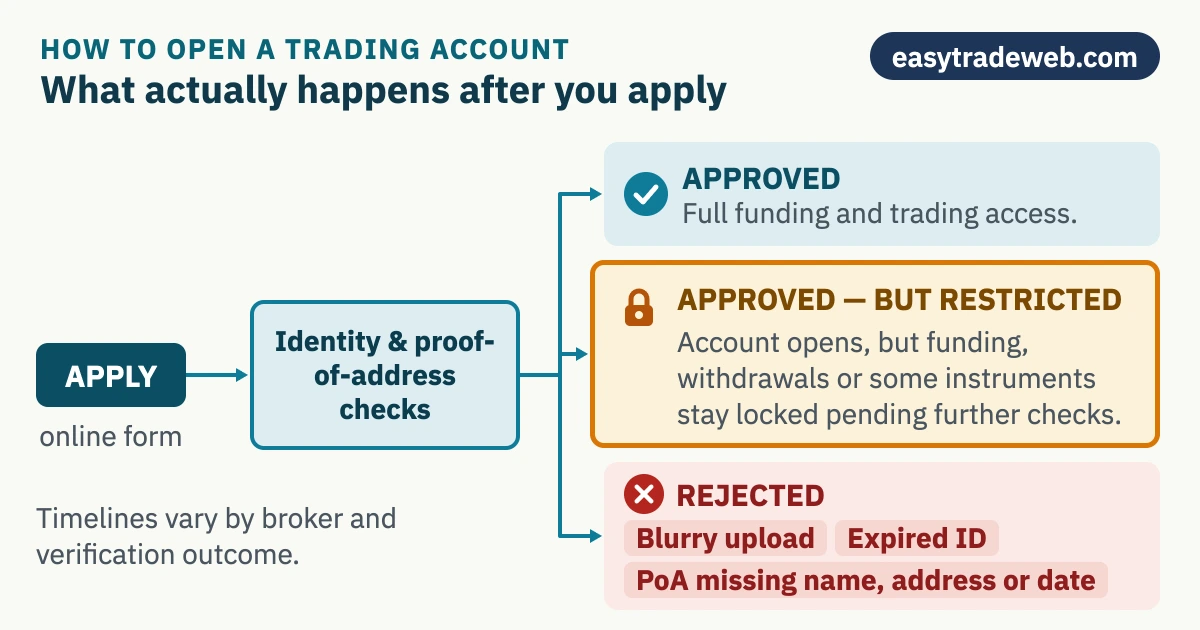
- An account can be approved and still restricted, unable to fund, withdraw or reach certain instruments while a further check runs.
- Retail and professional are not only classifications a firm applies to you; professional status is something an eligible client can elect to request.
- Electing professional status gives up protections that apply to retail clients only, and it can affect access to the Financial Services Compensation Scheme, which covers eligible claimants up to 85,000 pounds per eligible person per firm where the firm failed after 1 April 2019.
- Most delays are document quality problems rather than decisions about you.
Table of contents
- What a Trading Account Actually Is
- Choosing the Account Type Before You Apply
- The Documents You Will Be Asked For
- What a Proof of Address Has to Show
- Proof of Address When the Bill Is Not in Your Name
- Why Applications Get Rejected or Delayed
- Approved but Restricted: What That Means
- The Appropriateness Questionnaire
- Retail or Professional: What You Give Up
- Between Approval and Your First Trade
- When Opening an Account Is Not Your Next Step
- Frequently Asked Questions
What a Trading Account Actually Is
A trading account is a contractual relationship with a firm that holds your money and executes your orders. The login screen is the part you see; the agreement behind it sets who holds the cash, which instruments you can reach, and what happens if the firm fails.
That relationship is what the application process is really about. The firm is not deciding whether to sell you software. It is deciding whether it can take you on as a client under the rules that apply to it, which means establishing who you are, where you live, and what you understand.
The consequence for an applicant is that most of the friction has nothing to do with trading. It comes from identity law, from client classification, and from the firm needing evidence it can show a supervisor later.
Choosing the Account Type Before You Apply
Firms usually offer several account types on the same platform, separated by minimum deposit, spread structure and commission. The choice matters at application time because switching afterwards is sometimes a new application rather than a setting.
Read the comparison before you start the form rather than after approval. Our guide to forex account types sets out how the tiers differ, and the practical range of entry thresholds is covered in what brokers ask for as a minimum deposit.
Two questions settle the choice for most applicants. Whether the pricing is a wider spread with no commission or a tighter spread with one, and whether the account gives access to the instruments you intend to trade rather than a subset of them.
The entity matters as much as the tier. Large brokers operate several regulated entities, and the one that onboards you depends on your country of residence, which in turn sets the protections you receive and the leverage you can be offered.
The Documents You Will Be Asked For
Two categories cover almost every request: evidence of identity and evidence of address. A passport, national identity card or driving licence answers the first. A utility bill, bank statement or government letter answers the second.
Some applications add a third: evidence of the source of funds. That request is not a sign of suspicion. It is a normal step where the deposit size, the payment route or the applicant profile calls for enhanced checks under the firm risk assessment.
The document list itself is set by the firm, not by a regulator. That is why two brokers licensed under the same regime will accept different papers, and why a document refused in one place is accepted in another without either firm being wrong.
What a Proof of Address Has to Show
The Money Laundering, Terrorist Financing and Transfer of Funds (Information on the Payer) Regulations 2017 define what verification means, and the definition turns on one property: the evidence has to come from a reliable source that has no connection to the applicant it describes.
Independence is the whole test, and it explains the refusals that otherwise look arbitrary. A document you typed, exported or edited yourself carries no independence, whatever it says on it. Papers that an official body issued or supplied keep theirs, and the regulations say so directly, even where the applicant is the person who passes them to the firm.
In practice a proof of address has to carry four things on its face: your full name as it appears on the identity document, the residential address you entered on the form, the name of the issuing organisation, and a date recent enough to satisfy the firm policy on age.
That is why a mobile phone bill, a screenshot of an online banking summary, or a statement with the address blanked out fails so often. None of them fails because the applicant is suspected of anything. They fail because they do not evidence the four items, or because their independence cannot be established from the file.
Proof of Address When the Bill Is Not in Your Name
The four-item test above is straightforward for an applicant whose utility accounts are held in their own name. Across much of the Gulf they are not. The tenancy, the electricity account and the water account commonly sit with a landlord or an employer, so nothing the applicant can print carries their name and their address together.
That is a documentary problem rather than a suspicion problem. The firm still has to evidence the address from a source independent of the applicant, and a bill addressed to somebody else evidences that person and not this one. Sending the same bill again produces the same answer, which is why this particular refusal repeats.
The identity half is rarely what stops the file. The Emirates ID is the clearest example: the official UAE Government platform describes it as an identity card issued by the federal identity and citizenship authority, and sets out what the card holds as a smart card, public key certificates and a fingerprint biometric. The card settles who you are. A residential address is not among the components it lists.
Saudi Arabia sits at the other end of the same problem. Saudi Post operates the National Address, a registered address record supplied free of charge, whose components are the building number, the street, a secondary number, the district, a five-digit postal code and the city, alongside a short address of four letters and four numbers.
Because that register is a government service, it can produce address identification about you that you did not write yourself. Where you hold one, it answers the half a utility bill in another name cannot. Our page on brokers serving Saudi residents covers which entities onboard from the country.
Where no equivalent register exists, three routes still satisfy the four items, and each works for the same reason: a body with no stake in your application names you and the address on one document. A bank statement posted to the residential address does it, and so does a tenancy contract lodged with the authority that keeps the register.
A letter issued to you at that address by a government body is the third. Applicants in the Emirates can see how entity choice interacts with this on our page about locally licensed brokers.
The order matters more than the document. Establish which of those you can actually obtain before the application starts, not after a refusal, and then ask support whether that specific document is on the accepted list. Naming the document you can produce gets a usable answer; describing the problem usually does not.
Why Applications Get Rejected or Delayed
The single most common cause is document quality. A photograph taken at an angle, a scan that cuts off a corner, an expired card, a glare across the machine-readable zone: each of these ends with a request to upload again, and each round trip adds a day or more.
The second most common is a mismatch between fields. The name on the identity document, the name on the address document and the name on the application have to agree, and so do the addresses. A middle name entered on one and omitted on another is enough to stop an automated check and send the file to manual review.
Genuine refusals are a smaller group. They cluster around residency the firm cannot serve, an entity that is not licensed to onboard clients in your country, sanctions and politically exposed person screening, and applicants who cannot evidence an address in the jurisdiction they claim.
A refusal is rarely explained in detail, and firms are not obliged to give reasons. If the cause is jurisdictional, no amount of resubmission changes it, and the useful next step is to check which entity a broker uses for your country before applying again. Our guide to choosing a regulated broker covers how to establish that from the broker own disclosures.
Approved but Restricted: What That Means
An account can open, accept a login, and still refuse to do the thing you opened it for. This state is common and it is almost never explained on the application page.
The usual forms are a funding block until an outstanding document is accepted, a withdrawal block until the deposit method is verified as belonging to you, an instrument restriction where a product requires a further assessment, and a trading block on an account that was opened before the appropriateness step was completed.
The withdrawal case surprises people most. Firms generally return funds to the source they arrived from, so a deposit made by a card or wallet that has not been verified in your name can leave the money in place until that is settled. The mechanics of the routes and their verification steps are covered in our page on deposit and withdrawal methods.
The practical response is the same in every case: find the specific pending item rather than resubmitting everything. A restricted account has a named blocker, and support can usually state it directly when asked for that one thing.

The Appropriateness Questionnaire
Most applications include a set of questions about your experience, your knowledge of leveraged products and your financial circumstances. It is not a formality and it is not a sales qualifier.
For complex products, a firm has to assess whether you understand the risks, and the questionnaire is the record of that assessment. Answering it inaccurately to reach a result you want defeats its only purpose, which is to establish that the product is appropriate for the person opening the account.
A poor result does not always mean refusal. Depending on the firm and the regime, it can produce a warning you have to acknowledge, a restriction on certain instruments, or a request to complete an educational step before the account is enabled.
Retail or Professional: What You Give Up
Client classification is presented in most guides as something the firm decides about you. Under the FCA Handbook it is also something an eligible client can request. A firm may treat a client as an elective professional client where three things hold together, and the client asking is part of the procedure.
The firm must first run a qualitative assessment giving reasonable assurance that the client is capable of making their own investment decisions and understanding the risks.
For business in scope of the MiFID rules, at least two of three quantitative criteria must also be met. Those are dealing in significant size at a rate averaging ten deals each quarter across the last four quarters, holding a portfolio of financial instruments and cash above EUR 500,000, or a year or more spent working in the financial sector in a role that required knowledge of the business being asked for.
The procedure itself is documentary. The client states the request in writing, the firm sets out in writing which safeguards and compensation entitlements the change would remove, and the client signs a separate document confirming that the consequences are understood.
What is actually surrendered is a defined set of retail-only protections. The product intervention measures that ESMA agreed for contracts for difference apply to retail clients only. They cap how much leverage a position can be opened with, force the account to be closed out once equity falls to a set fraction of the margin it requires, stop the balance falling below zero, bar the firm from offering inducements to trade, and require a risk warning in a prescribed form.
None of that follows a client who has asked to be reclassified.
Access to the compensation scheme is a separate question again: the Financial Services Compensation Scheme covers eligible claimants up to 85,000 pounds per eligible person per firm where the firm failed after 1 April 2019.
| Element | Retail client | Elective professional client |
|---|---|---|
| How it is reached | Default classification on a standard application | Written request, firm assessment, separate written acknowledgement |
| Leverage cap on CFDs | Capped by the product intervention limits | Not covered by those limits |
| Negative balance protection | Applies on a per account basis | Not part of the retail measure |
| Written warning before the change | Not applicable | Required from the firm as part of the procedure |
| Reversibility | n/a | A client may ask to be reclassified, subject to the firm agreeing |
Classification rules and the compensation limit in this table were verified against the FCA Handbook COBS 3.5 and the published Financial Services Compensation Scheme limits on 3 September 2026. No broker sets these terms; they follow the regime the entity is authorised under.
Between Approval and Your First Trade
Approval is the moment the account becomes real, and it is the worst moment to place a first order. Nothing about the platform has been tested by you yet, and the account has settings that were chosen for you.
Three things are worth doing in order. Confirm the entity that holds the account and the leverage it applies, since both follow from your residency rather than from the tier you picked. Check the instrument list and the contract specification for whatever you intend to trade. Then place a first order at the smallest size the account allows, to see the fill, the charges and the statement entries on something that costs almost nothing.
A demo account on the same platform is useful for the mechanics, though the fills and the spreads it shows are not the ones the live account will produce.
Some applicants should not be at this stage at all. Anyone who cannot evidence an address in the country they are applying from will fail verification whatever the broker, and anyone whose only available deposit route belongs to somebody else will pass the checks and then meet a withdrawal block.
The same applies to an applicant who intends to answer the experience questions to reach a particular outcome rather than accurately, since the record produced that way is the one the firm relies on later.
When Opening an Account Is Not Your Next Step
Three situations make the application the wrong thing to do first, and each has a mechanism behind it rather than a general caution.
The first is a deposit that will arrive from a card or a wallet held in another person name. That deposit usually clears without difficulty. The withdrawal does not, because firms return funds to the route the money arrived from, so the balance stays where it is until a payment method in your own name has been verified. The account is worth opening once you hold one, and our page on withdrawals that stall sets out how those blocks are cleared.
The second is choosing between brokers on a headline spread without establishing which entity will onboard a resident of your country. The leverage cap and the protections follow the entity rather than the account tier, so the account that opens can be governed by different terms from the one that was compared.
The third is having no document that carries your name and your address on the same page, which the section above sets out in full. Verification stops at that point, and a second upload of the same file stops at exactly the same point.
Advertising disclosure: Easy Trade may be compensated when a reader opens an account through a partner link, including the link below.
Try this strategy on a demo account first
A strategy that looks clear in an article can behave very differently under real spreads and volatility. Testing it on a demo account shows you how it performs before you commit any capital.
Advertising disclosure: partner link. Easy Trade may receive compensation. Educational content, not financial advice. CFDs carry a high risk of losing your capital.
Frequently Asked Questions
What documents do you need to open a trading account?
Two categories are standard: evidence of identity, such as a passport, national identity card or driving licence, and evidence of address, such as a utility bill, a bank statement or a letter from a government body. Some applications add evidence of the source of funds. The exact list is set by the firm rather than by a regulator, so it differs between brokers licensed under the same regime.
Why was my trading account application rejected?
Most refusals are document problems: an unreadable scan, an expired card, or a name or address that does not match between the form and the papers. Genuine refusals usually involve residency the firm cannot serve, an entity not licensed for your country, or screening outcomes. Firms are not obliged to give a reason, so where the cause is jurisdictional, resubmitting the same file changes nothing.
What must a proof of address actually show?
It has to evidence four things on its face: your full name as it appears on the identity document, the residential address on the application, the organisation that issued it, and a date recent enough for the firm policy. The underlying legal standard is independence, since verification has to rest on a source independent of the person being verified, which is why a document produced by the applicant is not accepted.
Can a trading account be approved but restricted?
Yes, and it is common. An account can open while funding, withdrawal or specific instruments stay blocked pending a document, a payment method verification or a further assessment. The blocker is a named item rather than a general state, and asking support to identify that one item is faster than resubmitting the whole file.
Should a retail trader elect professional client status?
It is a trade rather than an upgrade. Electing professional status removes the retail product intervention protections, which include leverage limits, the margin close-out rule and negative balance protection, and it can affect eligibility for compensation arrangements. The firm has to warn in writing which protections and compensation rights may be lost, and that warning is the document to read before deciding.
What counts as proof of address when the utility bill is in the name of a landlord?
A bill addressed to somebody else does not evidence your address, because the firm has to rely on a source independent of you that names you and the address together. What satisfies that is a bank statement sent to the residential address, a lodged tenancy contract, a government letter issued to you there, or a national address record where the country operates one. The accepted list is set by the firm, so ask before applying.
Sources checked 3 September 2026: The Money Laundering, Terrorist Financing and Transfer of Funds (Information on the Payer) Regulations 2017, regulation 28 · FCA Handbook COBS 3.5 Clients who may be treated as professionals · ESMA announcement agreeing to prohibit binary options and restrict CFDs to protect retail investors · Financial Services Compensation Scheme, what we cover: investments · Emirates ID, The Official Platform of the UAE Government · National Address, Saudi Post SPL. No broker figure, document list, processing time or deposit minimum is stated as a general fact on this page, because each is set by the individual firm and by the entity that onboards you.
Disclaimer: This page explains the account opening process and the client classification rules behind it, for educational purposes. It is not investment advice and not a recommendation to open an account with any firm or to trade any instrument. Trading leveraged products carries a high risk of losing money rapidly.