
Forex Trend Forecasting Strategies

In forex, technical analysis is a useful tool that lets a trader anticipate a certain market activity before it happens. These expectations come from an asset’s past chart patterns, the probabilities of specific trade setups, and the trader’s own past experience. See also our guide to Trend Line Trading Strategies.
Over time, forecasting can reduce the need to over-analyze the forex trend and help you mark clear, meaningful areas of interest — and it is not as hard as it looks. To learn how to read the market’s direction and follow it, stay with us at Easy Trade.
Expectation versus prediction in forex
Technical analysis in forex is often treated as a kind of magic used to predict and forecast market movement. What many people outside finance don’t realize is that traders never actually try to predict the future. Instead, they build strategies designed to put the odds in their favor and identify situations where a forex move can be anticipated or estimated.
If traders could consistently pick tops and bottoms, they would place trades and make money from their computer screen. Here you may already be following in the footsteps of many professional traders who look for strategies that let them anticipate a forex move, then decide to enter trades once the setup is complete.
The power of anticipation in forex

When you decide whether or not to take a trade in forex, you probably have your own strategy for entering and exiting the market. If you don’t, you should settle on one before clicking a buy or sell button. Technical traders use certain tools such as moving average convergence divergence, the Relative Strength Index (RSI), the stochastic oscillator, or the double commodity channel.
Combined with recognizable chart patterns that have occurred in the past with a certain, carefully measured outcome, experienced traders will likely have a good idea of what a forex trade’s result might be. If a trade goes against them as soon as they enter and does not turn around over the next few candles, chances are their analysis was wrong. If the trade moves in their favor within the next few candles, they can start looking to move take-profit and stop-loss levels up to lock in gains as the trade runs.
The figure below shows trades taken on the British pound versus the US dollar (GBP/USD) using the exponential moving average (EMA) crossover. The blue line is the 50-day moving average, and the red line is the 20-day.
When the blue line is above the red, you lean toward buying, and the opposite is true for selling. In forex, this is a strong setup to take because it lets you take part in the large move that often follows this signal. The first arrow from the right shows a false signal, while the second and third arrows show a signal that played out.
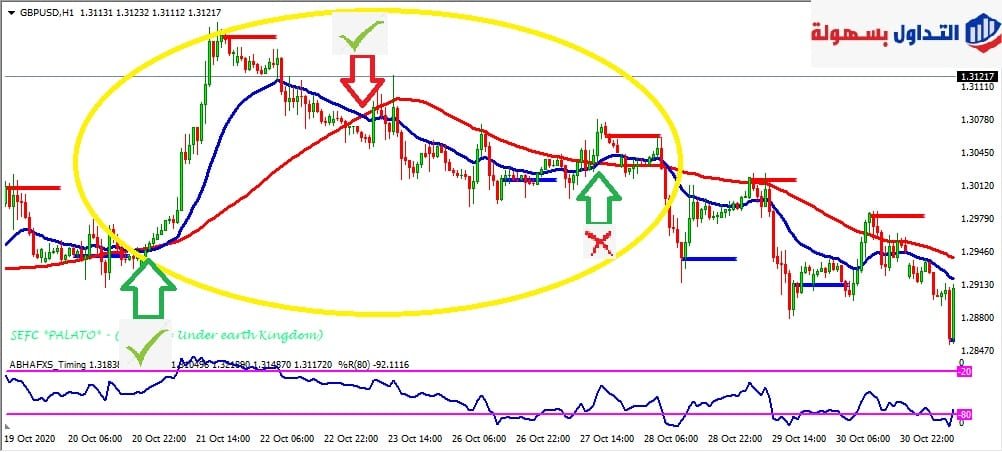
This is where the power of anticipation matters in forex. An active trader usually watches open positions as they move to see whether any adjustments are needed. Once you buy at the first arrow, within three candles it will already have risen by more than 100 pips.
By placing your stop-loss at the long-term moving average, you may want to exit this trade anyway after taking enough profit, since the signal can reverse at any time. On the second and third arrows, once the crossover happens, it takes only a few days before the trade moves in your favor. Trade management also plays a part, through trailing your stop according to your personal trading style.
The figure above also shows the difference between expectation and prediction. With expectation, we anticipate this trade will have a similar outcome based on the results of previous trades. When we placed the stop-loss at the same moment the trade was triggered, that is where we made a prediction. Unlike expectation, which uses past results to gauge the probability of future outcomes, making an exact prediction often involves a mix of luck and guesswork, so outcomes vary and cannot be relied on.

Finally, using the chart above, you can clearly see where the signals work and where they don’t, based on each candle’s price action in forex and its relationship to the moving averages. The key here is to have a strategy for your trades and to act on your trading plan again and again.
Forex trades around the clock, 24 hours a day, six days a week, and reflects the relative value of one country’s currency against another.
Like other capital markets, a currency pair’s exchange rate can move in a certain direction that can be estimated using a number of different methodologies in forex.
Try this strategy on a demo account first
A strategy that looks clear in an article can behave very differently under real spreads and volatility. Testing it on a demo account shows you how it performs before you commit any capital.
Advertising disclosure: partner link. Easy Trade may receive compensation. Educational content, not financial advice. CFDs carry a high risk of losing your capital.
Frequently asked questions
When should I sell and when should I buy in forex?
Buying and selling in forex takes a lot of knowledge and experience in technical and fundamental analysis of price action, and you should not let emotional factors drive your decisions. Technical analysis tools such as market indicators and charts can help investors identify a better time to buy and sell.
How much can you make from trading?
The profit-and-loss ratio differs from one person to another and depends on the trader’s level of experience, knowledge, and analysis. Some investors make large profits, while others lose large amounts.
Is trading easy?
How hard trading is depends on the trader’s level of experience and knowledge. Some investors find technical and fundamental analysis difficult to handle, while others achieve good results. Investors should build a solid trading plan and follow it carefully.
What is the best currency trading company?
There is no perfect currency trading company; the choice depends on several factors such as reputation, credibility, cost, service quality, and level of security. Investors should do their research and check a company’s history, the availability of customer service, and the level of security it provides.
Risk disclaimer
This article is for educational purposes only and is not investment advice. Forecasting tools and technical signals indicate possible outcomes, not certainties, and any signal can fail. Trading forex and CFDs on margin carries a high level of risk to your capital because of leverage, and you can lose more than your initial deposit. Do your own research and consider seeking advice from a licensed professional before trading. Some links on this site may be affiliate links, and we may earn a commission at no extra cost to you.