
How to Choose the Best Forex Broker: 13 Steps That Matter

Choosing the best forex broker is critical for trading. As a currency investor, picking a forex broker can feel like a daunting task, especially if you don’t know what to look for. As you know, the forex market has a daily trading volume of over $5 trillion, making it the largest financial market in the world. Because there’s no centralized forex exchange, traders need to choose a forex broker carefully to support their trading activity. There is a large and growing number of forex brokers, and picking the right one takes time and research. For how it compares with other brokers, see our roundup of the best forex brokers.
We’ll walk through the main advantages of picking one forex broker over another, including low commissions, differences in account requirements, trading platforms, and the quality of customer support.
Platform capability belongs in the same comparison. If you intend to follow other traders rather than analyse markets yourself, check the broker’s social trading features, including which copy modes it supports and how provider fees are disclosed.
When you feel ready to start trading currencies, you first need to find a reliable forex broker. First, let’s address exactly what the best forex broker is: it’s a broker that gives traders access to a trading platform that lets them buy and sell foreign currencies. Currency traders use these brokers to access the forex market 24 hours a day. A retail forex broker, as they’re usually called, handles a very small slice of the total foreign exchange market volume. Forex brokers mainly profit from the bid-ask spread.
Your first priority is to do the research needed to find out whether a forex broker has a solid reputation and whether it can meet your needs. The vast majority of major forex brokers let prospective clients test their services through a demo account, so they can get a real feel for how the platform works. It’s smart to test as many platforms as you can before deciding which broker to use. The rest of this article will show you how to pick a good forex broker.
How to Choose the Best Forex Broker
Choosing the best forex brokers first requires defining your investment type and your goals for trading currencies. Every broker offering forex investments comes with its own advantages and drawbacks, and among the most important things to weigh when choosing the best forex broker are regulation, the level of security the company provides, and transaction fees.
Security features vary from one broker to another. Some brokers offer built-in security features such as two-factor authentication to keep accounts safe from hackers.
Below are some of the most important factors to consider when choosing the best online forex broker for trading currencies.
1. Company Policies and History
As part of every investor’s due diligence process, the steps that help keep an account secure should include checking the forex broker’s regulatory licenses and its legal obligations to protect client funds. It’s also important to review the client agreements, check the company’s history, and make sure its main offices are located in a well-regarded country.
2. Licensing and Regulation
On any best-forex-broker checklist, the most important feature a good broker should have is a high level of security. After all, you wouldn’t hand over thousands of dollars to someone claiming to be legitimate, would you?
Fortunately, verifying a forex broker’s credibility isn’t too difficult. Regulatory agencies around the world separate trustworthy brokers from fraudulent ones. Which agency applies depends on the legal entity behind the brand, which is why UAE-licensed brokers are checked by entity rather than by name.
Many of the best forex brokers are regulated in the United States by the National Futures Association (NFA) and the Commodity Futures Trading Commission (CFTC). France, Germany, Switzerland, Austria, Canada, and the United Kingdom also regulate forex brokers. That said, not every broker in the market is regulated, and traders should be wary of unregulated firms. Some firms are not authorised in their own right at all but work under another firm’s permissions, which makes checking the entity on the agreement part of the same step.
Before considering putting your money with the best forex broker, make sure the company is a member of one of the following well-known regulatory bodies:
United States: National Futures Association (NFA) and the Commodity Futures Trading Commission (CFTC)
United Kingdom: Financial Conduct Authority (FCA) and the Prudential Regulation Authority (PRA)
Australia: Australian Securities and Investments Commission (ASIC)
Switzerland: Swiss Financial Market Supervisory Authority (FINMA)
Seychelles: Financial Services Authority (FSA SC)
Cyprus: Cyprus Securities and Exchange Commission (CySEC)
Belize: International Financial Services Commission (IFSC)
Not all legal licenses carry the same weight among forex brokers, and investors need to know which country their broker is based in and which laws apply to their account. To avoid fraud, it’s essential to use a broker that is well-known and properly regulated. The licence also governs whether the firm treats you as a retail or professional client, which decides the protections attached to the account.
An impressive or professional-looking website doesn’t guarantee that a broker is an FCA member or falls under NFA rules. A forex broker that is a member of the Financial Conduct Authority (FCA) will display its membership and FCA number on its website, usually in the “About Us” section, so you can verify it with the regulator afterward.
How to verify a license:
Example: Tickmill states on its official website that it’s licensed by the FCA. So we need to go to the regulator’s official website and search to confirm it’s actually registered there.
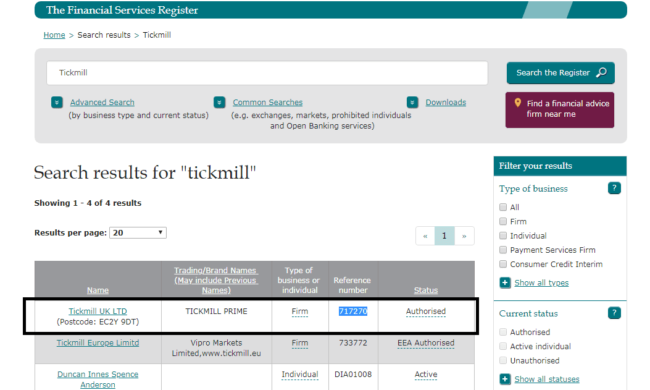
Now we click on the company to get clearer details such as the company’s address, phone numbers, license start date, registration number, etc.
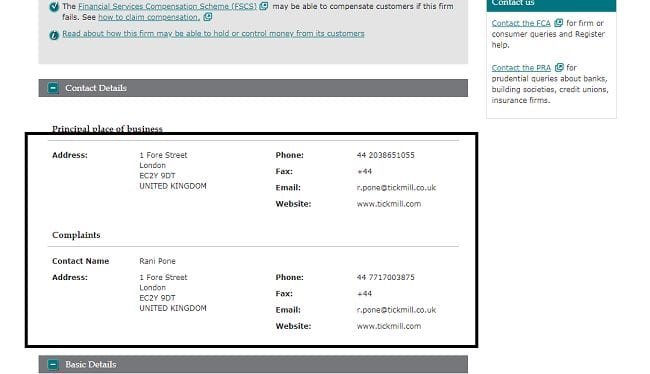
Repeat this for every broker, cross-check the forex broker’s website against the regulator, and confirm the licenses are genuine.
These regulatory bodies’ main role is to develop rules, programs, and services to protect the market and its participants. They also make sure members meet their regulatory responsibilities and other obligations. For example, the CFTC is a fully independent government agency whose mission is to regulate commodity and futures markets in the United States, and its core mission is to protect market users and the public from manipulation, fraud, and abusive practices related to selling commodities and futures contracts. So give yourself enough time to verify a forex broker’s licenses.
3. Trading Platforms and Tools
What platforms and trading tools are you considering? Do they work with your web browser, your computer’s operating system, your smartphone, or any other device you plan to trade on?
Any forex broker’s platform is a modern gateway into the currency markets. Regardless of your trading style or your preferred multi-asset tool, the platform technology you use can affect nearly every aspect of your trading experience. Forex trading platforms share the common goal of making it easier to trade and spot opportunities, while also managing your personal investments.
At forex brokers, most trading activity happens through the trading platform, which means your broker’s platform needs to be easy to use and stable. When looking for a broker, always check what its trading platform actually offers. A separate question is whether the broker can be connected to an outside charting platform for order entry, which is covered in our page on the brokers that connect to TradingView.
Does it offer a free news feed? What about easy-to-use technical tools and charts? Does it give you all the information you’ll need to trade properly?
The most popular platform is MT4, MT5, CTrader, WebTrader, and several other trading platforms, and of course through various trading apps and mobile web browsers.
The one notable difference is that many brokers offer forex trading through the MT4 platform, while only a few offer it through CTrader platforms.
That said, depending on which platform a broker chooses to build its service on, there may be some unique key features on that platform. For example, MT4 lets traders use Expert Advisors, or automated trading, and also lets traders install custom indicators to improve their trading process, plus connect the Autochartist service.
However, if you choose to use a web-based trading platform like CTrader, you may not be able to use Expert Advisors.
Your trading platform is your gateway to any forex broker, and you’ll need to find software that’s easy to use, but also fun and powerful enough to meet all your trading needs.
Most forex brokers offer demo accounts so you can always try their trading platforms before signing up for a live account.
Web-Based Trading
Many brokers offer a proprietary trading platform that lets you trade through the browser only, removing the need to download software. This can be especially useful for traders who may not have access to a personal computer during trading hours.
These web-based platforms tend to be less feature-rich compared with MetaTrader. Still, they should handle most core trading functions and charting. For beginner traders or those less technically inclined, web-based trading platforms tend to be simpler and easier to use.
Mobile Trading
Most forex brokers offer one or more mobile trading apps to let you monitor and trade your account on the go, and some also offer mobile versions of their trading software.
4. Forex Analysis and Global Market Research
Almost every forex broker aims to give clients content and research tools to find and analyze investment opportunities. At the same time, we live in an information age where traders can get lost in a sea of forex news headlines, making it hard to get the information they need unless brokers provide the right structure for forex news.

Besides news headlines and the economic calendar, leading forex brokers typically combine in-house research on fundamental news and technical analysis, then add outside research content on top. Companies that take this a step further may even build their own TV channel.
5. Spreads, Commissions, and Trading Costs
Regardless of which forex broker you deal with, whether you like it or not, you will always be subject to transaction costs.
Every time you enter a trade, you’ll pay either the spread or a commission, so it’s natural to look for lower spreads. Rebate programmes return part of that cost afterwards rather than reducing it, which makes them a separate question from the headline pricing.
Spreads can be either fixed or variable (floating), and floating spreads can widen or narrow at different rates across brokers.
While the overall cost of trading can be decisive for many traders, it’s important to look at the whole picture in terms of how a forex broker’s overall offer fits your needs.
6. Order Execution
The execution methods available can depend on whether the broker is a dealing-desk broker acting as a market maker, or an agency-only broker relying on external dealers (liquidity providers). Execution methods, policies, other terms, or available order types can vary. Behind those labels sits the broker execution model, meaning what the firm does with the risk of a position once it has accepted your order.
Under normal market conditions (for example, normal liquidity, no major news releases or sudden events), there’s really no reason a forex broker shouldn’t fill you at the market price you see when you click buy or sell.
For example, assuming you have a stable internet connection, if you click buy on EUR/USD at 1.2000, you should get filled at that price or within a few pips of it. How fast your orders get filled matters a lot, especially if you’re trying to move quickly on an opportunity.
Some execution methods or order types can cause slippage, up or down. This means orders still get executed, but the price can be better or worse than requested. Since every broker is different, some companies may requote an order at a new price for you to accept (or reject) if the price has moved.
7. Customer Support
Customer support matters, and the scope and quality of that support can be one of the key differences across online forex brokers, from the speed and overall quality of assistance to availability across global trading hours and international markets.
When evaluating a forex broker, a single customer service interaction isn’t enough to judge the overall quality and scope of service. Instead, several phone calls, emails, and live chat interactions should be made to form a well-rounded assessment of customer support.
Not every broker is perfect, so you should choose a broker you can reach easily when problems come up, because how efficiently a broker handles technical or account support issues matters just as much as its trade execution.
Brokers can be friendly and helpful at first, during the account-opening process, but then have poor “after you’ve opened an account” support.
8. Education
Currency trading can be complex; even seasoned investors keep learning to expand their market knowledge. There’s a real gap between forex brokers that offer thorough, high-quality education and those that show limited regard for their clients. Always check the “Education” section and webinars at the forex broker you’re considering.
Providing forex traders with effective educational resources matters, because educated investors make smarter investment decisions. Most forex brokers continually try to educate both current and prospective clients. Still, the delivery and quality of educational content varies from company to company.
9. Account Types
Every forex broker has different account offerings, including: Islamic accounts or zero-spread accounts, Pro accounts, Classic accounts, ECN accounts, and even cent accounts, etc.
You should compare these account types and choose what suits your trading before opening a trading account. Of course, you won’t find a single forex broker that offers every account type, since that differs from company to company, but you should look into these account types before picking a specific account with a forex broker.
10. Broker Type (Dealing Model)
Routing your orders directly to the interbank market, made up of financial institutions such as banks, mutual funds, hedge funds, etc., is known as being a Straight-Through Processing (STP) broker. An STP forex broker sees prices in the interbank market, then routes your order to the liquidity provider with the best price.
Since STP brokers don’t have direct control over the prices you see, they typically offer floating spreads, which tend to widen during periods of market volatility and low liquidity.
Some STP brokers let your orders interact with other orders inside an Electronic Communication Network (ECN). This lets you see not just the best prices currently on offer, but also the buy and sell orders from other ECN participants, so you can judge market depth better with that information. ECN brokers tend to charge commissions instead of charging through the spread.
You can read more about broker types.
11. Available Markets
Access to multiple asset classes from within a single platform matters to many investors, since financial markets, including forex and even cryptocurrencies, are highly interconnected. Being able to respond quickly to real-time news and economic events is key.
In the early 2000s, there was a narrow focus, with forex companies mostly concentrating on offering a single asset, such as forex. Today, however, trading platforms are no longer dedicated to just currencies, stocks, or futures. Instead, multi-asset offerings have become an industry standard among the best trading companies.
12. Currency Pairs
While there’s a fair number of currencies available to trade, only a handful get most of the attention at some forex brokers. The core pairs are USD/JPY, EUR/USD, and USD/CHF, as well as GBP/USD. Those positioning themselves as top-tier forex brokers may offer a wide range of currency pairs. Still, what matters most is that they offer the pair (or pairs) a forex trader or investor actually cares about.
13. Deposits and Withdrawals
There’s no reason a forex broker should make it hard for you to withdraw your profits, because the only reason they hold your funds at all is to make deposits and withdrawals easier.
Your broker only holds your money to facilitate trading, so there’s no reason you should struggle to get the profits you’ve earned, and your broker should make sure the withdrawal process is fast and smooth.
Good forex brokers will let you deposit funds and withdraw your profits without hassle or issues.
Summary
If you’re confident in your forex broker, you’ll be able to dedicate far more time and valuable attention to analysis and developing different forex strategies. Doing the research before committing to a particular broker can go a long way and can improve a trader’s odds of succeeding in the foreign exchange market.
By understanding the services a given forex broker offers, you’ll be able to judge whether that platform fits your interests before you start trading.
Doing some research and comparing one forex broker against another will play a pivotal role in making sure you choose the best forex broker, which in turn will improve your odds of earning calculated positive returns on your investments.
In this pursuit, your research should cover factors like regulation, customer service, currency pairs, minimum deposit and withdrawal amounts, as well as commissions and spreads.
What we’ve covered in this article is simply a guide to researching any forex broker before you put your money with them. The more informed you are about brokerage firms, the more aware you’ll be in this market.
Disclaimer
This article is for educational purposes only and does not constitute investment or financial advice. Forex and CFD trading involve significant risk and can result in the loss of your invested capital; a majority of retail investor accounts lose money when trading CFDs. Some links on this page are affiliate links, meaning EasyTradeWeb may earn a commission if you open an account through them, at no extra cost to you. Always verify a broker’s regulatory status independently before depositing funds.