
Fast Scalping Strategy

Fast scalping is the most popular way for smaller traders to take advantage of tiny market moves, as an alternative to the long-term investing that large-capital traders tend to follow. That makes fast scalping strategies a better fit for traders working with a small account. In this article we look at one of these strategies.
Fast Scalping Strategy
Fast scalping strategies are built on opening trades that do not last long — anywhere from a few seconds to a few days. There are several types of these strategies, and this article focuses on the fast scalping strategies that rely on momentum.
Momentum trading involves buying and selling assets based on the strength of the recent trend. The idea is that if there is enough force behind the current market move, that force is likely to continue for some time.
How the Fast Scalping Strategy Works
Now we get to the point of the article, which is explaining the strategy. Before that, we need to get to know the tools it uses and the timeframes you can trade it on.
Read also: Best Scalping Strategy 2026.
Strategy Requirements
This strategy needs three main indicators, and they are already available on the MetaTrader platform — you do not need to download or install them. They are:
- The 200 exponential moving average (EMA)
- The 50 exponential moving average (EMA)
- The 25 exponential moving average (EMA)
Timeframe Used in the Strategy
As the name suggests, the strategy is based mainly on fast trades, so we cannot use the larger timeframes such as the one-hour chart and above.
Because of that, the short timeframes — from the one-minute up to the half-hour — are the best choice for trading this strategy. In this walkthrough we apply it to the 15-minute timeframe.
Steps for Trading the Strategy
We will break the trading steps into stages to make the explanation much easier to follow.
1- Setting Up the Chart
The first step is to set up the chart by adding the indicators mentioned above to it, as shown in the following figure.
As you can see in the figure above, we added the 200 moving average, which represents the long-term trend, and the 50 and 25 moving averages, which represent the short and medium-term trend.
2- Determining the Overall Trend
After adding the technical indicators to the chart and understanding what each one does, we come to the first practical step in trading: determining the direction in which we will take trades.
You can identify the overall market trend by looking at the 200 moving average. If it sits below price action, that points to an uptrend; if it sits above price action, that points to a downtrend.
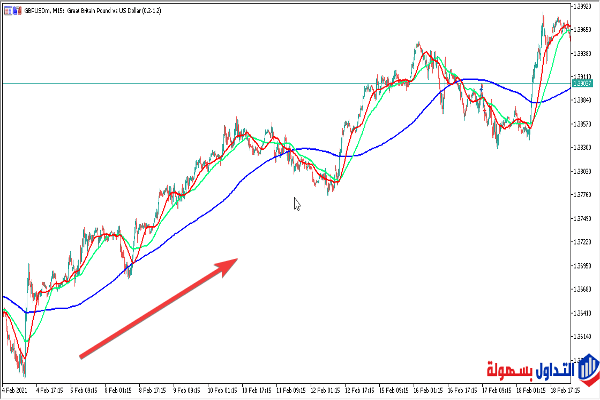
In the figure above, notice that the 200 moving average moves below price, which indicates that the trend is up.
Entering Buy Trades

Once we know the trend is up, we will take buy trades only — nothing else — as soon as any signal appears from the 50 and 25 moving averages.
When the 25 moving average crosses above the 50 moving average, you can enter buy trades, provided the 200 moving average is below price. See the following figure.
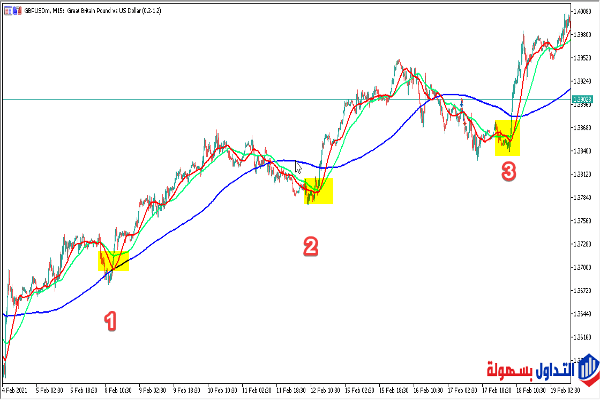
In the figure above you can see that three buy trades were available. Note that the crossover can happen below the 200 moving average, as in the second and third trades, but you should not enter the trade until price has moved past the 200 moving average.
Setting Take-Profit and Stop-Loss
In the fast scalping strategy, the chart is watched continuously, so you exit the trade only after the reason for entering it disappears — that is, when the 50 and 25 moving averages cross to the downside.
As for the stop-loss order, it goes at the last swing low in price on the chart.
In the figure above you can see that the trade was exited as soon as the 50 and 25 moving averages crossed to the downside.
At the same time, you might point out that price moved higher again after that crossover. But keep in mind that you are trading in the moment, and there is no room to stretch the size of the profit. Remember that settling for a small number of points is better than taking a loss.
Fast scalping is a trading style that focuses on profiting from small price changes and taking a quick profit from reselling in day trading. It is a term for a strategy that prioritizes making a large number of small profits.
Fast scalping requires the trader to have a strict exit strategy, because one large loss can wipe out the many small profits the trader has worked to collect.
Read also: Numeric Scalping Strategy. Best 1-Minute Scalping Strategy Explained. Full Guide to the False Breakout Strategy.
Try this strategy on a demo account first
A strategy that looks clear in an article can behave very differently under real spreads and volatility. Testing it on a demo account shows you how it performs before you commit any capital.
Advertising disclosure: partner link. Easy Trade may receive compensation. Educational content, not financial advice. CFDs carry a high risk of losing your capital.
Frequently Asked Questions
How do I identify speculative stocks?
Stocks considered high-risk in the securities market are known as speculative stocks. They offer potentially high returns to compensate for the high risk attached to them. Penny stocks, with their very low share prices, are an example of speculative stocks.
Is speculating in stocks profitable?
Speculative stocks generally perform well in very strong bull markets, when investors have a large appetite for risk. They tend to do worse in bear markets, because investors’ risk aversion draws them toward larger-cap stocks that are more stable.
How do you forecast currency price trends?
Purchasing power parity looks at the prices of goods across different countries and is one of the most widely used methods for estimating currency prices. The relative economic strength approach compares growth rates across countries to estimate currency prices. Technical analysis is often used to estimate currency prices for trading purposes.
What is a good trading strategy?
Scalping is a widely used trading strategy and one of the most common. It involves selling almost immediately after a trade becomes profitable. The price target is any figure at which you would make money from the trade. Signals can fail, so outcomes vary from trade to trade.