
What Is Dow Theory?

Before we get into the details of Dow Theory we need to understand trends. It’s important to notice that the market tends to move in a general direction, and not in a straight line. The market will rise to a high (a peak) and then get sold off to a low (a trough), but overall it keeps moving in one direction. A peak inside a falling market can be a rally that does not become a reversal, and the trend definition here is what settles which it was.
What Is Dow Theory?
On a broad level, Dow Theory describes market trends and how they typically behave. On a more precise level, it provides signals that can be used to identify the market’s primary direction or to signal a change in that direction. The theory centers on tracking the direction of the Dow Jones Railroad Average (now Transportation) and the Dow Jones Industrial Average, and using volume to confirm these trends. If the Dow Jones indices are trending in one direction, the market as a whole can be said to be moving in that direction, and investors can use these signals to identify the market’s overall direction and then trade with that trend.
Dow Theory was developed by Charles Dow, who along with Edward Jones and Charles Bergstresser founded Dow Jones & Company and created the Dow Jones Industrial Average (DJIA). Dow laid out the theory in a series of editorials in The Wall Street Journal, which he co-founded.
The theory went through further development over its more than 100-year history, including contributions from William Hamilton in the 1920s, Robert Rhea in the 1930s, and E. George Schaefer and Richard Russell in the 1960s. Some aspects of the theory have faded — for example its original focus on the transportation sector, or railroads in its original form — but Dow’s approach still forms the core of modern technical analysis.
Dow Theory has been around for close to 100 years, but even in today’s volatile, technology-driven markets, its core components still hold up. It addressed not just technical analysis and price action but also market philosophy, and many of the ideas and observations Dow Theory put forward have become axioms on Wall Street. While some believe the market is different now, the theory explains today’s market much the same way it did nearly 100 years ago.
Explaining the Theory
In Dow Theory, the primary trend is the most important trend to identify, because the dominant trend is what drives price movement. The primary trend will also influence the secondary trends in the market. Dow determined that a primary trend generally lasts between one and three years, though it can vary in some cases.
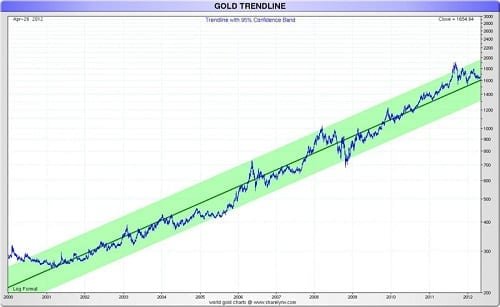
Regardless of how long a trend lasts, the primary trend remains in effect until there’s a confirmed reversal. For example, if the price is in an uptrend and forms a peak lower than the one before it, that can be a sign the market is about to head down rather than higher.
When reviewing trends, one of the hardest things to pin down is how long a price move will continue in the primary trend before it reverses. The most important part is identifying this trend and trading with it — not against it — until evidence appears that the primary trend has reversed.
Six Key Elements of Dow Theory

1.The market discounts everything. Dow Theory operates on the premise of efficient markets, an idea later formalised as the efficient market hypothesis, which holds that asset prices already reflect all available information — potential earnings, competitive edge, management efficiency. All of these factors and more are priced into the market even if not every individual knows all or any of these details. In stricter readings of the theory, even future events are discounted, in the form of risk.
2.There are three types of market trends. Markets have primary trends, which last a year or more, such as bull or bear markets. Within these broader trends we encounter secondary trends, which often move against the primary trend, such as a correction inside a bull or bear market. These secondary trends last from three weeks to three months. Finally, there are minor trends that last less than three weeks.
3. Primary trends have three phases. The primary trend passes through three phases. According to Dow Jones index theory, in a bull market there’s an accumulation phase, a public participation phase (or the big move), then a distribution phase. In a bear market, it starts with a distribution phase, then a participation phase, then a panic phase (or despair).
4. The averages must confirm each other. To determine the trend, Dow’s indicators or market averages must confirm each other. Dow used the two averages he and his partners invented — the Dow Jones Industrial Average (DJIA) and the Dow Jones Transportation Average (DJTA) — on the assumption that if business conditions were genuinely sound, as a rising Dow Jones might suggest, the railroads would benefit from hauling the goods generated by that business activity. If asset prices are rising but the railroads are struggling, the trend is unlikely to be sustainable. The reverse also applies: if the railroads are profitable but the broader market is stagnant, there’s no clear trend.
5. Trading volume must confirm the trend. Volume should increase if price is moving in the primary trend, and decrease if it’s moving against it. Low volume signals weakness in the trend. For example, in a bull market, volume should rise as price rises, then fall during a secondary pullback. If instead volume rises during that pullback, it could be a signal that the trend is reversing, as more market participants shift toward the downtrend.
6. Trends persist until a clear reversal occurs. Reversals in primary trends can be confused with secondary trends. It’s difficult to tell whether a rally in a downtrend is a reversal or a short-term rise followed by a correction, and Dow Theory calls for caution until a clear reversal happens.
Finally, a reversal in the primary trend under Dow Theory is signaled when the market is unable to form consecutive higher peaks and troughs in the primary trend. For an uptrend, a reversal is signaled by a failure to reach a new high, followed by a failure to reach a higher low.
In that case, the market would have shifted from a pattern of consecutive higher highs and higher lows to a pattern of consecutive lower highs and lower lows — the components of a primary downtrend.
A reversal of the primary downtrend occurs when the market stops making lower lows and lower highs. This happens when the market establishes a high above the prior high, followed by a low above the prior low — the components of an uptrend.
Test this indicator without risking capital
Reading about an indicator is not the same as watching it behave on a live chart. A demo account lets you apply the settings above to real market data and see how the signals form before any money is involved.
Advertising disclosure: partner link. Easy Trade may receive compensation. Educational content, not financial advice. CFDs carry a high risk of losing your capital.
Disclaimer: This article is for educational purposes only and does not constitute investment advice. Dow Theory is a framework for reading price trends, not a guarantee of future performance — trend signals can fail and markets can move against expectations. Trading forex and CFDs carries a high level of risk, including the risk of losing more than your initial deposit due to leverage, and may not be suitable for all investors. This page may contain affiliate links; if you open an account through one of them, easytradeweb.com may receive a commission at no extra cost to you.